

Maybe AI Won’t Destroy My Business
Introduction:
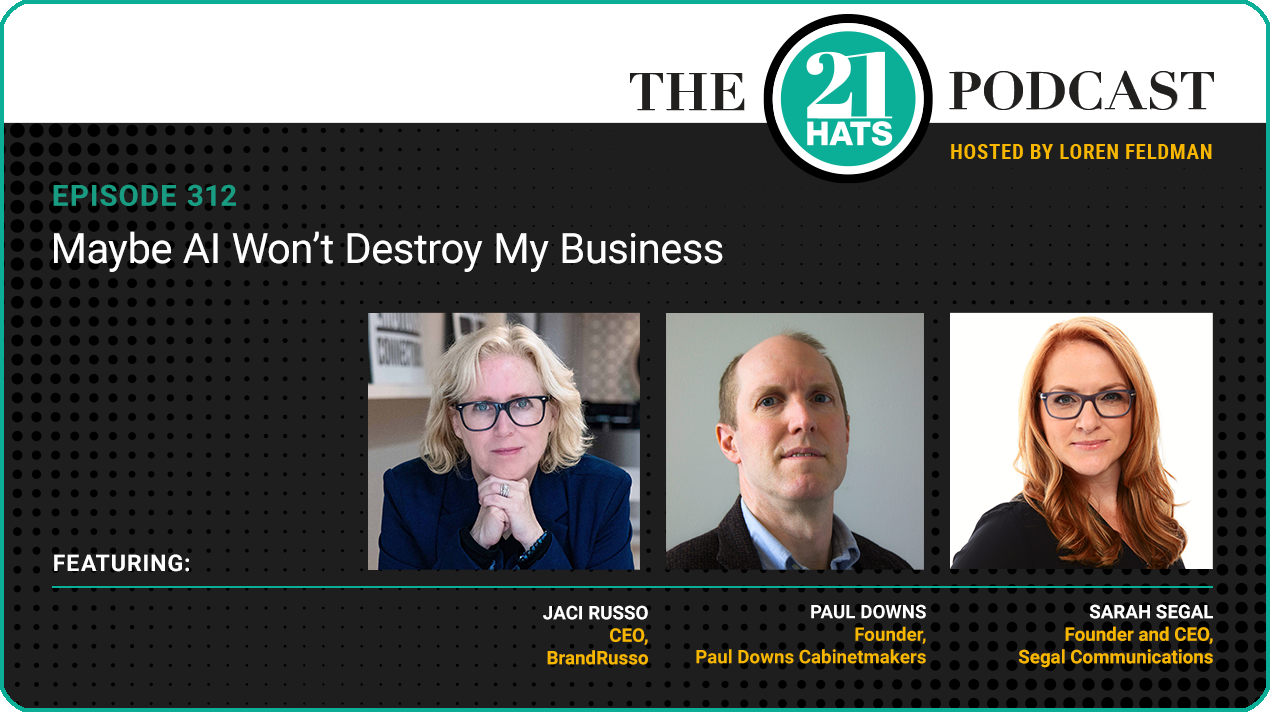
This week, Paul Downs, Jaci Russo, and Sarah Segal revisit a question that came up on the podcast more than a year ago: Is artificial intelligence going to doom professional service firms like Jaci’s branding agency and Sarah’s PR firm? So far, both Jaci and Sarah are feeling pretty good about their prospects. In fact, they’re seeing changes in the market that suggest AI may be helping rather than undermining their businesses. Paul, meanwhile, has encountered a different kind of AI mystery. For years, his custom conference table business has depended heavily on people finding him through Google. Recently, he discovered that his organic search traffic has fallen about 35 percent. That sounds alarming—except that his business is doing great. Paul says his tables are selling like “hotcakes,” and he’s backlogged into February. So what exactly is happening when traffic falls but sales keep growing?
Plus: In our latest Beyond Small segment, sponsored by Grasshopper Bank, Paul, Jaci, and Sarah talk about the financial processes they still insist on doing manually—even when technology could probably do more of the work for them. In each case, part of the reason is that doing the work themselves gives them a view into their operations that they don’t want to lose. As Sarah puts it, while she already knows how to handle public relations, “I am learning how to be a business owner every day.”
— Loren Feldman
Guests:
Paul Downs is CEO of Paul Downs Cabinetmakers.
Jaci Russo is CEO of BrandRusso.
Sarah Segal is CEO of Segal Communications.
Producer:
Jess Thoubboron is founder of Blank Word.
Full Episode Transcript:
Loren Feldman:
Welcome, Paul, Jaci and Sarah. It’s great to have all of you here. I want to start today by revisiting a prediction we discussed more than a year ago. Sarah and Jaci, I bet you guys remember we had Alan Pentz on, and he asserted that AI would pose an existential threat to professional service firms like yours. His basic argument was that, as clients learn to use AI to do more marketing, branding, and communications themselves, they’ll become less willing to pay agencies monthly retainers.
But lately, I’ve been hearing almost the opposite argument—that as people increasingly use ChatGPT, Claude, and other AI tools to figure out which companies to use and trust, strong branding and credible third-party coverage become even more valuable. So the question I’m thinking is, is AI making agencies like yours less necessary or more valuable?
Sarah Segal:
I’m happy to take the first crack at that. So, here’s the thing: I think AI is helping our agencies do more for our clients. And while there are certainly people out there who think that they can just use AI to do the work that we do, the reality is that they can’t. AI has limitations. It’s not an end-all be-all. I always say that AI can’t read a room. AI can’t look at the reaction of a reporter you’re talking to.
There are certain things that are never gonna be able to be handled by artificial intelligence. But some of those things are actually helping us better think through, better plan, have my junior-level people and my senior-level people not doing things that are really time-consuming that an assistant could have done, and taken some time to do. But now they’re able to kind of reallocate their time to the bigger picture stuff, the strategy, the conversations, the relationships, the in-person connections and events. I don’t think there’s an existential crisis in any way, shape, or form, and if there is, I’ll probably be dead by the time it happens.
Loren Feldman:
Sarah, you gave a slightly different explanation for why there’s no existential crisis. I’m curious, what do you think of the premise that AI is making PR more important than ever? Does that make sense to you?
Sarah Segal:
Well, yeah, it does. It’s actually really kind of interesting. So large language models across the board, they pull their knowledge from a bucket of places, and those places are definitely expanding over time. But one of the biggest places that it pulls, and the most important places it pulls valid information from, is news organizations. And how do you get coverage by those news organizations? You work with a PR agency.
So, you’re not gonna show up in those searches in Gemini and Claude and ChatGPT if you don’t have that third-party validation, endorsement, and stories written about you. So yeah, it’s giving us a nice little boost. I literally have had clients come back who I haven’t worked with for about a year and a half, and they’re like, “Yeah, so, we kinda need what you do right now.” So yes, there’s a boom aspect of it as well.
Loren Feldman:
Jaci, you operate across branding, marketing, and PR. Are you seeing any kind of shift in the balance between what’s called paid media, where people pay for advertising, or earned media, which is the kind of PR that Sarah was just talking about?
Jaci Russo:
Absolutely. And, you know, I would never put our efforts in the public relations space in the same arena as what Sarah does. Her company is a PR agency, and they do PR work, and they do it really well. We’re a branding agency.
Sarah Segal:
Awww.
Jaci Russo:
Well, I mean, well earned reputation. We’re a branding agency. That means that at times we dabble a little bit in the PR space. But that’s not our arena by any means. But to Sarah’s point, we may have a client that is going to launch a new office, so there needs to be an event, and there’s gonna be some in-person activities. AI’s not gonna do that, you know?
Yes, I think that we are, in many ways, more necessary than ever before, but different. So there are some things that Claude does better and faster and more efficiently. Those aren’t the services that we sell. We use Claude for those services, too. But there are some things that require our talent, our eyes, our abilities, our strategy, our experience, and that’s where I think we really come in handy.
Loren Feldman:
Paul, you do not run a professional services firm, but you are a potential client. You’ve told us that your business has benefited enormously from people finding you through Google, going back many years. And you’ve told us that that continues to work. Are you seeing any signs that that could be changing, that customers are now finding you through AI?
Paul Downs:
It’s interesting, because the only way I’ve been able to ask and get an answer to that question is by using Google’s AI. But one thing that we were doing in a sales review—my sales team every Friday sits down and goes through what calls came in. In the two weeks after Labor Day, we had sort of a relatively small number of people calling us, so the question came out like, “What’s going on?” And the nightmare, of course, is that Google kind of cuts us off.
So I went back and went into Google Analytics and looked at what the traffic pattern was for this year: number of visits, and how it sort of ramps up and down every week. Like, there’s traffic during the week and not so much on the weekend. And so it’s kind of like a sawtooth pattern, if you go back from the beginning of the year to the year to date. And then I turned on the compare-to-the-year-previously, and I saw that the amount of traffic from organic searches had dropped by about 35 percent, which is the first time I’ve ever seen anything like that.
And so I was like, “Oh my goodness, here it comes.” And then I asked Google’s AI, “What’s going on here?” Because Google just added AI analytics into the analytics interface that you have for your website. They sent me an email on Monday saying, “Hey, we’re doing this now.” I was like, “Okay, I’ll give it a go. Why did our organic traffic drop by 35 percent? What’s going on?”
And the context for this: We’re having no problem selling. We’re backlogged all the way into next February at the moment. We’re making sales like hotcakes. But that huge drop in traffic was worrisome. So I asked Google, “What’s going on?” And what it said was, “Paul Downs, you are now getting way more direct traffic, people who search directly on Paul Downs as opposed to searching for ‘conference tables.’ Your overall traffic is down about three percent, but that’s more or less in the noise band. And yes, everybody’s organic traffic is dropping, like fast, every website, because the ordinary ‘you ask a question, you do a Google search, you get some links, you click on them to find your answer,’ that’s being supplanted by the AI answers that are now at the top of every page.”
And so that’s dropping the organic click rate from where it was previous to AI to much, much lower, because there’s a lot of people who just want an answer, and they read the AI, and they don’t click. But Google was telling me—and is Google telling the truth? Who knows?—”You’ve got nothing to worry about. You have a very strong brand. You’re gonna be fine.”
And the sales results sort of back that up. Like, okay, traffic went down, but the people who wanted to buy from us still bought from us, I guess. So that’s what AI told me, and I don’t know, Jaci or Sarah, whether you’ve experienced a version of that with your clients—them noticing that organic traffic is down but overall traffic is probably more or less the same, or whether it’s unusual to us?
Because we have been dominant for so long in the very specialized search terms that people have used to find us. Plus, there’s still probably the distant echoes of all the time that I wrote for The New York Times, which has given our site a high level of credibility. And I don’t know whether the answer that they gave me is generalizable to everybody else, but Google was claiming that, overall, anybody who’s relying on organic traffic through a site can expect to see a big drop in the raw numbers, the raw number of people clicking in.
Sarah Segal:
You’re in a much different industry, and so the way that we get business is rarely through people finding us on Google, although it does happen. And most of it comes through referral or people see the stuff that we do. But with that said, there’s two things. I’ve been receiving a lot of inbound requests, and I always ask, “How did you find us? How did you find us?” And, more frequently than not these days, “Oh, I searched you using AI. I looked for these specific parameters, and you came up as the top person to reach out to.”
The second thing is, I don’t know if any of you have been hit up by this, but I literally get probably an email a week from—well, first of all, I get all the emails a week having people trying to lend me money, and that’s one thing. Or the second emails I get every week are the people that are trying to, quote-unquote, “book me calls.” And the third one now, which is a brand new trend, are the people who are trying to sell me their services that will help ensure that I come up on search in those new places like Gemini and ChatGPT and Claude and all of the other ones that are out there.
So I think there is stuff that’s transitioning, for sure, in terms of our prospecting into those spaces. And quite honestly, we’ve already done a lot that kind of helps us set it up, which is great. And your earned media that you have had, that’s probably already given you a leg up on everybody, because you didn’t rely on the silly quick-fix things that so many other people do. You continued to work on that earned media stuff, which this new generational technology has prioritized. So kudos to you, and you need to write some more articles.
Paul Downs:
Okay, Loren, you need to go back to work for the Times. That would really solve a lot of problems.
Loren Feldman:
I’ll see what I can do. [Laughter]
Jaci Russo:
Just to jump on that bandwagon real quick: Sarah makes a great point. When people do the right things the right way, they tend to get the right results. And Google has always published their list of rules, and they change the rules every once in a while, because there’s always somebody trying to game the system.
AI has not been as clear with their list of rules, but it seems to operate on the same foundational principles as Google, which is: Own a space. Don’t try to be a generalist talking to all people about all things. Be very clear with the problems you solve and who you solve them for, and have a specific way that you solve them.
Number two, be clear with your pricing. If you are vague, that is gonna hurt you. If you are clear, that is gonna help you. Be an authority in your space, which goes to what Sarah’s talking about, which is why public relations is in such demand now. When you’re an authority, you are published by noteworthy news sources—not some blog your friend’s writing, but real news. And people talk about you—third-party endorsements. So all of those pieces fit together. That is not an overnight fix, because nobody’s an overnight success, but slow and steady wins the race.
Loren Feldman:
Jaci, are you seeing any transition in the way potential clients find you, the way Sarah was discussing?
Jaci Russo:
Literally, I could have said that entire monologue personally. I get the same cold emails for loans. I also get the voicemails for it. I don’t understand how we haven’t solved the spam phone call problem yet, but our phone carriers are failing us daily. I get the same, probably to the tune of about 100-150 emails per week of junk, and I try very hard not to be one of those.
Sarah Segal:
Me too.
Jaci Russo:
I follow the ICANN rules. If I’m gonna cold email somebody, I’m not gonna do 700 in a day. I’m gonna do a few, and I’m gonna have a very specific thing that I know about them that I think I have a solution for. It’s gonna be very clear, because that’s part of the rules. That’s okay. And we have started to get some people who have found us on ChatGPT and Claude, and I’m excited when that happens. And every time, it’s because it led them to our podcast, it led them to our blog, it led them to one of our resources. We do the hard work to put out good content, and those are little bitty magnets that draw people to us.
Sarah Segal:
I know this is off-topic, but in my industry, the cold outreach is really like a non-starter. It just doesn’t work, and it’s such a waste of time.
Loren Feldman:
Jaci, I think Sarah is basically asking you about ProspectDaily. Do you want to give us an update?
Jaci Russo:
I think she is, Loren. Woo!
Sarah Segal:
Tell, tell.
Jaci Russo:
So I have always felt like the work we get from our referrals is obviously the best thing, but that’s not necessarily scalable, and I want to be able to scale it. And we do get leads from people finding us online—also not scalable. And so I’ve always tried to supplement that third leg of the stool with an outbound effort that is scalable. And that way, I can kind of control our destiny and scale up and down based on needing more volume or not needing more volume.
And so years ago, I put together kind of a tech stack of tools to help make that happen, and it cost some money, but it was worthwhile. And we got clients from it, and the ROI was great. And I finally, earlier this year, got to a point where I felt like Claude and I were in enough of a committed relationship that we could build it together. And so, one by one, we took each piece of the tech stack and recreated and built a tool that I started using for myself—because I’m my own guinea pig—and it worked. And we got some projects from it, and I was excited, and it continued to work. And so then I thought, “Well, I’m saving money, which is great, but I could be making money from it.”
And so I opened it up to subscribers, and it’s called ProspectDaily, and you can get five prospects a day or 10 or 20 or really any amount you want. But it shouldn’t be more than that. It takes time, so we don’t need to waste time. And we’ve got a nice number of subscribers, and more coming in regularly, and it does exactly that, Sarah: It goes through your website to help you pinpoint exactly who you should be targeting, and then it helps you develop a why you are the right person for them.
There’s a tool, a feature in there called Pitch Perfect, where it’s like, “Hey, I want them to buy a brand audit from me.” Okay, well, that’s not the right approach. So then it helps you rework it into something that actually is a good pitch and then fine-tune the email. There’s an email grader, so if your email sounds like it’s AI or junky or too much talking about me, it will help you rewrite it. You can build out an email sequence in it, and then you can automate it, and it will send emails to those five or 10 people every day and follow-up emails.
And as soon as they open, you get notified. If they click a link, you get notified. If they reply, you get notified, and the sequence stops. So there’s a lot of things it does for you. It also has a LinkedIn connector, so you can add people from LinkedIn directly to it, and you can sync your LinkedIn messaging, so all of your emails and all of your LinkedIn DMs with this one person are in one place.
Paul Downs:
Does it tell you if people are reporting your email drip as spam?
Jaci Russo:
Yes.
Paul Downs:
Because that’s what I do with the zillion of these emails I get every day and the follow-ups and all that. I’m glad it’s working for you, but honestly, they really bother me, and the volume of it is increasing, and the irrelevancy of it is increasing. And I don’t see this as something that’s gonna work for very long, but what do I know? So do you have a dashboard showing the aggregate experience of everybody who’s subscribing?
Jaci Russo:
Yes.
Paul Downs:
How’s it working for the group?
Loren Feldman:
Jaci, before you answer that, when you were on a couple weeks ago and you told us about this—I think Liz and David were the other participants in that conversation—you told us that you hadn’t announced it yet, and you already had, I think, more than 100 people who had signed up to use it. Has that number continued to grow?
Jaci Russo:
It has.
Loren Feldman:
How many people are using it now?
Jaci Russo:
About 225.
Paul Downs:
Okay. I don’t want to be peeing in your Cheerios here, but I think that this is the way the world works: People try stuff, and there’s innovation, and this is innovation. And I’m just curious whether it’s actually working or not, because being on the other end of one of those drip campaigns is of no value to me. It’s of negative value every time one of these emails shows up, even though it only takes me five seconds to block it and say “spam.” But you know, this is the world we’re in. So I’m just genuinely curious as to what success looks like to you and whether it’s sustained and growing, or not. Because you could picture, five years from now, the internet entirely consisting of agents talking to each other.
Jaci Russo:
Sure.
Paul Downs:
And you’ll probably be the first one to see it. I’m just curious whether you’re seeing anything like that now.
Jaci Russo:
Well, let me pose a question back to you, Paul. Have you ever received an email, or have you recently received an email from someone you did not know, and it was of assistance, it was helpful, it was of value? Or is every single email from a stranger spam, in your opinion?
Paul Downs:
That’s a good question. I feel like the answer is maybe once or twice, but the percentage of emails that turned out to be once or twice compared to however many millions I got does not—like, does getting one once invalidate my thesis? Or is the fact that once one was helpful worth having to put up with 150,000 that aren’t? I mean, those are just value questions. So I think actually the last time I received an email that I could absolutely identify as helpful was in response to a series I wrote for Loren in 2011 about credit cards. So, it’s been a while.
Jaci Russo:
Okay.
Paul Downs:
But I do remember that one. And so, you know, since then, 15 years, I can’t put my finger on one.
Loren Feldman:
Jaci, I think you should make clear what your pitch is for your business. You are not asking people to send you money and be clients right away.
Jaci Russo:
Oh gosh, no.
Loren Feldman:
What are you asking them to do?
Jaci Russo:
I have a select group of people who fit a very specific criteria that we invite to be a guest on our podcast. And so that is success for us. I’m not selling anything.
Paul Downs:
Well, that pushes a couple of buttons. I mean, I think it’s very clever if that’s what you want: cool guests on your podcast. But that’s stroking people’s ego in a way that doesn’t cost them any money. So it’s a good pitch. It’s a great pitch.
Jaci Russo:
Yeah, it works.
Loren Feldman:
It’s led to clients, right?
Jaci Russo:
Oh, yeah. I mean, that is why we do it.
Paul Downs:
And then what do you want after that, after they’ve been on the podcast? Is there a hope you’re gonna engage us, or just doing it for fun, or what?
Jaci Russo:
Well, I have a relationship, and so, sometimes that relationship has led to me introducing them to someone who they mentioned they need help with. Sometimes they’ve introduced me to somebody that they thought could help me or vice versa. Sometimes we have met up at a conference or they’ve been passing through Louisiana and we’ve grabbed lunch together. And at this point, about 20 percent of them have turned into clients.
Paul Downs:
I think that’s great. It’s a new way to network and you’ve made an attractive pitch, and you’re giving as much as you’re getting, and God bless you. But that’s different from the 55th person who offers to clean my bathrooms.
Jaci Russo:
Correct. I would not recommend that. That is not, to me, a good use of the technology.
Loren Feldman:
Sarah, this conversation started because you asked Jaci a question along these lines. Is this of interest to you?
Sarah Segal:
To be either on the receiving end or on the execution end?
Loren Feldman:
Actually, either.
Sarah Segal:
My inbox literally gives my team anxiety, so I don’t like being on the receiving end. That said, maybe there’s 1 percent of emails that I’m like, “Oh, that’s kinda interesting.” But mostly, when I’m considering the things that are being pitched at me, it’s through other people’s experience and referrals is where I go to. So even if I do get a cold pitch from somebody, I’ll reach out to my network and be like, “Hey, has anybody ever heard of this? Is it worth doing it?”
And you know what’s interesting is, I’m not gonna call the technology company out, but they cold emailed me, and their whole business is cold emailing campaigns like this. And the messaging was really good. The cadence wasn’t overwhelming, and so I had a phone call with them. And I had the call. I was like, “Listen, I have another solution I’m using. I’m just investigating different things for the future.” The big thing for these salespeople is like, “Okay, great, can we put another time on your calendar for like two days from now that we could discuss?” I’m like, “No.” Like, “I have your stuff. I’ll get back to you.” They realize that those initial things are not doing it. What’s doing it is the personal conversations. So they have to get to that point.
On the other side of things, I don’t know that the cold outreach is really gonna—it’s never worked for us. But for example, I have some teammates that are traveling to the East Coast near another client of ours, and so we’re like, “You know what, let’s just go around and find a couple different places, introduce ourselves, drop off some swag, say, ‘Hey, this is what we do. By the way, we do it for this other company that you know that’s nearby, so you can call them and get good’”—I almost think that, for my business, the in-person conversations work.
I’ll even go to an event or a restaurant or anything and try to find myself in a conversation with the owner and say, “Hey, listen, you know, this is really cool. I checked out your social media. I checked out your influencers. It doesn’t look like you’re doing that. Here’s my card. If you ever want to have a conversation, I’m happy to kind of just give you my thoughts.”
So I do a lot of, “I’ll give you free advice and give you my card,” and that’s kinda how I go about doing it. I don’t think that email campaigns are gonna work, because if other decision-makers are anything like me, their inboxes are—unless they have inbox zero, which anybody who does that, literally, like kudos to you, because you are an amazing human being who can do that. I can’t do that at all.
Loren Feldman:
Thank you, Sarah.
Jaci Russo:
Thank you, Sarah.
Sarah Segal:
See, I can’t do that. I archive everything. I have this massive fear of not having some information, so I never delete. I archive, which I’m sure will come back to haunt me at some point, in terms of my memory of my Google account or whatever. But I have to say, it comes in handy, because I can go back and be like: Well, how many times did this person email me, and how many times I didn’t respond? And you know what? I think it’s time for me to just say bye-bye.
For example, I had to reach out to a reporter who I haven’t talked to for years and years and years, and I was able to go back into my email and go, “Oh yeah, I talked to her about this story 10 years ago.” So, it’s not inbox zero, but I archive stuff. So anyhow, I think other decision-makers are more in my situation than the inbox zero situation, and I’m never gonna look at those cold emails for real.
Loren Feldman
All right, let’s move on. It’s time for another edition of Beyond Small, brought to you by our friends at Grasshopper Bank. As you guys know, the idea with these segments is to have my guests address a question related to managing their business finances. I’ve selected the questions with Grasshopper’s help, and their only request is that my guests answer candidly based on their own experiences, which I know you guys will do.
So here’s today’s question: What is a financial process in your business that you are still doing manually? And why are you doing it? Paul, are you doing anything manually these days?
Paul Downs: Sure, we write checks. And yeah, I mean, checks themselves are kind of a manual process. We’ve gotta look at them and sign them and stick them in the mail.
Loren Feldman:
You could be doing that with a bill paying process that sends a check for you. Why wouldn’t you do that?
Paul Downs:
Because the ability to hold a check for however long I want to after writing it is useful in cash flow management. So I keep very, very close tabs on my daily cash position. And there’s moments when I want to have written the check and have sort of the theoretical cash position, assuming that check went out. In other words, you write the check, now you’re liable for the amount. And what does that do to our amount of cash? Well, I can see that. And then if I decide that I want to hang on to it for a little while, I want to be able to see what that’s doing to my actual bank balance.
And I have set up spreadsheets that sit on top of QuickBooks that require manual entry and updating by myself and my bookkeeper. But they allow me to have basically a minute-by-minute picture of my cash flow, and not only the current one, but however many weeks I care to do in the future. So we had a kind of a potentially tricky cash flow summer coming up because we were working on one very large job, and I was worried that while we were working on that, we would not be able to say yes to short turnaround projects, which is something we normally do, and that would affect our incoming sales and deposits. And I didn’t want to run out of money because we were not gonna get paid for this big project till we’re done with it.
So I modeled out cash flow all the way through the end of the year, and I’ve been able to just make sure that we’re not gonna run out of cash. And so those are manual processes that are sitting on top of ordinary bookkeeping. And why do I do that? Because I’m obsessed with cash flow, and I actually sleep well at night if I have an extremely good idea of how much money I have in the bank. So that’s why I do it. It’s a manual process.
Loren Feldman:
But you couldn’t do that using a bill paying service?
Paul Downs:
Possibly, but I’ve been doing this since 2008, so I’m just used to it. And one of the things about my business is I’ve been in business for 40 years. I’m just a couple of years behind Jay. And I developed processes years ago, decades ago, that I’m comfortable with that allow me to feel like I know what’s going on in the business. And it’s entirely possible that the things that I had to make up 15 years ago are now easily accessible through other avenues. But I don’t feel like going out and finding those other avenues. I don’t care. I’ve got something that works for me. Now, if you were a younger business, if you’re just starting a business, you might be able to replicate all the things I do in a much easier way, but I don’t care.
You know, I don’t mind doing this work, because I don’t have that much else to do other than run my company. And it doesn’t actually take all that much time every day to do it the way I do it. And I just don’t have any real incentive to do it any differently, because what I’m doing is working.
Loren Feldman:
Jaci, how about you? Have you hung on to any manual processes?
Jaci Russo:
Just one. Everything else we’ve automated, I think, pretty completely. But way back on the first day of February, 2001, when we started the agency, I started a document called “Projections,” and it is the projects in the pitching process that we think are going to turn into real work, and what the project price and the gross profit of it’s gonna be, who’s managing it. And then if it gets billed, it gets marked off accordingly, and it’s a shared document.
So whereas not everybody has access to QuickBooks—we’re not that open-book—this is shared. And so people can use it to really see what’s going on, where things are. Has it been billed? Because it’ll be greened out where we ended. And so at the bottom of that document, you can see our sales and our gross profit for every month for the 25 and a half years we’ve been in business.
Paul Downs:
I’ve got something like that too. I mean, we do some of those functions, the project management functions, in a different way, but I’ve got every month’s P&L going back to 2011 in a shared document that people can see. So I think that the emergence of the better spreadsheets after about 2010 makes that kind of management much easier. And again, it’s probably gonna be obsolete pretty soon, but you know, old-school. We do it that way. We write the data in and look at it and think about it, as opposed to having agents just zap it by. I don’t ever want my business to be like looking at TikTok, where I just glance at stuff. That strikes me as a huge mistake.
Loren Feldman:
Sarah, is there anything you’re still doing manually?
Sarah Segal:
I go through absolutely every invoice that we’re sending to clients by hand with my CFO. Also, we use a tool for expenses for our clients, and I go through and I approve for our clients and our team. Our team, everybody has a credit card. I go through, and I personally approve every single transaction. And nobody else has any access to our bank accounts. And I do consistent audits of our QuickBooks accounts, and those are things I will never let go.
I have too many horror stories from other business owners where they lost sight of it. They trusted the process, in terms of the dollars, and it ended up in a bad situation. That’s my job. I am never gonna let go of that, and it’s manual. It’s time-consuming. It’s me going, “Wait, what’s that charge?” But it also gives me a firm understanding of where our dollars are being spent. And I am the final approval on every dollar that goes out of this agency and every dollar that we request coming into this agency.
Loren Feldman:
Jaci, do you do the same thing?
Jaci Russo:
I wish there was an easier way for the credit card review. Everything else we have pretty much automated. The credit card review I do look at. I don’t enjoy it. It feels like a waste of time, but I do always find something that needs to be investigated, so I know it’s necessary. I just hate it. I hate all the accounting stuff.
Loren Feldman:
Sarah, do you do your own payroll as well?
Sarah Segal:
Oh, yeah, nobody else touches payroll besides me. And we’re interesting, because California has some interesting laws where, if you’re paying somebody below a certain threshold, they can earn overtime. So I have to go back and make sure that we’re paying for their overtime and all of that stuff. It’s not so much me doing payroll, because for the full-time people, it’s all relatively automated. But it also gives me the ability—I look at people’s hours, because to me, that’s a flag of whether or not we’re underutilizing our team.
For example, we had a woman on our team, and I was looking at her hours, and there was a week I was looking at and she did a little extra hours every day, to which point it added an additional day of work. And it’s either, A) She’s got too much on her plate, and why is it? Can we redistribute that? Or B) Do we need to hire another person, because everybody else is at their max?
And it just gives me—I’m sure I could probably find an AI tool to do that, but I can really understand what people are being burdened with or the opportunity that we might have to have them work on something else, because burnout is a real thing for agency life. I’m sure that Jaci can attest to that as well.
But, like, any given day, you’re putting out three fires. Most people have anywhere between six to eight clients that they’re working on, and I need to make sure that my team is able to have downtime. And if they’re staying late at work every day because I’m not looking at those numbers, I risk having turnover. And to me, that’s more of a headache than just doing the payroll and looking at the hours.
Loren Feldman:
Do you ever question whether that’s the best use of your time?
Sarah Segal:
No, I don’t, and I’ll never give that up. I will 100 percent always do that. There are so many other things that I can pass off to people. And I’m always telling my team, like, “Train yourself out of a job. Train yourself out of a job.” I have people who are setting up stuff on the back-end and making sure that the invoices are prepared. I don’t prepare the invoices, but I review all of the invoices, and then I can go, “Oh, wait a minute. Where’s this expense? I know that it was supposed to be there.” I have people doing the things, like the admin side of it, but I’m still looking at absolutely everything.
Loren Feldman:
How does that compare with your approach, Paul?
Paul Downs:
I think that makes perfect sense. The owner of the company, it’s your own wealth at stake. It’s your own company at stake. If you’re not interested in the details of how your company operates, I don’t know why you would own a business. And the only thing that I would say is that, if you’re the only one who knows how to do payroll, and you’re the only one who knows how to access the bank accounts, you are actually building in a vulnerability that, if for some reason, you could not get back to the office or whatever, you couldn’t do the payroll, your employees are gonna be in for a nasty surprise.
So I spent many decades being the only one who could do the payroll, but in recent years, I’ve trained two people who work for me to do it. And that’s actually made my life a lot easier because now I can go on a vacation. And I check what they did and make sure that it’s right when I get back. And if there was an error, we correct it. But at least I don’t have to actually be here every other Tuesday, and that’s a big relief.
But I keep records, again, on top of the ordinary payroll records, another set of spreadsheets that allows me to look at labor data in a way that would be very hard to tease out of the ADP portal. And I think that, in general, if you’re not a detail-oriented person and you’re running a company, you are vulnerable to being defrauded or just not knowing what’s going on in a way that could be really bad. And so I think it’s an essential feature of company ownership that somebody has to be paying real attention to the overall picture and understand how the big picture and the details fit together. And Sarah sounds very much like a version of me at this point. And I don’t know, Jaci, whether you believe that or maybe it’s somebody else in your company who has that detail-oriented role.
Jaci Russo:
No, it’s me and our accounting team. I mean, I have people who help with that.
Paul Downs:
But do you feel like you could zero in on any given day and understand what’s passing in front of you?
Jaci Russo:
Yes.
Paul Downs:
Yeah, me too.
Jaci Russo:
I think you have to. You can’t abdicate that throne.
Paul Downs:
No, absolutely not. So I think, Sarah, you’re on the right track. I would look into vulnerability, if something happens to you.
Sarah Segal:
Yeah, you know, we definitely have a hit-by-the-bus rule—although I’ve been told to say “hit by the ice-cream-bus rule instead”—for most things.
Loren Feldman:
Wait, the ice cream bus?
Paul Downs:
That sounds like some kind of weird woke thing. [Laughter]
Sarah Segal:
I always say the hit-by-the-bus rule. You know, make sure that if you’re hit by the bus, there’s somebody else who can pick up the slack, and you’re not working in a silo, essentially. I don’t work in a silo. I have a CFO who sees things and has visibility into my bank accounts. He can’t do anything with the bank accounts. My husband, obviously, can get into my bank accounts, if needed. My operations person has a level of visibility in my payroll, but can’t run payroll. So I don’t know. I think that I’m not big enough where I need to delegate that just yet. I mean, there will come a time. I mean, we’ve seen, knock on wood, some incredible growth this year, and I’m going to have to figure out more stuff that I can delegate. I really just always need to be looking at the numbers, and I don’t not enjoy it. I like looking at it. I like going, “Okay, what’s our profitability?”
Like, yesterday I spent half the day working with Claude to do some P&L planning for next year. And I like that stuff. That’s not boring to me. I already know how to do PR. I know how to do influencers. I know how to do social media. I know how to do all those things. So I am learning how to be a business owner every day. I did not get my MBA. I am learning how to navigate everything from the finances to the HR to the retention to the recruiting, and I don’t get bored with it. I think that that’s fun, because I’m learning a brand new career.
Loren Feldman:
Would you be able to do more of that if you delegated more of the other stuff that you’re talking about?
Sarah Segal:
I mean, I do do that. And like, I’m on every onboarding call with a new client, and then I rotate into meetings with clients. Once a month, I’m on a client call, just to keep up with everything. We have a Monday morning call where the team is bringing me up to speed, and the team is really good about going, “Hey, Sarah, these are all the things that we’ve thought about doing. What would you do?”
And I have institutional knowledge, but I also have some other senior people on my team who have institutional knowledge, because they’ve been doing it for a long time. So not everything’s gonna be the way that I’ve always done it, and I’ve come to terms with that. It took me a minute. But they’re getting done, and they’re getting done well. Maybe the press releases aren’t written the same way that I would do it, because I’m really good at writing a press release. But they have a standard that is acceptable to me, and I jump in where needed.
But at some point, I may need to have another person like me. I have a VP right now, and most of her role is making sure that folks are doing the day-to-day. But at some point, she might get bored of that and want to move into more of the business stuff. But right now, that’s not the case. Right now, she’s thriving in that space. And the one thing that I do consider thinking about, is eventually getting myself an EA. Because I need an extra set of hands, and I don’t have anybody who I want to give those kinds of tasks to, because they have too many other skills that I need to leverage instead. So there’ll be stuff that’ll get taken off my plate, but I’m okay for now.
Loren Feldman:
That sounds like a very good topic for another podcast [episode]. In the meantime, my thanks to Paul Downs, Jaci Russo, and Sarah Segal. And a special thanks to our sponsor, Grasshopper Bank. Thanks for listening, everyone.

