

Three Branches, Three Brands: Anatomy of a Rebrand
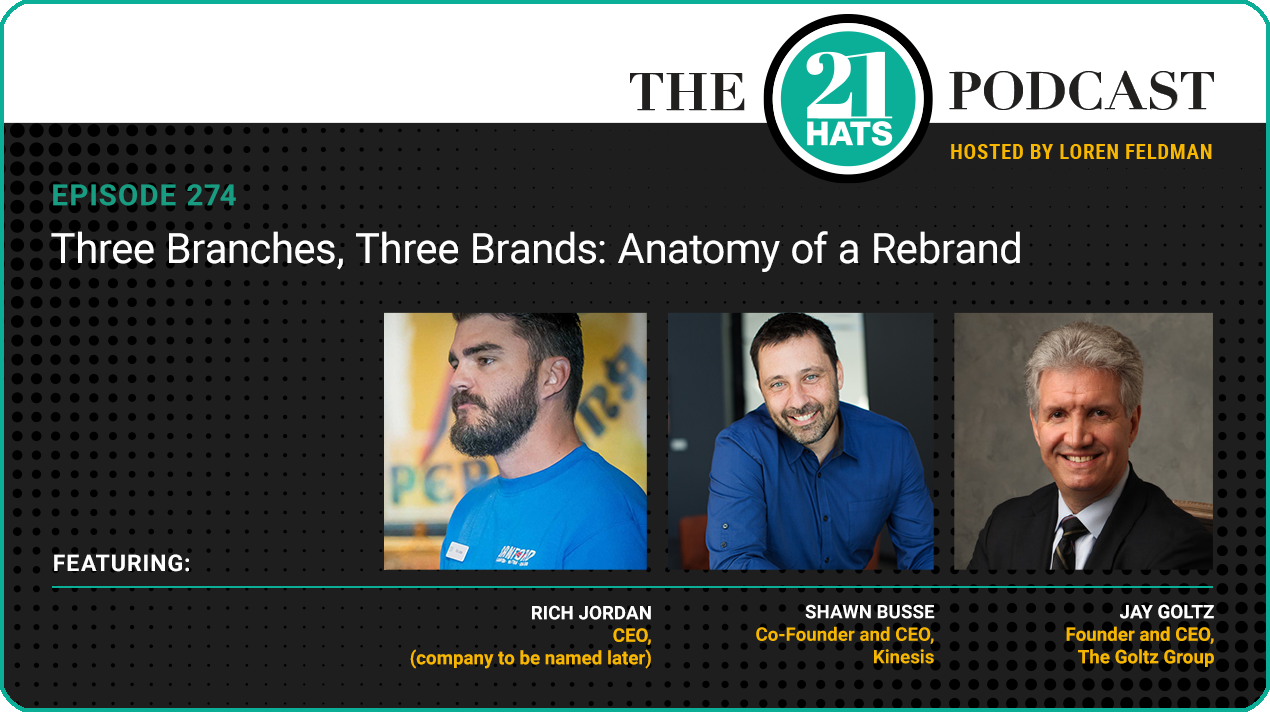
Introduction:
This week, special guest Rich Jordan takes us inside a marketing challenge presented by his successful acquisition of home services businesses. Do you keep the legacy names of those businesses to preserve local trust—at the cost of running a fragmented, inefficient marketing operation? Do you take the strongest brand you own and roll it out everywhere, even if it may not translate from one community to the next? Or do you wipe the slate clean and create an entirely new brand to unify the whole operation—knowing that it means walking away from money you’ve already sunk into branding your biggest location? In a conversation with Shawn Busse and Jay Goltz, Rich walks through how he wrestled with those choices, why he ultimately made the call he did, and what he learned along the way. His takeaways included that there are still people who listen to radio, that an authentic story can compete with private equity, and that it is possible to find a marketing agency that will align its interests with yours.
— Loren Feldman
Guests:
Rich Jordan is CEO of a home services business with locations in New Hampshire and New Jersey.
Shawn Busse is CEO of Kinesis.
Jay Goltz is CEO of The Goltz Group.
Producer:
Jess Thoubboron is founder of Blank Word.
Full Episode Transcript:
Loren Feldman:
Welcome Shawn and Jay, and welcome back, Rich, our special guest today. Rich, we had you on last year, a little bit more than a year ago, I think, to talk about your experiences leaving the Marines and jumping into the ownership of a plumbing business. Can you start by kind of bringing us up to date? What’s happened in the past year that got you thinking about rebranding?
Rich Jordan:
Yeah, sure. I think a couple things: In the year leading up to our interview last year, we had really started to lean into branded activity, like branded marketing—think mass media, radio, TV, streaming, stuff like that—really getting our brand and message out in front of the world. We really started leaning into that at one of my branches in New Hampshire for the year leading up to the interview and in the year since, and we saw a lot of improvement and growth off of that. You know, it was kind of an experiment at first, a little bit of a leap of faith.
Loren Feldman:
What did you learn? What worked?
Rich Jordan:
For us, radio. Radio has worked excellently for us, which, I think, anytime I tell people that, especially people my age, they’re incredulous, because a lot of them don’t listen to radio. They’d rather listen to Spotify or Apple Podcasts or something, but the reality is a lot of the world listens to radio, and we’ve just had tremendous growth of our brand off of radio.
Loren Feldman:
Has that growth included younger people, or are you getting an older customer that way?
Rich Jordan:
I would say, really, like your typical homeowner demographic: late twenties through sixties. So that was kind of the first part, is that we really started to build confidence around: Okay, we know how to build a brand now. That’s something we didn’t understand before, and now we feel pretty confident in our ability to do that. And then, sort of the straw that broke the camel’s back was this past summer. So about six months ago, I purchased a small plumbing company, and this led to us having our third location and also our third brand, because all of my branches were separate brands that had been acquired at some point or another.
Jay Goltz:
Wait, give us an overview. So you’ve got plumbing, electrical, right?
Rich Jordan:
That’s right. And HVAC.
Jay Goltz:
Okay.
Shawn Busse:
Rich, one of the kind of mumblings I’ve been hearing lately in your space—and I don’t really operate in B2C, but I am kind of interested in it—I’m hearing more and more questioning of the digital-only approach. And so you’re kind of one of the first people I’ve heard say, “Yeah, actually, we went on a different path.” You know, in a lot of ways, it’s kind of an old path, which is a mass media, broad-based, brand approach. What motivated you to explore the new thing? Was it that things were declining in efficacy, or costs were increasing, or you just needed more market share?
Rich Jordan:
Yeah, it’s a little bit of all of that. I mean, for one, it’s just digital, and as more contractors become familiar with digital or engage digital advertising agencies—you know, it’s a bid process. It’s an auction. And those leads just get more expensive every year.
And I think part of the problem, too, is, finding customers in that way is so transactional. Most people call it direct-response advertising. I sometimes call it transactional advertising, transactional marketing. I’m literally feeding dollars into Google. They’re giving me leads back, and you don’t really know me from Adam, as the customer, and I’m gonna send a technician out to your house. I was the one who picked up the phone, the one who got a guy out to you fast. And, like, there’s no branding. You don’t know me. You don’t like me. You don’t trust me. I just happen to be the top ad on Google.
Jay Goltz:
In Chicago, there’s two companies that are on TV constantly doing exactly what you’re doing, and they’ve got their name out there. So you’d have no reason to go to your computer to look it up, because you know this company. I think it’s a way of butting in front of the line and getting them to call you first before they even go do a search. And I have the same thing in my business.
Rich Jordan:
I think it’s huge.
Shawn Busse:
This is really interesting, Rich. Because for a while, that digital ecosystem pulled kind of an interesting move, which is to call it “performance marketing.” I don’t know if you’ve ever heard that title, so it’s this idea that the other types of marketing aren’t performing, which I find kind of funny. But can you quantify for us, in terms of that transactional marketing space, maybe what you were paying for a customer two years ago versus today, or three years ago versus today?
Rich Jordan:
So it would be like four years ago, I’d say, the sort of napkin math at the time was, you were kind of expecting to spend $100 per customer, which was pretty easy to stomach. Now, I mean, especially when you start factoring in your conversion rate on these clicks—after the customer clicks on your ad, and then they may or may not call you. If they call you, what’s your booking rate on that call? If they book with you, what’s the cancellation rate after the booking? And then ultimately, do you get a tech out to that house? So after you get through that whole conversion funnel, a lot of times, it’s like $400 per customer right now.
Shawn Busse:
Wow, and it was $100 when you first started?
Rich Jordan:
Yeah.
Jay Goltz:
I was gonna guess $200. That’s a lot.
Rich Jordan:
Especially, you know, let’s say you’re running a garbage disposal repair. I mean, a customer’s only going to see $200 and maybe $250 in value in a job like that, and it’s hard to charge that.
Loren Feldman:
Rich, do you also track what percentage of these customers end up being long-term customers, as opposed to a one-time purchase?
Rich Jordan:
They certainly skew more toward one-time, I’d say. We do a fairly decent job. Once we kind of get in front of the customer, put a technician in the home, customers are fairly happy with us, and we tend to retain them—or at least that’s what we convince ourselves is true. But certainly, the customer who’s just clicking on a sponsored ad is a little bit more difficult to retain. They’re certainly more difficult to convert.
The customer who might be using me for the first time but is familiar with me through branded mass media activity, they’re much more likely to not balk at the price. They already feel like they know us. They called us out because they wanted us to do the work, and they’re going to convert. So I think where you really see it is not necessarily on like repeat and retention, but it’s definitely on conversion. We definitely see a difference in conversion.
Loren Feldman:
All right, so you had the straw breaking the camel’s back: three brands in three locations. What happens next?
Rich Jordan:
So, I mean, I’ve always been envious of larger, single-brand companies. Ttrying to run multiple brands is difficult, and frankly, I’ve done all that big push and focus and experiment on the branding for my New Hampshire branch, and as far as branding goes, I completely neglected my other branch and just focused on New Hampshire. And we had success. And then, we just kept doing the transactional marketing, digital marketing for the other branch.
And then, as we saw success with the branding in New Hampshire, naturally, we want to do it everywhere else. But to do it for two, or now three brands, just felt like a very tall task, especially for a small team where I’m essentially the marketing manager and CMO.
Jay Goltz:
Well, it’s inefficient, in that you can put one ad out and cover all three brands, versus having to advertise three different ways to three different customers. All the customers that need plumbing ultimately need the electrician, ultimately need heating and air conditioning. So that’s one thing you know for sure: These homeowners need all three of those things.
Rich Jordan:
Exactly. Well, that, and then also something as simple as the production cost of a radio or a TV spot. You know, if it’s different brands, you’ve gotta run three different productions. That’s expensive, and that’s not even talking about creative bandwidth and your ability to have good ideas around marketing and branding while you’re taking a shower. If you’re trying to do it for three of them, it’s just difficult to do. And if you have one brand that you’re just constantly thinking about, I think you’re generally going to have better results.
Shawn Busse:
Tell us about the culture side of this, Rich, what tensions you were trying to solve there, if you thought about that from that perspective, or maybe tensions that got introduced through this process of changing the brands?
Rich Jordan:
Brand and culture, I think, are closely intertwined, especially if you’re doing a good job on the brand and on what I might call internal marketing amongst the team. Like, what are your team’s core behaviors? What does this brand stand for? What do we believe? And what are our standards? Again, it’s not impossible, and we did do it, but it’s harder to do it across three different brands. Like at Sanford, our New Hampshire branch, it’s very robust. We have core behaviors that we live and speak every day. You’ll randomly overhear guys saying them to each other in the warehouse. It was just a little bit harder for us to drive that at the other branches, things like that: shared mantras and shared beliefs.
Jay Goltz:
You know, I would think that one of the problems is just—thinking out loud here—if you have a plumbing problem, it’s pretty much an emergency, probably. Whereas if you have an electrical problem, it might be able to wait a week or two or three or five, because probably your house isn’t going to burn down. Maybe you need another outlet somewhere. So there’s probably a little bit of a culture problem, in that plumbers need to be more on the spot. Because if the toilet’s backed up, or if the sink’s not working, it’s a real problem. Or heating and air conditioning: Your heating goes out in the winter, it’s an emergency. So I would think there’s a difference in just the reaction time needed for each one of those businesses. True?
Rich Jordan:
That is true. It’s probably worth clarifying, though, that each of our branches is multi-trade. It’s not three branches that all have separate trades across the three trades. You know, I don’t have an electrical branch and an HVAC branch.
Jay Goltz:
When you bought it, that’s how you bought it? They had the three things together?
Rich Jordan:
No, generally we bought them as either plumbing or—
Jay Goltz:
Right, that’s what I was talking about. I was talking about, in merging those together, I would have thought there’s a little bit of a difference in mentality of: How much of an emergency is this, versus, you can wait till tomorrow.
Rich Jordan:
Yeah, no, there definitely is. What I find is that when customers call for plumbing, they’re really expecting you to get out to them either today or tomorrow. Electrical, for the most part, is sort of like vanity projects or like home upgrades. It’s like lighting, ceiling fans, outlets, things like that. And then, occasionally you’ll get a no-power call for electrical, but those are actually pretty rare. Electrical systems are pretty robust and pretty reliable, it turns out. HVAC can often be an emergency, but I’d say it typically skews a little less urgent than plumbing.
Loren Feldman:
So Rich, you’ve kind of described why you started thinking about wanting to have one brand everywhere. There’s an obvious cost to that, I assume, that some of these brands may have been fairly well known and entrenched in their locations, and you would be walking away from that to some extent. How much was that a part of your thinking?
Rich Jordan:
Yeah, I would say that was a big part of our thinking. So, part of the context is that the real brand equity that we have—three brands—we are largely responsible for. We built them into what they are. We bought them as small companies that were largely not well-known in their own markets, and we built them into what they are. And especially in New Hampshire, where we had been doing the two years of branded activity, we had really grown that business. I mean, that branch is twice the size of my next largest branch, at this point.
Loren Feldman:
Do you know how much money you spent on marketing and branding there?
Rich Jordan:
[Laughter] You’re trying to make me cry in this interview? Close to a million dollars on branding for that branch.
Jay Goltz:
Over how long a period?
Rich Jordan:
Over about two years.
Jay Goltz:
That’s a lot.
Rich Jordan:
Yeah, it’s a lot. It seemed like the natural move was to take the name of that large branch that we had built and branded and just use that name across the other two branches. The name of that branch is Sanford. It’s named after the last name of the founder, and that was the plan. That’s what we were going to do. And the whole company was aware of that. And we were getting ready to execute that.
As we got closer to finally pulling the trigger, I just started feeling this friction of, like, “Man, like, how are we going to—what’s the story that we’re going to tell in these other two markets?” You know, I take Guaranteed Plumbing in New Jersey, named after Tom Guerin, the founder. I take C&F plumbing, named after the two founders of that business, and then I rename it to another founder, a different market that no one knows. And it’s not my name. What’s the story?
Jay Goltz:
Wait, what about trademark issues? That’s a fairly common name? Did you do a thorough trademark thing? Are there other Sanford companies out there that could go after you, if you would have changed your name to that?
Rich Jordan:
There are none that are sophisticated enough to have trademarks on their name. But really, the real friction was: What’s the story we’re going to tell? Well, we have a sister company, up in New Hampshire. And they’re bigger, and they kind of have their shit together. So, you know, we decided we’re going to change our name to them. It’s really hard to do that and make it not look like some sort of corporate takeover. It’s not really something that anyone can get excited about. It kind of feels like a loss for the other two branches, in my opinion, like they didn’t make the cut. So we ended up pivoting away from that.
Loren Feldman:
How far along did you get before you pivoted away from it?
Rich Jordan:
I guess we maybe got to the starting line of a rebrand, and then that’s when we sort of pivoted away.
Jay Goltz:
You know what, I think you have very good instincts. Because I’ve got to tell you, as someone who’s used the same heating/air conditioning people for years, when they changed their name, I did get some anxiety of, “Oh, here we go. Roll up, raising prices, get rid of my guy that we like for the last 20 years.” There is an anxiety level piece to this that I think you were smart to think about, because it’s true.
Rich Jordan:
Yeah, and I think even no matter what you change your name to, you’re still up against that, right? But if you can meet that objection or that anxiety with a feel-good story, you can overcome it. But, the potential story that I just laid out, I think falls flat.
Shawn Busse:
At what point, Rich, I’m kind of curious where your brand agency played a role here or didn’t play a role. Were they effectively taking orders from you? You know, where you’re saying, “We need to rebrand, and we want to rebrand under Sanford.” And they’re like, “Yes, sir, let’s do it.” Or did they push back and say, “Hey, there’s an opportunity here. Let’s examine it”? Or did you drive that?
Rich Jordan:
Yeah, I’m fortunate that I’ve got really incredible brand agency partners. So us getting to the starting line with them was under the pretense that we were going to rebrand everything to Sanford. And how are we going to do this?
Loren Feldman:
I assume they had done the work for you on Sanford, the million dollars that you spent building that brand?
Rich Jordan:
No, no, I did that all by myself, probably way too inefficiently. And after having done that, brought them on to help me tackle what I wanted to do with bringing everything under one banner.
Jay Goltz:
But to Shawn’s point—which is an interesting point—I didn’t realize you had a branding agency. Was it all your instinct that said, “Wait, I think I’m making a mistake”? Or did they flush that out for you? That’s what they do. That’s what they’re supposed to do. Did they raise any flags while you were doing this to say, “Listen, you better think twice about this,” or otherwise, what the hell do they do?
Rich Jordan:
We brought them on, and yeah, the initial marching order was like, “Hey, we’re rebranding everything to Sanford. Let’s figure out how to do this.” And then, we kind of got in a room, and that’s when we really started to think hard about this and just kind of reassess our approach. And, yeah, certainly they drove kind of like the initiation of that.
Jay Goltz:
Okay, good for them.
Rich Jordan:
Yeah, very thankful for that. Because I think it would have been a mistake.
Shawn Busse:
Yeah, it’s really props to both them and you, because it is risky for an agency to push back on a client, in that regard. You know, because you just said, “It cost us a million dollars,” right? That’s the hard costs, right? There’s the cultural costs, there’s the risks, there’s tons of other things. It’s so easy for an agency to say, “Yeah, we’ll make you a nice, new, pretty logo with the name Sanford on it, no problem.” And that says a lot, I think, about your relationship and that idea of being partners, as opposed to order takers.
Rich Jordan:
Yeah, and we’ve had some marketing agencies in the past, like we had a local agency that did—you know, I joked and said all that’s been on my own under the Sanford name—but we did have an agency helping us with the media buys and things previously. And they were a little bit closer to what you’re saying, Shawn. They were a little bit more, for better or worse, they’d let me walk off the end of the cliff, as long as I had a smile on my face while I did it. [Laughter]
Jay Goltz:
And you were paying them.
Rich Jordan:
Yeah, and you paid the check before you got over the cliff. So, as the entrepreneur, I have to ask: Did those people make their money from the 15-percent agency fee on the buys? Or did you pay them in addition to that? Or how did that all work?
Rich Jordan:
The original agency?
Jay Goltz:
The one that you said you had that was placing the ads and stuff.
Rich Jordan:
Yeah, they were your classic advertising agency. They got a monthly retainer, plus, you know, 15-percent agency fee on all the media buys.
Shawn Busse:
That’s a really good question Jay has, because I think a lot of listeners probably don’t know the difference between these different types of agencies. An ad agency that makes a commission off of media buys, they generally don’t want to push you in the brand direction, because it’s risky to the relationship. It isn’t something that they’re making a percentage on usually. They just want to keep the ad machine going. Versus it sounds like the newer agency is much more of a strategic partner. Is that fair? And they probably charged you for the branding process, not just a percent of the advertising, right?
Rich Jordan:
Yeah, the agency I’m with now is unique, just on the typical agency model. Yeah, I think you’re right. Obviously, I guess the agency does stand to benefit if your business does grow. You know, you’re probably going to increase your media buy, and they’ll get a larger cut of that. But I think it’s, like, a marginal benefit.
Jay Goltz:
Simply put, you’re smaller. You’re not Coca Cola. I mean, if you were a gigantic company, 15 percent would be a zillion dollars, but a smaller company just doesn’t—even spending a million dollars over two years. That’s not big money. I mean, 15 percent is not going to make anybody rich.
Rich Jordan:
Yeah, exactly. So I think they’re happy to have you and their other three dozen clients, and everyone’s just spending and happy and retained. I think client retention is top of mind for them. My new agency has a different model. They actually don’t take any agency fee. So I basically get that agency fee back from my media buys. My media buys are 15 percent cheaper than they would have otherwise been. They don’t mark up any of the production costs—so any of the radio spot production, any of the branding, website design, graphic design, all that stuff. You know, another agency would be putting some sort of markup on that. They don’t. And then, they just take a percent of last year’s revenue.
Shawn Busse:
Wow.
Rich Jordan:
And then, as my company grows, their fee grows.
Jay Goltz:
Wow.
Rich Jordan:
When you first hear that, it can be kind of hard to stomach. You’re like, “Oh, man, what?” But then you start to do the math on how much your advertising agency, on the traditional model, is taking. And if you’re spending real dollars on branding and media buys, let’s say you’re spending 6 percent of revenue on media buys. You know, they’re taking 15 percent of that. That’s about 1 percent of revenue, and that’s before all the production costs that are probably above and beyond that 6 percent. They might be getting 40 percent of your ultimate advertising spend.
Jay Goltz:
I’ve gotta tell you, that doesn’t sound bad to me. It sounds like it’s an honest approach. They’re not pushing you into doing particular ads to get to 15. It’s not like they’re making the ads. They’re getting 15 of something that they really have nothing to do with. This seems like a more honest approach to the whole thing. I mean, nothing’s perfect. It’s not like you’re selling peanuts by the pound, but it kind of makes sense to me.
Loren Feldman:
Shawn, how common is that arrangement?
Shawn Busse:
It’s super uncommon, and it’s pretty cool, because one of the reasons I left the ad agency I worked at 25 years ago is because they were the typical model. And I kept pushing them. I was like, “Hey, we need to charge clients for things like brand work”—or, at the time, this crazy idea of building websites. And they were like, “No, Shawn, shut up. Just make more ads.” And because they made their money on the number of ads that were run, that was always the answer. It was always more ads, whether that helped the company grow or not. And that’s been my complaint about an ad percent model forever.
And it’s pretty cool, because now you’re aligned on the incentives, right? It’s like, Rich wants to grow. This company benefits by Rich growing. They’re gonna put things on the table that they think are going to help him grow, not necessarily just what’s to their benefit.
Rich Jordan:
Yeah, and I think in a traditional advertising model, let’s say you’ve got some advertising channels that are very cost-effective and really achieving the goals you want. You tell your advertising agency to kill some other channels and focus on this. You know, we’re going to reduce our ad spend to 2 percent of revenue, and we’re really happy about this as a client. This is great. The advertising agency is going to be pissed.
Shawn Busse:
Yeah, totally.
Rich Jordan:
You’re taking their money. An agency on this model is happy for you. You know, we’re both growing together, and we’re doing it cost-effectively. That’s great.
Jay Goltz:
And as a quote-unquote partner, if you have an off year, okay, they’re making less. You’re making less. They’re actually in the game with you. I mean, not bad. And if you have a tremendous year, you can afford to pay them more because you had a tremendous year. So I give them credit for coming up with that. I’m surprised.
Rich Jordan:
Of course, I don’t have a ton of visibility into the advertising space, but they’re the only firm that I’ve come across with a model like that.
Loren Feldman:
So, Rich, you start talking about putting one brand on all the branches, and not a brand that already exists. How long did it take you to get over the million dollars you’d spent on the one brand you built? [Laughter]
Rich Jordan:
It still keeps me up at night. I haven’t gotten over it yet.
Jay Goltz:
You know what, it wasn’t all lost. You did get those customers out of it, and you’re gonna retain those customers. So it’s not like you threw the money away. So sleep better. It wasn’t a catastrophic loss. You still have those customers.
Rich Jordan:
Yeah, and I think there’s a risk to changing the name, but in my estimation, it is all execution risk. It’s all execution risk. And generally, I’m happy to take on execution risk. So, yeah, I mean, we spent the money, we invested, we built the Sanford brand. I think we got ourselves pretty close to household name status in the market we’re in, and there’s no reason that we can’t transfer that goodwill to a new name if we execute it properly.
Jay Goltz:
Okay, I’m dying to hear the punchline here. So?
Loren Feldman:
How did you go about figuring out the new name?
Rich Jordan:
So, you know, we talked about culture earlier, and shared mantras and how important this is to us. So, we have 10 core behaviors at Sanford—and across the other branches as well, but certainly most embraced at Sanford. And one of them, which, funny enough, was voted the team’s top core behavior, is: “Seize the high ground. Do the right thing, even when not easy or profitable.” And “Seize the high ground” is a little bit of a throwback to my military background and has a little bit of that flavor to it. And I mean, of the 10 core behaviors, I feel like we lean into that one more than any other one.
Of course, you know, we’re dealing with dozens of customers every day. You know, things go awry occasionally. We have to go back out, fix stuff, do stuff for free, refund money. Where another contractor might argue with you, and try to nickel and dime and split hairs, we really lean into that “Seize the high ground.”
Jay Goltz:
It always surprises me that companies don’t do that, that you don’t lose money once in a while. So, good for you. I’m sure that’s the major reason why you’re successful,
Rich Jordan:
I think so. I mean, I think that that core behavior, and a few other things that go behind it operationally, I think are a huge part of our growth story and our satisfied customer base. And in many ways, it’s one of those things that you want to try to be able to say things that your competition is not willing to say, right? And for us, one of those things has been, “We offer a lifetime workmanship guarantee.” Anything we touch, it’s done right, or we’re going to make it right. And we totally stand behind that.
Jay Goltz:
Whose lifetime, the customer’s are yours? [Laughter]
Rich Jordan:
Yeah, you know, I play pretty fast and loose, Jay, so I don’t know if you want to do it on my lifetime. So, that’s very much tied into the “Seize the high ground” core behavior, and certainly something we lean into every day.
That all said, now that I’ve given a quite lengthy prelude here, our new name is High Ground Service Pros, and it’s been really cool. I did the reveal of that name to the team about a month ago, and just seeing the buy-in from the team around that—the fact that they had been taking that core behavior so seriously, living that, and then now seeing it on the side of the truck. It was very cool, because I was worried not just about our customers, but I was also worried about the team and if they’re gonna like it, if they’re gonna buy into it. And the response was resoundingly positive.
Jay Goltz:
You know, you’ve really tapped into something that I believe my 116 employees buy into, which is: They feel good knowing we’re taking care of customers. I feel great that I took what my grandfather taught my father, who taught me, who I taught them: I feel great about the fact that my employees get it, that they want to take care of customers, and they’ve been trying to take care of customers, and they’re proud of that. And I think that’s what you’ve done. And I can see where they would be proud of that name, because they get it.
Rich Jordan:
I think one of the toughest things as a technician, if you’re working for the wrong company that doesn’t lean into that, is you’re standing in a basement with a homeowner with a broken furnace, and it might have been our fault, or maybe we installed it improperly. And then you’ve got to tell that customer that it’s another $1,500 to fix it.
Loren Feldman:
Rich, how did that name emerge? Did you have a whole long list of names that you considered? Did you test names? What happened?
Rich Jordan:
It’s kind of cool how it happened, actually. So we decided we were going to entertain this idea that we would change the name. And my branding agency came out on site for a full day, and it was the creative ad writer, like the copywriter, and sort of more of the sales and operations focused partner of the two. So they came out, spent the day with us from like 8am to 10pm interviewing me, some of my key leaders, the rest of the team, went out to dinner, really just immersed for a day.
And then they left, and we stayed in loose touch for a few weeks. And really, it was that creative just kind of like stewing on what he saw while he was here, and then he—you know, classic kind of marketing advertising—pitched me on a few names. And actually, I went into that meeting and I was like: “I hope these names suck. I hope he just brings me some names I can just shoot down.” [Laughter] I was like, “Because if we can stick with the Sanford name, that’s gonna save me like 300 grand on the rebrand.” And one of the ones that he put in front of me was High Ground, and it basically just knocked me over.
Jay Goltz:
You had me at hello.
Rich Jordan:
Yeah, basically. I think, verbatim, my response was, “You son of a bitch.” [Laughter]
Shawn Busse:
Oh, that’s awesome. That’s so cool.
Loren Feldman:
And no testing, I assume? You just went with it.
Rich Jordan:
Yeah, we just full send, yeah.
Shawn Busse:
What about the legal side of it: trademark research, that kind of stuff?
Rich Jordan:
So early on, we did some trademark research. We came up clean. Funny enough, highground.com was available.
Shawn Busse:
Wow!
Jay Goltz:
Wow!
Shawn Busse:
Are you kidding me? That’s incredible.
Jay Goltz:
That’s remarkable. That’s a message from God, looking out for you.
Rich Jordan:
Yeah, my expectation was that we’d have to do something, you know: callhighground.com, choosehighground.com, seizehighground.com.
Jay Goltz:
I would think highgroundservice.com would have been available—but not just the word highground, though. That’s the remarkable part.
Rich Jordan:
Yeah, really happy with that, with how that went down. And yeah, so now we own highground.com. That website’s just recently been built out.
Jay Goltz:
So what are you doing about the formerly known as Prince? I mean, what are you doing? Are you putting formerly known as? How are you doing that transition?
Rich Jordan:
So I’m kind of leaning into my previous experience with some of the acquisitions we’ve done. We have, in the past, acquired other local businesses and rolled them into, say, Sanford, for instance, in New Hampshire. And some of those businesses were well recognized, despite being small. They were well recognized and well branded, and they had been doing radio and TV, and people knew who they were. So there was a little bit of risk in those brand transitions back then, and the way we handled them was basically quick absorption into the Sanford brand, as far as operationally: trucks re-wrapped, technicians in new uniforms, and full absorption for the cultural benefits and for the operational benefits.
So the company that we had the success with on this, the company’s name was Bill Trombly Plumbing and Heating. So if you’re a longtime customer of Bill Trombly, or if you’re someone who is familiar with Bill Trombly and wants to use them for the first time, you’re probably going to type Bill Trombly into Google. Probably. So I want to make sure that when you do that, you’re not met with nothing. So we left the website up. We left the Google business profiles up. And then on the website, like on the marquee on the website, there’s a photo of me and Bill shaking hands, and a little bit of an introduction to the partnership.
And then, for the first six months, we can track what phone number you called to get to us. So if you called us from a Bill Trombly phone number, we would answer the phone as, “Thanks for calling Bill Trombly. How may I help you?” Go through the entire booking flow, book the call, and then on the end, say, “Hey, you know, by the way, we’re really excited to announce we recently partnered with another local business, Sanford, so that we can get a technician out to your home quicker. It may be a Sanford or a Bill Trombly truck coming out to your home. Is that okay with you?” “Oh, yeah, no problem. That sounds good.” “All right, great.”
And that’s what we did. And then we slowly, kind of tapered off and just started answering the phone in Sanford over the course of a year. That worked great, and that’s basically exactly what we’re planning to do here.
Loren Feldman:
Where do things stand? How far along in the process are you?
Rich Jordan:
So we did the internal reveals just about a month ago and started really working toward the public launch. We started introducing the rebrand publicly on social media about 10 days ago, roughly two weeks ago, and then just yesterday, we did a full public launch. So right now there’s billboards up, radio spots live. We did a full email blast to the customer list announcing the rebrand. And so we’re basically 36 hours into this rebrand, at this point, into the public launch.
Loren Feldman:
Rich, can you tell us what this whole thing is going to cost you?
Rich Jordan:
Every rock I turn over is another couple thousand bucks, but it looks like it’s going to be about a half a million dollars to get the whole thing done.
Loren Feldman:
Wow, so less than you spent on Sanford.
Rich Jordan:
Yeah.
Jay Goltz:
But that can be amortized over—it’s not like it’s a one shot. You’re gonna have the benefit from this for the next 10 years.
Loren Feldman:
Rich, I’m curious about one other aspect of this. Can you estimate, do you know to what extent you are competing with private equity-backed businesses in your various markets?
Rich Jordan:
Yeah, it varies by market. So, like, for instance, the branch where I first got started, which is coastal New Jersey, like the Jersey Shore, it’s a red ocean down there with PE, like pretty much any company. I can’t really think of a single company down there that is my size or larger, at this point, that is not owned by private equity. It was only companies that are smaller than us that are independent.
Jay Goltz:
Which means, in about two or three years, you’re going to get some people giving you some serious offers, which—you probably thought of this—that by doing this, you’re going to get back those advertising dollars 100 times, because your company’s gonna be so much more valuable being branded as one—
Loren Feldman:
If he sells it. But hopefully, he won’t sell it to private equity.
Jay Goltz:
No, my point is, given that I’m 69, I now understand something I never used to think of. You can’t do this forever. So, one day someone’s going to pay you a fortune for having all these branded things together.
Rich Jordan:
Yeah, one day, after we’ve achieved all of our aims and all that, maybe we’ll think about it.
Loren Feldman:
But I wonder about another aspect of this, Rich, which is, I hear that there’s some backlash against private equity-owned businesses, that customers don’t necessarily love big companies coming in from outside of town and buying up their local favorites. Are you at all concerned—and through this process, were you at all concerned—that by adopting this larger brand, putting it on all of your locations, and in some ways, doing things that look like you’re professionalizing your whole operation—not that it wasn’t professional before—but are you at all concerned that you’re giving off a PE vibe, that some customers might think you’ve been bought by somebody, and that they’re not going to get the care that they got before?
Rich Jordan:
You know, it’s interesting, because at Sanford, for instance, we had really professionalized that company, even under the Sanford name. And the trucks, they had the Sanford name on them, but they looked good. They looked good, they looked clean. The techs wear a nice uniform. So I think you could have confused us for private equity then, as well, which often happens—you know, a private equity company that’s masquerading as a family-owned company, because it’s got the founder’s name on it.
And I think part of the friction that I felt—of course, I’m not private equity, but I am someone who acquired the business, right? I have equity in the business, and it is private. And there was a little bit of friction for me for a few years, and I ultimately got over it. But there was definitely friction where I felt like I had to hide behind the brand, because my last name is not Sanford, and like, why does this guy own the company? Who is this guy?
Loren Feldman:
What do you mean by “hiding behind the brand?” Do you mean you didn’t want to put your face forward?
Rich Jordan:
Yeah, like, I was hesitant to tell people that I was the owner, that my name is Rich Jordan, and I’m the owner of the company.
Jay Goltz:
Versus letting them think a guy named Sanford owns it, and he’s at a desk somewhere, which is what I would think if I saw a name on a truck. I’d assume there’s a guy named Sanford sitting in an office somewhere, making sure his guys are going out on time.
Rich Jordan:
Right. So, yeah, I mean, you’d like to tell this story of, striving entrepreneur, good story, all that stuff. But people will see it as like, “Oh, he acquired the business. He’s an investor.
Jay Goltz:
He’s not a plumber.
Rich Jordan:
Yeah, exactly. So there was a little bit of friction there. I feel like—to Loren’s question—even though we may look more polished and certainly a more deliberate brand aesthetic, it’s my brand now, and it also speaks to my background and what I believe in and tells the customer a little bit about what we stand for and what they can expect from us.
For instance, the radio spots that went live on the radio yesterday, they’re spoken by me. They are me on the radio talking about what’s valuable to us and what we care about and what our values are. So, I think you bring up a good point, Loren, but I think the fact that we changed the name is something that reflects our values, and reflects a little bit of my background and philosophy, I think negates that.
Jay Goltz:
If not negates it, it certainly counteracts it. There will certainly be some people that will want to deal with Mr. Sanford. But to your point, you’ve got a good story to tell now, so I think it will more than make up for it.
Rich Jordan:
And I think this is the real—like, what Loren just brought up, this is the real reason why taking the Sanford name and putting it across all three branches, kind of like a big brother takeover, would have been the wrong move. Because we would not have gained the ability to lean into the brand and the brand story. I mean, basically, what really would differentiate us from private equity, other than we just have less cash, you know? [Laughter] So, I think that would have been a big mistake, and I think we would have looked like private equity entering the market. It would have been difficult for us to convince people otherwise.
Loren Feldman:
So what you’re saying, I think, if I hear you right, is the difference between that—putting Sanford on all the locations—versus what you did is really a matter of authenticity. It’s your story. So you’re rebranding everywhere. It is different. It is maybe more polished, but it’s a real story. Does that make sense to you, Shawn?
Shawn Busse:
Well, yeah, I mean, I think it’s a great move, and honestly, I’d say lean in even harder, man. You know, in coming years, as there’s more and more awareness of what private equity does to price, experience, quality, I think customers are going to start to look more for brands that actually say, “No, we are not owned by private equity.”
Loren Feldman:
Rich, what are we going to talk about when you come back next year?
Rich Jordan:
Oh, man. Well, hopefully we’re not talking about how I blew up my company and brand.
Loren Feldman:
I don’t think so.
Jay Goltz:
I have to tell you, your whole process is really impressive. Good for you. Great instincts. Everything makes perfect sense. Really. Hats off to you.
Rich Jordan:
I appreciate that. I do.
Loren Feldman:
My thanks to Shawn Busse, Jay Goltz, and Rich Jordan. Thanks for sharing, all of you. I do appreciate it.

