

I’ll Deal with Succession Next Year
Introduction:
If you’ve owned a business for any length of time, you’ve probably told yourself some version of this: I’ll deal with succession as soon as I solve whatever crisis my business is confronting right now. The problem, of course, is that there’s always another crisis to solve or opportunity to pursue, and time has a way of passing.
Jay Goltz has spent decades building a collection of successful businesses in Chicago. He knows he needs a succession plan. He knows that if something happened to him tomorrow, there’d be chaos. And he’d very much like to leave the business in the hands of the employees who helped build it. Over the years, he’s considered the usual options—selling to a bigger company, to a few key employees, to an ESOP, even to an Employee Ownership Trust. But every option comes with compromises. And so, year after year, it’s been easier to focus on challenges that seem more urgent—until this past April, when Jay turned 70. “I realized,” he says, “I can’t kick this down the road much further.”
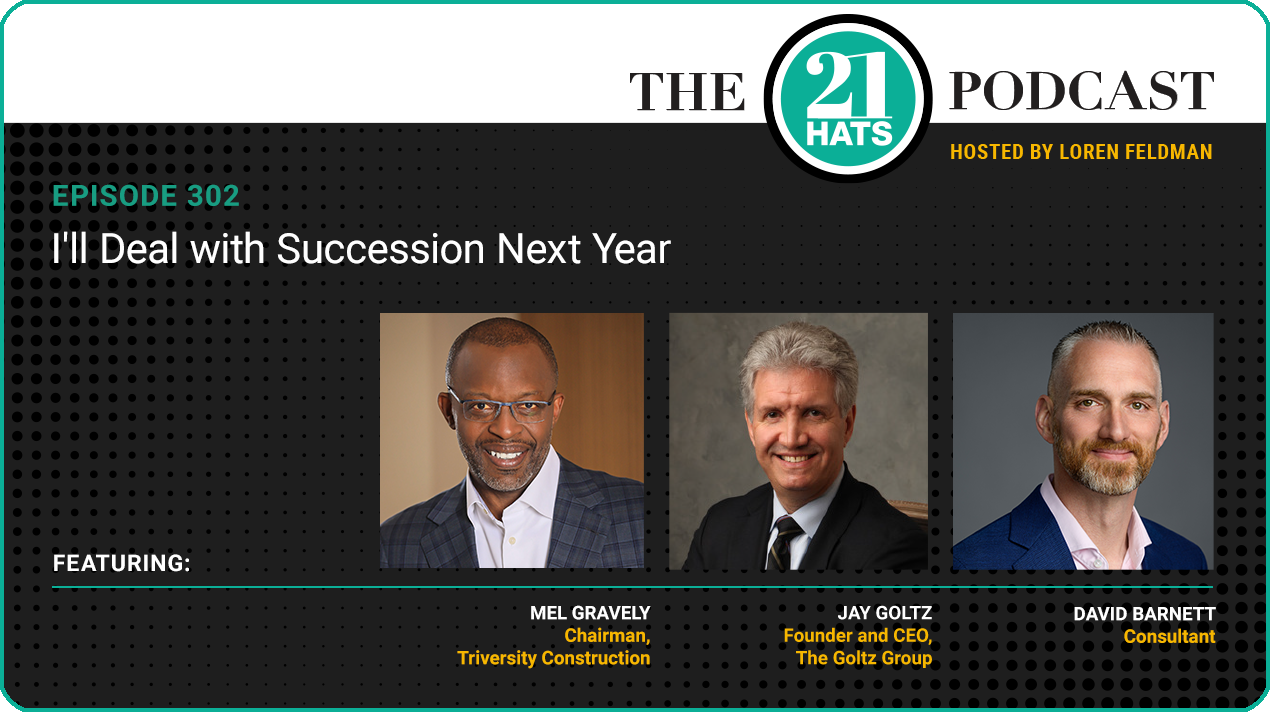
This week, Jay sits down with David C. Barnett and Mel Gravely for an unusually candid conversation about what makes succession planning so difficult—even when you understand how important it is. Jay explains why he has no interest in selling, why money isn’t really the issue, and why he still loves going to work every day. Mel, meanwhile, offers some tough love, suggesting that if protecting Jay’s family and employees really are his priorities, then something else must be holding him back.
Mel also shares an unexpected twist in his own succession journey. After stepping away from the CEO role two and a half years ago to become executive chairman, Mel found himself pulled back into operations this spring—a reminder that even well-designed succession plans don’t always unfold as expected. And along the way, David offers a blunt explanation for why many aging business owners overestimate what their companies are actually worth. The episode is brought to you by Grasshopper Bank.
— Loren Feldman
Guests:
Mel Gravely is chairman of Triversity Construction.
Jay Goltz is CEO of The Goltz Group.
David C. Barnett helps people buy and sell businesses.
Producer:
Jess Thoubboron is founder of Blank Word.
Full Episode Transcript:
Loren Feldman:
Welcome Dave, Jay, and Mel. It’s great to have all of you here. First of all, Mel, this is the first time you’ve been on the podcast since you hosted our 21 Hats Live event in Cincinnati in May, and I do want to take the opportunity to thank you publicly. We had a great time there. A couple of things in particular that I would note: One, just spending a few days in your space, in your neighborhood, it became obvious that Triversity has a special relationship with its community. And it was really impressive to see that up close and personal.
The other thing is, you told us that Cincinnati is a very cool place, a great place to walk around. And I don’t want to say I didn’t believe you, but you know, everyone brags about their hometown. But I have to say, Cincinnati was the surprise hit of the week. People really fell in love with it. You were telling the truth.
Mel Gravely:
Well, I try to tell the truth. If it didn’t come across, our team was thrilled to have you guys, and we’re proud of our culture and our business, but we’re also proud of our community and our city. So, thanks for coming.
Loren Feldman:
It was a pleasure. You didn’t tell me you could walk to Kentucky. That was kind of amazing and cool. So, Mel, while we were there, we learned that you’ve had to reengage with your business a bit. You kicked yourself up to executive chairman, I guess it’s a couple of years ago now. Is that right?
Mel Gravely:
Yeah, that’s correct. It was the end of the year, 2023.
Loren Feldman:
But at least as of May, when we were there, you’d kind of been pulled back into operations, maybe a little bit like Michael Corleone of The Godfather. [Laughter] Can you tell us what’s going on?
Mel Gravely:
Yeah, so I’ll try to make a longish story short—and then we can talk about the whys—but we lost our COO late last year [in] October, November. He was our CFO before that, and Jim, the current CEO, promoted him to COO. He bought a business and left our firm at that point, and that left three executive leadership team members. We had five. I stepped down and that left four, and then he left the business. That left three. And for a business our size and our—I don’t want to say complexity, because it sounds arrogant—but with our balance of short-term and long-term expectations, it was hard for a three-person executive team to have the kinds of conversations that balance the short-term versus the long-term.
There just wasn’t enough brains in the room, challenging each other. Too many of them, of the three, kind of thought the same way, and so that was the first sign that they needed some support. The CEO was asking me to step in and do certain things, and we have a super good relationship. We ran the business together for 12 years, 13 years, and he’s a partner and owner of the business. So, anyway, with all those things coming together, it was just time for me to come back and help him do some very specific things, I’m hoping.
Loren Feldman:
What’s it feel like to re-engage? Are you enjoying it?
Mel Gravely:
I’m getting better. It’s July, so I’m getting better. To be honest with you, I really didn’t want to do this, at first, and so I felt a little bit annoyed. Maybe that’s [not] the right word. If I had more time, I’d pick a better word. And jumping in, I felt overwhelmed a bit, because I had made a bunch of commitments, and my schedule’s pretty full. And now I’ve got these other things I’ve got to do, and standing meetings I need to be in, and so it took a little bit of time for me to get adjusted. The team has been very gracious and welcoming, and I’m not there yet, I wouldn’t say, but I’m getting close. I’d say, you know, August or so, I’ll figure out a stride that makes some sense.
Jay Goltz:
The guy that left, I’m just curious, how long was he with you?
Mel Gravely:
Eight years, almost eight years.
Jay Goltz:
Was it a surprise that he left?
Mel Gravely:
See, so I wasn’t close enough to know whether it was a surprise. I will tell you, he gave us a lot of time to prepare. And he still hovers around us to this day. So there’s no animosity, but I think the team—I know I did—underestimated both the tension needed in an executive leadership team, the tension meaning this positive thing that happens when we’re asking tough questions of one another and challenging our thinking, and where we are as a mature business. We’re probably more of an adolescent than we are an adult, and so without him there, it created a vacuum.
Loren Feldman:
Are you trying to replace him?
Mel Gravely:
Oh, yes, we’re actively searching, although we’re not searching for a COO. We’re searching for a CFO. We think we’ve got a couple of good candidates, and hopefully we’ll get that battened down by September.
Loren Feldman:
Has the search gone well? Have you been able to find people reasonably quickly that you’re reasonably positive about?
Mel Gravely:
Loren, that’s a great question. How’s it going? Well, we’ve got a great recruiting firm that we’ve worked with before on very, very critical high-end hires, but we’re more vigilant than we are in a hurry, and so I think we’ve seen some high-quality people that are a great fit for some organizations, probably wouldn’t work in ours. But this last round of candidates, again, we think we’ve got two for sure who could do this job. The question is, how do they go through the rest of the steps that we ask executives to go through, and which one ultimately do we pick?
Jay Goltz:
I have to tell you, hiring a CFO was absolutely the worst, most difficult thing I did. I did it really badly. I tried. I hired the recruiting firms. Just from my own personal experience, hiring somebody to come into a smaller company in that role, I just think it’s a weird job. I just think that the people—I got all these resumes and people working at these big accounting firms. Their heads would blow up after about 10 minutes, I’m confident, if they walked into an entrepreneurial situation. It’s been my biggest problem. There’s no question about it.
Mel Gravely:
Yeah, I get that. You know, I totally agree. So we’re looking for candidates who have worked in privately held companies of different sizes. We’d like for them to have done a run through one of the public accounting firms, or at least done some public accounting, because we think that just confirms a certain level of ability around GAAP and things like that. But you’re right. I mean, the way we move would destroy someone that’s only known big, big companies.
We’re 100 and will be 150-some million this year, so we’ve kind of grown out of the really small. But we’re still really pretty darn nimble, pretty entrepreneurial. I’m liable to do something that makes everybody flip out from an acquisition to a divestiture to whatever, so they’ve got to be nimble enough to handle that, for sure.
Loren Feldman:
What was it like going back into the business on a day-to-day basis? Did you like what you saw?
Mel Gravely:
Yeah, generally so. You know, the reason I’ve stepped so far away was because I’ve got a big personality, and when I’m around, I’m liable to see everything wrong, right? And it’s just not true. Everything’s not wrong. But no, generally, yes, the business is doing fine. Our customers are happy. We continue to hire talented people. It was the balance of short-term obligations, short-term objectives, and long-term that they were struggling with. They were very good at executing and getting what we needed for this year. They were struggling to balance that need with staying focused on the things we need for the next 3, 4, 5 years out.
David Barnett:
The classic challenge of trying to push all the balls at the same time.
Mel Gravely:
Yeah, absolutely. So, Loren, I wasn’t disappointed when I came back. You know, we’ve got stuff to do, but you know what I’m focused on is our three-year plan. That is the biggest initiative I’ve got. It’s leading the effort for our three-year plan, and I think we’re that inflection space of size that either we’ve got to get to 250 or we’ve got to figure out how to be profitable at 140. And you know, 150, 160 might be tough to hold, so that three-year plan is very important, and we’re working really hard on that. And that does invigorate me. I am good at that part, good at the process, the structure, the rigor. So I’m glad to do that for the team.
Jay Goltz:
So, how many employees are there? I’m trying to convert it to my business—the dollars are obviously way more.
Mel Gravely:
Yeah, there are 140 or so. Yeah, there’ll be 150 in the next three weeks. That’s part of the other challenge: We’ve added so many people. When I left, I think we had like 85 people, and you know, we’re at 140 now. And it’s just hard to manage that kind of growth that fast.
Loren Feldman:
So is your goal to take your time to hire the right person, but then get out of there as quickly as possible? Or are you kind of liking it now that you’re reengaged?
Mel Gravely:
Yeah, wow, you must be like in the business of journalism or something. [Laughter] It was never my goal to reengage. I enjoy the process of the three-year plan. I’m playing a little coy because I don’t know the answer to your question. I know I want to step back, not just because I want to step back, but because I think the business needs that. But I’m going to pay more attention to my CEO this time, and listen, and try to understand what he’s asking me to do, and why. And so, I will probably be closer than I was before I reengaged, but not day-to-day, if that makes any sense. If I was guessing, I’d say in the next six-eight months that I’ll be acting as executive chair, but my executive chair role might have a little bit more touch to it than it had before.
Loren Feldman:
Okay, so we know that successions don’t always go precisely according to plan, but at least you have a plan, Mel. Let’s talk about Jay. [Laughter] Jay, over the last few years, we’ve had a lot of conversations checking out various options that you might consider for your succession plan, and several times you’ve seemed to get pretty excited about one option or another. But then I think doubt sets in. You turned 70 in April. Tell us, what are you thinking?
Jay Goltz:
I’ve got a new revelation. I realized I’ve been in a process, and I found a perfect list that describes it. It’s seven things: shock, denial, anger, bargaining, depression, testing, and acceptance—called the seven stages of grief. [Laughter] And as I look at this, I go, “Oh yeah, right. Oh, the shock. Oh, I can’t do this forever.” And then, “Oh, no, no. No, I can do it for another 10, 15, years.” And then the anger of just like, “Damn, I don’t know how long I’ll be”—and then the bargaining: “Well, maybe I can.” So, I think I’m working my way. I’ve gotten past the depression thing, which didn’t last long, because I’m not big on that. I deal with things. I’m on the testing stage, or I’m in the acceptance stage, which is much better, because it’s okay. I just realize I need to do something.
And the other issue is, I went to a webinar around this, and this woman described her journey. She did an employee ownership thing and she’s hanging around. And I said to her, “I hate to be this blunt, but it just seems like you’re taking your money, giving it to your employees to give back to you.” And she said, “You know what, that’s a fair question.” And she explained she believes that they’re doing better now that they’ve done this, and they’re going to make more money. And then it’s going to be a win for everybody, because they’re going to make more money in this new arrangement. And whether she’s there for three years, four years, five years, at the end of the day, she’ll end up coming out just fine.
And you know what? I accept that. I think that was a good answer. So, I’m kind of getting hot on it again—not an ESOP. I don’t want anything to do with ESOPs. There’s too much regulations and rules. Just whether it’s an employee ownership trust or some other form of it, I think that that would work out well for me, would give me total flexibility. Because the other option is selling it. A) I don’t know if I could, and B) the next thing I know, I’ve got a boss. That’s not going to go anywhere, so that one’s off the table. Doing nothing isn’t a good plan. And so I’m definitely working on figuring out: How can I do this in the most efficient and best manner so I don’t wake up one day and say, “Oh my god, what did I do?”
Loren Feldman:
You know, there are a lot of issues that kind of get blended together under the rubric of succession. I’m curious which of the issues are most important to you right now. You know, there’s an irony to this. It’s kind of interesting. Several years ago, when Bo Burlingham wrote a book about succession, he turned to you for help coming up with his title, and you came up with the title Bo chose, which is Finish Big. I’m curious, what does finishing big mean to you? What’s your primary concern?
Jay Goltz:
Yeah, first of all, part of what I’ve come to understand, figuring this out at 65, it’s just not the same thing. Hitting 70 just changes things in my head. It’s much clearer now that I need to do something. And finish big, in my case? I’m going to try to do this. I’m going to try to do the best possible thing. I accept the fact that it might not work out like I think and that I’ll give it my best shot.
Loren Feldman:
But you’re going to try to do what?
Jay Goltz:
Try to finish big, that the business can go on beyond me. I don’t use the word “legacy.” I don’t really—that’s not a big thing to me. I’ve got 110 employees. I want to do the best I can to hopefully keep them working and keep them in a job and keep it going. There’s really two pieces to this, and this is the part that’s so frustrating.
Unlike everything else in the world, in business, usually you can look at something and do an analysis and figure out, “Oh, I’ve got enough tread on these tires. I can drive the car for another two years before I replace the tires.” In this case, I could be going to work every day in 10 years, just like now, or I could be dead. I don’t know, and so I’ve got two jobs. One is, what do I figure out for the long-term? And the second thing is just to have kind of a backup plan that, if I do die, the business is on solid footing. And at this point, I am absolutely not doing day-to-day stuff. I haven’t dealt with customers in years. I’m not dealing with vendors. I have it running pretty well without me doing the day-to-day stuff. So, I think I’m three quarters of the way there. I’m trying to set something up that will just give stability, basically.
Loren Feldman:
Jay, if you got hit by that proverbial bus today, would your wife become the owner of the business?
Jay Goltz:
Yeah, and that’s just… she’s had nothing to do with it. Yeah, she would technically be the owner of the business. I know what my accountant will say for sure. My accountant will go, “Close it down, rent out the real estate, or sell the real estate, blah blah blah.” There’s no question.
I have a note I wrote—I update it every year—about if something bad happens. And I explained to my wife that our accountant is going to tell—I go, “Ignore him.” Because he tells me right to my face. You know, he’s an accountant. On paper, it makes sense, what he says. It just doesn’t if you care about your employees. So yeah, I need to figure out a transition plan of who’s going to call the shots and decide what to do, and luckily, it’s not about the money. I’ve got enough real estate that it’ll be fine either way. So, it’s not about, “Oh my god, if this goes bad, my wife’s going to be out in the cold.” And I’ve got lots of life insurance.
Loren Feldman:
But see, that’s what I thought you would say when I asked you what your biggest concern is. I mean, I don’t want to put words in your mouth, but from what you’ve said here through the years, I know you don’t want to dump this problem in your wife’s lap.
Jay Goltz:
No, absolutely not. That would be my number one concern.
Loren Feldman:
And your thoughts on approaching that, at this point?
Jay Goltz:
I will put together a board and make sure that everyone, first of all, and people—
Loren Feldman:
I’ve never heard those words come out of your mouth.
Jay Goltz:
Yeah, right. I know. And people laugh when I say this, but I’m telling you: a key component to this—and sometimes people think I’m being facetious, and I’m not—having a lot of life insurance is a really good thing.
Loren Feldman:
That doesn’t solve the problem.
Jay Goltz:
Well, it solves one problem. It solves a huge problem of anyone’s got to worry about, “Oh my god, what if this goes badly? We’re not giving any money.” So, between the real estate I own and insurance, money is not the issue on this. Because if it was, just walking away and shutting it down would be a perfect solution. That’s not a perfect solution, because I really don’t want to do that to my employees.
So, the goal is to try to set up an infrastructure that it can continue on. And, like I said, the key here is I’m going to try to do that, but I am not going to put my—I’ve had the burden for 48 years of trying to make sure everyone’s taken care of. And it’s fine. I wouldn’t even call it a burden. I’ve had the joy and the privilege of 48 years of taking care of employees, taking care of the business, and making sure it all works. I am not going to hang that noose around my neck and say, “Oh, I’ve got to make sure that it goes on for another 40 years.” I’m going to try, and if I can’t, I can’t. So that’s where I’m at at the moment.
Loren Feldman:
Anybody have any thoughts?
David Barnett:
Well, I can tell you, from both of these stories, we’re getting a really deep insight into why businesses need to have an owner. I mean, even as these businesses get bigger and bigger, and more and more middle management-type people are involved in these businesses—or even in the case of Mel’s business, more C-level leaders are coming into the business. There needs to be someone to make the ultimate decisions on a lot of this stuff, and that kind of responsibility is not easily handed over to anybody else. There’s no one who’s going to have the same kind of care or desires, or beliefs, or vision that an owner would have.
When I was in Cincinnati, I heard Mel’s story about how he had to come back into his business, and it kind of inspired a video I created on my YouTube channel where I talk about this. There’s a myth out there in the social media world that if you buy a business that is organized well enough, you can just put a manager in charge. And it’s kind of like an automatic sort of thing, like, I don’t know, buying a government bond and collecting dividends or something, which is ridiculous. And I gave the example of Mel’s situation, I said, “Look, I know a guy with a business with over 100 employees, and he still got dragged back into the business when circumstances changed in the business, and his leadership was required. And that is always going to be on the edge of consciousness for any owner.
What do I think that you should be doing? Well, it’s really difficult to do what Mel’s trying to do, which is create this leadership team that is in place where he doesn’t have to be there every day. I would say even the world’s biggest investors in sort of passive vehicles like publicly traded stocks are still spending time on their portfolio, keeping an eye on what’s going on in their businesses, and so it’s impossible to completely step back from a business altogether. And Jay, it sounds like when you say, “I’m going to put a board together,” it sounds like you are thinking just now of doing the steps that Mel began engaging years ago.
Jay Goltz:
We’re in very, very different businesses, though.
David Barnett:
That’s true.
Jay Goltz:
I’m in retail. I own the building, so like, if we just don’t screw it up, the customers will keep coming in, keep doing business. When you’re dealing with construction, I mean, there’s always big jobs. It’s far more volatile, I would say.
But the analogy I always use with businesses is there’s horse races and there’s car races. In a horse race, if you’ve got Secretariat, you can probably put most jockeys on that horse, and it’s going to win the race. In the car, it’s about the driver. You never hear about what kind of car Mario Andretti was driving. So, I think businesses are not horses. They’re not just these thoroughbreds that any moron can get on there and ride that thing to victory. To your point, someone needs to run it, and I agree with you.
David Barnett:
But Mel, I mean, when you went back to Triversity, it wasn’t because you guys were having trouble putting up a building, was it?
Mel Gravely:
No. If so, they wouldn’t call me. [Laughter]
David Barnett:
Right. The thing that the business does every day, you guys have all the pros you need to make sure that’s done properly. The problem was in that vision and leadership part, right?
Mel Gravely:
Yeah, and your point about—yes, let me answer your question. Absolutely, it was the mortar between the bricks. We could have continued what we’ve been doing for years, but your point about thinking this through—and when Jay mentioned the board, I almost passed out. Because I remember months ago Jay saying, “No way in hell. No one’s telling me what to do,” or something like that.
So we do have a fiduciary board in place for this very reason, because I agree that there needs to be an owner. And that fiduciary board will be the stewards of the business, and they will elect and hold accountable—this is all theoretical, by the way—they will elect and hold accountable the leadership, and they will help with that transition. And so that’s the general model. But Jay, I have come to appreciate your view on things. It is hard to give you input, and can I give you three reasons why?
Jay Goltz:
Go. That’s why I’m here.
Mel Gravely:
One is because you are stubborn, and you’ve been successful, and I think the combination makes you less open. Two, you’ve got a list of what-you-won’t-dos that’s longer than most people I know—at least it comes up first on your list. And the third is, there’s something that I’m missing about what you’re saying, and I can’t get you to say it. Because if I don’t want to leave it on my wife as a burden, and I don’t want to have my employees left hanging, if those two things are my primary drivers, then you would be in action already. So, there’s some other driver or drivers that are keeping you from being in action.
Jay Goltz:
Oh, I gave you the list. It’s right there: denial. I figure, “Okay, I’ll deal with it next year.” [Laughter]
Mel Gravely:
I thought you were kidding. I swear to God.
Jay Goltz:
No, I meant it. It really gave me clarity. I realized, “Oh, I’ve been in the seven stages of grief,” because the idea of leaving my business, I find it’s not like some people, “Oh, I’m going to sell the business. I’m going to get a boat in Florida.” I go out to dinner now with friends who are retired, and I hear what they did all day long, and it’s like, I have no interest in doing any of it. So, it’s grief.
David Barnett:
You love punching in every morning.
Jay Goltz:
I love going to work. I love seeing my employees. I love seeing happy customers. I just like the whole thing. And that’s why I said turning 70, though, has changed that. Then I realized, “Yeah, I can’t kick this down the road much further.” I need to definitely—so that is the answer.
Mel Gravely:
Got it. Let me ask you this question, though. Why wouldn’t you just ride this horse until the horse literally died underneath you? Why wouldn’t you just do that?
Jay Goltz:
Well, I’m planning on doing that, except back to Loren’s thing, what’s my finishing big? A glorious finish would be that it can keep going, keeping my people working. And so I am going to try to do that.
Loren Feldman:
But I think that’s your secondary concern, Jay. I think both those options—either riding it till it dies or you die, or setting up something, some kind of employee ownership thing—those are great options. You don’t necessarily have to do that tomorrow, though it would be great to get started. But the thing I think you do have to address is the if-you-get-hit-by-a-bus concern. Mel, I’m curious, at what stage in your ownership did you address that issue, put something in place to make sure that it wasn’t chaos if something happened to you?
Mel Gravely:
Yeah, I’d say 18 months after I bought the company, we had a ripcord scenario where our board, which was pretty small then, knew exactly what to do if something were to happen to me. Because I didn’t want to put my wife in that spot either. My wife’s a physician. This is not what she does, and she doesn’t need distress. Plus, she’ll be really, really unhappy that I’m gone, I hope. So I wouldn’t want her dealing with this, and our kids were too young, so we had a ripcord.
We have evolved that strategy over the years to an actual succession, both emergency and long-term plans. So, every single key job, including mine, has a succession plan and an emergency plan, but we’ve been working on that over time. But I want to just go back to one thing Jay said. You said, “I’m going to try to do better than that.” And Jay, I just don’t know if what you’re describing is actually better. It might sound better, but I’m not sure it is better. And I don’t mean just for you and your family personally. I mean, a rocky landing for your team post-you is probably worse than an organized landing while you’re around.
Jay Goltz:
That would mean—I think what you’re saying is—I would need to leave the business. And I have no interest in doing that.
Mel Gravely:
So you want to work until you die.
Jay Goltz:
Yeah.
Mel Gravely:
But you want to—okay, got it.
Jay Goltz:
Yeah, for sure.
Mel Gravely:
I’m collecting the priorities.
Jay Goltz:
No, we’re in very different places. You said you left it. I have no interest in doing that, and I totally respect people who want to do that. I have absolutely no interest in doing that.
David Barnett:
You know, you can help the business transition to a new owner in some form, whether that’s a person or employee ownership or some other thing, and not retire. You could create a new job, a new reason for yourself to show up there every day, if that’s what makes you happy. And then you would be around to help steward and shepherd the transition of the authority and the vision and everything to the new owners. But then everyone else wouldn’t be left in limbo worrying about what might happen should you pass on.
Jay Goltz:
Well, that’s one of the interesting things. I’m not sure anyone’s worrying about that. And I have a very open, honest relationship with my employees. I can’t tell you that anyone cornered me and said, “Jay, you’re 70. Like, what’s the plan here?” You know, is anyone worrying about that? I don’t know.
David Barnett:
But do you think maybe, when you go looking for something as specialized as a new CFO, that person takes a look at the situation and wonders if this is really a wise long-term career choice?
Jay Goltz:
Oh, for sure. Well, in this case, I made it clear when I was hiring the person that, “Listen, you’re going to be a key person when I’m out of the business.” So I used it as an advantage rather than a disadvantage. Listen, it’s a mess. I mean it, really. There’s no clean, simple—most of the decisions I make in business are pretty cut and dry. In this case, I’ve accepted the fact that I will do the best I can, and I think it’s a good plan. The board thing, it’s funny, yeah, you’re right. I heard “board.” It’s like, I cringe, except the reality is I have to. How can I not? Except, I mean, I need to have a board. I’ll have some people that work here.
My son said something to me, very interesting, my youngest son. He’s 36. He said one day to me, he figured out why he’s not optimistic about the company, because he doesn’t know how to solve problems, and I do. And I’m glad he came to that conclusion. He doesn’t have years and years of experience, of having a problem, figuring it out, and solving it. And that’s all I’ve done for 48 years.
Loren Feldman:
Except for this one.
Jay Goltz:
Well, I kind of feel like I’m going in the right direction.
Mel Gravely:
I do too. I mean, since you’re serious about going through the stages of grief, I think you’re going in the right direction. And you know, I can think of a number of scenarios or variations of what you said. If your role is truly as you describe it—
Jay Goltz:
Absolutely, it is.
Mel Gravely:
It really is. Okay, so yeah, I mean, there are a number of paths down that road. But I do encourage you to move faster than slower, because it takes much longer to put anything in place than you think it’s going to take. And it takes more energy on your part. And if you were to get tired or ill, it just makes it almost impossible to carry that wood, because only you can put this in place the way you want it.
Jay Goltz:
No, I agree.
Mel Gravely:
Yeah, sooner than later.
Jay Goltz:
Just figuring out the ESOP thing, going to two seminars out of town, spending days, I really have gotten a good insight on that. That absolutely, for me, is the wrong choice. But so far, so good on the employee ownership trust. And the phrase that was told to me, which totally takes the pressure off: “It’s naked in, naked out,” meaning no one’s paying anything to get into this, and no one’s getting anything when they leave. It’s all for when they work there, which is perfect. If I don’t ask anyone, “Oh, you got to buy in,” I think I can keep this very clean, to where nobody can complain about anything.
Loren Feldman:
What has kept you from moving on that? You were very excited about it. We had John Abrams on, and we had an extended conversation about both worker co-ops and Employee Ownership Trusts.
Jay Goltz:
It’s the story of my 48 years. It’s called triage. It ain’t fun right now in business, in the furniture industry. The industry is in the toilet because interest rates are high, and therefore people aren’t moving. When people don’t move, they don’t buy furniture. So I’ve been just dealing with regular business stuff, and I’m getting somewhere on it, but if you haven’t noticed in your town, they think 32 percent of furniture stores are going to go broke this year.
And the problem isn’t that the interest rates are high. This is the only time in history interest rates were 2.75. So these people who have those 2.75 mortgages are holding on for dear life, and even if they need a bigger house, they’re not buying one because they don’t want to double their—so we’ve never seen such a drop in people moving as it’s been right now. And I’m dealing with that.
Mel Gravely:
Is there a single kind of operations lead, since you’re not running the day-to-day? Is there a person who, like, everybody goes to to solve the problems of the day?
Jay Goltz:
No, I’ve got one person running the home store, and I’ve got one person who’s running the framing business and the wholesale framing business. And I’ve got someone running the art business, and they’ve all been with me for 30 years.
Mel Gravely:
Well, how old are they?
Jay Goltz:
Good question. No, no, the oldest one, who’s my cousin, he’s 62. And the other two are 52 and 51, which is where one of the problems is. If I’m working in 10 years, which I’d like to think is at least a 50/50, they’re going to be 60-some years old at that point. So the whole succession thing, they’re going to be ready. So that’s why I need to start working on some younger people, which is why I keep saying: I’m going to try to do this.
David Barnett:
You know, Jay, I’ve worked with a lot of business owners who have sold to their employees. They haven’t necessarily sold to all of their employees or used any of these prescribed formats, like ownership trusts or ESOPs or anything like that. They’ve just chosen a group of their employees, or their employees have gone together in some kind of collective group and said, “We five managers,” or, “We 10 people, we want to buy.”
And then, basically they just form a group that is buying, and how this gets apportioned and who gets what rights or number of shares or etc. is totally open to negotiation. And those buyers, I mean, you can finance them or they can get a loan from the bank if they’re able. You know, it’s totally like any other kind of buyer, and you have absolute flexibility in how you set things up with them.
Jay Goltz:
Here’s a key part—I am a recovering entrepreneuraholic. And I just couldn’t do enough and couldn’t start enough businesses. I was just starting business after business. Some of them worked, some of them didn’t. I’m completely different now. I don’t need to grow this thing. Minimal growth would be just fine. I’m the one who gave Bo the name Small Giants, and one of, I believe, one of the issues of being a Small Giant is sometimes enough is enough. You don’t have to just be obsessed with growth, and if you are, great, as long as you’re taking care of the employees and the customers and the business.
David Barnett:
Why would you assume that these new owners, who might be employees of yours, are going to suddenly become focused on growth?
Jay Goltz:
No, I’m not. That’s my point. I don’t need to structure it in such a way that they’ve got to keep growing. It’s fine the way it is. Which is why it’s simpler, which is why I’m fairly optimistic I’ll be able to pull this off. We’re not opening more stores. Like I said, a key part of this whole thing is I own all the real estate. In retail, that’s a critical piece of the puzzle.
David Barnett:
So if your business was open today, paying fair market rent, if you were renting space from a stranger, would the business be struggling right now? Or would it be closed?
Jay Goltz:
That’s a very insightful, good question. And the answer is, my furniture store is questionable. When Loren says, “Well, what have you been doing?” That’s what I’ve been doing. I’m figuring out what is the market rate, and that’s a major issue, and I’m working on it. I mean, the furniture industry, like I said, is it coming back next year? I don’t know that it is. So I just have some decisions to make on all that. But you’re right.
Here, I’ll tell you one thing. I used to be in the garden business. It was Jayson Home and Garden, and I now have someone else I totally have rented the space to. I went on a tour with this bus 20 years ago with all these garden stores, and I realized that every single one of them was second- or third-generation. And I realized if their grandfather or grandmother bought the land for $100 an acre in 1953, that’s why they have these garden stores.
I had just written my book The Streetsmart Entrepreneur, and the person in charge knew it: “Oh, Jay, tell us some business stuff.” So I said, “Well, here’s something I realized after a day of being with all you guys. I would be very careful to make sure you charge yourself what the real rent is for the business—or really, you’re just subsidizing it with free space.” And this guy gets really angry at me, and he goes, “We’re doing God’s work!” I said, “Okay, I get all that. I’m just saying, it might be worth looking at what your property is worth.” Because we went through these rolling hills out east somewhere, these magnificent mansions everywhere, and there’s a garden store in the middle of all of it. And I said to the owner, “Does this really work with the math?” He goes, “No.”
David Barnett:
There are an incredible number of really poor businesses out there being subsidized by smart real estate investments decades ago. And those businesses, if they had to pay a fair rent for the space they were in, they’d be closed. And this is some of the behind-the-scenes stuff that most people don’t see when they drive past a business, and see a business operating. Everyone just kind of assumes that if it’s open, it must be profitable, and people are doing well.
And even some owners don’t get this—like what you were saying with those garden center owners. Garden centers, in particular, I’ve had a few conversations lately with people looking at buying these things, and the problem that messes up all these deals is that when somebody sells one of these garden centers, of course then they want fair market value for the property. And the reality is a garden center is a business you put on marginal land, on the edge of a town, that you can buy inexpensively, to your point. And then later, after three decades go by, maybe you’re in the path of development. Then it becomes worth more. It’s a totally different investment from operating the garden center.
Loren Feldman:
Jay, Dave brought up the possibility of selling to key employees. You’ve actually helped other people do that. We did a podcast [episode] about you helping another owner of a picture framing business do it. You called the process a We-SOP. Is that something that you’ve considered with your business?
Jay Goltz:
No. Here’s the difference. He wanted to leave. He wanted to move to the West Coast, and he was in New York State. So, it worked perfectly for him. In my case, I’m not going anywhere.
Loren Feldman:
Is it possible to sell the business to employees while remaining CEO for as long as you want?
Jay Goltz:
For sure, for sure. But the issue there is, like I said, they’re 18 years younger than I am. So if I’m working for another 10 years, which I hope to be—or maybe not. I’ve also come to the realization: You know what, maybe when I turn 75 I’ll say I’ve had enough. I recognize that.
Loren Feldman:
Or it’s a transitional board that maybe somebody takes over for three or four years, and it’s their responsibility to find the next generation.
Jay Goltz:
Maybe.
Loren Feldman:
Where are you on your stages of grief right now, Jay?
Jay Goltz:
I think I’m either on six, which is testing, or I’m on seven of acceptance. So, I think, given that this isn’t exactly the same as grief, that I can do something about it. I’m testing, I’d say, and I feel good about it. I think I’ve got a good plan here.
Loren Feldman:
Wait, what’s your plan?
Jay Goltz:
The plan is I’m engaging with a not-for-profit that does employee ownership plans, all kinds. It’s kind of surprising. They’ve got like 20 employees. There’s a lot of organizations out—I had no idea. There are some serious-sized organizations that help with this stuff. I’m having a meeting with them, and I’m going to flesh out what are the options and figure it out. The key thing is, it doesn’t keep me up at night. It’s okay. Maybe in this case, acceptance comes before testing. I’ve accepted that I should do something, and then I’m testing out the options.
Loren Feldman:
Mel, you’ve seen a lot of businesses go through this kind of thing. You’re a member of Tugboat. Those are businesses that, like yours, are striving to be around for 100 years and more. They have to come up with some sort of structure to make that possible. Any thoughts?
Mel Gravely:
Well, I sit on the board of a few others that are not Tugboat-like companies, that have different family ownerships and different partner ownerships. And so Jay’s ideas all sound relevant. I say we have this discussion when Jay’s at the final stage of his grief process, because until then, this is unsolvable without a true commitment to, “I’m going to do something for damn sure. I’m willing to take input from others.” I don’t know why, Jay, you would try to solve this without any expertise.
Jay Goltz:
No, that’s why I told you I’ve got an appointment with them.
Mel Gravely:
Okay, you know, accountants and tax attorneys and lawyers, they know the options, and they can help with that. But you know, it’s just hard. I’ve been listening, trying to figure out what really are the drivers. And Jay, in my mind, you’re just not ready to have a serious conversation about this, because you’re not at that stage yet. So, when you’re ready, there’s a lot of options. I will say that, including riding it out.
Jay Goltz:
Yeah, and I believe you just gave a reason why so many business owners never do anything. I have found in discussions the accountants don’t get it. Ones I’ve talked to—I’m not going to say all of them—that’s just not what they do. And lawyers? I don’t think going to your lawyer or your accountant is going to give you that. I think you need to go to one of these organizations that specializes in transitions or employee ownership or whatever, because they’re transaction-oriented, the lawyers. I’ve never met one of them that said, “Oh, I’ve got some ideas for you.” And I don’t know that many lawyers, but I think that’s the exposure that most business owners have. They have their accountant and their lawyer, and I realize there’s lots of other resources out there that can give a much better view of things and do this for a living.
Loren Feldman:
Dave, does that make sense to you?
David Barnett:
One of the most frustrating things that most owners have to face is that they say, “Who is the quarterback that’s going to coordinate all of these different parties?” Because there’s the lawyers, the accountants, the wealth planners, all these different people who have to have some kind of input into how you’re going to successfully transition out of a business and get to the next stage of life and make sure you can afford it. And people say, “Well, who coordinates all these different folks?” And the frustrating answer is, it’s the entrepreneur.
Even people who have certifications in what is called exit planning, all they can do is sit beside you, because there’s so many decisions that have to be made. It’s like the same frustrating problem when people decide to have a custom home built. You know, their builder can be a great builder of homes, but they’ve got to have you available to tell which kind of bathroom tap you want to have, right? All the little decisions all along the way have to be made, and so learning about the different outcomes is wise. I think that it’s going to be far easier, Jay, for you to learn about the different tactics, strategies, methods, etc. when you have a very clear idea of what you want the outcome to look like.
If you don’t know what you want the end result to look like, it’s going to be hard to even get the right information from them, even though that’s their thing. So, figuring out: Do I want to sell it to all the employees as a group? Or do I want to sell it to some of the employees? Or, what does it look like when you are finally out of your ownership position? I think that’s the first thing you have to figure out and make sure that those other people you’re identifying as prospective owners actually want to participate in this—because they have to want this too. And if there’s nobody in the organization who wants to rise up and take the leadership roles, then that’s when some people realize, “Hey, you know what? If this thing is going to transition and survive in the long run, maybe it needs another owner.”
Jay Goltz:
You know what, you really hit on a key piece of this, that I can put together any plan I want. There are two separate issues: one is, who’s going to run it? And how do you do the equity in it? And you’re right. If I plan this all out, except I don’t go ahead and make sure there’s someone in place that’s going to run the whole—that’s an issue, for sure.
David Barnett:
The employee ownership people—and there’s very different formulas of how this happens, you know, worker co-ops, the trusts are new, the ESOPs, etc.—all of those people say the same thing. The biggest challenge is the governance. Once you make employees the owner, then how do you recreate that executive function that lives within the brain of an entrepreneur to make those ultimate decisions and have that vested interest in profitable future outcomes? Otherwise, you get this momentum where, as you point out, you don’t think growth is necessary, but if there’s no growth and no change and no reaction to the changing business environment, eventually things get stale. And then things die.
Jay Goltz:
No, you brought up a couple of very insightful points. One of them is the real estate issue. It could turn out that some of my real estate gets so expensive that the business just isn’t viable in that spot. So, you’re right, things are changing, and that’s what I’m dealing with now.
Loren Feldman:
Well, Jay, I just want to thank you for taking our sometimes blunt questions, especially from me. I think this will help a lot of people, because you clearly are not the only person wrestling with these kinds of issues.
Jay Goltz:
I like to call it navigating instead of wrestling.
Loren Feldman:
Okay.
Jay Goltz:
I’m navigating.
Loren Feldman:
You’re not the only one, for sure.
Mel Gravely:
There’s a ton of them. We’re in the same spot.
Jay Goltz:
Thank you to you all. You brought up some excellent points, good food for thought.
Loren Feldman:
My thanks to David C. Barnett, Mel Gravely, and especially Jay Goltz, and a special thanks to our sponsor. This episode was brought to you by Grasshopper Bank. Thanks for listening, everyone.

