

Do Small Businesses Still Need HubSpot?
Introduction:
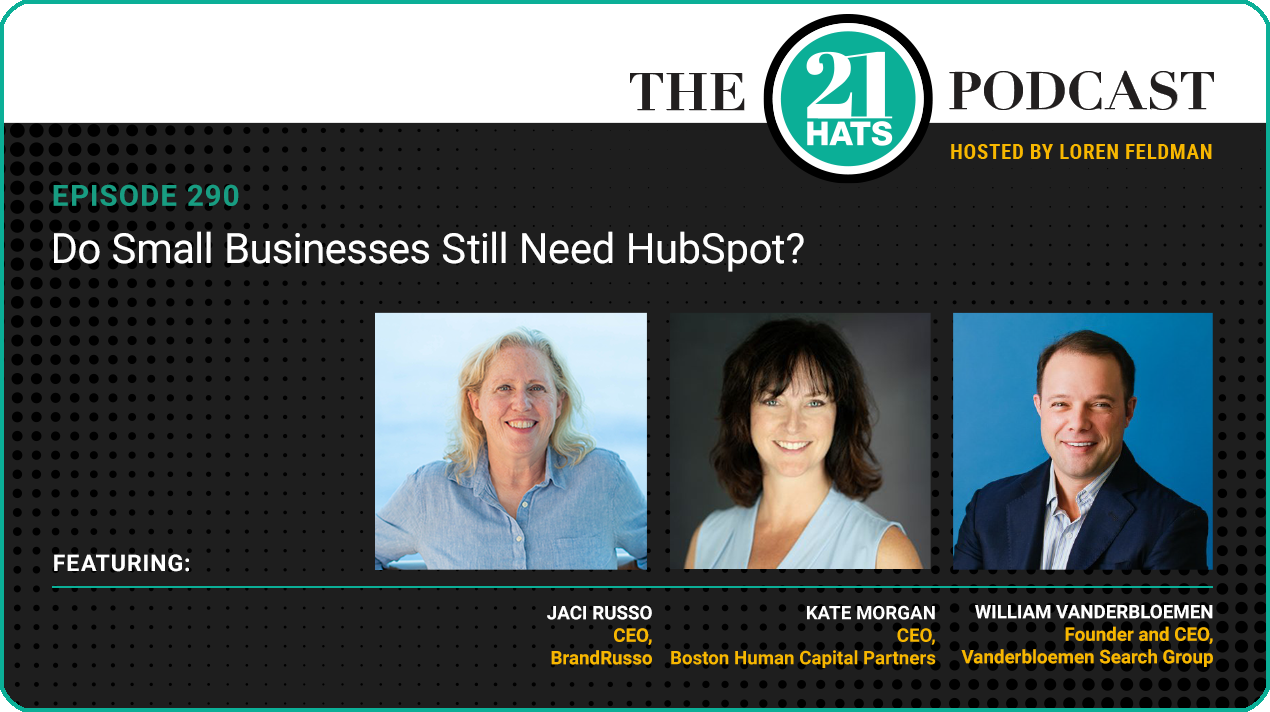
Early on, William Vanderbloemen’s search firm was exactly the kind of business HubSpot, the marketing platform, was built to help. William had a highly specialized audience, his team produced content that audiences needed, and HubSpot helped make sure the right people found it. Back then, he tells Kate Morgan and Jaci Russo, HubSpot’s promise was that it could help a David compete with a Goliath, and that’s what it did for Vanderbloemen Search.
But that was almost 20 years ago, long before AI began reshaping how people discover information. Now, William contends, the rules are changing. If you create strong content for a specific audience, large language models can do more and more of the work of connecting that content to the people looking for it. Which raises a question: If that’s where marketing is headed, do small businesses still need a sophisticated platform like HubSpot? In this week’s episode, William shares his doubts.
Along the way, the three owners also discuss why Kate changed her mind about selling her business, whether companies really need to pay attention to their Glassdoor reviews, and what a plumber should tell an SEO agency that wants a monthly retainer of $12,500.
— Loren Feldman
Guests:
Kate Morgan is CEO of Boston Human Capital Partners.
Jaci Russo is CEO of BrandRusso.
William Vanderbloemen is CEO of Vanderbloemen Search Group.
Producer:
Jess Thoubboron is founder of Blank Word.
Full Episode Transcript:
Loren Feldman:
Welcome Kate, Jaci, and William. It’s great to have all of you here. I want to start with you, Kate. As we all know, there’s a lot of crazy stuff going on in the world, a lot of uncertainty, much of which has an impact on the economy and, ultimately, on individual businesses. But, as I think we’ve all seen, even when times are tough or crazy or uncertain, there are always lots of businesses doing just fine, and right now, one of those businesses happens to be yours. Why is that, Kate? What’s going right?
Kate Morgan:
Well, I keep reflecting back to when I first launched. So when I launched my company 15 years ago, it was on the heels of the recession, and the job market actually didn’t rebound until 2015. But by 2015, I was already at the $2 million mark, and I’m just seeing this trend again. And what it appears to be in my armchair economics, is the market, the high tech software market, really stalled back in October of 2022, and then we had the big tech layoffs. We don’t work in big tech, but it trickled down to the smaller companies, smaller software companies, and the VCs even kind of threw on the brakes and said, “Listen, we’re not giving you guys any more money until you have product-market fit.”
Last year, finally, when we hit summer, then we started seeing the coffers replenish themselves, and money was going out to these startups. And now, we’re at a crazy amount of growth. I think we grew 17 percent last year, and we’re already definitely on track to have 20 percent growth again this year. So I am ecstatic, and it’s modeling more of what we saw back when I first launched. So I just feel like, yeah, we know this story. Let’s ride this wave.
Loren Feldman:
William, your business is somewhat dependent on the job market, but a very different slice of the job market. How does this compare with what you’re seeing?
William Vanderbloemen:
I don’t know. I’m not an economist, Loren, and you know, I don’t have formal training in these things, but whether the job market is flat or not, eh… I don’t know. I mean, we’re busier than we’ve ever been, but I don’t know if there’s a correlation there or not. I will say, in the years I’ve been doing what I do, helping do executive search, pendulums historically have swept on who’s in charge: the employer or the employee who has the leverage. And it’s swung back and forth over the years.
It sure feels like for the last five or six years, it’s been the employee who has the leverage. Talent is short. People are staying put. They have to have a really good reason to leave, or better pay, or “I want to work from home,” or what have you. So, there’s a little more of a war for talent right now than I’ve seen in a while, and candidates are harder to dislodge than they have been in the past. Don’t know if that means they’re happier or not, or if they just don’t want to move.
Loren Feldman:
Who’s keeping you so busy, William?
William Vanderbloemen:
Well, some of this is maybe not helpful to the conversation, but we’ve shifted our marketing subtly to really only the top of an organization, maybe the person who reports to them. And you have to do that slowly, because we were doing a lot of searches that were second share searches, what have you.
So I think our idea of helping churches find a pastor, schools find a headmaster, it was a relatively new idea, and we hit a tipping point a few years ago where people are like, “Yeah, no, we probably need to hire a firm to help us with that sort of thing.” And so I don’t know if it’s just awareness that there’s a service that there didn’t used to be or what, but the leads that are coming in are healthier than anything I’ve seen.
Loren Feldman:
Jaci, does any of this surprise you?
Jaci Russo:
No, not at all. You know, I see, from the marketing side, companies that are really struggling with recruitment. And it tends to happen because they haven’t done a very good job of building their brand, and so they are not the kind of companies where potential recruits are magnetically drawn to them, and they’re not doing the things they need to do to be ready when the opportunity hits.
You know, companies that aren’t constantly marketing themselves for recruitment all of a sudden have to start at zero when there’s an open position and they’re caught off guard. The number of companies, Loren, that I talk to on a weekly basis that don’t even know what Glassdoor is, much less have somebody monitoring it, it’s mind-blowing to me.
Loren Feldman:
That’s interesting. William, Kate, does that surprise you? The Glassdoor thing is really surprising to me. I would have thought by now everybody would know that they should be paying attention to—
Jaci Russo:
Common sense is not sensical nor common. [Laughter]
Kate Morgan:
Glassdoor, I think it may have peaked, and it’s kind of pittering out now. It usually was younger generations, and they would just go and piss and moan about stuff. But we’re back to the reality of it. Because, when we work with clients and candidates, we’ll tell a recruit, warts and all. Even in my own world of recruiting for my own company, we really push on, “This is what you’re signing up for. Are you really up for it?” And there’s no employer brand for a company that doesn’t even have product-market fit. And that’s kind of the world we live in. So we have to actually build a strong case of: What is compelling about that company to join it? And our candidate pool isn’t necessarily looking at Glassdoor. So I don’t know if that really impacts us that much. But again, it could be the stage of the company.
Loren Feldman:
I’m surprised. I would have thought that your tech-oriented talent pool would be first in line to check Glassdoor.
Kate Morgan:
It’s the junior people who are like, “Oh, let me check into it.” Not the person with 10 years’ experience. They look at it as gossip pages.
Jaci Russo:
I think you might be surprised who looks at it and how often they look at it.
Loren Feldman:
You think most people do, Jaci?
Jaci Russo:
I do.
Kate Morgan:
Not for us. Because we were talking to the candidates. We’re not commissioned headhunters. A lot of our clients, they just don’t even have Glassdoor, and they don’t have people sitting around bitching about, you know, “I had to work an extra hour,” or, “I don’t get paid lunch.” They’re not doing that.
We saw it before. I would 100 percent say, yeah, back during Covid, during the hiring frenzy, yes, there were a lot of people who were leveraging it. I just don’t see it now, not in the last three years. Because right now we’re also seeing a lot of people who are unemployed, and they have been struggling. They’re just really happy to start to see opportunities coming forward. And if we’re being very upfront about, “Hey, this is what you should expect,” then they’re not looking deeper. But again, we’re talking about people who are making $200,000 a year, not the $70,000 person.
Loren Feldman:
William, how important is Glassdoor in your world?
William Vanderbloemen:
Not. I have used it for my kids, checking to benchmark a salary, but we use the most premium version, whatever the highest paid version is. So I might see things that other people don’t see. I don’t know. I don’t know much about it. But it feels to me like Yelp or Amazon with product reviews. And if you get activist people doing the ratings—and I think that is what happens at Glassdoor more than, “Did you like this book you read?” If you’re mad and you want to make a mark, you go to Glassdoor and leave a review.
I don’t know that that happens as much in consumer products, but I don’t trust a Glassdoor rating right out of the box. Nor do I trust the salaries, now that we’re—what is it? 18 states are forced to post salaries now? They just pick a range of $100,000 to $500,000 so that they’re telling people what the pay is. So it’s more opaque than it was in the beginning, and the clarity it has can be driven by activists and not reality. So I don’t pay a whole lot of attention to it.
Loren Feldman:
So, Kate, given how well your business is doing and that kind of growth, I have an obvious question for you. Not too long ago, you were on the podcast, and you told us that you’ve decided to try to sell your business. Is this having an impact on that? Is it making you think this is the right time to sell? Or is it making you think, “Yeah, maybe I want to hang on to this a little while”?
Kate Morgan:
So, funny about that: I’m an accelerator chair for EO, and we just had the Execution Day. And I explained to the accelerators: Think of execution as go find the holes in your company that if you were going to sell, you’d have to fix. And I say that because that’s exactly what, when we had that podcast [episode], I was like, “Well, I have my book, I have my speaking opportunities that I want to give attention to. In order to do that, I probably need to consider selling my company.” So that’s really why I was thinking about it, because I was kind of spread too thin.
And then I took it to my team. I have my leadership team. We call it a council. And I asked them, “What do you want to do with your careers?” Both of the two individuals have been with me for five years. I’m like, “What’s on your mind? Because if you want more out of life, we probably should consider being acquired. And because there’s just a lot of holes here, there’s going to be some heavy lifting. What do you want to do?”
And they said, “Well, can we have a week?” So they went away, and they came back for our Level 10 meeting, and they’re like, “No, you know what? We’re really happy with everything the way it is.” And it was a complete, “Wow! Okay, well, let me go, think about this now.” And you know, I think everybody gets really hung up on exits. Everybody’s like, “Oh, they’ve had two exits.” Well, I know plenty of people who’ve had really lousy exits, and in a professional services organization, you just don’t get the big 15 times valuation. You just don’t. And doing the math, if I hang on to this for five more years, I make way more money.
And, yeah, it puts everything I wanted to do with the book on the back burner, but half the time I’m struggling with imposter syndrome anyway. So I’m like, “Yeah, you know what? We’ll just stay the status quo”—obviously, it’s not exactly status quo, because of our continued growth. But I don’t know. In my world, in my mind, I read years ago that there’s three reasons why you go into business: good idea, ego, or money. And I’m presently checking off all three boxes, because I’ll talk to people, because I get referred to them, and I tell them the model, and they’re like, “Wow, that’s a brilliant model. Everybody should be doing this.” I’m like, “Yes, yes, they should.”
Loren Feldman:
What are you referring to when you say that? What’s the model?
Kate Morgan:
Because we’re hourly, and the hourly keeps the cost per hire lower, but it’s white-glove service. And so, because it’s so successful, it does cost them less, which, anybody listening to this could be like, “Well, she’s a bad business owner.” No, because guess what? I have zero cost for customer acquisition. I do no marketing. I have a newsletter. Whoop de do. I do not have a sales team. Everything is referral-based, and so that’s why people are drawn to it.
And if I go into a competitive situation, even against executive search firms, well, the executive search firm is going to charge anywhere—I’m hearing ranges because of the market being so soft for the last two years—75 grand to 150 grand. I go in and I tell them the hourly model, and they’re like, “Well, what could that look like?” And I am very honest with them, that it’s probably going to be closer to about 10 percent, if that, of the cost of the person’s yearly salary.
So in a competitive situation, I dislodge them. Guess what? I made a team so happy that they’re like, “No, we don’t want anything to change.” And I have always looked at the “why I do this” is, when we take the Simon Sinek, it’s I really wanted to take people and give them a career that they could be proud of and find meaning and purpose in their lives. So that box is checked. And I’ve always found that if I do those two other things correctly, the money happens. So I’m feeling super, super good about going into 2026, even with everything else going to hell in a hand basket, when we look at some of the topics on the news lately.
Loren Feldman:
William, any thoughts about Kate’s business model?
William Vanderbloemen:
You know, if you’re able to recruit without doing marketing, you’re doing really well.
Kate Morgan:
Thank you.
William Vanderbloemen:
Yeah, and, I mean, do you have employees that are bringing you people, or is it more organic than that?
Kate Morgan:
As far as bringing candidates, you mean, or clients?
William Vanderbloemen:
Yeah, bringing candidates to you.
Kate Morgan:
Oh, we’re hunters. We are incredible marksmen when it comes to finding candidates. People are like, “Well, you could just AI it.” No, you cannot AI stuff that’s touching a person. That’s my general opinion. Yeah, sure, I’ll go to WebMD when I want to look up what may be an issue. But if I’m really serious about it, I’m gonna go to my doctor. I’m gonna go get blood work, I’m gonna go get the real thing.
That’s how we look at having these conversations with candidates. People don’t take jobs—they take companies. So we have to articulate what our client is doing and the purpose, and that story becomes what is so impactful and why we land people even when the companies—I mean, we work with companies, they’re in stealth mode. There’s no website. We have to have really compelling abilities to reach out and connect with people.
Loren Feldman:
William, what about the hourly basis on which Kate charges? I’m pretty sure that’s not how you do it. What do you think?
William Vanderbloemen:
You know, everything in our contract—Harvard Business School would dissect my contract and say, “You need to be doing this differently.” It doesn’t make sense, from a business standpoint. I could probably sell more if it were different. But everything that is in our contract is designed to protect our objectivity. So we’re paid a fee for a job, and it gets paid on a schedule, irrespective of how the job is going. We don’t ever want our clients to feel like we’re running downhill trying to get the search closed so that they get a check.
The other side of that is when I had our intellectual property work done some years ago to trademark and license and all that, it was a flat fee arrangement with the attorney. And I just said, “Well, this is kind of refreshing.” I usually set my iPhone to alert me every time six minutes has passed when I’m talking to an attorney, so there’s some freedom in knowing that the meter is not running. I’m paying what I’m paying, and I get what I get. But that’s more about my preferences than what’s solid business practice. Does that make sense?
Loren Feldman:
Well, I think your success suggests that it’s been pretty solid, as well.
William Vanderbloemen:
It may just be success within the niche client market that we have, but our folks love seeing the number and knowing that’s all I’m paying, one way or the other—if it takes five minutes or five years. And I don’t know, maybe that’s not smart business.
Loren Feldman:
Kate, when we started talking about whether you were still planning on selling your business or not, you said that you followed the advice that you often give of looking to see what holes would need to be filled, and that there were a lot of them. What kind of holes were you referring to?
Kate Morgan:
It really falls on if somebody took over the company. And I had a couple of conversations, because they’re like, “Okay, well, who are your managers?” Well, we break all rules—we basically say: It takes a village. When we bring somebody new on, we have some subject matter experts on our team. So we just onboarded a new guy, and, wow, he’s just a dynamo.
I don’t know, I read this book called CustomFit—by me [Laughter]—and I’m like, “We’re not skipping a single step on this.” And you know, it played out very, very well, but there’s nobody really managing him. And that, to a potential buyer, would freak somebody out. It would freak somebody out to know that we don’t have a sales team. We don’t have marketing. There’s all those things that aren’t in place that makes this not really an attractive acquisition, because they’re not going to believe that all the work that we get is inbound—and it’s not Kate and company. It really is Boston Human Capital Partners.
Loren Feldman:
Why wouldn’t they be attracted to an operation that doesn’t require marketing to grow 17 or 20 percent a year?
Kate Morgan:
They’re gonna look at me side-eye and say, “No, it’s because of you.” It’s plain and simple. Always, the first question is, “How much is the company really dependent on Kate Morgan?” Well, I’m about to go away for two weeks. And I was talking to my counsel this morning, and I’m like, “You guys need to know: I have no fears taking off and going abroad for two weeks.” And I have to say, if this was two years ago, I wouldn’t have felt comfortable, but we are so operationally strong now. We’re not set up like a typical company with management and all of that, but we seem to get it done.
Loren Feldman:
It sounds like you were reaching out to some people, when you were thinking about selling. How far did you get? Did you actually get an offer or two?
Kate Morgan:
No, no. And it’s funny, because those were the things that they wanted to know about. So I ended up talking to three folks, and at the end of the day, I think they were all just fishing to know how and why I am successful, because they were looking at it as: It would be more like a strategic add on. Because they haven’t done as well as I have. And so I think they were trying to figure out, “Okay, well, what’s the secret?” It’s a different mindset. Again, I’m not a polished business owner, but I do get the people side of it, and that’s what my whole company is.
Loren Feldman:
What do you mean by that, Kate? It’s not “polished”?
Kate Morgan:
Well, I think the last time I was on, we were talking about, I’ve never been in our QuickBooks. I do not have an MBA. I have very little education, when it comes to business.
Loren Feldman:
I think that’s true of most of the people on this podcast, for what it’s worth. [Laughter]
Jaci Russo:
One hundred percent.
Kate Morgan:
I don’t know. I’m always impressed with some of the things that come out of this. But no, they are looking for a checklist, and if that checklist isn’t there, they’re not going to feel comfortable buying it. And that depreciates the value of my company, and that’s where I go back to the: I’ll make more money hanging on for the next five years. And you know what? In about five years, hey, maybe my team will be in a place that they would be ready to take it over, which I would gladly let them do.
Loren Feldman:
Jaci, you’ve spoken openly here about thinking ahead to the not-too-distant future, about your succession plans for both who runs your agency and who owns it. Does this have any impact on your thinking?
Jaci Russo:
I’m in the process still of collecting: collecting people’s stories, collecting their experiences, collecting data. I’ve narrowed it down to kind of three paths forward, and I’m sort of okay with all three. They each have pros and cons for me and for the next generation. The question really becomes a matter of my industry being in such a state of transition right now. I would not want to pull a trigger on a decision this moment that ends up not being the best one in a couple of years. And I’m not in a rush.
You know, I have a date circled on the calendar to when I transition out of running, but I don’t have to transition out of owning on that day. And so, where I sit right now—and, you know, ask me in an hour… who knows what the answer will be—but where I sit at this exact moment in time is that the date is the date, the plan is the plan. And that’s not changing. But that I will probably kick the selling—or the ownership transition—I’ll kick that can down the road just a bit and serve as a paid advisor for a period. And that, I think, gets us through some of the biggest part of the industry transition and allows us to then make a decision based on who the agency has grown into in its next evolution.
We’ve just launched the Growth X Academy with four cohorts funded by state economic development departments and training first stages—to Kate’s point—about entrepreneurs not knowing what they don’t know. And so two of the cohorts are for first-stage companies. They’re not startups anymore, but they’re not second-stage. They’re less than a million in revenue, and don’t know how to scale and grow to that next stage.
And so it’s the seven pillars of business that are being taught by subject matter experts around leadership, both internal and external finance. Because no entrepreneurs seem to know how to read their P&Ls the right way—and not just what the numbers are, but what they mean, how to use the P&L as a fortune teller, or find a system that works for them. Because maybe Profit First is a better system for them than straight up normal accounting. Find your system. Operations, marketing, sales, service, and talent acquisition. I hate, for y’all sake, that that’s last, but that’s just how the pillars break down. I don’t make the rules, but people aren’t really ready to hire until they’ve figured out the other thing. So that’s why it went last.
And so, you know, as we start to roll that out across the country, I am realizing that, much like what Kate’s saying, I can do both. I can still own this agency and do all these things that feed my soul and provide me the opportunity to serve, which I enjoy so much, because my agency does run without me. I’m not in client meetings. I am probably six weeks away from being out of the new business process almost altogether, and I’ve never been a graphic designer or web programmer or a copywriter. They don’t even let me in that part of the building without a special pass and advanced permission, because they say I ruin their vibe, whatever the hell that means. [Laughter]
Loren Feldman:
Is it your husband that says that?
Jaci Russo:
Oh, yes, absolutely. Thank you for acknowledging it. Yes, one hundred percent, it is. The rest of them like me. He’s the one who’s the barrier to entry, and his office is right at the beginning of that space. [Laughter] And so, I can own it and not have to run it. And so, I’m now approaching this whole thing into some baby bite-sized pieces, where I finish the transition out of me running it, and then I worry about the transition of ownership.
Loren Feldman:
All right, I want to move to a different topic, but I can’t leave this one, Jaci, without just asking you, what do you think when you hear there’s a business growing 17 or 20 percent a year without spending any money on marketing?
Jaci Russo:
I spend very little on marketing. I think that’s how it should be. When you’re building your brand, you don’t have to spend a lot of money on marketing. Those are two very different things. Brand is how people feel about you. There’s a reason why I have a branding agency and not a marketing agency. Brand encapsulates marketing, and sales, and referrals, and how you serve, the work you do to retain the business that you have.
To grow like that, you’ve got to keep some people around while you add others to it. If you’re just replacing new for old, you’re not growing. You’re barely treading water. And so brand is what does all of that. Brand is having your systems working right. Brand is knowing who you are and who you serve. Brand is having messaging that serves as a magnet to the people who you work for. Brand is all that good stuff, and so no.
Loren Feldman:
But that messaging costs money, usually, right?
Jaci Russo:
Well, I mean, if you’re a really good writer, then no. If you go hire a writer, then sure. But it shouldn’t cost a lot, because it shouldn’t have to be done every day. You should be able to set the tone and know who you are and who you’re not, how you talk about it, how you don’t, and then be able to replicate it consistently and use it properly.
Loren Feldman:
Okay, well, I want to keep talking about marketing, actually.
Jaci Russo:
Oh, me too. [Laughter]
Loren Feldman:
Well, I want to start with William on this one. I want to ask you, William, about a story that ran in the Wall Street Journal recently about HubSpot, the marketing platform. The article suggested that they’ve been kind of thrown off course by AI. Their stock price is way off. Their theory of content marketing has been kind of called into question. And they just changed the name of their annual event from Inbound to Unbound. William, correct me if I’m wrong, but I think you’ve had a lot of success with their approach. You’ve used the platform. I think you’ve spoken at their event, if I remember correctly. What do you make of this?
William Vanderbloemen:
Yeah, you’re hitting a nerve, Loren. I think the world’s shifting again. A little backstory, just so people understand. As Loren knows, I have a religion and philosophy degree. That’s not super helpful for starting a business in 2008. [Laughter] But we were—
Loren Feldman:
That was almost 20 years ago, William, and I think you’ve learned a few things.
William Vanderbloemen:
Well, hopefully, but you know what, a whole lot of the success we have now, a lot of what success we’ve enjoyed has been right place, right time. I’m not smart. We just got lucky. We started right when Twitter started. We started right when blogging was starting. And so we were a ripe business for HubSpot, where their whole thing was: We can let David beat Goliath. We can give small businesses the same, if not better, impact as a big business. Well, how do you do that? You create good content. We’ll show you how to put it out there in a way that people can come find you, and you won’t have to do outbound calling, and you can grow your business.
Well, that’s really interesting. And our search in a sector where there’s a giant knowledge gap between what you learn in seminary, or at least what I learned at Princeton, and what you actually have to do. So we were just in the right place, right time. In fact, we were so uniquely positioned, Brian Halligan, who was one of the two founders of HubSpot and is their former CEO, he called me and said, “Would you mind if we used you guys on our road show while we’re doing our IPO roadshow?” I was like, “Cool. What do you want to do?” “I just want to tell your story.” And I’m like, “Wow.” I felt very legitimate as a business owner. I was like, “We’re doing something right!” And I thanked him, and he said, “Well, okay, full disclosure, the theme of the road show is: ‘HubSpot: It can work for anyone.’” [Laughter]
I’ve laughed about that for years, but it’s right. We were the perfect example of people who had no business training and could out-market the Big Five search firms and win a whole new thing. So it was great. Now, fast forward. I’m sure some of you—
Loren Feldman:
Wait, William, before you go forward—for someone who’s not fully familiar with HubSpot, what did the platform do for you that you couldn’t do yourselves?
William Vanderbloemen:
So we were writing very specific content. Like, how do you fire a volunteer? Well, that’s not something anybody else on this call is probably interested in, but our people, you know, most of them are running volunteer organizations. That’s really interesting. So we write it, and HubSpot makes it more visible and does the SEO, so that when people come to us—or we build our email list and put out that we have a new article—traffic comes to us. It starts a funnel that leads from “I’m looking at your website” to “I’m really active in your website.”
And we scored them, based on website activity, to, “Now I’m ready to receive a call.” Is that as a candidate? Okay, that’s one call. Is that as a potential client? That’s another. But it basically gave us a megaphone that we would not have had on our own—and right at a time where people were starting to go to blogs and people were starting to do content-based marketing. I think, Loren, that was maybe even something that piqued your interest about our business when we very first met.
Loren Feldman:
Absolutely, especially when you told me that you wouldn’t hire anybody, including a receptionist, who wasn’t capable of writing a blog post.
William Vanderbloemen:
Yeah, it’s part of our interview process, actually. You’ve got to write a piece of content for us. That’s the way it is. So that’s been wonderful, but now that we’re moving toward AEO and not SEO, and everything’s about what the algorithm is going to feed the major LLM platforms, whether that’s Claude or Perplexity or Chat or Gemini, the whole thing shifted.
And here’s a quick way to summarize it. I don’t know if it’s 100 percent accurate, but boy, it felt good when I heard it. And it was Gary Vaynerchuk, who I don’t know if people follow or not, but he’s brilliant. He’s also way past PG 13 in his approach and such. [Laughter] Gary said: Here’s the switch. Right now is when you need to do more content marketing than ever, and the switch is because you used to design content so people could find you, but now the algorithm is finding the people who want your kind of content and feeding it to them without any effort. So now, just write the content. You don’t even really need a fancy, funnel-driven, content-based marketing thing like HubSpot. Just write good content and put it out there. The algorithm will now find you. It’s the other way around.
And that shift, I wish I’d have sold my HubSpot stock earlier, because I don’t know how it ends well for them. Well, I bought it at $15, so that’s pretty good, but the days of $800 and $900 are gone, and I don’t know that they come back unless HubSpot changes. I do think they’re on top of it, and you nailed it, Loren. The renaming of the conference? Things aren’t inbound anymore. It’s you have to be interesting enough for the algorithm to be interested in you.
So it’ll be interesting to see where it goes. I probably should have sold my stock. And that’s coming from a guy, Loren—Adrienne, my wife, makes sure we don’t spend every penny we have. I make sure we earn pennies. So we’re a good marriage, and we were in a season several years back where we had to do some cost-cutting. “What’s this HubSpot? Let’s get rid of it.” And I said, “Adrienne, you can fire everyone in the company before you can take that away. Like, that’s the last thing I’m removing.” It was that important to us. And now I just don’t know what it looks like a few years from now.
Loren Feldman:
Are you still using it now?
William Vanderbloemen:
We are. They’re very kind to us, because we’ve known them a long, long time. But I cannot say with the same certainty I would have said even two years ago that we will use it in as robust and holistic a fashion as we have in years past.
Loren Feldman:
Jaci, have you used HubSpot? Do you have any thoughts about this?
Jaci Russo:
We were agency number four, I think, maybe five. We were at the beginning, and they really, I think, were an awesome tool, just as William mentioned, and great. And then they started raising prices. And they raised prices on agencies hundreds of percents, thousands of percents in those quick years. And we didn’t want to be in the business of selling HubSpot to be able to afford our HubSpot. And so we bowed out, and it was a lot more work, and it was a much heavier tech stack to replicate what HubSpot bundled and made so easy.
But I think William’s right—the world has changed. And it’s hitting a lot of those software companies really hard. HubSpot happens to be the most, I think, popular of the group. And good on them, looking for ways to pivot and adapt. But yeah, it is a different world. The theory, though, still applies. Making good content is still important. Having a very targeted, specific audience segment that you’re going after is still necessary. Writing to that audience and not being a generalist is still the right thing to do. And I think when you do the right thing the right way, it’s going to work out for you.
Loren Feldman:
Kate, if I’m not mistaken, like HubSpot, you’re based in Boston. I bet you’ve run into them or their people from time to time. Do you have any thoughts about this?
Kate Morgan:
Well, it’s funny, I actually was a contractor there and worked for Brian and Dharmesh [Shah] back in ‘09.
Loren Feldman:
Oh, that’s funny.
Kate Morgan:
Yeah, and actually, one of my favorite stories is, I brought in a junior guy who eventually became their SVP of product when they didn’t actually want to hire him originally. So that’s my extent. But I think it is really fascinating, because particularly for all the things that William just was saying, everything is all being flipped on its ear. And unfortunately, I think being as successful as they have been, their ego kind of was too far forward, and they didn’t see what was really happening. They weren’t really listening to their customers. Because, you know, they’ve been it, they have been it, the story in Boston and across the country and so forth. But they never took the time to really listen as things started to change. And that’s going to put them behind the eight ball.
Loren Feldman:
All right, I want to hit you guys with one more thing. It also happens to be marketing related. I want to read you a small business subreddit post that I suspect a lot of business owners listening to this can probably relate to. I’m eager to hear what the three of you think. Here’s what the owner wrote in the post:
“I just got off a call with an SEO agency that quoted my plumbing business $3,500 a month. When I asked what that actually gets me, they said—quote—’local pack visibility’ and—quote—’authority building.’ I asked, ‘How long before I see more calls coming in?’ They said, ‘Typically, six to 12 months.’ I’m a plumber. I don’t have 12 months and $40,000 to find out if this works or not. The thing that’s messing with me is that local SEO for a service business feels like it should be simpler than some national ecommerce play. I just need to show up when someone in my city searches ‘plumber near me,’ but every agency prices it like I’m competing globally. Is local SEO for a local business actually worth paying an agency for? Or am I better off just optimizing my good my Google Business Profile myself and calling it a day?”
Anyone?
Jaci Russo:
I’ll go first. Please tell that person to save his money. That is awful! So Loren, I won’t do the full, “This is why we need certifications and licensing in our industry,” because I’ve done it enough times, and I get emails regularly from your listeners who are like, “I agree, but man, we’ve heard it.” And I appreciate that people listen to us and have thoughts, so keep them coming. So I won’t go into that again, but that would help eliminate a lot of this grift, is what it feels like.
Loren Feldman:
What do you find most offensive?
Jaci Russo:
The most offensive thing, to me, is this flat-rate fee with no discussion around what terms we’re optimizing for, over-inflated rip-off, comma, while completely ignoring the thing that actually needs to be done, semicolon, and really putting a bad taste in the mouth for the industry as a whole, period, exclamation point.
Loren Feldman:
Okay, so this plumber calls you up and relates the story and says, “What do you think I should do?” What do you tell him?
Jaci Russo:
I’m gonna send the link to three classes that he needs to take with about two hours a week that he needs to spend, because there’s no reason for him to go pay and start with digital agency alone. That just makes my tooth on the bottom back right really hurt, because it’s a rip-off, and that’s not what this guy needs. This guy works really hard for his money. He does a really important thing. He is not getting replaced by AI. I need him to be able to go unclog toilets, not taking half of his income every month or day or week, or however much he charges, and giving it to somebody who’s not going to see any results in six to 12 months. That’s ridiculous.
Loren Feldman:
What are the three courses going to teach him?
Jaci Russo:
Well, they’re going to teach him how to better leverage his Google My Business. His instincts are right. He has to start there. And yes, I know AIO, or we can call it AEO, or we can call it GEO. I like AIO. I know the value that it is bringing to people right now and the impact it’s going to continue to have. But let’s just start with Google My Business, because that is still where search is happening. And so Google has some really great classes for how to leverage the Google tools for free. Start there. Go to the source. Coursera and Udemy both have some really great low-cost classes. I’m talking $49 here, $79 there. And depending on what state you’re in, most states, through the library system, get free courses in those platforms. So let’s leverage that.
Brand State U—I’ll put in a whole personal plug. Brand State U has classes. Now, if you are specifically going to optimize for “plumber near me,” that’s not a Brand State U class. That’s a Google class, because you want Google. But you want to talk about how to make your marketing work together, how to not try to just “be near me,” but go after certain things. Like you’ve identified that not a lot of plumbers in your market are really available after hours and on weekends, and you know that’s where the good money is, and you maybe are single, without kids, or just looking to pick up some quick cash, so you want to be “the after-hours guy.” Or, let’s say, you want to focus on a certain neighborhood that has a lot of mature landscaping, and those oak tree roots are just cutting through those old pipes from the ‘30s and ‘40s. Be that guy.
Well, then you can start building on what you’re optimizing for. So it’s not just a plumber near me, but it’s a plumber near me with these specialties or these availabilities, because then you can be at the top of a list on a very specific thing. And here’s the complication: When we talk about “plumber near me,” that is specifically a Google search optimization. That is not how we use AI. And so we all, collectively—plumbers, too—have to recognize the differences in the two platforms.
Google and Yahoo and Bing have taught us to be very brief: “plumber near me,” “Italian restaurant open on Monday.” The AIs, whether that’s Gemini or Claude or ChatGPT, are teaching us to do the exact opposite. They want big stories so that they can really understand what’s happening. And so it’s like, “Hey, listen, my master bath is clogged again, and I don’t know why I’m suspicious it’s the tree in the front yard and the four women who live in my house who don’t follow the use-a-trash-can rule. And so here we are—and the hair in the shower? Don’t even get me started. So is this something I can do myself? Should I go to Home Depot? What do I do?”
So when you tell a story like that—which you would never do in Google, but you absolutely should do in your AI tools—now you’re going to get a more full answer. Please do not try to snake your own drain. Disaster awaits. Then a very large bill. Instead, these are the plumbers near you that work weekends, specialize in your neighborhood with the mature landscape problem, and can be of the greatest service. I’m not saying I’m speaking from experience, but my house was built in 1940, I’ve got a 250-year-old oak tree in the front yard, and four women living at my house. So you can do the math. [Laughter]
Loren Feldman:
I don’t expect it would hit the same kind of nerve with you, William, or you, Kate, that it did with Jaci, but I’m curious if either of you have any thoughts about this plumber and his dilemma. I bet you get emails or pitches from SEO companies along the lines of what he described.
Kate Morgan:
It’s awful. It really is. I mean, again, we don’t do any sort of marketing like that, so it doesn’t hit my radar. But I do think, 100 percent, these are exactly what Jaci was just saying about it being a grift. They’re trying to take money away from small business owners. It’s kind of like when I look at the cold calling. Like, “Oh, well, we’ll do all of your outreach.” It’s insane the amount of money that they want to charge. I asked, “Well, what would it cost?” And they said $10,000 a month to do lead gen. Are you kidding me? There’s no guarantees. I actually posted this on LinkedIn a couple of weeks back. I decided to actually start counting. By Monday morning to Thursday afternoon, I had clocked 56 emails for people offering to do lead gen for me—56.
William Vanderbloemen:
I will tell you, over the years—and it feels more so now, because SEO is just cratering, right? So how do you do lead gen in that kind of world? That’s a different thing, and I’ve always wondered what it would be like to be a small restaurant owner in Chicago and get approached by the local protection that you had to pay money to every month. That’s kind of what it feels like when I talk to our AdWords people. Like, “If you just keep giving us money, you’ll be safe, but if not, bad, bad things are going to happen to you.”
Loren Feldman:
You know, Paul downs has said on this podcast that he does exactly that voluntarily. He’s got a very strong organic traffic situation with Google, but he pays them money anyway, just to try to keep them happy. What do you think of that, Jaci?
Jaci Russo:
I think that Paul probably could reinvest that better.
Loren Feldman:
All right, my thanks to Kate Morgan, Jaci Russo, and William Vanderbloemen, and a special thanks to our sponsor. This episode was brought to you by Grasshopper Bank. Thanks, everybody.

