

‘I Want My Employees Building My Business, Not Theirs’
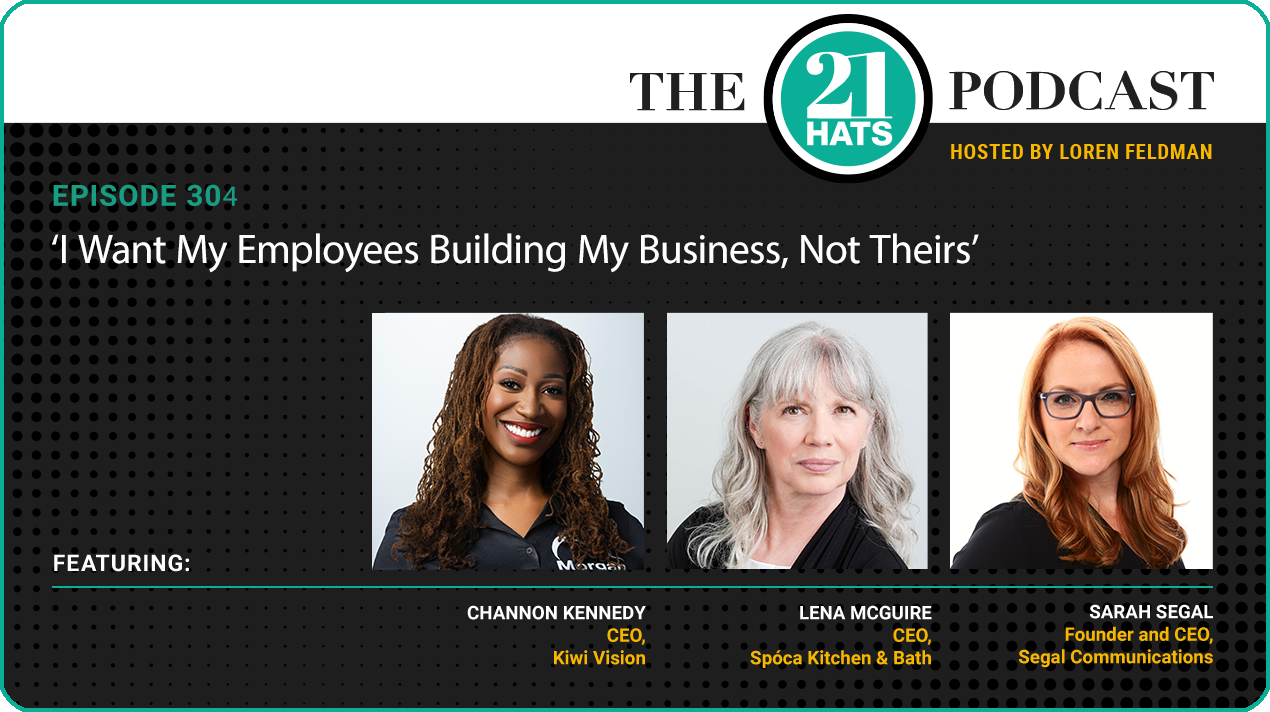
Introduction:
Side hustles have gone mainstream. More employees than ever are starting businesses of their own—sometimes to earn extra income, sometimes as insurance against layoffs, and sometimes because they dream of becoming entrepreneurs themselves. But what does that mean for the businesses they already work for? If you invest months in training an employee, isn’t it fair to expect that person to devote their best energy to helping your company grow? That’s not an immediate concern for Lena McGuire, who’s still a solopreneur. But as she prepares to hire and train her first employees, she worries about investing in people who ultimately may see her business as a stepping stone. Sarah Segal isn’t as concerned, but she does want her employees to view their jobs as careers, not placeholders. And then there’s Channon Kennedy. While working full time at Silicon Valley Bank, Channon invented a woodworking tool, got it manufactured, landed national distribution, and traveled the country to trade shows—all, she says, without letting her day job suffer. And that’s what she expects from her employees with side hustles.
Meanwhile, both Lena and Sarah are wrestling with another challenge: finding the right home for their growing businesses. Lena needs a showroom but doesn’t want to sink money into leased space—and she can’t find a building to buy. “I’m missing out on growth,” she says. “I feel like I’m stalled.” Sarah has opened a second office in Silicon Valley, but she’s wondering whether it’s time to leave her quirky “starter” office in San Francisco for something that better reflects where her business is headed. Buying would be ideal, but that’s easier said than done in San Francisco these days.
Plus: Sarah recently did something she hadn’t done in almost a decade as a business owner—she turned on an out-of-office message and actually unplugged for a vacation. Spoiler alert: there was only one real crisis.
— Loren Feldman
Guests:
Channon Kennedy is CEO of Kiwi Vision.
Lena McGuire is CEO of Spóca Kitchen & Bath.
Sarah Segal is CEO of Segal Communications.
Producer:
Jess Thoubboron is founder of Blank Word.
Full Episode Transcript:
Loren Feldman:
Welcome, Channon, Lena, and Sarah. It’s great to have all of you here. Sarah, I understand you recently conducted a bit of an experiment. You took a vacation. How’d that go?
Sarah Segal:
I love that it’s an experiment. It is an experiment, when you’re a founder of a company, you know. So I started, what, in 2018. We’re approaching our 10th year, and I think that—and I would love to hear Lena and Channon’s thoughts on this—but when you are in charge of the business, you don’t really ever feel like you can totally turn things off. And you trust your team 100 percent, but after year 10… Yeah, I mean, I think you should. If you don’t, that’s a whole other conversation. Our M.O. here is to be each other’s cheerleaders, and their whole thing was like, “We got it. You go enjoy your vacation. We got it. Don’t worry about anything.”
And, you know, based on conversations on this podcast and then with other people, during the 21 Hats Live meeting, somebody in one of those conversations chimed in and said, “You know, when you’re the chef at a restaurant, nobody expects you to be bringing stuff to the table and serving the food. They expect you to be in the background.” So I really took that to heart and really tried to implement that. So I’m not on any clients directly, day-to-day. I still know everything that’s going on, I’m just not necessarily in the weeds. And so when I went on vacation, I only had a little bit of client work that I was kind of wrapping up. And my team was really like, “We got this handled.” And I still did little bitty things here and there. I came back to a pretty full inbox, but nothing exploded. And I think it was, like, kind of a, “All right, yeah, I can do this.” It was scary, Loren.
Loren Feldman:
How long were you gone for?
Sarah Segal:
I was gone for probably about 10 days.
Loren Feldman:
Did you check in regularly? Did you talk to people?
Sarah Segal:
I peeked at things. You know, I peeked at things just to make sure no fires were happening. But I didn’t try to problem solve anything, and I let them do it. And I basically was like, “I’m your ‘break glass in case of emergency.’ Like, here’s the house number. Here’s how you get in touch with me.” But Loren, it was the first time I’ve ever put an out-of-office on my email since starting. I’ve never put an out-of-office on my email. So it went pretty well, and I might do it again.
Loren Feldman:
Well, you know, William Vanderbloemen has spoken here many times about how he started the process of taking longer and longer vacations every summer. I think he started with a couple of weeks and got up to over a couple of months—with the goal in mind of proving that the business can operate without him and giving people room to do what they do.
Sarah Segal:
And one thing interesting is that I think I was less worried about my employees handling things. I was more worried about clients being annoyed that I wasn’t available to them. I did have one client that was not thrilled that I was on vacation while they were going through a bit of a crisis, but that’s another story. But I held true to it and did it.
But most of my clients were like, “Hope you had a great vacation. Did you have a good time? We’re so glad you’re back.” Like, there was a lot of positive reinforcement all around. I wouldn’t have done it so calmly three years ago, but now I feel I’ve hit this place where I’m like, “I have people, and they’re doing the things.”
Loren Feldman:
Tell us what the client crisis was that came up while you were away.
Sarah Segal:
Oooh, well, that was a social media crisis. So, this is a client who had hired us as kind of a favor to help them get a presence up for a small business. And they didn’t really want us to create the content, but more just deal with the scheduling and the analytics and all the tools that we know how to use to make social media go better. You know, in terms of carousels being highly valued by Instagram these days and video being so valuable.
So they hired us to kind of be the doers on that. And the client was still kind of involved in the weeds on the back-end, and unfortunately clicked a link through a message that they had received through Meta Business that ended up being phishing and took down her entire account, and started charging thousands of dollars using her ad account through the Meta account. It was a mess of a mess of a mess.
And my team, through due diligence, got it up and running again, but it wasn’t without total panic from our client. They were obviously distressed, because they had a certain number of followers and didn’t wanna lose it. But they were texting my team at all hours, like 6:30 a.m. on a Sunday morning, like way late at night. I know, it was a lot. And it was a crisis, and I get that, but I don’t know that every communication was a crisis 6:00 a.m. texting worth.
Loren Feldman:
We talked about that the last time you were on. You were talking about having to issue some guidelines to clients.
Sarah Segal:
Yeah. This is like the perfect example. So, when I send out an email to all my new clients saying, “Hey, these are our hours, and we’ll respond to you if there’s a burning building after these hours. But you know, don’t bug my team during off-hours, because they need to recharge, just like everybody else.” She has that email. I sent it to her. I think that she just forgot.
Loren Feldman:
Or wasn’t this a burning-building situation?
Sarah Segal:
It was, but we weren’t even contracted to do crisis communications for her. Oh, but it gets worse, Loren. So we got it back up and running, and through a couple other bad decisions, it got taken down again. So we think it may be dead in the water. We’re now, you know, threatening legal—
Loren Feldman:
Taken down again because of a mistake the client made in operating it?
Sarah Segal:
It was a mistake. It was a multifactor mistake. It was pushing too hard too quickly to get up and running, in terms of the ads account. It was misinformation provided to us by Meta to get reverified. There were a lot of factors, but here’s the thing—and this is what I came up with: We’re really good at crisis communications, like really good at crisis communications. But when it comes to social media, and dealing with the technical side of social media—channels being compromised—it’s a huge time suck for my team.
So we’re now looking for a third-party partner that we can refer our clients to, because they don’t have to have any idea about the editorial content or the goals of the brand or anything that we need to do. They just need to fix it. And so we’re now on the search—and maybe somebody on your podcast hears this—for a third-party Meta whisperer who we can refer business to.
Loren Feldman:
I’m confused about one thing, Sarah. It’s not entirely clear to me why this should have even been your problem.
Sarah Segal:
It wasn’t.
Loren Feldman:
A phishing episode sounds like a matter that IT should deal with. Why were you dealing with that? And on top of that, to what extent is it crisis communications? Because that sounds like putting out a public statement to explain something that’s gone awry, and that doesn’t seem to apply here. Or does it?
Sarah Segal:
It’s not really crisis communications, but it’s a crisis. Right? They got everything taken down. And in terms of IT, what IT are you talking about? Whose IT?
Loren Feldman:
The client’s. Not yours.
Sarah Segal:
Well, yeah, but this is a small proprietor. They don’t have IT. I don’t even have IT, Loren. I am IT!
Loren Feldman:
If something goes wrong with your website, you probably have somebody you can call on who can help you figure it out, right?
Sarah Segal:
Yeah, I have a webmaster or whatever, but yes. We are starting to look into having somebody join us in a fractional IT capacity. We have that for HR. We have that for finance. But having somebody that can troubleshoot problems, sure. But yeah, they didn’t have IT. A lot of these small business owners don’t. I can’t expect them to.
Loren Feldman:
I understand that completely, but that doesn’t necessarily make it your problem to solve, right?
Sarah Segal:
It’s not my problem. But as far as the client, they don’t know who else to go to. And at that time, I don’t have somebody I can refer them out to right now. But we are actively looking for somebody we can refer them out to. Because it just takes my team off of the focus of what they need to be doing, which is the comms side of things. And we’re pretty savvy with how to deal with Meta and how to deal with these things.
Like, my son got his Twitter account hacked earlier this year, and it took me three to four days, but I got it back. He also was phished by somebody and clicked onto something. So, we just need somebody else to be able to—it’s not our area of expertise, Loren, and I don’t have something set up for it. So that was a good learning opportunity for me that: Okay, we need to have somebody we can rely on to refer people to because, yeah, not my job.
Loren Feldman:
What’s the biggest problem that you had to solve?
Sarah Segal:
Dealing with Meta. Oh no, it goes into a void. Meta is probably the worst customer service that you have ever encountered. If anything would ever go wrong with your channels, you are in trouble, because it’s all auto response. I’m sure a lot of it’s AI-driven response. Getting a real person that can look into it? It is probably the worst customer service I’ve ever experienced.
Loren Feldman:
Have you done any training of your staff to help them avoid clicking on the wrong thing?
Sarah Segal:
My director of operations is looking into finding somebody to do that, yes.
Loren Feldman:
All right, next question. I’m curious if there’s a particular decision that any of you have made over the time that you’ve been running your businesses that continues to bounce around in your mind—something that you keep thinking about and wondering whether you did the right thing or not.
Channon Kennedy:
Hey, I’ve got one. You know, sometimes you don’t want to admit or even really want to talk about it, I guess, if it’s under there. Well, I would say it’s actually my manufacturer. And I say that in the sense that it’s not that I don’t trust or don’t think that they’ve delivered or what have you, but I am really struggling with the possibility of interruption. So, my manufacturer is stateside, but then my product is basically made overseas, and I have to wait for it to come in.
But what I’m starting to realize is, at first it was more like a partner type thing. But as I’m seeing it and things are starting to evolve, what I’m starting to notice is—maybe it was the tariffs or I don’t know—but all these random fees are starting to pop up that didn’t exist before. So I feel like: Okay, yes, I’m gonna be ordering this product, but if you agreed to help me in the original state of my business, that’s something we do. And we probably just need to have this conversation. Now, all of a sudden there’s these fees. And you’re getting paid before I do. I kinda have a problem with that.
I’m sure things change, and things evolve. There probably just needs to be a discussion about it. But I know that I need more than one manufacturer. I know that I wanted to bring it stateside, and I know they talk about things being made in the U.S. being expensive. However, I think once I analyze the landing costs, that might change my mind. When you’re considering how much it’s actually going to—whether it’s the quality-control piece of it, the boxing, the shipping, the people who are in-between you and your manufacturer, the person you’re actually getting it from.
It’s obvious there’s going to be some costs to that, but are they hidden? Are they really disclosed? I’m not sure. So that’s a part that I need to tighten up and make sure that there’s a clear expectation and agreement of what we’re having. And then again, like I said, it’s finding someone, a manufacturer to fabricate my product closer, locally, or however that looks. So it’s just been something I’ve been struggling with.
You know, I never set out to make my product. I am not a manufacturer. I’m not in any of that. So perhaps I may have been a little too trusting upfront and I’m getting more educated along the way, which is fine. I consider that to be growth. But that’s one thing, I think, a decision to focus on, determine, to clarify, get it right. It’s just something that, you know, they say trust your gut kind of thing and make sure that I need to look at that. Because there’s so many different parts of a small business, like Sarah was saying. You got your hands in everything. I laugh jokingly now because I really do feel like I probably have like 23 personalities, depending on what I’m doing in the roles and everything else.
Loren Feldman:
We call them hats, Channon. It’s 21 hats, right?
Channon Kennedy:
You’re right. You’re right. You are exactly right. That’s exactly what we’re doing. So that is a burning decision on my end that I need to get clarity on myself and then address, I think.
Loren Feldman:
Just to make sure it’s clear, you said that your manufacturer is stateside, meaning that the company is headquartered here, but they’re outsourcing the actual manufacturing of the product to China?
Channon Kennedy:
No, it’s in Vietnam.
Loren Feldman:
And you would love to find someone who would actually do the manufacturing here in the U.S. Have you started the process of trying to look into that?
Channon Kennedy:
I have. I need another hat for that because that’s something I need someone to focus on. I mean, I would love to hire. There’s so much stuff that I have to do, but I have been looking. I’ve been putting it out there. I have some versions, but it needs more attention to do that. But that has always been a goal for me.
Sarah Segal:
You should talk to Liz. She’s done so much research on U.S. manufacturing for her Citibins. She just may be able to point you in the right direction, in terms of finding local manufacturers.
Loren Feldman:
There are outfits, and I know Liz has talked to some of them, that actually will help you do that research.
Channon Kennedy:
That would be amazing. Yes, I will reach out to Liz. Yeah, it’s something that’s right there. I feel like I’m right here on this hill. I’ve got my foot on the gas in 2026. I feel like I’m Thelma and Louise. I’m either gonna make it across to the other side, or I’m gonna hit the mountain. I’m ready for it, but that is important. I don’t wanna run out and be stuck. And if something were to happen, what do I do? You can’t just have one, and that would interrupt my entire business.
Loren Feldman:
How about you, Lena? Is there a decision that you continue to wrestle with?
Lena McGuire:
Sure. I’m always second-guessing. You know, I want to buy a building, and I attempted to purchase a building, and that deal didn’t go through. And as time goes by, interest rates are going up, prices are going up, and I’m wondering if I really made a mistake by not just leasing a space for a temporary kind of situation. But I keep coming back to: No, it’s right to go ahead and do the building because the build-out costs and time and effort are so massive that I just don’t wanna waste all that. In the meantime, it’s been over a year since I made that decision to actually sign a contract saying, “I want to buy this building.”
So I just feel like I’m missing out on sales. I’m missing out on growth. I feel like I’m stalled because I’ve made a decision to buy a building, and I’m not moving forward with getting a bigger showroom in place—a nicer showroom with better quality products—because I just don’t have the space to expand. So I’m in a small space, and I feel like I’m suffocating a little bit. So yeah, I think about it almost on a daily basis. Like, every time I walk into the showroom, it’s like, “Yeah, this is a mess. I need to do something about this.” And then I’ll start looking again with the Realtors and looking at buildings.
There just isn’t anything that fits my particular needs, and I have to wait until something comes up. And, you know, Jay’s been saying all the time, “Nobody’s moving. Nobody’s doing anything.” It’s the same with businesses. They’re hanging on to the real estate because the real estate is the value, so they don’t wanna sell it. And I’m trying to buy something. So yeah, it’s frustrating
Loren Feldman:
Do you see a path ahead? I mean, is there an alternative to just going back to the real estate agents and asking if there’s something new on the market?
Lena McGuire:
I check with that regularly, but my thoughts now are like, “Well, maybe I should just lease something,” because I don’t know how long it’s gonna be. So it’s like reversing the decision that took me so long to come to. And I know I came to the decision to buy because it was fiscally responsible. It was a good use of my time and my resources. And then to say, “Well, I’m gonna do this other thing that I know isn’t the best option”—but maybe it’s the best option for short-term. So yeah, I wrestle with that.
Loren Feldman:
Sarah, how about you?
Sarah Segal:
I’ll piggyback on Lena a little bit. So, I haven’t announced this. This is not public knowledge. You guys are the first to know. I’ve told a couple people offline. We’re opening a second office in Silicon Valley. It was done for three reasons. One was, we have a lot of clients in that area, and it’ll be easier for us to be able to service those clients. The second part is, I have a lot of great employees who have been doing really mega commutes, and I wanna make sure that I’m keeping them because they’re too valuable to me—and so, giving them a better space. Three, we’re growing beyond our space here in San Francisco, where we need extra seats, and I can’t fit anything else. And then four, San Jose is a much bigger market than San Francisco: just more people, more businesses, this and that. And I’ve actually lost opportunities to work with companies because we didn’t have a physical presence there.
So a lot of decisions went into it. We will probably officially be working out of that office next month. But the big decision I’m working on right now is not something that I’ve made yet, but I love my office in San Francisco. It’s this funky old place. It’s in Chinatown. It’s two stories. It’s cute as can be. But, you know, it’s a little bit more on the funky side. And as we get bigger clients, I wanna be able to have an office that’s a little more sophisticated. So when they come in—it’s like dress for the job you want, you know?
And there’s little things that we don’t have. Like, we don’t have a full kitchen, which is kind of annoying, but we work around it. We have nobody who can accept packages. There are logistical issues with our space: No elevator, that kind of stuff. But it’s been a great place, and I love my landlords. I love them. They’re so easy and so nice. But I kind of want to up our game and just be a little bit more sophisticated to match the kind of clients that we want to grow into.
And so that will be a decision that will probably cost me money. Our lease doesn’t run out until next spring, in May. But I’ve already been thinking about it hardcore because it’ll be a little bit more expensive, and then I have to do the whole thing. And maybe I should just stay here for another several years and see how it works. Because San Francisco real estate? With all of the AI companies popping up, it’s not cheap. Chinatown, where I am, tends to be a little less expensive, because it’s not cool for AI companies. So you still have this little bit more cultural, interesting, fun, colorful area. But it’s something I’m really thinking about. What is gonna be the right decision? And I probably don’t need to make that decision until later this year, but that’s something I’m a little stressed out about.
Lena McGuire:
Sarah, are you planning to open a second location or move to a new location?
Sarah Segal:
So we opened the second location in Silicon Valley. So we will maintain San Francisco and Silicon Valley. And people may look at a map and go, “Oh, they’re so close.” They’re not really that close. For me, I went from my office to the other office yesterday, and it’s about an hour and a half each way.
And it’s not easy. And there’s a lot of great talent down there too that I’m probably missing out on because they just don’t wanna have to—and there’s a lot of more businesses, a lot of money. San Jose is a bigger city population-wise than San Francisco.
Lena McGuire:
Will you keep your location that you have in Chinatown?
Sarah Segal:
I’ll keep one in San Francisco. I don’t know if I’ll keep this particular space because it’s a little bit—it was my starter home, you know?
Lena McGuire:
It’s your baby.
Sarah Segal:
My husband and I moved to California, we were like, “Oh, this is a cute house. We’re gonna get it as our starter home.” It’s now our forever home because we can’t afford to move, because California real estate is, like, mind-blowingly dumb. But this has really just been our starter home, and do we keep the starter home? And do I put money into it and make it nicer? Like, I don’t know what to do.
Loren Feldman:
You’ve talked here quite a bit about how your agency is not focused on finding tech clients.
Sarah Segal:
No.
Loren Feldman:
But you’re going to Silicon Valley now to open another office. Are you thinking of changing who you—
Sarah Segal:
No. But here’s the thing about tech, and specifically with AI and a lot of tech companies: They need an agency that can do the tech PR. Where we come in—and we do have tech clients—we do their events, because a tech agency is not gonna have the capacity to do that.
Like, we’re working with a company that lets people create feature-length films through their platform. They’re doing premieres of these films around the United States, and so we’re helping them with those events. Our job is to get the content creators to show up and learn about the platforms and get people seeing the democratization of these kinds of platforms so anybody can make a feature film, and it doesn’t have to have the billions of dollars that is required by Hollywood.
Loren Feldman:
If you do decide to move your San Francisco office and do something different there, have you given up on the idea of being able to buy something? Is that just out of the realm of possibility?
Sarah Segal:
I look at all the listings. I don’t know what listings you guys look at, but I look at all the listings, and I watch things. But I like a diamond in the rough. It’s hard to lease something and fix it up. Like, that kind of pains me a little bit because I’m investing in somebody else’s property, so I’m never gonna invest as much as I want if it was my own property.
So, like, Lena, if you can do your own space and make it your own and have a space that you’re happy with, even if you end up retiring someday, you still have this great property that then becomes a source of revenue for you. So there’s a long-term value in that. And I don’t know that I have the funds to invest in my particular area, but I admire anybody who can do that.
Lena McGuire:
Yeah, and I’m even looking at fixer-uppers. I don’t have to have something nice. I just need location, and it has to be multi-use, because I have to be able to have trucks bring in cabinetry, and I have to have foot traffic where clients are able to come in also. So most warehouses are in industrial areas, and most retail shops are in commuter and village-type settings.
So it’s a little bit of a hard thing trying to bridge that gap where I’m ready for a real showroom with one dock, as opposed to somebody who has a 5,000- or 10,000-square-foot showroom and then has a separate warehouse somewhere else where the property is less expensive. Bridging the gap could take years. So trying to find that multi-flex space is rough. And then it has to be in a place where clients are willing to go. I can fix anything and make it look great, but if clients won’t go there, it’s useless to even put any money into it.
Sarah Segal:
Actually I’ve kind of been looking at grant money too to see whether or not—as a woman-owned business, there’s dollars out there where you can get access to grant money to help grow your business.
Lena McGuire:
Yeah, a lot of that’s in the cities. So there’s economic development zones, which I’m very interested in, but they’re scary neighborhoods and my higher-end clients are not going to drive through those places. And a lot of the neighborhoods are like that.
Loren Feldman:
Who gives out the grants you’re talking about, Sarah? Where have you found that?
Sarah Segal:
There’s no one-stop shopping, but there’s a lot of organizations that do provide grants to women founders and stuff. This is embarrassing: I’ve never registered. Like, I’ve gotten halfway through the registration process of being a woman-owned business. I know Channon’s done this. It’s just like one of those things that I started and then I got busy and so I stopped. So I think that will help give me visibility and access to it.
But here’s the thing, Loren, because now I have a team that’s dealing with the day-to-day stuff, I have bandwidth now to like look into those things and take advantage of money that might be available to me. So, any recommendations from your listeners, I’m all ears on funds that will help me continue to grow. But, yeah, I’m still in the exploratory phase of that.
Loren Feldman:
Question for today: I keep reading articles about how everybody’s doing side hustles. I’m exaggerating of course, but it sounds like all employees are worried about losing their job to AI, and they gotta have something else going, so they’re working on side hustles. But I am curious what this means for business owners. How should business owners feel about employees who are investing significant time in a side hustle?
Lena McGuire:
Yeah, I’ll start. Until I was queried with this question, I never gave it a thought, and I am actually shocked at my feelings about this. I would be very upset. I plan to pay employees a living wage. I plan to train them extensively so that they are experts in their field, and I don’t want them going off somewhere else and starting their own business. And I don’t want them being tired when they come in because they did something else because they felt like they weren’t earning enough money, and they had to get a side hustle—or because they didn’t feel secure enough in the job that I’ve given them, that they think that their job is insecure.
So yeah, that hit a nerve with me. I was very surprised about that, because I love the freedom of choosing how to use your time and resources. And if somebody wants to develop themselves, I’m all for that. But then when you look at it as a business owner, it’s like, “Hey, wait a minute. I’m giving you those resources and my time and my money to help you grow.”
Loren Feldman:
But you don’t have a call on all of their time. Obviously, if their side hustle is a competing business to yours, that would be ridiculous. But that might not be the case. Would you still have a problem if it’s not?
Lena McGuire:
If they were doing something that became so successful that I would lose them after I’ve invested in them and I’ve brought them in as part of the family and I’m offering you a future and this is the business and we’re on this path together? So I’m feeling very Pollyanna and, like, I have to think about this. It’s like: Oh, now I know why non-disclosure agreements are signed, that you can’t start a business for two years.
Like, I never really gave this thought. I’m still a solopreneur. I have three people who I use as 1099 help when I need it. And it’s just a whole different ball of yarn when you’re thinking about having actual employees who you’re spending to train somebody. I plan to put probably two to three months of extensive full-time training just to get somebody to put them out on the floor by themselves. And then they still have to follow around for six months to a year before they really know the ropes. I mean, that’s a lot of investment. It’s almost a college education that they could skip.
Loren Feldman:
Sarah, do you feel the same way?
Sarah Segal:
So, a big thing with me is I treat my employees like adults. Like, I’m not gonna micromanage your work, as long as you get your work done. And if it’s a non-competing-industry side hustle, a passion project, I don’t really have a problem with it, as long as they get their work done.
I do only hire people—I can tell pretty quickly—I hire people where they look at what we do as a career. If you come in, and you start treating it as a punch-in, punch-out, then this is not the right place for you to work. We hire people who are interested in a career in what I do. And so, if this is just a placeholder for something else, and they’re punching in, punching out, and they’re focusing their attention elsewhere, then that’s really a larger conversation.
If there is a potential, like say a small client that doesn’t really meet our threshold for work, and they wanna do it as just a side hustle, if it’s below a certain monthly retainer, yeah, go for it. As long as it doesn’t interfere with your work, I have no problem with you doing that as your side hustle. But the moment that it interferes with your deliverables, and you’re not being a good team member, and you’re calling in sick because you have to do something else, and we find out, it’s kind of black and white. I want people who I hire to be wanting to work in my industry, and not really have a passion project for selling real estate. Like, pick one. Pick a lane. You can’t do two things well. I’m sorry.
Loren Feldman:
Two things could be true though. They could be dedicated to the job with you, intent on having a career, but also realistic about the changes that are happening to our economy and wanting to protect themselves—and also they make good cupcakes or something. And they wanna pursue that on the side.
Sarah Segal:
That’s fine.
Loren Feldman:
Is that something you can live with?
Sarah Segal:
Yeah, I can totally live with that. I mean, they better freaking bring cupcakes into the office on a regular basis, but just as long as it doesn’t interfere, as long as their extracurricular work doesn’t put an undue burden on the rest of my team or make my clients feel like they’re not important, then I have no problem with that.
Loren Feldman:
Channon, to some extent, you are the problem we’re talking about here.
Channon Kennedy:
Who, me?
Lena McGuire:
Yeah, you. Miss accidental entrepreneur.
Loren Feldman:
You have had a career as a banker for many years, and yet the reason you’re on this podcast is to talk about your side hustle manufacturing a tool. How has that gone for you? Has that been a problem in your relationship with your day-job employer?
Channon Kennedy:
No. So, I mean, I totally get it. There should be no conflict of interest if you’re gonna have a side hustle. Don’t get me wrong. There just shouldn’t be. There needs to be that trust. And if you’re gonna have a side hustle, whatever it is, making cupcakes, making Morgan Squares, I also truly agree that when you’re at your job, you’re at your job 100 percent. You show up, you show out, you do it magnificently. That’s what’s paying your bills. That’s what you show up to do.
And I have this conversation often because people find out, and they’re like, “Wait, wait, what? How are you doing this?” Part of it is this way: I have been in banking for close to 30 years. I’ve done it all, done all kinds of things. No, I didn’t set out to be an entrepreneur, but things change, and sometimes, you know, side hustles can be seasonal. They can come and go. They may become a complement to your business. And I say that in the sense of, my job is I talk to entrepreneurs all day. What am I? An entrepreneur.
Loren Feldman:
Your banking job is talking to entrepreneurs?
Channon Kennedy:
Yes, I speak to founders and entrepreneurs. I speak with startups every day. So I’m able to bring in twofold, not only as an experienced banker in what they’re seeking, but also living and breathing the pains that we’re on this podcast talking about and being able to relate.
But on the flip side of it, now my employees—the folks who are helping me out—they have other things that they’re doing. But I also know that going to these trade shows and everything, it takes a lot of time out for all of us to go and do that. So I think there’s a maturity aspect to being able to have a side hustle.
There’s just some things, like I said, if your job is investing in you, yeah, that’s what you’re there for. I mean, you need to be able to have that conversation. There shouldn’t be that lack of trust. As long as you work for someone else, you are always at somebody else’s mercy. That is just by experience, things that I’ve had. You know, I’ve seen people put their heart, love into everything for years on end, and things happen. People get sick. Other things happen. They die, things like that, and they never really get to do the things that they ever really wanted to do.
So I’m twofold on it. If you’re gonna be at your job, you show up to your job. You do your job. Do your damn job. It’s not that hard. When I’m at work, I am at work doing what I need to be doing. When I’m on my business, I’m doing my business. You know, I tell people: My child is the Morgan Square. A lot of people go on vacation, they’re going to colleges or doing whatever that looks like as kids are growing. On my vacation, I am going out there and putting out, “Hey, I created this thing. Let’s see how far I can take it.”
Sarah Segal:
My first job out of college, by the way, was at a bank, Brown Brothers Harriman in Boston. That I couldn’t explore anything else and couldn’t figure out what I wanted to be, I would have never explored journalism. I would never have explored communications. I would never have moved into what I was doing. So I also try to have a level of flexibility where you don’t know what you wanna be when you grow up, when you’re just out of college. You don’t. I mean, I went from banking to broadcast journalism to public relations and communications.
All of those have something that, you know, there’s a through line mostly. But I feel like it’s only fair for me to afford my team, especially my young team, the ability to have those ideas of what they wanna do. I had a woman who worked for me, and she was very clear. She’s like, “I think I wanna go to law school.” And she just graduated UCLA and is now working for a fancy law firm and doing crazy things. And we just hired an intern for the summer, super smart, but she also wants to go into law, which is totally fine, media law, and I’m like, “Hey, can I introduce you to the woman that used to work for me who’s now a lawyer? It might be a good connection for you.”
Loren Feldman:
Channon, how far did you get with Morgan Square before you told your employers at the bank that you had a side hustle?
Channon Kennedy:
I told them upfront because there was gonna be a publication with my face in it, so I really couldn’t—so I let them know that I was doing something. And they were like, “Okay, sure, no problem.” They know I’m a CEO, they know what I do, they approved it, and they gave me the okay to be like, “Woo, I could be out there.”
So I got this amazing PR team, right? So I’m out there left and right, but now I think it’s more like: Maybe they thought I was gonna sell cupcakes. Maybe they thought I was gonna be a JT. Maybe they didn’t know how far I was going to take it. So I wonder now, and I think maybe it’s more them putting the pieces [together] like, “Wait, what the…” Because I get that, like, “How are you doing this?”
Because I’ve been putting in work for a decade now on this business, pieces and parts, because I have a job, I have a life, I’ve got other stuff to do. But I’ve been putting one foot in front of the other, so all you see now are kind of flowers coming out of the ground, but not all the work that I’ve been doing as a side hustle without telling everybody.
Sarah Segal:
Well, your side hustle’s helping your job because you talk to entrepreneurs. You understand what they’re going through, and there’s a value they must see there, no?
Channon Kennedy:
Well, that’s now. I haven’t always had the same job for the past 30 years. I didn’t always talk to founders. I wasn’t speaking to entrepreneurs and founders when I started my journey. It’s just now that they’re intersecting, and that’s within the past couple of years. I didn’t always have that. It just so happened to align in that manner.
Loren Feldman:
You do a lot of traveling, Channon. You go to a lot of trade shows and stuff. Is that all vacation time?
Channon Kennedy:
Well, I mean, I’m allowed to do on my vacation—that’s what I do. I mean, I go to trade shows, and a lot of the trade shows are over the weekends as well. It’s one of those things, yes,I have the flexibility of being remote. I’ll take a red-eye somewhere, and I still do my job. I’ve never had any issues with that because that’s my bread and butter. That’s my livelihood. That is helping me with my business. I can’t leave my job. It just doesn’t work like that.
Most founders in startups and side hustles, they’re not making any money. And in my mind, I’m like, “Well, if you were smart, you wouldn’t mess up the people who are paying your bills.” It doesn’t make any sense to me. I live in California—Sarah was just talking—I can’t afford not to have a steady income to live my life because I wanna explore seeing what I can do with this tool, but here I am. But yes, I take my vacations, and people ask, “Well, how do you do it?” I’m like, “I’m allowed to do whatever I want on my vacation, just like you are.”
Loren Feldman:
So it’s really never been a problem with your employer? Never been an issue?
Channon Kennedy: No. No, because I’m where I’m supposed to be. I travel for work as well. I do what I am supposed to do so I don’t allow there to be a reason to question what I’m doing, and that’s where I say: There’s the maturity. I know what I need to be doing.
Loren Feldman:
Where would you draw the line with an employee of yours?
Channon Kennedy:
It’s kind of the same thing. I want the same thing that I’m doing. So because I show up, I expect my employees to show up for me when I need them. I know they’re not gonna be there all the time, but when I need their input, when I need them, where I need them, I need them to show up. I need communication. I would expect my employees to do the exact same thing that I’m doing. Do your job, don’t make me track you down, and be excited about it.
Loren Feldman:
My thanks to Channon Kennedy, Lena McGuire, and Sarah Segal. And thanks to our sponsor. This episode was brought to you by Grasshopper Bank. Thanks for listening, everyone.

