

‘I’m Skeptical AI Is Going to Help Us’
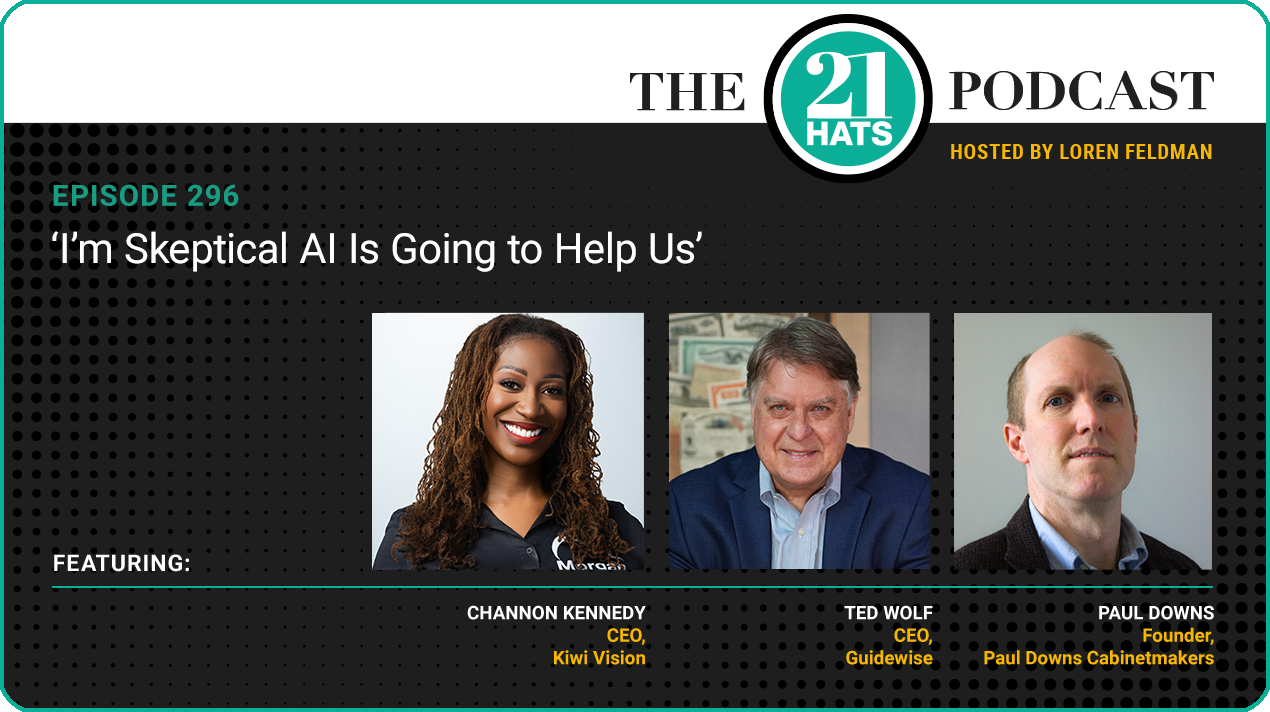
Introduction:
This week, we explore some contrasting opinions about artificial intelligence. Paul Downs has serious doubts that AI will ever have a significant impact on his business. Paul, who builds custom conference tables, says his business depends on something AI still lacks: real world experience. While AI can generate impressive images and concepts, he argues that it has no understanding of manufacturing constraints, material properties, production processes, or the capabilities of the people and machines that have to bring an idea to life. “An image of a thing that looks cool is not a design,” Paul says. “A design is a set of information that’s informed by intelligence and experience.”
- Ted Wolf, who helps companies implement AI, agrees that AI can’t replace the collective creativity and judgment of skilled people. But he believes Paul may be looking at the problem too broadly. Instead of asking whether AI can design and build custom furniture, Ted suggests breaking the workflow into smaller pieces and experimenting with targeted applications. “You know your business better than anybody else,” Ted tells Paul. “But don’t look at the big picture and think that’s the entire thing. There are many small pieces that people can start doing today.”
- The result is a thoughtful debate about one of the biggest questions facing small business owners: Is AI going to change everything, or are there businesses where human expertise will remain irreplaceable?
- Plus: Channon Kennedy shares what she learned from participating in a Goldman Sachs program for Black women entrepreneurs. And the owners discuss what debt can—and cannot—do for a business: “Funding does not fix a broken business model. It makes it die faster.”
— Loren Feldman
Guests:
Channon Kennedy is CEO of Kiwi Vision.
Paul Downs is CEO of Paul Downs Cabinetmakers.
Ted Wolf is CEO of Guidewise.
Producer:
Jess Thoubboron is founder of Blank Word.
Full Episode Transcript:
Loren Feldman:
Welcome, Channon, Paul, and Ted. It’s great to have all of you here. Channon, we haven’t seen you in a little while. How’s business?
Channon Kennedy:
It’s great. I’m right in the middle of a—I would call it a pause of my business, if you will. I’ve been a part of a Goldman Sachs program called “Black in Business, One Million Black Women,” over the past eight weeks, and it’s basically been a place where I am getting education, tips, tricks, and all of that good stuff from professors from NYU Stern.
There are 315 of us—315 women—so it’s been phenomenal. We’ve been talking about the shift from being a founder to CEO and what that looks like. So I’m really excited to implement all the things I’ve been learning these past couple of weeks as I move toward my trade show season, that’s going to be picking up, or has actually started as of yesterday, actually.
Loren Feldman:
So, you have a full-time job. You have a side-hustle business, Morgan Square. And you’ve been taking this program. Is that why you had to put the business on pause?
Channon Kennedy:
Oh no, the business isn’t on pause. The business is in full swing. I’m saying it’s enough, from a mental capacity, a strategic capacity, shall we say, just kind of slowing down and getting that bird’s eye view of my business—instead of just being in it, churning, churning, churning, churning.
So it’s more like it’s helping me establish what my action plan is going to be for the next 12 months. That’s what I mean by “pausing.” So, yes, I have all of that going on, but business is great. We are booming. I’ve got six trade shows planned. I don’t know that I’ve shared—I’m finally in homedepot.com. Things are going really well.
Loren Feldman:
Tell us about the Goldman Sachs program. Is this a virtual program?
Channon Kennedy:
It is. It is a virtual program. They did fly us out for orientation to New Jersey, and I will be flying back out in July for graduation. This Goldman Sachs program, you need to apply. It is about profitable businesses that are planning to scale. Every week, we’ve got a different topic, from knowing your customers, understanding your value proposition. Are you delivering it properly? Learning how to utilize AI with the prompts. You know, it’s how you talk to AI, which determines the types of results that you get.
It’s also helped us understand the alignment from our marketing perspective. Once we learned our value proposition, we talked about financials, projections, so much. But it’s been fantastic. And just some of the basics that every business needs to know, from accounting and understanding your profit and loss, and how to read it, cash versus accrual. So this has been jam-packed, to say the least, the past seven weeks.
Loren Feldman:
Has there been anything that really took you by surprise or that you think will be especially useful going ahead for your business?
Channon Kennedy:
Yes, I am so excited. You know, I am the founder of the Morgan Square, which is a measuring device, and one of the things that I was struggling with was trying to basically execute or deliver my value proposition. What I’ve learned is, I am not competing with other hand tools, such as the Speed Square and things that are out there. I’m actually a new sub-category of hand tools. My innovation is actually streamlining a process, which none of the other tools do, so I’m more of a compliment. If you have a tape measure, you need a Morgan Square. It’s not: You need a Speed Square or a Morgan Square.
And I already knew that my product, when you first look at it, you’re not exactly sure how it works. So that also let me know that I need to be showing—in the photos and all the images and everything—that I need to be sharing and putting out there, it needs to just catch your attention within seconds. So, it was already there, but I’m really excited to get to these trade shows. And then speaking to the benefits of the Morgan Square, about 40 percent of time saved versus just talking about all the cool features and letting people hold it.
When it’s shown, it sells. That I know. So basically, I need to stop talking so much when I’m at these shows, let it show for itself, and then start the conversation. So I’m really excited about that, because I’ve been able to align with my marketing team. I’m aligning with my team. It’s helping me change everything from my descriptions on Amazon, Home Depot, Walmart, wherever I’m at.
Loren Feldman:
In the emails we exchanged before this, you mentioned that you have a partner who doesn’t really have their stuff together and that you’ve been struggling with. Can you tell us about that?
Channon Kennedy:
So I will leave them nameless, but one of the retail stores, one of my first retail stores that I was in, bought a pretty decent-sized purchase order, probably about a year and a half ago. And the thing is, I’m a new brand with a new product. So what happened is, you know, everybody’s increasing their prices nowadays. It just happened to be my turn around this time of year. So after notifying my partner, “Hey, we’re going to be increasing our prices as of May 1,” making sure everybody’s aligned, I get this message that says, “Oh, so and so is handling your account now.”
Okay, so I converse with this person, and then after just a few emails, they’re like, “Oh, your product isn’t selling,” so basically, “Good luck.” And I’m like, “Wait, what? How is this possible?” Because I know for a fact that it sells, because I’ve sold thousands of them. So there’s something going on. So my struggle has been trying to track down people within that organization who can partner with me or with my marketing team to help my brand. If they just buy it, which I think most of them did, and some people had it just on a shelf, nobody knows about it if you’re not telling people. So it’s a good learning experience, because it makes me realize that there needs to be more communication with the people you’re doing business with anyway. But it has to be reciprocal.
So that’s the challenge that I have. It’s going, “Oh, well, basically, good luck with what you have,” to, “Oh, just kidding! Wait, we’re going to leave you on there. We’re going to let you leave your product on our site and see how we can get better.” So I’m working with them, sharing new videos, pictures, and some of the descriptions and benefits, and you know, my value proposition again for a retail store with them, to basically save this lifeline. And hopefully that works out, but if it doesn’t, it’s okay. Not everybody is your customer. That’s something else I’ve learned, so that’s been a struggle.
Loren Feldman:
But it sounds like it actually hasn’t been selling there, and the real problem is that the value proposition is not being communicated to their customers. Is that right?
Channon Kennedy:
Yes. So, it’s not selling for them.
Loren Feldman:
Right. Right.
Channon Kennedy:
But it is selling. Yes, it does sell. And so, yes, there’s a disconnect in the show-and-tell once it’s in the store, or even just letting them know I’m a small brand. I’m not Makita or Dewalt or somebody that a lot of folks like to run—you know, they like to expose the bigger brands, the well-knowns.
So that is my struggle as a small business. I’m like, “Hey, I’m here.” I just need to know what you need. Also, how do I get that front store display for a couple of weeks? Or what does that look like? What do you need? So just having this dialogue, I think, is going to better the relationship in the long run.
Loren Feldman:
Did you discuss this specific problem with the folks at Goldman Sachs?
Channon Kennedy:
I did. I did. Just to add to it: I’ve got business advisors. We’ve got growth group meetings, all of this stuff. So, I have been very vulnerable and been very candid about things that I’m going through. So I think I’m on the right approach here.
Loren Feldman:
All right, next topic. You guys may have noticed that we talk a lot about AI here, and what businesses can do with it, but especially of late, there’s a real backlash growing against AI. We saw that recently with a lot of booing that occurred during commencement speeches, when anybody even mentioned AI to the people who are about to join our workforce. I’m curious if you guys are thinking about that at all, if it’s been an issue that you’re concerned about. Ted, you’re actually in the business of helping other businesses adopt AI, and dealing specifically with getting employees to buy in. What are you thinking about what’s going on with the backlash?
Ted Wolf:
Yeah, before I answer that question, I just want to do a shout-out to Channon. Don’t stop doing what you’re doing. You are so respected and putting your best foot forward, and you’re asking the tough questions, and you’re becoming vulnerable. You’ll do it, you’ll make it, you’ll find the people who will help you do it. So, I want to congratulate you, because it can be a very lonely experience in the beginning, and the learning curve is huge, but you got it. And I admire you for stepping forward publicly the way you are. That’s what’s going to make it happen.
Channon Kennedy:
Thank you.
Ted Wolf:
Now, back to what you just said, Loren. I’m not seeing backlash where people are saying, “I’m not using it.” I know I read about it. I’m getting the opposite reaction, where people are saying, “I want to know more. I want to learn more. I want to dive into this thing full force, because I don’t want to lose my job.” Because they’re hearing—like yesterday—8,000 employees at Meta, the Facebook company, just got laid off again. So I’m finding the opposite. I’m not finding within organizations—and we work in mid-size companies. $20 million to $100 million is our real sweet spot. We can go higher than that, but that’s our sweet spot. I’m finding people are saying, “I’m experimenting with it. I’m fascinated by it.”
They have that question, “What’s it going to do to my job?” but that’s not the forefront. I’m reading that in the press, but I’m not picking that up in companies. I am picking up, “Why aren’t more of these agents paying off?” And it’s because of very, very common errors they’re making, but I’m not picking up this fear of everybody’s going to be out of a job, doomsday’s coming.
Loren Feldman:
Paul, I know you’re not rushing to change the way you run your business with AI, but you use it yourself. Has it been an issue at all with your employees?
Paul Downs:
Not that they’ve mentioned to me. The office workers, I told them, “Use it if you feel like it’s useful.” There’s no prohibition on it. I think that some of the people who are not as comfortable writing are using it to help them write. And I find it most helpful when I’m trying to understand, for instance, what legal obligations I have if we’re doing a particular kind of business, or in a particular place, or interacting with some complex government system. AI does a pretty good job of wading through all the materials available and giving me actionable checklists, but I don’t think it’s going to transform our business in any huge way, mostly because much of what we do just requires I, not AI. [Laughter]
Quite a bit of our workflows and what it takes to get a project from the first phone call to a crate going out the door, is a lot of things that aren’t done on a computer and require a flexibility and sort of an ability to juke and jive that I’ve never seen from any computer program. Now, I was at a demonstration of some high-level agents being used by various executives just a couple of days ago, and it looks like AI is possibly getting to the point where it might be more useful to me, because here’s what I need it to do.
Let’s say I’ve come up with a workflow to do something that involves me going in and out of multiple different programs—some things are on a browser, some things are here, some things are there—and not just operate within a spreadsheet, but also adding new tabs and renaming them based on naming schemes and just doing a bunch of different things that get integrated into a workflow across multiple programs.
Part of the information is living on a Microsoft server. Part of it’s in the cloud. Part of it’s on my desktop. I need someone who could actually follow that as I do it, and I’d be like, “Hey, watch me do this,” and then I do some magical thing, and then I say, “Okay, you got it? Now I need you to generalize from that.” When I need another version of it, I’m just going to tell you I need another version that does this differently, and then it does it. I’m not sure that AI is there yet, but that’s what would actually be useful to me. And so, if that’s the true state of the art at the moment, and I’m just ignorant of it, I’d love to hear that.
Loren Feldman:
I think there is a program that does that. It literally just observes every keystroke you make on your computer and then creates a step-by-step explanation of what you’ve done that you can then share with others.
Paul Downs:
Well, I’ve used a program called Scribe.
Loren Feldman:
That’s what I’m thinking of.
Paul Downs:
It records mouse clicks, but there’s a lot of things that happen that aren’t mouse clicks, so it’s going to be taking sort of screenshots, because you do various things. And I’ve used that, and I found that it required extensive editing, like hours and hours of editing, to get the final output to really describe what I was doing.
Anyway, Scribe is good at screen capture, but it’s not very good at figuring out what you’re actually doing. And so I’m trying to document all the administrative things I do over the course of an entire year, and have a folder full of instructions for an assistant to start doing them. And I find that, first of all, it takes a lot of time to do the thing, and then when I use Scribe, then I have to go back and spend six to eight hours editing it for clarity and for conciseness and what is actually happening in these workflows. So, maybe the real future is I just stop doing things that make sense to me and only do things that make sense to AI, which is the future I fear the most—that we just cut down what we’re willing to consider as being a human action to fit within the confines of this rather arbitrary set of skills that can be replicated on a computer.
Loren Feldman:
Paul, the thing I thought would make most sense for you and your business employing AI was in design of your custom conference tables. It seems like there ought to be a program that makes it really easy for you—since you don’t build the same product more than once. You’re building what you build from very specific specifications from different customers. Each time you design it, it seems like there must be an AI solution for you to design it quickly and show photos, or images created by AI, to your customer to sell the product. Is that something that you’ve looked at?
Paul Downs:
Well, sure, but that just goes to show how misunderstood the act of designing actually is. So, we live in a world where material objects are so ubiquitous that one gets the impression that they’re simple, and they just aren’t. We have had clients now starting to approach us and say, “Hey, we used AI to design a table or lectern or whatever.” And we look at the image, and it’s always a very, very attractive image, but the lack of understanding about how things actually are made and how pieces go together and whether something that looks cool might be extremely expensive or not expensive—there’s so much more than how things look to designing things.
And so, again, getting back to the deployment of just “I”—and I would add another one: “experience.” So we really use IE to design: intelligence and experience. And those are going to give you an output that no AI program can even come close to matching at the moment. Because my designers have to think through: Okay, here’s a client. They want a thing. They want it to look like this. Got it. Then they have to think through: How do we actually manufacture this? What are the materials we use? Where do they come from? How do the materials we decide to use interact with the skill-set and the machinery capabilities we have on the shop floor? And all of these interactions are invisible in the finished product.
But if you have a design process that’s not informed by the understanding of how to make it, it’s just useless. An image of a thing that looks cool is not a design. A design is a set of information that’s informed, as I said, by intelligence and experience. So I don’t see us giving over our designing to AI, because that would be ridiculous. We couldn’t actually build most of what AI will show you, and if you just have AI design your house or something, you’re going to find out what I mean. It’s not in any way ready to replicate what a group of humans can accomplish together in the old style of thinking about how things are actually made.
Loren Feldman:
Ted, does that make sense to you?
Ted Wolf:
A lot of it does. I’m thinking, as I’m listening to you speak, Paul, how to respond, and I would say there’s two things, two skills going forward that are going to be really important in the age of AI, and we’re all going to be impacted by it. One is critical thinking, which is what you just described. How do humans get together and think outside the box in a creative way? And AI cannot do it.
I would say I’d probably agree that AI can’t do it today, but it can certainly complement what you’re doing and get you thinking about it critically in many more ways than what maybe a group of humans can do right now. Emotional intelligence, emotional maturity is the next one, because when the changes do come, the first place they hit is culturally and people’s identity. Because they see part of their job being taken away. Now, if you communicate well, and you can get them critically thinking, they play a higher level of intelligent contribution to the organization.
I would say, “Look at your workflow,” as you have mentioned you are. Make sure your data is prepared accurately, so it has full accessibility in one spot. I’m going to use the word data warehousing and data lakes, meaning that’s where it resides. And AI can go in and get it, but the true value of AI today, I believe, is how it can think beyond the sphere of a human, and here’s what I mean.
In most organizations, you have islands of information and islands of how work gets done, and the island of how work gets done with people is usually side agreements, unspoken escalations, exceptions. They never get logged into a system. That means you’re not going to be able to take full advantage of AI. But AI can look beyond.
I’m going to give you an example. A lot of organizations have orders coming in, and they have problems with project management. They can’t get all the information together and offload AI in a proper way—not one agent doing multiple things, but orchestrating agents properly, giving them tasks they need to achieve, and then having others oversee and make sure they are doing it correctly. And those others first are other agents, but you need a human in the loop. And the human and the agents begin to create a flywheel, and by that I mean they make each other more intelligent. Because AI will be able to ask questions, because it has more information simultaneously at its hands, so to speak, at lightning speed that we cannot begin to compete with.
I have learned the difference between a good company and a really good company is the quality of questions that they ask. And that quality of questions comes from having more accessible data and information that they can think through and use critically, so they can innovate. I look a year ago at what I thought was leading edge AI, and it is historic now. It is moving so fast, and I believe in the next six months, you’re going to see so many instances of AI agents actually working now, not in theory, but actually working. And where we’re heading to is an organization that has its workflow documented, its data clean, quality all the time, a few other things put in place for data engineering.
But all of a sudden, you’re going to have an organization with potential capability to change workflow, processes, so many things, and write agents to do it in hours. That means you’ve got a real-time changing, breathing business that is not slow to make the changes. You can make them fast. But humans are directing it. So we’ve got to teach them to think in a different way. That new paradigm is going to be difficult, but there’s three ingredients you’ve got to balance in the ecosystem. What are your business objectives, and how are you going to scale? Because you have to scale. I think long-term small mom and pops will be discounted more and more and more, because they can’t react fast enough, unless you’re a very small boutique shop.
The second bucket, you’ve got to have the technology in place that will help you scale, and the third thing is you’ve got to get the people who can adopt the technology, who are willing to adopt it, to use it in new ways, because businesses will be transformed. And the thing that scares me, for a lot of companies, is you’ve got to look over your shoulder. Because there’s two 25-year-olds, 30-year-old kids, putting these tools together that we can’t think of, and all of a sudden, we can’t compete because they outrun us in every area. Now, I hope I addressed some of the AI concerns.
Loren Feldman:
I didn’t hear you address the specific issue Paul did, of whether AI could help with the design of the conference tables that he makes on a custom basis.
Ted Wolf:
I think they can do it by challenging your thinking or complementing your thinking, and that’s the critical thinking part of when you do design. I don’t think it’s capable of designing a house. I wouldn’t trust it right now, but it can help me ask better questions, and it can help me double check. All of my bill of material, my MRP, my ERP system, is it working properly? It can help me with all of those things.
Paul Downs:
Let me jump in and respond to what you just said. There’s probably businesses that are perfectly suited towards the future you just described. Mine is not one of them. I think that I don’t know what experience you have in mastering a trade, but my shop floor involves people who have mastered multiple different trades, and by which I mean they have experience working to perform different types of manufacturing functions. And what you said is that the businesses you describe would have to have the ability to actually somehow write down the totality of what a skilled craftsperson needs to know, and that I believe is just flat out impossible.
And this is something that’s, in a way, a new version of the old debate between communists who believe in central planning and capitalists who believe in an emergent market that delivers information to the people who need it without anybody designing it. And so if a business is suited to actually describing its processes in a way and defining them, and their processes are simple enough that the immediate feedback of doing the thing and seeing what’s happening while you do it is not present, then yeah, I could see your businesses using AI and all these things, the agents, like that.
But what you described is not at all what happens on a manufacturing shop floor, unless the manufacturing is confined to large numbers of one thing. Now, that you can automate, you can describe, you can SOP to death. Even then, the machines are still going to break. There’s going to be variation of materials. The humidity may change. There’s a lot of different things that could happen.
But I will tell you that by the time you get to a shop that does what we do, it’s flat out impossible to provide information in any reasonable way that would cover the totality of the things you need to do with it. And so I’m just deeply skeptical that this is ever really going to help us all that much, because what humans are really, really good at is on-the-fly adjustments to whatever they’re doing in response to conditions, and so that’s the human genius that has gotten us through hundreds of thousands of years of trying to survive. And I don’t see AI being able to do that.
Ted Wolf:
Okay, so if I may respond, respectfully, I have a different opinion in some areas, but I am not questioning the validity in total of what you’re saying. When people talk about AI today, very often they talk about agentic AI. It’s the generative AI, and that’s the language patterns. There’s a lot of other types of AI that are out there. The internet of things: You can set up all kinds of sensors for humidity, and it will notify you as soon as the humidity is not correct for what you need. And you can build those pieces that eventually add up to the whole. But the pieces individually can help you, and that’s the critical thinking of saying: How do I break these tasks down?
Large language models are learning from everybody. They’re learning from the best in the trades that are out there, and it’s learning it, even using the language models that we use, the natural language, it’s educating itself. It’s training itself all the time. My son and I always had a debate, and this is a simple example. I have a good intuitive sense of direction, so when I get out of going to an Eagles game and the traffic is insane, I sit there and I say, “Here’s how I think I can get around, because I know the back roads.” And he’ll say, “Dad, just put Waze on. It’s the internet. It’s got everybody’s calculations. It knows exactly where to take you to go.” So, a friend of mine was driving after an Eagles game, and he took the old route that I would have taken. And I followed Waze. I went into New Jersey. I went into places I never thought I would. It was way, way out of where I would go normally, and it got me home before that person.
So, what I’m saying is: Look at the pieces, not the whole. There are many other forms of AI that are very dependable, and you can bring in for the pieces. And when you put those all together, which is what the big organizations are doing—and now it’s coming to the mid-market, because that’s where Anthropic and Claude, that’s where IBM is focusing. They want mid-market now, because the technology makes it affordable to bring in all these others, the internet of things, and many other areas. Those pieces put together can give you a competitive edge.
And if nothing else, you’re now training your people. And you can come in and put it into what I’ll call a safe container, where you’re training your own small language model versus a large language model—your unique ways of thinking, your unique ways of doing things. I mean, I know people—Loren, you know people, I know you do—who, all day long, everything they do, everything they do, gets put into their language model. And it’s just building more and more experience around them.
So, I wouldn’t discount that. Paul, I can’t argue with you. You know your business better than anybody else, and I would never question that in any way. But don’t look at the big picture and think that’s the entire thing. There’s many small pieces that people can start doing today. Does that make sense?
Paul Downs:
Sure. As I said, the things that I do on a computer that are just like drudgery, multi-steps, I can’t wait for the AI to take it over. Although I will say I’m a bit concerned by, if I was documenting my procedure using today’s snapshot of AI, and AI is changing 100 percent every six months, like what’s even the point?
Ted Wolf:
Because you’re developing intelligence in your large language model. I’m sorry to interrupt.
Paul Downs:
The other thing would be the reason I would want to even bother to document all this stuff is so that I could hand it to another person, and if it turns out that we chose the wrong one in a year, and that company is out of business, and blah blah blah… I’ve always been worried about going all in on a rapidly developing technological fix at any given point. It’s almost like being in a deflationary market, where you know it’ll always be cheaper and better if we just wait and do nothing. And the minute you start to do something, you’re kind of locking yourself into that minute’s version of whatever you’re doing.
So, a good example of that: I’m trying to renew my GSA contract. I got a checklist from ChatGPT four months ago, and talked to the person at GSA, and they’ve just completely revamped all the procedures. So, any documentation I had done prior to yesterday is no longer applicable. It’s worthless. Now, will it be easier to do it next time? Maybe, but why should I do it tomorrow when I can wait another year, and it’ll be even better? So there’s a weird problem with actually committing to it at any moment.
Ted Wolf:
So, let’s have a little fun here, if we can. Paul, you mentioned: Why should I go in and do my, we’ll say, compliance of government regulations and things, because it was two months old and they changed it? Well, why wouldn’t you want an agent that is looking at compliance issues like that 24 hours a day, and updating everything? And I’m talking competitive pricing, what competitors are doing, movement in raw material pricing, I mean, to the second, almost—changes as they are made. Your agents are picking all of this up.
You can’t do that manually. And if you wait—and I’m not saying you jump in without considering many, many things. This isn’t just: Run into it. That’s the worst thing you can do. But it’s like the old batch processing. “Well, I ran that on Tuesday, now it’s out of date on Thursday.” Yeah, but okay. Computers upgraded themselves. Now it’s real-time processing, for that particular instance. But AI is to the second updating things, keeping all kinds of compliance issues: environmental compliance, safety compliance, cyber security compliance. So many things now, that it’s not, “Well, I’m going to wait and see what happens,” because there’s so many people doing it. I don’t think you’re going to get locked out by picking one vendor, but that is an important consideration to make. And for us, that’s why we are on the IBM platform, because it is so solid and stable.
Paul Downs:
So you’re suggesting that I unleash agents to investigate every variable of my business and constantly update them?
Ted Wolf:
I don’t know every variable, but when I mention compliance as an example, in compliance and competitive pricing and what competitors might be doing, I would begin thinking: How do I break this one total solution of what we do down into its pieces? And each piece: How do I look at that? Because eventually they all add up to the result of that intuitive wisdom we all get by working so long and very well within a given trade or area. How do I do this? Because AI is coming in. So I would say, look at your compliance issues, at a minimum, and say, “What do I need to keep following, so I’m not using two-month-old compliance regulations that are out of date now?”
Paul Downs:
Well, I mean, getting back to the sheer amount of information that conceivably could be linked together algorithmically within my operation approaches the number of stars in the sky. I don’t think that just unleashing agents to sniff around or whatever is actually how anybody would approach these problems. First of all, it requires that there be some algorithmic description of the interaction of all these things, and that’s an unbelievably complicated thing to do. Second of all, it’s really up to the business owner to pick and choose what needs to be done at any one time. If AI agents were, let’s say, balloons that were floating around my office, and every time I opened my door, I had 7,000 balloons shoving in my face, saying, “Oh, I just found some new thing,” that’s not how I run a business. That’s not how anybody runs a business.
Businesses of any complexity require some decision about what you don’t pay attention to at any given moment, and the idea that you can just set up agents to do whatever they do all day, and that you can get something useful out of that just strikes me as being deeply unrealistic. But there may be businesses where that works great, and they’re going to go all in. That’s fine, but nothing that happens in my building is suited at all to that, mostly because it’s very difficult to describe the interactions between all these variables.
Loren Feldman:
I don’t think we’re going to solve this today, and I do want to hit one more topic before we go. I found an interesting post on the small business subreddit that I’d like to read to you and get your reaction. Here’s the post from a business owner:
“I know this sounds ridiculous coming from someone who makes a living deploying capital, but I need to say it. Stop taking money just because you can. Hustle culture has completely warped how people view debt. Taking out a massive line of credit isn’t a badge of honor. I talk to local business owners and agency guys every single day who are taking on debt just to fix operational nightmares. Here’s the reality: funding does not fix a broken business model. It makes it die faster. My golden rule: before I fund anyone, you need to be able to show me on a napkin exactly how every single dollar I give you is going to directly print more than $1 within 90 days. Buying inventory in bulk to boost your margins? Smart. Bridging a seasonal cash flow gap so you don’t lose your best people? Totally fine. Remodeling your office because you want to look like a Silicon Valley startup? Absolutely not. Protect your cash flow.
Channon, you work for a bank in Silicon Valley, kind of ground zero for hustle culture. I wonder if you have any thoughts about that advice.
Channon Kennedy:
That’s 100 percent correct. Borrowing money is expensive, and people don’t realize that. When people start businesses, they go get those credit cards that are 12 months free, 18 months free, but they don’t realize when that 12 and 18 months is up, and you haven’t paid that debt off, that interest rate is going to eat you alive. If you don’t understand your money, your financials tell you a story, and that’s one of the things, even with Goldman Sachs, I know that that was a hard subject for many people. People run to do businesses, and often they don’t have that financial understanding, and that can be the doom of your business. It will tell you a story right now, a story of what it’s going to look like in six months, nine months, but borrowing money just to keep doing it is very expensive.
I work with a lot of people who are bootstrapped. I’m bootstrapped, and I have to agree 100 percent: If you’re going to borrow the money, it needs to be something smart. Like she said, the inventory, so you can have higher profit margins—but not to remodel your office. People have asked me why I haven’t raised or anything—because I know that that’s giving away part of my business, and I don’t know that I’m there. I don’t know that that’s something I want to do.
Loren Feldman:
Paul, the last time you were here, you told us about what a battle it was to get your bank to increase your line of credit. How do you think about what’s a good use of credit?
Paul Downs:
Well, I think of credit as only a short-term bridge for monies that I know are on the way, but may not be here today. And otherwise ,I think that it’s wisest always to think: How could I get the money I need from customers—not from bankers, not from investors. How could I raise money by doing my business in a way that produces income? And that’s stood me in good standing for decades. Just like: How do I sell another thing? How do I build it? How do I do it profitably? Not: Where can I go to borrow money?
Now, I did increase our line of credit from $200,000 to $400,000, but we haven’t drawn on it yet. And if I can manage my affairs correctly, I will not be drawing on it. I don’t go out to borrow money just for chuckles, and so I definitely agree with the poster in the small business subreddit, but what he was describing was basically he wants to act like any bank, which is extremely concerned with how you’re going to pay back whatever money you borrow. So, I mean, I’ve never run into someone who bragged about borrowing a ton of money just for the hell of it, but I guess maybe there are such people. They’re not going to be in business real long, I’ll tell you that.
Loren Feldman:
Ted, you’ve told us here about the very substantial business that you built and eventually sold. Did you use debt in building it?
Ted Wolf:
Sparingly, very sparingly. I’m not a big debt person by any means. When people ask me about debt and borrowing money, the first place I go is, “Well, how do you increase your productivity?” That person on Reddit said, “Let me know, in 90 days, if I give you $1, how are you going to give me back, $1 plus?” I’m in total agreement.
Loren Feldman:
My thanks to Paul Downs, Channon Kennedy, and Ted Wolf, and a special thanks to our sponsor, Grasshopper Bank. Thanks for listening, everyone.

