

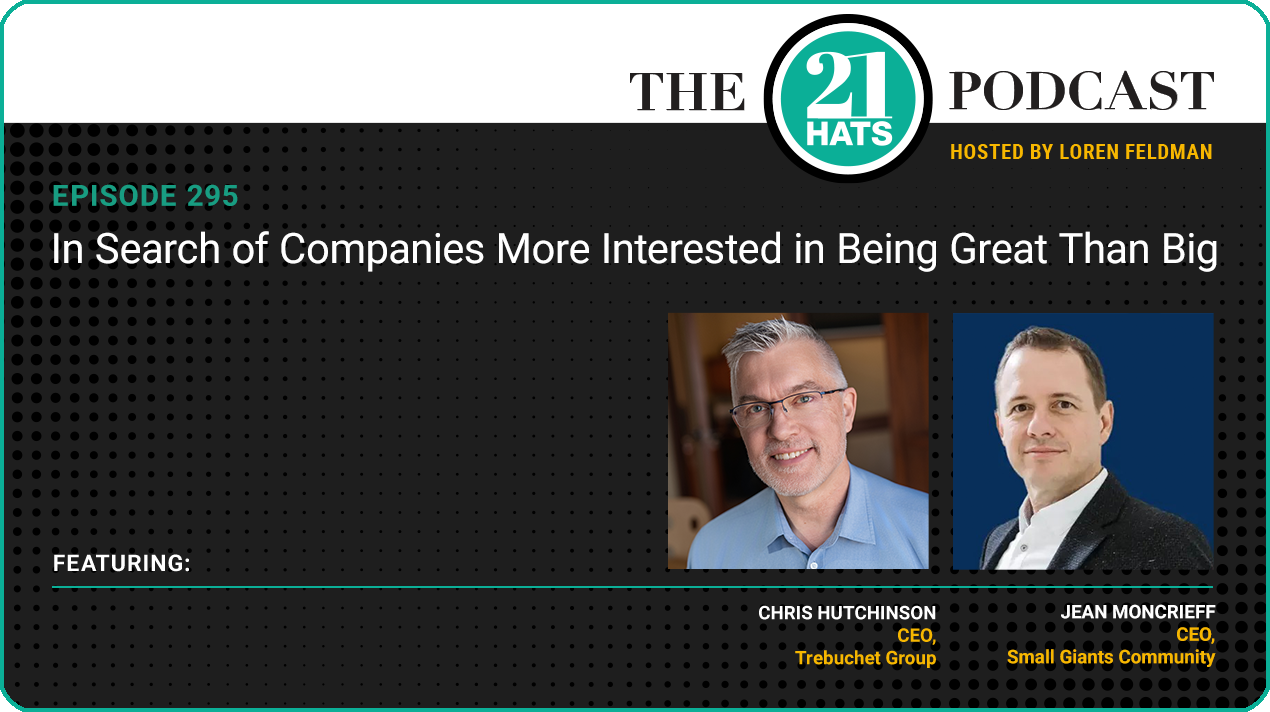
In Search of Companies More Interested in Being Great Than Big
Introduction:
20 years ago, Bo Burlingham gave a name to a feeling a lot of business owners had struggled to articulate. In his book Small Giants, Bo profiled companies that had chosen not to chase growth at all costs. Most were bootstrapped, owner-operated businesses that cared less about getting big than about building something enduring, meaningful, and excellent. They weren’t anti-growth. They just wanted growth to be intentional. And for many owners who read the book, the reaction was immediate: “I thought I was the only one who felt this way.” Out of that recognition grew a community—and eventually an organization—led in large part by Paul Spiegelman, whose own company embodied the Small Giants philosophy. With Bo’s encouragement, Paul launched the Small Giants organization 15 years ago to connect owners trying to build great companies without sacrificing culture, independence, or quality of life.
At our recent 21 Hats Live gathering in Cincinnati, we explored where that movement goes next in a Brainstorm session with Jean Moncrieff, who took over leadership of the Small Giants organization last year. Jean—who’s from South Africa, lives in Zurich, but is moving to the U.S.—brings both momentum and candor to the role. He recently led his first Small Giants Summit in Detroit, which attendees—including me—praised for its renewed energy and sense of purpose. He’s also the author of a terrific new book, Finding Freedom: The Business Owner’s Guide to Building a Valuable Company and a Meaningful Life. But as you’ll hear, Jean recognizes there are challenges ahead.
What exactly is Small Giants today? Who is it for? What makes it different from the many other organizations competing for the attention of business owners? Does it need a more formal set of principles—or even an operating system—to help companies put its philosophy into practice? Can it stay true to its founding mission while also attracting businesses large enough to support its events and programs? Ultimately, the conversation arrives at a tension at the heart of the enterprise: Can the Small Giants organization itself become a sustainable, profitable business without losing the values it was created to protect? In other words, can Small Giants become a true small giant?
— Loren Feldman
Sound engineer:
Casey Helmick is founder of New Bridge Studios.
Producer:
Jess Thoubboron is founder of Blank Word.
Full Episode Transcript:
Loren Feldman:
So, Jean, you’ve bought a community of business owners. Why don’t you just quickly tell us what prepared you to do that? What in your background led you to this point?
Jean Moncrieff:
So, I think for me, it was I’d been through the entire entrepreneurial journey. I started and founded a number of businesses. I’d been through the process of acquiring businesses. I’d been through the process of screwing it up many times, and then ultimately gone through an exit process. Having been connected to the community for 10 years throughout that time, I had a unique understanding of the community. So I think that prepared me for stepping into this role, to some extent. There’s a whole lot of unknowns, and this had been kind of one of those baptisms by fire years, but—
Loren Feldman:
Before you tell us about that, tell us about the community. What did you buy? What is Small Giants, for those who aren’t familiar with it?
Jean Moncrieff:
So, Small Giants started off with a book written by Bo Burlingham. And it was really about companies that choose to be great, rather than just big for the sake of being big, so being intentional about growth and trying to grow a company that’s really great.
And this sparked a movement. Paul Spiegelman, who owned Beryl Health at the time and was going through the process of exiting that business, kept going to Bo and saying, “We’ve got to create a community around this. This book really resonates.”
So, a group of business owners came together, and those business owners felt that their businesses were purpose-driven. The decisions they were making were very aligned with a set of values, and they cared deeply about the people in the businesses. So, ultimately, this community got together in about 2011, and we’ve been having a summit. And things evolved over the years to include leadership training.
We’ve done 16 summits, and the whole purpose of the community is to identify, to connect, and to develop leaders. That’s what we do. We find you folks, and we try and connect you to people like Loren and people like the Great Game of Business, and people who help you with figuring out your purpose, and all those kinds of things. So it’s really to help business owners along their journey—
Loren Feldman:
And how did you come to actually purchase this business?
Jean Moncrieff:
Shortly before the summit last year, I got an email from Paul Spiegelman, and it said, “Hey, can I run something by you?” And I was involved with selecting the Hall of Fame that year, and I thought, “Perhaps he wants me to stand up and talk about the winners, or something like that.” And we had a quick call before the summit, and he said, “Jean, I’m thinking about transitioning. I’m thinking about passing over the torch. Would you be interested in taking over the community?”
I can’t say it was something that I had consciously thought about. I think, subconsciously, the seed had been planted. So, when he asked me, the first thing that happened was impostor syndrome. I was like, “There’s no way I can step into these shoes.” Right after speaking to him, I was doing research for my book, and I had a podcast interview with Elizabeth from Smiley Technologies, and Elizabeth had to take over this company when her brother walked out. The family business had been there for probably close on 10 years, and her father called and said, “Elizabeth, your brother’s walked out. You need to take over the business.” She was like, “What do I do?”
And at the time, her daughter, Grace, was having about 100 fits a day, epileptic fits, so she was trying to keep Grace alive. She was head of people in HR at Smiley, and her husband was going to go and climb Mount Everest. By the way, he’s an amputee, so he was going up with one leg, and Elizabeth thought, “There’s no way in hell I can do this.” So I just interviewed Elizabeth straight off this call with Paul, and she inspired me. She’s got imposter syndrome, and think about what she went through. I basically typed an email and said to Paul, “I want it.” We went to summit, we had the summit, and straight off the summit, we got together. We talked about financials and everything that was involved, and ultimately, the deal was done.
Loren Feldman:
And you bought it?
Jean Moncrieff:
I bought it. I took it over as a going concern, and I’ve invested into it, so while the transaction was, Paul said to me, “Take it over as it is, but you’re going to need to put $100,000 or whatever into it.” So I knew that that was coming. We’ve done that, but we still need to invest, and we still need to grow. Paul, a phenomenal person, cared very deeply about this community, and had essentially funded it for many, many years.
Loren Feldman:
In other words, it wasn’t making money.
Jean Moncrieff:
It wasn’t making money. It’s, you know, had good years and bad years, and our economic engine, the programs that we run—so we run a Leadership Academy, which takes next-generation leaders and helps them to step into senior leadership roles to build leadership teams. And we have a program called Journey for founders and CEOs, which is similar to what we’re doing here today, where we go behind the scenes of companies. But you’re doing it for three years in a cohort and following a certain program.
So those were all going really well for a while, but something happened. They started to dip off, and that economic engine isn’t as strong as it used to be, and we need to fix that and make it financially viable. And the reason that’s so important to me is that, when I look around at small businesses, these small businesses are the things that make a difference in the world. We make an impact.
The reason my daughter’s here is, I want her to learn from all of you, as a young person coming out and trying to figure things out in her life. These are the people I want her to learn from. These are the people I think a lot of young people should be learning from. So, when I close my eyes, I see these beacons that are Small Giants around the world, your businesses lighting up the world, and I feel those ripples when I walk into a company in Germany and Munich, or companies in Italy, or companies in Peru. I mean, Small Giants had a good relationship with Forbes for many years, and we still have Forbes Small Giants across Latin America, into Japan, into Italy. So those ripples are there. It’s just: How do I kind of keep growing the impact that we have as a community?
Loren Feldman:
Do you have a vision for how you’re going to do that, or are you in the process of figuring out that vision?
Jean Moncrieff:
I think parts of the vision are there, but I’m, I guess, a kind of glass half full kind of guy. And I don’t know everything, and I’m surrounded by people who have been in business for years and years, and there’s so much wisdom in this room and in the folks that I work with, so I’m open to listening. There are pieces of that idea.
We know that one of the challenges we’ve had is that we’ve over-indexed on the next generation of leaders, and we have not focused on the people in this room. So what was happening was our room full of next-gen leaders is getting bigger and bigger. Our room full of CEOs and founders is getting smaller and smaller. And with that happening, we don’t have the same investment in the programs, because those founders and CEOs who are in that room have been there for years and years, and we’re not getting as many new people.
This year, that flipped. We did a massive amount of work on LinkedIn, and just kind of getting in front of people and talking about Small Giants. So our founder/CEO room was bigger than leadership with next-gen for the first time this year. The problem is, the conference was about the same size, so we sold the same amount of tickets. We didn’t bring back the folks who were there the year before, and that shouldn’t be the case. We should be kind of growing that. We don’t want to turn into a 350-people conference. We want the intimacy. We want sort of 220-250 or so, but we want to see new people and the old faces coming back.
Loren Feldman:
And how would you define your business model? How important is the summit? How important is the leadership track? How important is the journey that you describe?
Jean Moncrieff:
So, from a financial standpoint, the programs are really important for us, in terms of generating revenue to run everything we’re doing. The summit is profitable, but with a dip. We used to have 30 people going through Leadership Academy. I think this year, there were 13. So it’s dropped off a lot, and I think the reason for that is that we’ve been fishing in the same pool. We haven’t brought new founders and CEOs in, and that’s now come back and is haunting us.
Paul and Hamsa had the right vision about next-generation leaders. We’ve got three big problems I think we’re facing at the moment, where we’ve got the Baby Boomers going through that succession process and exiting. We’ve got ITR Economics talking about depression in 2030—and maybe it comes sooner, maybe it’s not as bad as we think. And then we’ve got a vacuum of leaders. So for every five leaders I talk to, CEOs and owners in the community that I speak to, there’s maybe one leader ready to step up into a senior leadership role in that organization. Very often, there’s no one. So they haven’t been cultivating the leadership, and we’ve got this vacuum of leaders.
So, I think what Paul and Hamsa did was 100 percent right in building the Leadership Academy, trying to grow next-gen leadership, but we’ve neglected the founders and CEOs who put their people through Leadership Academy. So those two programs are super important to us. Summit is profitable. We need to bring these things together. And then, you know, Covid tore down geographical barriers, and we were employing everywhere. And we could operate remotely, and we learned how to do that.
With AI, I think community is more important. We want more of this, and this is going to become part of the model going forward. Pop-up dinners, getting together more often between summits, is something that we’re working on right now. And we’ll support that. Courtney is working on putting circles in place to kind of support some of the stuff that goes in between, but what we’re hearing is: We want more community get-togethers. We want more time together. So we’ve got to figure that one out.
Loren Feldman:
But you don’t charge people to be a member in the Small Giants community?
Jean Moncrieff:
No, this goes back to Bo. He wanted it to be open to everyone, so I think we’d keep that. We’ve got a lot of very small microbusinesses coming in, and fortunately, we’ve got folks who have gone through building and selling their businesses, who are now—we had a table for Tiny Giants this year. And we had a founder and CEO who had been through that whole process and sold the business, kind of facilitating that.
So we want to keep it open. But equally, as we think about making more programs available for some of those smaller businesses. And even for some of the bigger businesses who are putting people through our programs, they want to go deeper into the organization. So part of what we’re looking at is putting in place sort of micro courses or workshops or whatever that they can access, and that we’d look at as a revenue stream.
Loren Feldman:
I want to open this up to questions now. Who’s got a question? Paul.
Paul Downs:
I’m Paul Downs, Paul Downs Cabinetmakers. What is the target demographic, in terms of industry, size, revenues? And can you just tell us a little bit about who are the Small Giants at the moment?
Jean Moncrieff:
So I would say there are a number of different industries, but probably the majority are kind of the unsexy traditional things: manufacturing, lawn care rather than tech. So we’ve got a lot of bootstrap businesses that have created traditional businesses, I would say. A lot in the Midwest area, some over the Connecticut side. Denver’s another hot spot. But manufacturing, food services, some tech businesses.
And then the sweet spot is probably 50-odd employees to 250 employees, $5 million to $20-odd million. So, when you kind of get to that stage where you’ve built something that is going over $10 million or whatever, you start turning to Tugboat, I think. A lot of the folks in the community who’ve got bigger businesses have gone from maybe $3 to 75 million, are now kind of heading over to Tugboat and thinking about Another Way, and being around for the long-term.
I think there’s a couple of other answers to your question. Basically, if you look at the journey that we all go along, there are times that we need help. So, for me, it was growth. I was late 30s, I guess, when I came to Small Giants, I was struggling to figure this stuff out. I felt alone, trying to figure out what I was doing, and I leant into this community. And I think there’s a chunk of entrepreneurs who get to kind of 35 to 45 and they suddenly realize that they don’t know it all. They mature a bit more. They’re not as gangers as they were 25 to 35. So that is fairly common, and then as they get older, there’s a problem with succession and transition, so we see folks coming back at that stage. And I think there’s sort of times where people engage with the community to solve a problem.
What I did when I took over was, I rang up loads of people that I’d kind of been with over the past years who weren’t there anymore. Like, “Why are you gone? What happened?” And very often, it was, “We got what we needed out of the community at that time, and we’ve moved on. And it was great, and maybe you’ll see us in the future, but we kind of got what we needed.” Does that cover?
Paul Downs:
That’s the beginning of an answer. I would be curious about how these people were recruited, and also, who do you see as competing for those owners’ attention and time? Not just who are your competitors, but what would prevent them from dedicating some time and attention to your group?
Jean Moncrieff:
Yeah, the book is still a big part of the recruitment, so both books, particularly Small Giants. If I look at stats, a lot of the folks have downloaded the first chapter, and then we follow what happened. They kind of come into the community. Increasingly, the amount of work we’ve done on social media, LinkedIn, is showing results. We run LinkedIn campaigns that are bringing in—we kind of went from no marketing to now 20 new people joining the community a month. The challenge is that those businesses aren’t always ideal, so we’ve got a bit of work to do on that.
So to some extent, Tugboat is a competitor. Certainly, Disney programs come up. So folks are sending their staff to learn customer service and all that with Disney. Zingerman’s, the Great Game of Business, to some extent. You know, when you think about it in terms of Coca Cola and the battle for the throat, as a small business, where am I going to spend my money, and what’s important to me right now?
So we might be investing in a coach with EOS. We don’t have time, additional resources to put with Small Giants Leadership Academy for training. Or we want to go to these two conferences this year. We can’t afford to do the Small Giants conference as well. So there’s that competition, but at the same time, we work very closely and cooperate with Zingerman’s, with the Great Game of Business, with EOS. So, who coined the term earlier? Was it Jaci? Co-opetition—there’s a lot of that.
Loren Feldman:
Who else has a question? Sarah.
Sarah Segal:
What is your social media strategy, and how are you using that to target your ideal customer?
Jean Moncrieff:
Fundamentally, it’s around awareness. We want to build awareness around the community. So, there’s, I guess, two key parts of the social media strategy at the moment. One is, myself as key person of influence, which Paul never really wanted to do. So, how do I make sure that I’m out there and building myself up as a key person of influence in the industry, in the space? So that means not just social media, but getting out and speaking more, getting all that stuff onto social media, putting out podcasts, all that kind of stuff, all of my stuff, onto social media engagement on LinkedIn, all that kind of thing, book done.
Then, from an awareness perspective, limited budget, but we run LinkedIn primarily awareness campaigns, and we target certain areas. So right now, we’re targeting Chicago, Denver, and I’ve gone blank on the third one. But there’s three target areas. And we’ve been running that for about three months. We look at the data. We have somebody in the background connecting to all those businesses. So, Annie runs my LinkedIn to a large extent. So she’ll get out there, connect, do what needs to be done on that .But LinkedIn is the primary strategy at the moment.
Sarah Segal:
How are you determining whether or not it’s working for you? What are your metrics for assessing its value?
Jean Moncrieff:
40 percent new people at the conference this year—but we didn’t bring back the old. So we did a phenomenal job. We looked at all the data around the connections and everything that’s been going on and how we attracted new people, and the majority of that comes down to the work we’ve done on social media. So we’re really happy with that.
What we haven’t done is attract people from the past. I’ll walk into folks, and they’ll say to me, “Geez, we see all the stuff that’s coming out of LinkedIn and everywhere.” And we’re finding new people, and we’re attracting them to the conference. We’re now 20 new members a month, but we’re looking at that data and saying: Is this our ideal target market, which is the business owner who is looking at kind of navigating that stage where I need to build a leadership team? Because that feeds into our programs. We do get a lot of very small microbusinesses, which we’d love to help, but they’re not the ideal customer.
Loren Feldman:
You just referred to members. What’s a member?
Jean Moncrieff:
So, a member is pretty much anybody who comes in and joins the community.
Loren Feldman:
Does that mean attending an event?
Jean Moncrieff:
Yeah, so whether it’s a virtual online event, so that first thing is sign up. We then will kind of try and schedule a call with them, have a conversation with them. So they’ll go into a normal marketing thing, but we want to have a conversation with them and just connect over coffee, so to speak. And then we tell them about the programs. Typically, we’ll want them to get to the summit first, or to a pop-up dinner, or to something of that nature. And most of the time, once somebody’s attended the summit once or twice, they will look at putting people into the program.
Loren Feldman:
Who are you?
Michael Russo:
Michael Russo, creative director at BrandRusso Agency. Not to put you on the spot, but you mentioned some competitors earlier, and I think a lot of companies, we talk a lot about the why. And so if you could give me your why, and some people call it a brand promise, your elevator pitch, whatever it is. I run into you, and you’re trying to tell me why I should get involved with your organization.
Jean Moncrieff:
I mean, my personal why has always been around entrepreneurial freedom. So, I was telling everybody earlier, the Little Shop of Horrors was what my business was like. You started with this cute little thing, and it’s kind of, “Ooh, let’s nurture and grow this,” and before you notice, it’s like, “Feed me, Jean. Feed me.” And I tend to obsess over what I’m working on, so it cost me a marriage. And then more recently, on the way over here, just before I left, my partner said to me, “Hey, where am I at the moment on your top five list in terms of priorities?” Which made me think as well.
Loren Feldman:
This is your partner in life you’re referring to, right?
Jean Moncrieff:
Yes, we’ll see if she’s listening to this. [Laughter] My whole thing is about helping entrepreneurs find freedom. I’m not that good at it half the time. It’s probably why I do it. Small Giants for me is helping those leaders and business owners who realize that they need help to create something that gives them whatever their definition of freedom is in life.
And, yeah, I think the difference, if you asked me about the difference between us and maybe some of those other businesses, we are a for-purpose business. We’re an L3C, so we put purpose before profit, but we know profit is important. That’s why I’m talking to you folks, because it gives us the ability to do that. And our goal is to connect you to what you need to run your business, and that might be connecting you with Ari [Weinzweig], and saying: Go figure your purpose out with Ari. So it’s more kind of working together than sort of competing with them, I suppose. How do we work that out? Maybe I’m too idealistic. [Laughter]
Matt Pardieck:
Matt Pardieck, Harbour Wealth. Jean, what would you define as the biggest threats? What keeps you up at night with taking over this business?
Jean Moncrieff:
Aside from the financial stuff and all that, the bigger threats—and Loren’s emails that come in the morning and say “MBA programs and all of that are dying”—I’m very lucky because I have a great team and a very supportive community. So that’s fantastic. The thing that keeps me up at night is screwing this up, honestly. We’ve got 6,000 companies in our database who’ve touched us over the years, and they’re all over the world. And unfortunately, we’ve only got a small group of people who are super active. So I need to grow that, but what keeps me up at night, what I’m scared of, is failing at this. I’m scared of screwing something up that’s been around for 15-odd years, and it’s helped businesses around the world. And I guess when Paul asked me to do this, he probably took that into account, that he kind of had some faith in me, but that’s what keeps me up at night. It’s screwing this up, honestly. You know, making the wrong decisions.
David Barnett:
Hi, David Barnett, I help people buy and sell businesses. Jean, how many more new members do you need each month or each year in order for you to achieve your goals?
Jean Moncrieff:
That’s a really interesting question. I think what I need is more Small Giants. So we’ve got some companies in the community who are those exemplar Small Giants: Text-Em-All, Tasty Catering, Venturity. They show up all the time. They’re involved all the time. Rob Dube from ImageOne, and the ImageOne team. And they support us all the time.
Loren Feldman:
With money. They’re sponsors.
Jean Moncrieff:
With sponsors, with just everything they’re given. Carl Erickson and Atomic Object. And I mean, there’s so many of those great companies. But the pool has stagnated, because we don’t charge for membership. At the moment, it’s about making sure that whatever we’re doing on social and whatever we’re doing, in terms of me getting up and talking to people, is attracting the right kind of companies to the community. So I think your question is, “Okay, how do we go back in all this data and everything that we’re doing, and the leads that we’re generating, and the community members that are coming in, and make sure that what we are doing is actually bringing in the right profile?”
Loren Feldman:
I don’t think he asked, “How?” He asked, “How many?”
Jean Moncrieff:
20 members, 20 new a month at the moment.
Loren Feldman:
Will that be enough?
Jean Moncrieff:
If we’re attracting the right folks, that would be enough, yeah.
David Barnett:
If you only need 20 new people each month who are the right people, is marketing really the solution, or should you be trying to do sales?
Jean Moncrieff:
We’ve got to build a pipeline first.
Ed Simon:
Ed Simon, Giant Industries. Can you explain to me a little bit how the structure of your leadership team is at Small Giants? I don’t quite understand. Sounds like you’re doing a lot of stuff, like maybe more than 21 hats. So I’m just kind of wondering, how does it work, or who all is involved?
Jean Moncrieff:
Katie runs all our programming, and it’s phenomenal. I don’t need to worry about that. So she pretty much sort of deals with all that. Bridget runs all new-member onboarding and kind of all the finer detail and making sure that’s done. Annie does all of our email marketing content. Courtney, social media and podcasts. What we don’t have, and we’ve been looking at, is a sales person. But we’ve been fishing in the same pond for so long that we don’t have any more fish there, so to speak, so we need to bring some fresh vision.
And that’s, at the moment, have I missed anyone? Oh, Nicky runs all my—so I’ve got a virtual assistant, and she runs my life. She has the keys to the bank. I’ve worked with her for five years. I had to learn to delegate. I have a part of a marketing agency, Stoica, in Europe. They run all our marketing, sort of the other stuff. We have another agency, Winbox, who runs all our LinkedIn marketing. So, we’ve got a core team, a small but mighty team, and I’d love to keep it that way and leverage AI more, which we do. And then we’ve got partnerships with community and non-community businesses that we work with.
Loren Feldman:
We need to move to the next portion of this process, but I’ve got one question I want to ask you. It plays off what Michael asked, and to some extent a few others. That question is this: You referred to the Great Game of Business that grew out of another book that Bo Burlingham wrote, with Jack Stack.
It’s about open-book management, and it’s kind of an operating system for how you run a business. And that’s how they attract their clientele. It’s people who want to learn how to run their business in a certain way. What you’re offering with Small Giants seems a little more amorphous. It’s not an operating system. Do you see that as a challenge? Is that an issue you feel you need to address?
Jean Moncrieff:
It’s something that we’ve certainly talked about a lot. So, a lot of the Small Giants companies that we talk to will say: We run open-book management for finance, we run EOS for systems and whatever, and Small giants for values, culture, all that kind of thing. And we have this triangle that works really well for us.
So we kind of went down the road a little bit in thinking: Do we look at how we turn this into a system? And I was talking to Ron [Kincade], CMO of Text-Em-All, this morning about a playbook for Small Giants to become Small Giants. And it’s part of the Journey program that we run, where there’s actually a playbook. And you’re going through modules to go from being where you are now to a company that’s more like Text-Em-All or Venturity or ImageOne or whatever.
So, there is that element, but I think we’re the softer side of the business, right? So, you’ve got the hard edge of the business, which is your execution, your strategy. But most companies neglect the softer side, and you need to zip those two things up together, otherwise it goes all wonky. So, I think we do bring that soft side, and we don’t have a system sort of approach to it, but we’ve got a Leadership Academy of nine months that they go through that teaches them some of the really tough, softer skills, like how to have difficult conversations, how to create a place where people feel like they are valued and they matter.
And we’ve got some great coaches along the way, like Zach Mercurio, just finished the book The Power of Mattering; Beck [Sydow], who’s really good, in terms of kind of thinking about your nervous system as an operating system as well and getting that right in the context of being a leader. So, we’ve got some really good coaches in that program, but we’ve never thought about turning it into GGOB open-book management or EOS or something—well, sorry, we have thought about that. But I’m not sure. I don’t know. Is it the right approach? Are we a system?
Loren Feldman Voiceover:
At this point, Chris asks Jean to choose which issue he would like us to brainstorm. And Jean asks Chris, who’s been taking notes, for a quick recap.
Chris Hutchinson:
So, basically, the current Small Giants are non-sexy, traditional businesses: manufacturing, food services, some tech. They’re bootstrapped that have 50 to 250 employees, $5 to $20 million. They need growth or succession in transition. Your recruitment is through the book, social media, with some awareness campaigns—you, as an influencer, certain markets. You have competitors of Tugboat, Zingerman’s, Great Game of Business, EOS. You’re attracting 40 percent new to the summit, but you’re not attracting your ideal clients yet.
Jean Moncrieff:
We don’t know that.
Chris Hutchinson:
We don’t know that. Okay, that’s a question mark. And then, the why was: It’s helping business owners and leaders create freedom. The biggest threats are screwing this up, failing these 6,000 companies and the community. You need more Small Giants. You want to attract the right kind of companies. You get 20 a month. And you fished it out, and you need fresh fish. Which of these would you like to us to give you tips—
Jean Moncrieff:
I think the bottom one is probably the most important one. We’ve had lots of discussions around the sales aspect. Do we hire a salesperson? In fact, I put money into the budget for that. Then, there was: Do we actually have enough leads, enough folks coming in for that salesperson to be working with yet? Maybe now that we’ve been running this for the past few months, that might help, but I think that’s probably our biggest challenge. How do we grow this community and attract the right folks? I mean, a lot of them are sitting in this room, so—
Loren Feldman:
You’re asking the right people.
Jean Moncrieff:
[Laughter] I’m asking the right people, right.
Loren Feldman Voiceover:
At this point, Chris splits us into groups of three to discuss what we might suggest to Jean as a next step, as a caution, or as a success tip. Chris encouraged us not to shoot for the entire solution but to look for pieces of the solution that we could report back to Jean. When all of the small groups were done, we started going around the room.
Sarah Segal:
Sarah Segal, Segal Communications. Our thought for you is that either you are targeting the wrong audience for your kind of services, or you’re doing the wrong content for the right audiences, if that makes sense. So if you’re talking, there’s only certain people—there’s probably one person in this room that is your target audience. And you have to think about what they read, consume, and how they interact, in terms of the content that you put out there to attract them. And based on what you said, I have recommendations on how we think you should go about doing that. For example, starting your own podcast as a prospecting tool.
Jean Moncrieff:
It’s done.
Sarah Segal:
Sponsoring panel discussions at larger conferences, where you’re talking to the panelists that may be your eventual target audience. And the third is creating intimate dinner gatherings—
Jean Moncrieff:
We do.
Sarah Segal:
—in the cities that you happen to be, because those folks that you’re targeting aren’t on LinkedIn. I mean, they’re on LinkedIn, but they probably have somebody managing it for them, which is what I do.
Loren Feldman:
Why do you think there’s just one business in this room that’s in his target market?
Sarah Segal:
I mean, revenue of $5 million and above, 50 to 250 employees.
Jean Moncrieff:
Yeah.
Sarah Segal:
There’s only one person in this room like that.
Loren Feldman:
But you have lots of people go to the summit who have revenue of less than $5 million.
Jean Moncrieff:
Yeah, we’ve got a lot.
Loren Feldman:
And are you okay with them coming?
Jean Moncrieff:
Yeah, I think what maybe has crept in is a lot of coaches. And then marketing agencies, funnily enough, come in, wanting to get business, I think. So, coaches, we’re trying to deal with that, because otherwise you kind of have folks who are coming in to try and sell something, and we’re trying to avoid that. You folks don’t want to be sold to while you’re attending a conference, particularly.
Loren Feldman:
Marketing agency wants to respond.
Michael Russo:
Michael Russo, BrandRusso. No, definitely not sold to, but educated and being made aware of opportunities, yes.
Jean Moncrieff:
Yeah.
Michael Russo:
So, yes. However, you do that, yes.
Jean Moncrieff:
So the companies are typically 50 to 250, so that’s kind of the sweet spot. When they hit 20 or so, they’re starting to think about leadership teams and how they educate their leadership team. But our program is $12,000 for a nine-month program, and to send your whole leadership team through it as you develop is expensive. So they will send maybe one or two in one year, another two in the next year, and then build the team off that. So, as they get to 50, from 50 to sort of 200, it works really well.
Loren Feldman:
A bunch of hands have gone up.
Shanna Mann:
Shanna Mann, Central Virginia Prep. So we looked at probably your closest competitor being Tugboat or GGOB, both of which have operating systems and IP, basically, and you guys have a 20-year-old book. And the original founding team has moved on, and we look at it as you not only need to reinvest in the IP to power the movement. You could actually leverage drawing people to your flag by doing partnership in IP. So we looked at Profit First by Mike Michalowicz, and he now has Profit First for Resellers and Profit First for Real Estate Agents. Finding people in those verticals that you already have identified as Small Giants, perhaps the leadership there, has been open to developing books. And you could do a publishing partnership and draw people to your flag that way.
Jean Moncrieff:
Yeah, we have a publishing partnership, which we kicked off six months ago. So we even have our own imprint, Small Giants Press, because we realized that is so important.
Loren Feldman:
That’s who published your book, right?
Jean Moncrieff:
That’s who published my book. We’ve got a couple in the pipe, and we’ve got one author who just signed to kind of launch it. So yeah, we’re working on developing those partnerships. There are strong and enduring partnerships with, like, Great Game of Business and open-book management, EOS, a number of those organizations.
But I think there’s also this competitive kind of partnership thing going on, where for a long time, Great Game of Business and Jack [Stack] have talked about developing programs like ours and taking and developing that for Great Game of Business. They never got to doing it. The conversations that were had in the past were: Bring white label Small Giants Leadership Academy—which we’ve often talked about doing, but they’ve pushed back because they want to do it themselves. So Zingerman’s has phenomenal programs that have similarities to us, but our first stop on our journey is at Zingerman’s, and they’ll teach their program, visioning, and values. So we actively work on those partnerships, but also we have loads of people approaching us for partnerships. So it’s just kind of like, how do we select the right ones?
Shanna Mann:
Sorry, do you have a 7Ps thing like Tugboat does?
Jean Moncrieff:
Yes, we do. We have seven traits of a Small Giant. So, those we’ve got, and it actually got developed further with Tugboat. So it’s not as eloquent as the Ps, and when I chatted with Bo not long ago, he said, “We should come up with the P things, or whatever.” And we’ve kind of started reworking that, so there are the sort of seven traits of a small giant, which tie back to the book. But you have a great point about our own IP.
Mel Gravely:
Mel Gravely, Triversity Construction. So I wanted to make sure you didn’t miss the point, because you started talking about partnerships. To me, that is secondary to your own IP, clarity about it, repetition, driving it in, because I’ve been to your summit and I love the people, but I’m not sure why I come.
Jean Moncrieff:
Gotcha.
Mel Gravely:
And until that gets clear and drummed into my head—you said something I don’t know if you realize. You said there was EOS and somebody used EOS for this, and they use Great Game of Business for open-book. And then they use you guys for culture. And I wonder, is that the space for you? A $5 to $10 million company looking for a clarity of culture, a common communication vehicle, language for their employees? Is Small Giants that place? But I just worry that, right now, I come because I like the people. That’s not strong enough. Because when I get busy, I don’t come.
Jean Moncrieff:
That is so true. That is why so many people come back. It’s about: This is the opportunity to see my mates. It’s not about the speakers, and that comes through. The other thing, maybe, Mel, I’m pushing you on this one: When you go to Tugboat, you’re surrounded by people who are stretching you upwards, right? Whereas, at Small Giants it’s kind of maybe the other way around?
Mel Gravely:
I will say–you pushed me a little bit—I go to Tugboat, and I am anchored by the 7Ps. Conversations are all coming right back to the 7Ps, all the speakers, all the conversations that happen over beer and at dinner, all lined up with the 7Ps. Yes, it is true that we are mid-majors at best in that group from a size and complexity standpoint, but I still believe there’s a lane for clarity of that IP and aligning your messaging back to it.
Jean Moncrieff:
Clarity of IP, do we get that?
Loren Feldman:
I want to give you a chance to address one thing one more time. According to Sarah, the impression has been gained in this room that most of the businesses represented here are not in your target audience. Is that how you feel?
Jean Moncrieff:
I don’t know. I don’t know the size of most of the businesses here.
Loren Feldman:
Most of them are below $5 million.
Jean Moncrieff:
We’ve got 6,000 folks in our database, 6,000 companies that have come through over the years, and a massive portion of those are under $5 million. And a lot of them, maybe there’s some that are asking us for programming that’s more affordable, that they can sort of get their folks through to become more like a Small Giant, asking for more playbooks to do that. Where they kind of come into the Leadership Academy is when they get to that kind of size that they can invest in training their people. And maybe we’ve missed something there.
Jaci Russo:
Hi, Jaci Russo with BrandRusso. So, I think it starts with surveying your 6,000 to ask them what they need and want. But if we’re talking about the level and quality of the programming and the price of it, and if you look at those 6,000 companies and most of them are the size of us, then having more gateway drugs to build them up to that.
You know, I recently just signed up, like, 10 minutes ago, and I got the welcome email. Thank you for that. And at the very bottom, in a P.S., it said, “Hey, there’s this virtual meeting next month.” Where’s the thing I can buy? Like, you know, like get me to the resources, get me to a library, get me to the community, which is a Slack channel, get me to something I can buy. I had to sign up for something, but there was nothing to buy.
Loren Feldman:
You’re working on the community, right?
Jean Moncrieff:
The community’s in the works. But the goal for this quarter that we had a summit, and the priority is go back to these automations that we’ve got and figure them out, so that’s really good input for us right now, because we had the marketing meeting on Monday to figure out all the priorities for this quarter, and that process is on it.
Lisa Woodruff:
Lisa Woodruff, Organized365. How would you define a tiny giant?
Jean Moncrieff:
That’s really good. I think, sub-$1 million at the moment is kind of where—so companies that are not startups, per se. They’re generating revenue, they’re probably around $400K a year, $500K a year, and their next goal is sort of grow, but they want to grow with intention.
Loren Feldman:
You’re shaking your head.
Mel Gravely:
I’m losing my mind. [Laughter] Mel Gravely, Triversity Construction. So, they’re asking you for targets, and you’re giving them revenue numbers. I’m going to invite you to consider giving them psychographic information. Where’s their head? What are they trying to become? Because that’s what’s going to speak to them, not the revenue. If it’s 250 grand and they want to get to a million, but they’ve got three people now, and they’re trying to figure out culture, they’re a Small Giant.
If they’re meeting a Small Giant kind of criteria—and I wish I knew it, but I don’t. It’s a value system. This is culture we’re talking about. I would really be careful letting someone, letting us drive you into revenue size, because I think the majority of the people in this room are in your sweet spot because of where their heads are, not because of where the size is.
Jean Moncrieff:
So to rephrase, to answer that question again, then maybe it’s: We want to be like Triversity. We want to be like Text-Em-All, we want to be like Tasty Catering. How do I become like that company? And they’re looking at something: How the hell do we get there? Like, I love what I see when I walk into this business, but how do we go from where we are now to that?
Loren Feldman:
We need to move really quickly.
Michael Russo:
Michael Russo, BrandRusso. I said earlier about the why, and I don’t think you did—no offense, you didn’t do a great job of really telling me what I was wanting to hear. And I think you have the answer. You just weren’t able to define it that very moment. The answers are all out there, but you have to be able to define the why—based on the who, right?
But if you don’t have that, nothing else really matters. And one thing we use is, “We’re the only blank that does blank.” If you can’t define that answer—and it’s not always easy, because sometimes you’ve really got to dig deep on it. But once you do, everything else follows. But you have to be able to walk into a room and say, “This is why you need to be with us.” And if you can’t do that, then everything else is just tactics. So that’s my, that’s my thing.
David Barnett:
Hey, David Barnett, davidcbarnett.com. So it sounds like you have a lot of opportunity to work out what you want to be and who you want to go after, but I just want to bring it back to the original topic. If you need 20 new members every month who have between 50 and 250 employees, those businesses are not hard to find. There’s all kinds of commercial databases that list the size of business by employees.
You talked about intimate dinners. I mean, if it was my challenge, I would be setting the date for one intimate dinner in a new city for 12 months in a row, and have a schedule of 10 weeks before that dinner. I’m mailing out copies of the book to those businesses. I’m reaching out to those business owners from the database. I’m doing a proactive sales effort to talk to those people and get them to show up at my dinner, so I can then pitch them on why they should be a part of the community. Because those are the people who can afford to buy your leadership training. So it’s a sales process. It’s not necessarily about creating content online you hope they stumble across.
Jean Moncrieff:
Yeah, love it.
David Barnett:
You go find them, and you talk to them, and you start a conversation.
Jean Moncrieff:
Because we’ve talked about doing the dinners. We haven’t put into that structured approach which you’re talking about, which is fantastic. I mean, I think we’ve started a piece of that. So David, brilliant idea. I think the conversation around who’s our target market and the why is super important. Like, we need to figure that out, and we’ve been working on it. Maybe we’ve actually been in the wrong place, and maybe we need to fix that, and then get the why right for that target audience.
Loren Feldman:
I hate to have to cut this off, but this is really cutting into my nap time.
Jean Moncrieff:
I’m going to go back to the team, and we’ll re-look at our targeting, we’ll re-look at our why, and we’ll do some work on that this quarter. Because that’s really important. And I think, at the same time, there’s two things that are kind of in motion already as priorities this quarter: one is the automations that we’re working on for new members, and the other one is these dinners that we’ve been doing. And I love the sales process.
Loren Feldman:
Those of us who have sat in the hot seat know it’s not all fun and games.
Jean Moncrieff:
I’m super grateful, though.
Loren Feldman:
Well, I want to thank you for being vulnerable, for sharing your challenges, and for accepting our commentary so graciously. Thank you, thank you, thank you, thank you. [Applause]

