

It Took 25 Years to Get Here
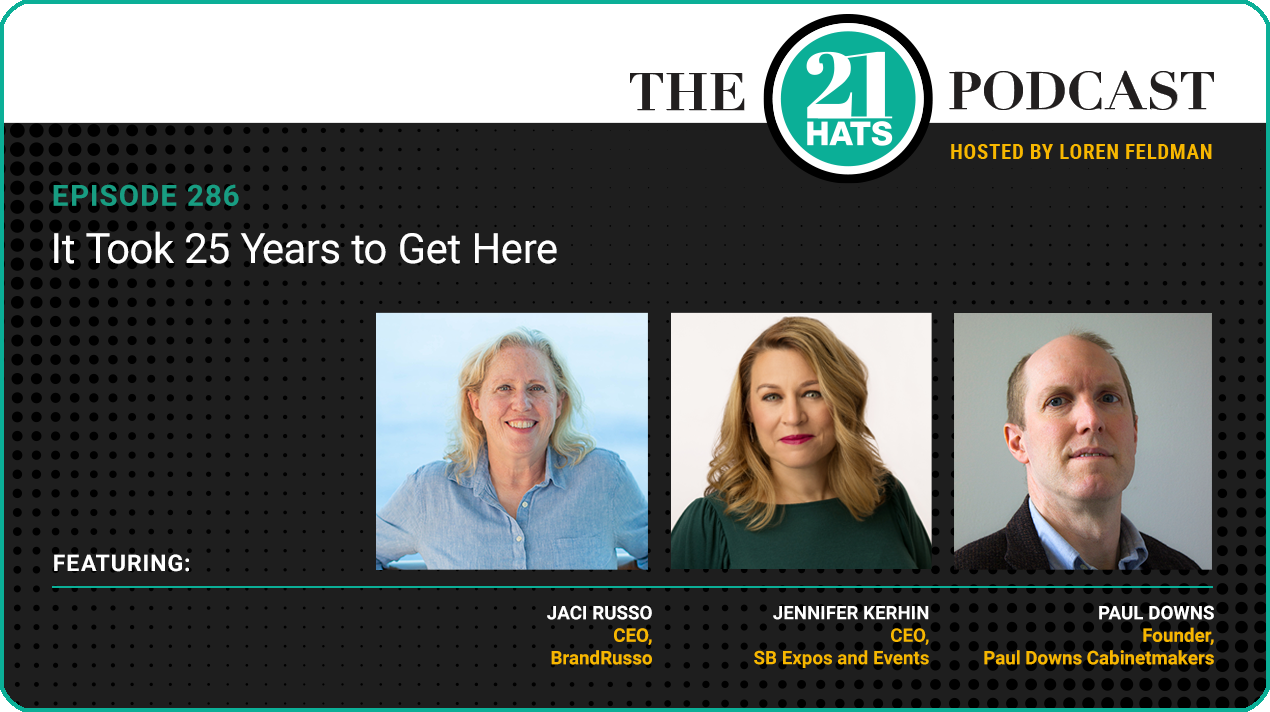
Introduction:
Given everything going on in the world, you might expect a rough start to the year. But for Paul Downs, Jennifer Kerhin, and Jaci Russo, 2026 has actually begun quite well. In fact, Jennifer and Jaci say they’re finally climbing out of what many owners call the Valley of Death—that long stretch when the business depends on you for everything and when it starts to outgrow your people and your systems. Exiting the valley can take a lot longer than people expect. Jennifer is seeing daylight in year 17. Paul says it took him 25 years, a quarter of a century. “Most of that time,” he admits, “I was just wallowing in ignorance.” One lesson they’ve learned the hard way: growing too fast can do real damage. “You burn out your employees,” Jennifer says. “You provide poor quality control to your clients. You make everybody upset and angry.”
Along the way, the three owners cover a lot of ground: what actually makes trade shows worth the investment (hint: it’s what you do before and after), why you may not be able to copyright that graphic design, why your logo needs a trademark, why Paul’s Google traffic is holding up but his Middle East expansion is on hold, what Jaci has uncovered about the shocking cost gap in health insurance for her female employees, and why it’s insane that business owners have to manage their employees’ health insurance in the first place. It’s a wide-ranging conversation—but underneath it all is a theme most owners will recognize: Progress doesn’t always come from big breakthroughs. Sometimes it comes from surviving long enough to figure things out.
— Loren Feldman
Guests:
Paul Downs is CEO of Paul Downs Cabinetmakers.
Jennifer Kerhin is CEO of SB Expos and Events.
Jaci Russo is CEO of BrandRusso.
Producer:
Jess Thoubboron is founder of Blank Word.
Full Episode Transcript:
Loren Feldman:
Welcome Paul, Jennifer, and Jaci. It’s great to have you here. I’d like to start by asking Paul and Jennifer how their years have started. I already got Jaci on this one. Let’s start with you, Paul. Last year, you kind of stunned us when you told us just how poorly your year started. How’s it looking this year?
Paul Downs:
Well, a lot better. We came into the year with a 16- to 18-week backlog, and that’s kind of a good thing because it means we’re not about to run out of work. And also, I had to lay everybody off—not everybody, a lot—about a third of the company last March. And so we had 28 people when that happened, went down to 18, and we’re back up to 24. And I feel like this particular crew of 24 can do as much work as we were doing with 28 before. So we are off to a good start, in terms of production and profitability.
It’s been a little low on cash, but that’s started to fix itself, too, because my theory is, if you can operate profitably on an accrual basis—in other words, you’re spending less to produce your product than you’re selling it for, then cash flow problems tend to fix themselves. We’ve had not incredible sales coming in for the first couple of months, but solid enough that the backlog is in a good position. And we have work through, I’d say, middle of May right now, with a couple of large projects that will come later in the year. So this is a decent start to the year. That’s my prognosis.
Loren Feldman:
You’ve told us in the past that your sense is that you could tell fairly early in the year whether it’s going to be a strong year or not. Last year, you were thankful that the year did get better and the beginning wasn’t entirely reflective.
Paul Downs:
Yeah, I mean, last year proved that my theory was not always correct, and we’ll see what this year proves. My suspicion is, it’s going to be more like last year, in that it’s a slower start, and then bigger stuff is going to come in. Because we are working on a lot of large projects, and we have people who are sort of like, “Yeah, we’re going to do it. We’re just not going to do it today.” And a couple of good-sized ones, and then we’re supposed to get a very large purchase order for a federal project at the end of the year for delivery at the end of 2027. And that’s a project that has been delayed and rebid and blah, blah, blah, blah for political reasons. And I’m not going to go into it, but I think it’s finally going to happen. And yeah, so we’re doing all right.
Loren Feldman:
Do you still sense a certain amount of uncertainty among your clients or potential clients?
Paul Downs:
It’s hard to say. I mean, every few weeks, we wake up and we’re at war with somebody else. So, like, what’s certain? But it’s harder to tease out the national mood from the encounters we’ve had so far this year. I would say that it’s possible that if things were a little more stable in the news that we would be doing more. It’s possible that things would get less stable, and we’d be doing less. It’s really hard to know. I don’t sense the same kind of shock that we had last year, because in the last 12 months, we’ve just lived through a pretty large dose of craziness, and everybody’s kind of getting used to it. So, that’s my sense of where we’re at.
Loren Feldman:
Jennifer, how has your year started?
Jennifer Kerhin:
Good, really good. We hired our first-ever part-time marketing manager and a part-time business-development person last summer, and that’s done a lot of great things for us. It’s caused, not issues, but sort of yet another system that has to be put in place as you grow.
Sometimes you’ve just got to throw something against the wall to see if it works. And then once it starts working, you’re like, “Oh gosh, I gotta put a system workflow to this.” But it’s been successful. And for us, we’re in the events industry, and it’s interesting: As AI takes off and more automation and that back-and-forth seesaw between remote work or hybrid work or back to the office—what hasn’t changed is the need for humans to get together in person, right? That face-to-face event.
And especially we’re in business-to-business ones, so professional ones, no matter how many Teams or Zoom calls you have, coming together for a convention and trade show, I don’t see it going away. It’s changing a little bit, but it’s still moving forward. My industry, as a whole—the trade show industry—is moving forward, and we’re doing really well. It’s a great start to the beginning of the year. And I have some new additions to a leadership team, and I feel like my leadership team is so strong. It’s pretty exciting.
Loren Feldman:
You’ve talked in the past about being in what we’ve called here the Valley of Death. Are you still in the Valley of Death?
Jennifer Kerhin:
I think I’m right across from it. So I use—I think I talked about this—Google Notebook. I created an image that showed—we think of ourselves as Sherpas—we use a lot of mountain imagery, as we’re Sherpas, helping you climb the summit. And I showed how the Valley of Death is this big, giant crevice, and I showed us standing right on the other side of it. So one wrong move, we can fall backwards, but we’re past it, and pretty excited to see the future ahead of us. We’re still kind of close that we can’t make mistakes, but I’m through the Valley of Death.
Loren Feldman:
For those who aren’t familiar with the term, it’s commonly defined as a small business that reaches a point where the things that used to work kind of stop working. You need new processes and, in some cases, new employees. Is that how you think of the Valley of Death?
Jennifer Kerhin:
Well, I think one of the images I saw was that when you’re small and you’re growing, the founder is the center of all major decisionmaking. And to move, really, to scale up, you as the founder and the owner can’t be the center of all decisionmaking, right? You have to be more the visionary and have leaders. And to me, I always viewed the Valley of Death as creating systems and workflow and metrics that you can be out of the day-to-day decision making. But you can set a vision and set metrics so your leaders follow that.
And there’s so many. There’s the service ones. We’re a service company. So you have service leaders, then you have your business development and marketing. Then you have your accounting and finance, right? The administrative, the HR aspects. Every time you think you have one system and you’re out of it, something else pops up as you grow. But I think we have a really good foundation and structure where I can set the vision and not have to do the day-to-day work. So that, to me, is what the Valley of Death is.
Paul Downs:
How many years have you been in business?
Jennifer Kerhin:
This year will be 17.
Paul Downs:
Okay, so 17 years to get to—
Jennifer Kerhin:
[Laughter] Yeah.
Paul Downs:
It took me about 25. And I think that some of that is—most of that time I was just wallowing in ignorance. And so, congratulations for clawing your way out of it. But I think one of the main lessons is that it often takes a long time to get to the point where you’re starting to get some momentum. And so, well done.
Jennifer Kerhin:
Thank you. I would agree. If you’re bootstrapping this and you don’t have investors and stuff, it takes a while to get enough momentum and revenue and profit to be able to hire a skilled person to take over. And then your next person, your next person. This is not overnight—unless, suddenly, you have a bunch of investors and they’re giving you $20 million. The rest of us are scraping, you know, clawing our ways to the top.
Paul Downs:
Well, the other thing is that you need to have been around a while and built something that can attract those good people, because good people aren’t going to take a flyer on somebody who’s three weeks into their career or a business that’s clearly not heading someplace. So it gets easier as you go along, as you get better, as you get smarter, and as you are able to attract a better caliber of employees. But the number of years, I think, might be a big surprise to people who are just entering the world of entrepreneurship.
Loren Feldman:
Jaci, you’ve used the Valley of Death phrase at times yourself. Where would you place yourself in your journey through the valley?
Jaci Russo:
About to be standing in the sunlight.
Loren Feldman:
Wow, how do you know when you make it out? Does somebody send you a certificate or something? [Laughter]
Jaci Russo:
There’s a parade and a crown and a sash.
Jennifer Kerhin:
Yeah, the shadows aren’t over top of you, and you can breathe a little bit easier, like Jaci said, in the sunlight.
Loren Feldman:
What’s happening, Jaci, that makes you feel like you’ve reached that point?
Jaci Russo:
Well, you know, as always, Loren, I am a tweaker and a tinkerer, and so I’m always adjusting our new business process. And when I feel like I’ve hit a groove, it feels good. And it’s really not rocket science. It’s little bitty adjustments along the way.
And so, we’ve really kind of expanded our offerings around brand audits. We’re using that as a revenue generator, instead of just the free work that I found we got ourselves kind of caught up in, and that’s doing a good job of helping us turn those clients into Razor Branding, which turns into retainer. And so it’s just a nice, steady climb up the mountain, to use her analogy from earlier.
Loren Feldman:
Jennifer, I think when I first met you at the 21 Hats Live event in Chicago, you told us, at that point, that you were working 12 hour days, six days a week. Was that the worst of it?
Jennifer Kerhin:
You know what, here’s what happens, too, I think, as you go through it. When you’re by yourself and you’re growing, you work really long, hard hours, but you can change the aspect of growth. So if you don’t want to work that much, okay, so then you don’t grow. You stay stable for a couple years. Or you want to grow, but you grow 2 percent, and so you take time off more, and you accept it. When you make the decision, which I had at that time, post-Covid, I made a couple decisions around a vision of a different type of company with significant growth.
So that changed my insane working—what I did is I underestimated what that meant. So to have that vision, have that desire for growth, and have where there’s no debt, I underestimated the systems you’d need—besides just the people to do it, the systems you need. So I was working insane hours that were brought on by myself because I accepted that growth. I could have said no to that growth, but I wanted to be a certain type of company. It has now leveled out. We’ve created the systems. We’ve hired the leaders. We have the structure. We have just amazing employees—and figured out how to do this now, so we can absorb growth faster, easier, and better than we could have years ago.
Loren Feldman:
You’ve talked in the past about kind of tamping down that growth a little bit to give yourself a breather, and I think you told us more recently that you’re ready to run again. What are you looking at right now? Are you expecting a big year of growth?
Jennifer Kerhin:
Yes, I’ll never do this kind of growth. We grew 150 percent. I’ll never do that again. Like, yeah, I think 20 to 25 percent growth is very strong, very good growth. And that seems fine to me. I think anything below 10 percent is sometimes just growing based on slightly increasing your pricing. But I think anything more than 30 percent, it’s just too much. It’s just too hard.
And someone on one of your podcast [episodes] had said: One of the reasons companies fail can be too much growth. And if you grow too fast, you burn out your employees, you provide poor quality control to your clients. You make everybody upset and angry. That’s not good either, and I’ve definitely learned that lesson.
Loren Feldman:
You talked, Jennifer, about being in the events business. I gather you’re teaching a course on selling at events or trade shows. I’m curious, what do you see out there? What are you telling businesses that they don’t know? What kind of mistakes are you trying to correct?
Jennifer Kerhin:
I’ll say, the top three things that I see when a company is considering a trade show is: Have they gone to the trade show to really check out that it’s the right people, the right attendance? Sometimes people think that the top competitor in their field goes to this event, but really, it could be a very expensive event. It could be 25,000 people. Maybe if they went to a smaller one, and they could start off with a specific niche, that would be the better fit. So the one thing is: Go see it. Don’t start big. Start small. Start with a very small niche, or a more regional meeting.
And then second, we tell people: The cost of the exhibit is usually only 20 to 25 percent of your entire investment in that meeting. Travel costs can be expensive, and all of the shipping of your materials—what’s called drayage—and getting your booth there, and then the brochures, that’s pretty expensive. So when you’re doing a budget, the cost of the booth really isn’t the most expensive thing. So think about that when you’re doing a budget. And then finally, know why you want to go.
And I’m sure Jaci has seen this many times: I’ve seen a lot of companies come on to the show floor and just expect people to come to them. Really, what they’re doing is you’re buying a space on a trade show floor. You need to think about how to get people—but not everybody. All you need sometimes are a couple great leads, right? How do you get them to your specific booth? Spend more time thinking about that.
That’s really where a lot of things drop off. They spend so much time and money on this beautiful booth, or maybe they spend stuff on an open bar in their booth, or great popcorn or something, but not how to get the few people they need—they don’t need everybody—to their booth. So we talk about that a lot. It’s really focusing on which trade shows, the right trade show, and what do you do to get people to your booth?
Loren Feldman:
Jaci, is this something that you incorporate into the marketing that you offer your clients?
Jaci Russo:
Oh yes, absolutely. And I couldn’t agree with Jennifer more. One of the things that we really focus on is not the two or three days of the show. What do you do the six weeks before and what are you doing the six weeks after? That’s where the real time should be spent. That’s where the real strategy kicks in. And so to use the six weeks before building awareness, setting appointments, giving people a reason to want to see you during the show—not just, as she mentioned, if you just stand at the booth hoping they walk by, well, good luck.
Jennifer Kerhin:
Exactly. And I would say, Jaci, that one of the things we talk about too is the post-show. You now have all these leads. How are you following up with these people? They came to the event to see you. How do you get in touch with them immediately? And how do you expand on what they need? And so making sure that you’re delivering either communication, or maybe they want to talk about a service or a product or something, following up on the hot leads. Unfortunately, sometimes those go by the wayside. And if you’re going to spend all that money to do a trade show, then making sure you have a good post-show follow-up is really important.
Jaci Russo:
100 percent. Six weeks before, six weeks after. That matters so much more than the three days in the middle.
Jennifer Kerhin:
Yeah, agreed.
Paul Downs:
What should the post-show approach look like? Is it an email? Is it a bouquet of flowers? What is it?
Jennifer Kerhin:
I mean, it depends. So Paul, for your product, it’s a pretty expensive product, and it’s a one-and-done, right? You’re not buying software-as-a-service every month. So for me, let’s say I was working at your booth in a trade show, and you have a hot lead, I’d be sending them presents, right? I think, on one of the podcast [episodes], you talked about creating cutting boards or something, right?
Paul Downs:
That’s right.
Jennifer Kerhin:
Sending those to top leads, maybe one small thing every month for three months, or every other month—because your sale is very different than someone who’s just trying to get 100 leads in so they can get 10 people to do software-as-a-service each month. I think emails have their place, but I like phone calls, to be honest, or presents. And it depends. If it’s a big product, it can be worth it. If you don’t have a big product or service to sell, you’re probably not going to do that.
Jaci Russo:
Absolutely, it really is about serving. And so, I don’t think it’s, “Are you ready to buy yet? Are you ready to buy yet? Are you ready to buy yet?” It’s more, “Let me provide resources and helpful things that will serve your purpose. I hear you. I see you. I get you. I understand the challenges you’re going through. Maybe this will help.” That is going to go a lot longer than an email or a phone call that says, “Are you ready to buy?”
Jennifer Kerhin:
And I’ll add to what Jaci says. I agree. I’m not the marketing expert. I’m the trade show expert. But one of the things that I think companies really could do a lot of is thought leadership at these meetings. There are free-speaking and paid-for-speaking ways to get into a meeting. So, if you want to talk about how you can help somebody in a non-commercial kind of way—more thought leadership—there’re countless ways to be a speaker at a conference. And I think more companies should take advantage of those possibilities to provide thought leadership to the people coming to the meeting, because it makes you noticed as an expert, and you get free publicity out of it.
Loren Feldman:
Paul, what’s your current thinking on trade shows? Is that something that you’re interested in pursuing?
Paul Downs:
No, is the short answer. But we have an unusual situation, in that we just get a stream of calls off Google pretty much every day, and a lot of those are quite valuable. Also, my product is enormous, so it’s difficult to to really convey what it is we can do in a trade show booth, unless I was willing to spend huge amounts of money to do it. And so that may be short-sighted on my part.
Now, the other thing is that the trade shows that would be a good fit for me are well attended by billion-dollar companies. I mean, the big one is NeoCon in Chicago every June. And the big guys are in the good positions, and then there’s some little ghetto areas where the people who are struggling are stuck. And I just don’t really want to do that. I get good business without doing it.
And so we had tried an alternative, which was meetings where we were just meeting with people we wanted to meet, as opposed to setting up a booth. And we’ve done that three years in a row, and frankly, it really hasn’t produced what I hoped it would. So I’m kind of catching my breath right now, and the money that I would have spent—ironically, I was just gearing up to do a whole push into the Mideast, and had arranged contacts in Dubai and Saudi Arabia. And we were moving ahead with some projects on the ground there. And then our esteemed president decided to pee in my Cheerios again. And so nobody’s talking conference tables. So we’ve got to wait that one out. And I don’t know what we’re going to do in the short run. We have enough work coming from the United States, and I’m not really worried about it, but that’s where I’m at.
Loren Feldman:
Paul, you mentioned that you’re doing well on Google. A lot of people are not having that experience. Your business coming through Google is holding up as well as ever?
Paul Downs:
Yes, and that, I think, is one of the dirty little secrets of Google is that the people who get the top organic search results are the ones who had it yesterday, five years ago, in our case, 20 years ago. We realized that the clients were coming from that channel, and then started really focusing on making sure that we were defending those positions.
Now, I have such a niche product that there’s not like a million people trying to shoulder their way in and eat my lunch, but still, it’s very effective. We get calls all the time and from good clients, and we’ve made a lot of sales. So if somebody was trying to replicate the path I took, I don’t think it would be possible. I don’t think there’s any amount of money you could give Google to knock me off that position. We could probably screw it up somehow, but I don’t see anybody taking my cheese or whatever you say.
Jaci Russo:
But are you seeing a decrease in traffic as more and more people use AI to search?
Paul Downs:
No.
Jaci Russo:
Okay.
Jennifer Kerhin:
I was just going to ask that, Jaci. A lot of people have been talking to me about how the words that you put on your website for Google searches are going to be dramatically different for AI. And we’ve asked AI, “What kind of things should we change on our website for that?” We do not get much website traffic at all, but even I’m looking at that. That was a great question, Jaci. So Paul, you haven’t seen at all a change?
Paul Downs:
No, but we’re actually trying to rewrite a lot of the content on the website to be more LLM-friendly—in other words, to be written in more of a natural voice rather than keyword stuffing. So that’s my big push for the next few months, is to go back through all the content on the site and make sure it looks and feels a bit more like a human. But I think that there’s other aspects to winning the Google wars, too. We’ve put a big effort into getting good reviews and really credible reviews.
Jaci Russo:
That’s valuable.
Paul Downs:
And I don’t have a huge number. We have 145 as of today, but they go back eight years. Consistently every month or so, we put up another review that’s clearly written by a real person. They often add photographs, and they’re like, “You guys did a great job.” And so I think that’s an important part of being credible to Google, because they want that, and it goes through Google Maps. But when I look at businesses, I always look at their Google reviews to see what’s going on.
I have an AdWords budget of about 2,500 bucks a month, and I do it just to do it, just to give them money. And I look very carefully at our web traffic, and it’s pretty clear that we’re getting visitors from all around the world. They’re getting onto my site, finding content, and staying for a while. In general, we’ll have one to two people on the site all the time, and sometimes up to 10 or 12. And they could be from anywhere in the world. It’s kind of interesting to look at the live view and see who’s there and where they’re from. I get a report from my AdWords guy who tells me the name, email, company, LinkedIn profile, of some of the visitors. But I can get a sense of whether it’s busy or not, just from looking at those.
Jennifer Kerhin:
Paul, do you have international contract sales reps?
Paul Downs:
Well, I have one in Dubai now. [Laughter] But he’s not in Dubai, because you can’t get back there. He’s in Belgium, where he’s from, and we’re both wringing our hands about what’s going on there. But I do not have any others. This is a pretty new thing, thinking about exporting, and I had decided to target the Middle East earlier this year, mostly because I felt like there would be a good reception for American-made and less price sensitivity.
Because in much of the rest of the world, we would be competing directly with makers in India, makers in China, who are just cheaper. You know, they do good work. They’re just cheaper. But in the Mideast, my perception was: If we could talk to people and say, “Hey, we’re the ones who did this table in the United States, and we’re the guys,” that that would be a place where they would be excited about that.
Jennifer Kerhin:
Yeah, and the reason I said that, too, is because you have such a beautiful product. If you were in a trade show, you don’t need to bring your product. You could have this beautiful LED screen that just shows like a slideshow or a video of it. You just need someone there on the ground, I would think. But I don’t think from a trade show you need to ship your product. That’s way too expensive for how heavy it is. But goodness, you have beautiful, beautiful photographs.
Jaci Russo:
Well, I’m just gonna jump on that real quick: Can’t you make little miniature ones? I just think that would be so cute. [Laughter]
Paul Downs:
Yeah, you can. And actually, I’m planning, if this thing is still happening, on a show that’s going to be happening in, I think, Oman in September, working with my rep to put together a package of things. And we have looked at making miniatures. It’s actually oddly difficult to scale down a table to miniature, because it’s not so much the wood, it’s the hardware. It’s really hard to take the fittings and the things that we buy in a normal size and then turn them into 1/20th of that scale.
But with 3D printing, we might be able to actually just make a scale model of the table. And one of my engineers can do that. And we started talking about, “Well, how would we make a scale model that could be taken apart so someone could really look at the guts?” And we just haven’t gotten around to doing it. We’ve actually been so busy just trying to get work out the door that we haven’t really focused on that yet.
Jennifer Kerhin:
Well, you know what I just said: Too much growth is not a good thing. It sounds like you have just enough growth.
Paul Downs:
Well, with manufacturing, it’s difficult to scale up and down, particularly the kind of manufacturing that we do, where the people on the shop floor need years of training. They’re highly skilled, and we do a very unusual thing that nobody else can just walk in here and be productive, because what we make is different from what most woodworkers do, and how we make it is very different, too.
So it’s a disaster for me if the business is changing speeds, either getting too fast or too slow. And that’s what happened to us last year. We suddenly had all these people from the previous year, and then we didn’t have work for them. And if we run out of work because we just have too many people, that’s a serious, serious problem. So I had to cut some heads, and I did not want to do it.
Jennifer Kerhin:
Funny, the grass is always greener on the other side. Here, I’m thinking, “Yeah, but you don’t have a time deadline.” Like, I have to put on an event at that time, or I can’t. So it’s funny how every business owner, you always look at the other one: “They got it easier,” right? And then I’m thinking, “Well, he also has pretty heavy capital equipment expenses, so I guess it equals out.” [Laughter] But everybody’s got their own issues.
Paul Downs:
Yeah, the really easy businesses just don’t exist because they’ve competed away. So everybody’s got a niche. And there’s got to be something difficult about it, or somebody else would come along and eat your lunch every day.
Jennifer Kerhin:
Well said.
Loren Feldman:
Jaci, are you surprised that Paul’s Google traffic is holding up as well as it is?
Jaci Russo:
No, I think that’s great. I just know that we are seeing the canary in the coal mine, that Google’s total traffic is down considerably, and staying down. But it could take months before he starts to see it, because his quality of traffic is staying consistent. But the total volume of traffic? Yeah, it’s on the decline. We’re seeing more and more people using AI for their search instead of Google.
Paul Downs:
Well, are they using Google’s AI or are they just going somewhere else?
Jaci Russo:
ChatGPT and Claude are the primaries—Perplexity, too, are the three bigs. Now, I mean, sure, Gemini is still picking up traffic, no doubt about it, but we’re talking about double-digit declines, percentage declines. And so it’s gonna take a while for everybody to start to feel it. I’m just telling you what’s coming.
Paul Downs:
That’s interesting. Well, I think part of it is that we’re so niche. There aren’t very many people who can do what I do.
Loren Feldman:
You’re not spending that much money per month on AdWords. You’re not driving this with your keyword purchases, I don’t think. This is based on your having been doing the same thing for decades now. Does that make sense, Jaci?
Jaci Russo:
Yeah, it does.
Paul Downs:
Well, I think the other thing is that when you come to my site, and you come to my competitors’ site, it’s just clear what the difference is. Even though the search terms aren’t all that different, nobody out there has the same depth of range of things they do, the same client list, and there’s just nobody who really matches up to us. And knocks on wood, thank God for that.
But it took 25 years to get where we are, and we really try to highlight how we’re different from everybody else. Now I check ChatGPT and Perplexity and Gemini every now and then and ask them, “Hey, who should you call if you want a custom boardroom table?” And we show up in those searches, at least when they’re delivered to me.
Jaci Russo:
Well, you’re always going to show up in a search on your computer, because your computer knows what you care about. The question is, for people who don’t know you, or haven’t used you, or don’t regularly search for you in other markets, ask them to do the search.
Paul Downs:
Well, as I said, I’ve seen on Google traffic that we’re attracting traffic from all over the world, and so I think that, at the base, a lot of what ChatGPT and Claude and all these people, they’re still kind of rolling off the existing internet. So they’re sucking up what was there 10 years ago, and that’s part of what they’re delivering.
Jennifer Kerhin:
Well, Paul, you’ll be happy to know, I just typed it into my ChatGPT—and I’ve never, ever looked for custom boardroom tables—and you were No. 1.
Jaci Russo:
It’s highly possible some of your traffic is coming from the AIs. You just don’t know it because they’re still routing to your website.
Paul Downs:
Could be. It could absolutely be. I’m hoping that at the end of the day, if you’re in a limited market with a small number of entrants, and you’re the best one by head and shoulders, that all the platforms are going to figure that out. But we’ll see. We’ll see how it goes.
Jennifer Kerhin:
Paul, this is what it said—a bunch of bullet points, but it said, “Best for executive board rooms that need a statement table designed specifically for that room.”
Paul Downs:
Well, that’s pretty much what we do. Pretty happy to hear that.
Loren Feldman:
So speaking of how AI is changing marketing, there was a Supreme Court decision this week that produced a few stories but didn’t get as much attention as I thought it would. Maybe because there’s so much going on.
Jaci Russo:
There’s a lot going on, Loren.
Loren Feldman:
Yes, there is. Jaci, you know what I’m talking about. The Supreme Court decided not to review a decision by a lower court, which means that designs created through AI cannot be copyrighted, which, it seems to me, is potentially a big deal for graphic designers and marketing agencies like yours. I would have thought there might be some celebrating going on. Maybe I’m overestimating the importance of this. What do you think?
Jaci Russo:
Well, I think that you are reading it right. It does matter, and it is good, and I think it’s right. You know, we should be protecting things created by humans. The AI stuff, even as it gets better and better—and y’all know I’m a huge fan. I use it daily. My whole team does. But at the end of the day, it is not original creativity. So that’s what copyrights are supposed to protect: things originally created by humans.
But here’s where I think the two issues are with the celebration and the ticker tape parade. One is, there’s a lot of other stuff going on in the world, and so people are distracted. And two, I’m going to put a percentage on it, but gosh knows, this is not well researched. 25 percent of the companies out there actually appreciate and care about legal protections for their logos and their work, and go through the time and energy and expense of having a trademark attorney. And I know this just based on my career of creating logos for people and saying, “Okay, who’s your copyright attorney? Because we’re gonna send this packet to them so they can file,” and them saying, “No, it’s fine.” We’re like, “But then you’re not protected.”
Jennifer Kerhin:
What happens if you’re not protected, Jaci?
Jaci Russo:
Somebody else can use it. Somebody else can create their version of it. Somebody else can have a slight—or, even more importantly, what I see often is they didn’t do the protection. Therefore, in the protection process is when you figure out if somebody else owns something similar.
Jennifer Kerhin:
At what point in a company’s development do you think that they should copyright or trademark—I don’t even know—like their name and their logo?
Jaci Russo:
I mean, day one.
Loren Feldman:
Jennifer, it sounds like you haven’t quite gotten to this point yet. [Laughter]
Jennifer Kerhin:
I was really hoping she wasn’t saying day one. I was hoping year 16.
Jaci Russo:
Day one. Year 16 is the next best time. It’s like planting a tree. [Laughter] Here’s why: On day one, sure, nobody’s trying to steal your stuff. You have no value yet. So that’s the best time to protect it, because it’s least expensive to go through the trouble. It’s the easiest to get it approved. It’s the most seamless approach.
And it’s the quickest to make an adjustment if it turns out somebody filed that thing 20 years ago, and yeah, they’re kind of sitting on it. But it’s still protected and they still own it. And you didn’t know. But somebody in the USPTO office has decided you’re too close, and you don’t want to find that out in year 16. You want to find that out on day 16.
Paul Downs:
Yeah, I went through copyrighting about 10 years ago. I just actually did the update you have to do at 10 years. And I will say that for that, I originally had to hire an attorney to do it, and I hired some attorneys out of St Louis who were a quarter of the price of the New York attorneys, and they did a fine job. Got my copyright.
But then to go to the re-upping, all I had to do was ask ChatGPT, “Hey, how do I do this?” And they walked me through the whole thing, and it was a breeze. So I’m glad that I trademarked my name, because since that time, a bunch of actors have showed up that are named Paul Downs, who are quite famous. [Laughter] And so I own the URLs pauldowns.com, pauldowns.net. And I’ve got the name Paul Downs trademarked. So, you know, maybe I could sue one of these guys one of these days.
Loren Feldman:
Or sell it to them.
Jaci Russo:
Right, more like that.
Paul Downs:
I at least have secured that, and who would have thought that this would happen? But it did.
Loren Feldman:
Jaci, I had another question about that Supreme Court decision. They decided not to hear the case, so it reverts to the lower court ruling, which stated, as you put it, that for something to be copyrightable, there has to be human involvement. But I’m not sure it really defined how much human involvement. Do you know anything about that?
Jaci Russo:
Good point. Well, I joke regularly that I pretend to be a lawyer when arguing with my husband. And any legal advice I give is exactly what it’s worth: zero dollars. That’s what I charge for it. So that said, there is, I think, a real slippery slope here. I can go fully create it in AI, and then a graphic designer can redraw it in Adobe. Or if I was a little bit more talented, I could redraw it in Canva, and then it’s human created.
So I think that people are going to lean into that kind of slippery slope on how to squeak by and use a whole lot of AI, but still have the human element. Because there has been no ruling on 10 percent human, 50 percent human, 75 percent human. So we’re all just kind of making it up as we go along.
Loren Feldman:
All right, one other thing I wanted to ask you about, Jaci: Last time you were here, you surprised us by telling us about your health insurance situation and how you are seeing your young female employees being charged dramatically more for health insurance than comparably aged male employees.
Jennifer Kerhin:
Wait. What?
Jaci Russo:
Yep, more than double.
Jennifer Kerhin:
Are you kidding me?
Jaci Russo:
I kid you not, my friend.
Loren Feldman:
And we all thought that must be illegal, but you’ve done some research since then. What did you find out?
Jaci Russo:
Oh yeah. Well, here’s the thing. I have noticed it from day one. You know, we’ve been with Blue Cross since when we started in 2001, so 25 years in. And I noticed it, but it was a few dollars more. It was $20 more, $30 more. And so, you know, everybody’s got a different tier and a different whatever. So quite honestly, I kind of let it slide for years and years and years.
But the gulf between the very inexpensive men and the very expensive women, even though they have the same medical history and they’re in the same age group, continued to grow and grow and grow. Until this year, I about lost it. Because it’s like two and a half times. It’s stupid, and so I’m pissed.
And so I mentioned it in an offhand [way] here, just because I jokingly told Loren when we were talking about what to talk about on the podcast. I said, “Well, you can ask me why I’m never hiring women again,” which obviously is a joke, because I like women first of all, and obviously I do a podcast for women, and the Women’s Summit at Sea. So, you know, calm down. I still like women, and I’m still hiring them. But they cost me a lot, and so we were talking about that.
So then everybody reacts the way you just did, Jennifer, and they get me all fired up. So I’m firing off emails and text messages to my agent and to Blue Cross, to the Louisiana insurance commissioner. I filed a formal complaint with the state, and I now have been educated. So let me explain what I’ve learned.
Yes, in 2014, as Loren found the statute, it is now illegal for insurance companies to do discriminatory pricing between men and women in the same age band EXCEPT—and that’s all capital letters—do you remember the whole, “If you like your insurance, you can keep your insurance” line? So that line means that Blue Cross—and I’m sure there are others out there too, but we’ll just pick on them for a minute, because they are the white whale, the big whale, the massive albatross around my neck in the state of Louisiana. We don’t have competition here. They’re a monopoly. United slips in every once in a while, but Blue Cross spends a lot of money on lobbying to keep them at bay. And so because we have a grandfathered policy—which everybody keeps telling me how great it is that I have a grandfathered policy from 2001—allows Blue Cross to break the law, ignore ACA, and continue to create a bigger and bigger gulf between the same-aged and health of men and women.
Paul Downs:
Loren, do you remember when I wrote that long series about Obamacare back in 2014?
Loren Feldman:
I do.
Paul Downs:
And you guys don’t know this, but when I was writing for The Times and Loren was my editor, I wrote extensively about the pricing of the Obamacare plans and the origin of the pricing curves that describe what the premium increase would be for every plan as you got older. And I found out by discussing with the person who wrote the original scheme for the age band increases, the guy showed me that there were two curves. There’s the curve for men and there’s a curve for women. And they averaged them to come up with the curve that was built into ACA. And basically what it is is that women use a lot of health care in their child-bearing years, and men just don’t.
So the costs are very, very different to the insurance companies, and what ACA did was force them in the plans to offer the same number to everybody, which means that the insurance companies are losing money on women and making it up on men, because men just basically don’t go to the doctor unless they’re almost dead. And so that’s what you’re experiencing. In Louisiana, the state government and the state insurance commissioners for every state have either decided to adopt those ACA curves or not. So in Pennsylvania and I think something like 25 other states, what you describe would not be happening.
Jaci Russo:
Well, that’s why I filed a complaint with the state insurance commissioner.
Loren Feldman:
Jaci, you’re grandfathered in on a plan, but you would have the option of taking a plan that’s not grandfathered in and that does adhere to the law, correct?
Jaci Russo:
I do, Loren. I do have the option of abandoning the plan we’ve had since 2001 that has gone up roughly 20 percent a year. So it’s not like I’m still at 2001 rates. And I could leave it, and I could go to a couple of other different plans. And shockingly—I know y’all are all going to find this very hard to believe—they don’t actually save me any money. Sure, the women are a little bit less expensive. The men are dramatically more expensive. And the deductibles? Don’t even get me started. The out-of-network pricing, the co-pays, everything else is more.
Paul Downs:
Yeah, well, my takeaway, after learning quite a bit about the insurance market, is you’re screwed. [Laughter]
Jaci Russo:
Yes, they’re gonna get theirs no matter what. The biggest issue, though, is explaining that to employees. We want to provide health care. We want to provide great benefits to keep people, but this is just so—you can’t predict it. You have no idea. It’s complete uncertainty. And it’s really, really hard to continue to add benefits when this one is so—it’s not even a roller coaster ride, because it only goes up.
Loren Feldman:
Jackie, do you cover all the health insurance for your employees, or do they pay a percentage?
Jaci Russo:
They pay a percentage.
Loren Feldman:
And do your employees, especially your women employees, know about this discrepancy?
Jaci Russo:
Oh yeah, I’ve been honest with everybody.
Loren Feldman:
Well, it’s not your fault, obviously. How did they react when they learned of this? Are they concerned about it?
Jaci Russo:
Oh, yeah, absolutely. I mean, you’re talking about people who just took a 20 and 30 percent increase hit. And so we’ve moved some things around. I’m trying to find different ways to pay them more so they have at least the same take home. I mean, it just sucks, because I get caught in the middle. I can’t reduce what I’m paying Blue Cross. I don’t want to reduce what I’m paying the employee, so I got to make up the difference.
Jennifer Kerhin:
Jaci, that’s the issue, I’m saying. We’re stuck in the middle. We want to do great by our employees. I want to do great by my employees, but we’re stuck in the middle. We have zero control. And I don’t know what to do.
Paul Downs:
There’s not much you can do. But one thing you do have to understand is, no matter what kind of plan you have, as people get older, the premiums are going to go up. And so that when you talk about Susie, she’s age 21, and Jim is age 21, and they’re paying different amounts? Susie, age 21, and Betty, age 35, are going to be paying drastically different amounts, too.
And so it’s very difficult to come up with any kind of equitable cost-sharing with employees, because they’re all different ages. But it’s an almost impossible system to get your head around, and if you do, then you just want to hang yourself. So I would say that it’s one of those things that you don’t want to spend too much time worrying about, because there’s very little you can do to get out of it.
Jaci Russo:
Correct.
Loren Feldman:
And further evidence that it just makes no sense for business owners to have to determine health insurance for their employees. There’s got to be a better way. My thanks to Paul Downs, Jaci Russo, and Jennifer Kerhin. I really appreciate you taking the time. Thanks, everybody.

