

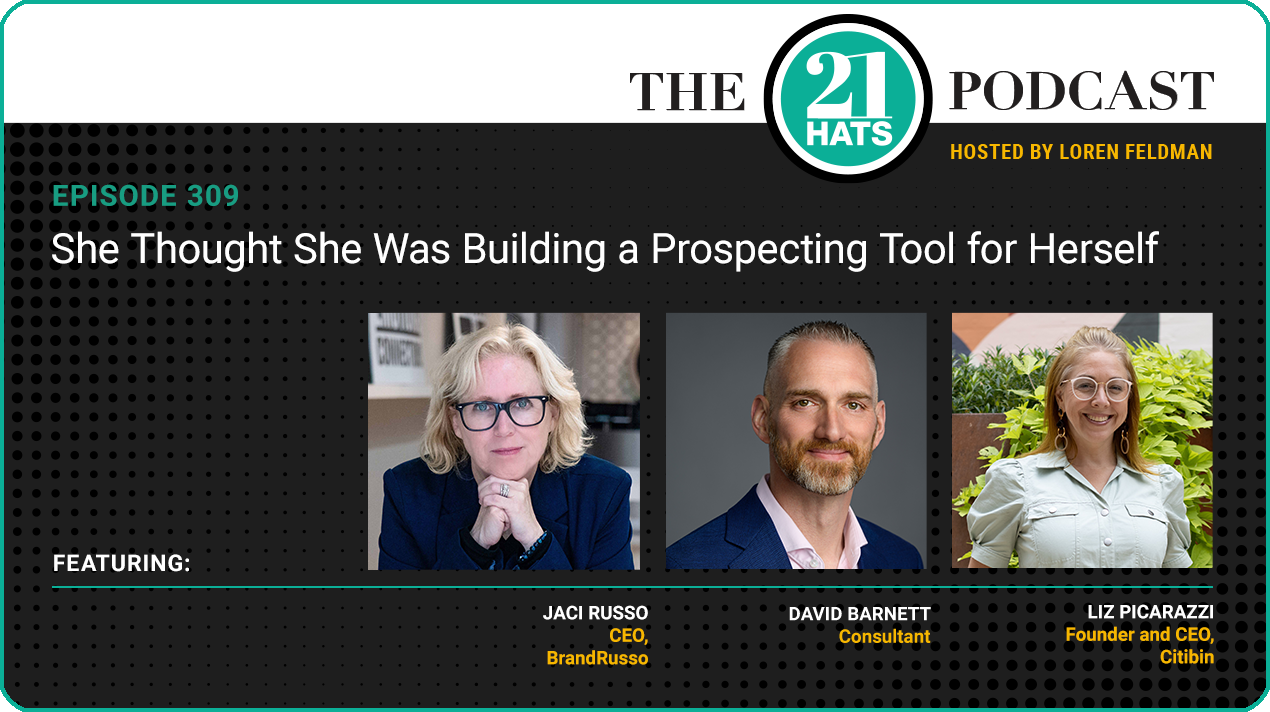
She Thought She Was Building a Prospecting Tool for Herself
Introduction:
This week, Jaci Russo, Liz Picarazzi, and David C. Barnett talk about something entrepreneurs are always being told they have to do: innovate. But how do you know which ideas are worth pursuing, how much time and money to put into them, and when an experiment starts to become something much bigger? Jaci Russo may be finding out. What started as a prospecting system she built for herself—with AI, verified data, and a simple CRM—has turned into ProspectDaily, a subscription product that attracted more than 100 customers before she even announced it. That has Jaci thinking the tool could do more than generate a little extra revenue. As AI makes it easier for clients to do more of their own marketing, she sees ProspectDaily deepening client relationships and ultimately changing the nature of her business. So far, she says, the hard costs of creating the tool amount to $185. (Try ProspectDaily for free.)
Liz, meanwhile, is spending $10,000 this year testing whether old New York City trash cans and other recycled plastics can be turned into a new cladding material for Citibin. And she’s itching to spend another $30,000 on the equipment to manufacture the material once she determines whether customers actually want it. Both Liz and Jaci kept their projects quiet early on. As Liz explains, “I have so many ideas all the time. I didn’t want there to be eye-rolling, ‘Oh, here’s another of her things.’”
Plus: In our latest Beyond Small segment, brought to you by Grasshopper Bank, the owners compare how closely they watch their numbers, which metrics matter most, and whether spending time on financials gets in the way of doing the work they really want to do—like coming up with new products.
— Loren Feldman
Guests:
Jaci Russo is CEO of BrandRusso.
David C. Barnett helps people buy and sell businesses.
Liz Picarazzi is CEO of Citibin.
Producer:
Jess Thoubboron is founder of Blank Word.
Full Episode Transcript:
Loren Feldman:
Welcome, Dave, Liz, and Jaci. It’s great to have all of you here. Both Jaci and Liz, you’ve been experimenting with new products of late. And Dave, I know you’ve rolled out some new offerings recently, too. So I thought we’d talk about how you decide which ideas are worth pursuing, how much you’re willing to invest before you know whether they’ll work, and how you know when it’s time to keep pushing or to pull the plug.
Jaci, you’ve made some significant changes in how you prospect for new business. You’d already told us that—after you took the Alan Pentz AI course—you had set up AI agents that were sending you verified leads every morning. Does this new thing you’re talking about go beyond that?
Jaci Russo:
It really does. You know, it was interesting. Taking Alan’s class back when Claude Code was first introduced, I think it was a combination of Alan is 10 times smarter than me—Liz knows that—and it probably wasn’t as refined for a non-coding professional as it is now. And so I followed the steps, I did the work. I was able to build a tool. It was working fine, but by no means was it ready for primetime or public viewing or anything. But as Claude made updates, and I got more comfortable with the tools, and there became more tools, I was finally able to build out, really, the product of my dreams.
And it was just for me. I was using it for myself. I kind of figured out my system that works best for me is if someone hands me 10 prospects a day that are vetted, verified, researched, fit my target audience, and then I can go do my thing, which is follow them on LinkedIn and make contact there, send them an email. We have a whole kind of marketing campaign that we do beyond just pick me, choose me, love me. We could talk about messaging later. And then I was able to say, “Okay, now I still have to do some manual things of taking them from this beautiful Google Drive of prospects, getting them into my CRM, and then doing things with them there.”
And so over time, I iterated, iterated, iterated until finally I was like, “Oh, hold on. I have now built a perfect—for me—A-to-Z, prospecting-to-lead-to-client system. And if I like it, I bet other people would, too.” So then I took the time to do some things right, not just kinda rinky-dink, patched together, duct tape, and WD-40, but do it in a way that it is fully set up and legit. And people would pay money for it, and now it’s available for people to subscribe. And we went live two weeks ago, and I have 107 subscribers.
Loren Feldman:
That’s a lot of subscribers.
Jaci Russo:
I thought so, too. I was a bit surprised when I realized they were coming from SEO searches and AI recommendations because I just publicly announced it seven seconds ago. I’ve not talked about it at all. I still haven’t even said the domain yet. And so, that was all while I was still soft launching it, people were finding it. And then I was having to both build this plane as it was flying and answer tech support questions, and the chat assistant. But it’s up and running now.
Loren Feldman:
Jaci, when you initially set the thing up after taking Alan’s course, I think you had some significant hand-holding from Alan and his assistant to set up those agents. This time around, did you do it all yourself?
Jaci Russo:
I did. And it was a point of real importance to me to do it myself. A) My team is busy, and they are about done with my shenanigans. Because every five minutes, I have this great new idea of something I want to do, and so then they have to—
Liz Picarazzi:
God, I so relate! Keep going. I just had to tell you: Oh, I so relate.
Jaci Russo:
Well, and it’s like, I do take advantage of the fact that I have this incredibly talented team. So when I want a logo, I’ve got all these great graphic designers to go build logos for me. And when I’m thinking about a name, then somebody’s going to go register 15 different domain names, and then somebody’s gotta go build the website.
I have shown it to three people on my team to say, “What do you think?” And they know when I say that, mostly I just want them to say, “Oh, this looks great.” I’m past the point of needing feedback. When I need feedback, I’ll say, “Hey, go see if you can break this. Tell me what I need to fix. What am I missing?”
When I say, “What do you think?” I feel like it’s already great. And so, I sent it to them and I said, “What do you think?” And they were like, “Is this why Tim wasn’t working on my project?” I’m like, “No, Tim didn’t do this.” “Is this why Krista and Emily weren’t…?” I’m like, “Nope, Krista and Emily didn’t do this.” “Is this why Jonathan and Michael…?” I’m like, “Nope, they didn’t do this. This was all me.” And I was very proud of that.
Now, to be clear, it’s me plus a whole lot of Claude and AI agents and Perplexity and becoming an actual legitimate bonafide data reseller. And I mean, it wasn’t just, like, me and a box of checkers. I mean, I actually really brought in a lot of resources.
Loren Feldman:
What does that mean, “becoming a bonafide data reseller?”
Jaci Russo:
Well, in the early days, when I was taking Alan’s class and he and his team were helping me build this out, it was strictly all AI. And that was fine up to a point. But when I realized I was gonna think about offering this to other people, and they were gonna give me money, they were not gonna be as comfortable as I am with, “I’ll get 20 leads in a day, because only 10 are gonna be accurate.” And so I was like, “Oh, that’s not gonna fly.”
And so there are a lot of companies you can go buy data from, and so I reached out to a few and met and figured out who was gonna be the right price point and provide the right quality of data, because I want it to be verified data sources. And so now, I will tell you, of the last 500 that I have personally worked with since we made the switch to be all data all the time, I’ve only had three emails that have bounced back.
David Barnett:
Nice.
Jaci Russo:
So that’s pretty legit.
Liz Picarazzi:
Amazing.
Loren Feldman:
There are lots of existing prospecting tools.
Jaci Russo:
Sure.
Loren Feldman:
Did you try them all? What made you think you could build a better one?
Jaci Russo:
Well, all is a lot, and so, no. I have, though, tried most of them. I built what I needed, and there may only be five other people in the world who think this is good for them, and I hope they find it and use it and are happy about it. And that’s okay for me, because I am using it every day still. And it’s working great.
Loren Feldman:
What’s different about yours? Why is it right for you?
Jaci Russo:
Simple: What made it right for me was, one, I didn’t have to go buy a list of three or four or five thousand. And that, to me, has always been a problem. Because by the time you work your way through the list, half of it’s already out of date. The drip of 10 a day is a manageable number, and it’s accurate in that day, which is one of the reasons why I think I have so few bounce backs.
Number two was, okay, great, I get all this data, and it would be, you know, name, address, email, whatever. Well, I want more than that. I want their LinkedIn. I want to know why that company’s a good fit for me. What are they doing right now? What’s happening in their world that makes them aligned with why they’re gonna say yes to what we do? And so that takes some AI brain to do that research.
And so now when I get my daily report, it is—and you can see a sample daily report on the website—it is a great, for me, dossier. I feel like I’m Jennifer Garner in Alias, and my handler has just handed me the whole folder of everything I need to know to get in their head. That’s what I get—to the point that it gives me a pre-written first draft of an email and a LinkedIn outreach. Now, I don’t copy and paste those exactly, but it gets me started, and I love that.
Loren Feldman:
When you did this after taking Alan’s course—your first version—you told us that you got some actual clients out of it pretty quickly.
Jaci Russo:
Oh, absolutely.
Loren Feldman:
Have you gotten clients out of this version?
Jaci Russo:
Yes, I have, and I actually just met with one that may end up being the biggest ever.
Liz Picarazzi:
Incredible. Well, I’ve signed up, I think it was just yesterday. And I am so excited to use it, and it’s really because of all the things that you talked about where you can take a class and, you know, in my case, you can be a subscriber to Apollo and Claude and Instantly—those are three services I think I’ve been paying for for six months and barely using—to sort of pull it all in together.
And then I like the part you mentioned, your Google Drive, where sort of like the marketing, the ethnography of the customer or the different segments, is discussed—where I know those profiles of my customers, but when I pass them off to, let’s say, new employees, it really tells them: Who is this prospect? Are they a residential customer or are they a municipal customer? Like at that level.
So I’m really looking forward to using it, and if this all works out, I can literally be a good case study, because I can be someone where you can quantify how much money I’ve spent on AI tools that I haven’t been using. And then I just keep thinking, “Oh, just keep at it. You’ll figure it out. You’ll use it. I’ll put someone on my team to work on it.” And it’s like, no, none of those things worked.
So I think that your tool, ProspectDaily, is gonna push us to the next level, and I know it’ll take some tweaking and back and forth. It’s not like a plug and play, certainly not. But I think—I can’t remember what you’re charging, but when I saw the fee, I was like, “That makes total sense.” I could probably get an ROI really quickly on it, and it sort of costs money not to do it.
Jaci Russo:
Well, thank you. I appreciate that.
Loren Feldman:
How much are you charging, Jaci?
Jaci Russo:
Oh, I’m looking right now, Loren, because that was a big source of back and forth. So it’s supposed to be a higher rate, but we did like a founder’s rate for people who sign up soon. And so, if you’re on the starter plan, which is that 10 prospects a day, the annual rate is $241 a month. If you wait and go when it’s off of the founder’s rate, it will be $366 a month. So it’s a pretty significant savings.
David Barnett:
I signed up three days ago under the solo plan, so I’ve had three deliveries so far of five prospects each day. I’ve been really impressed with it, Jaci. I think you did a great job.
Jaci Russo:
Thank you.
David Barnett:
It gives me these individual people, and I gave it some criteria for some of the training sessions that I do. And so, it’s giving me the people within the professional associations—like bar associations or CPA associations and things like that. And it’s giving me real descriptions as to why a particular person might want to talk to me.
So it says: This association represents this many lawyers, and there’s only three people on staff. And this individual person is the person who does these kinds of community outreach, or manages the newsletter that they put out every month, or something like that. It gives me the LinkedIn profile URL. And so all 15 of those people I’ve sent connection requests to on LinkedIn. And I have yet to have somebody accept one. But I was really just impressed that all the URLs were correct.
Jaci Russo:
Thank you.
David Barnett:
So I think it’s great. I mean, I don’t have a sale to report yet, but I’m impressed. I think it’s great.
Jaci Russo:
Thank you very much. Well, three days, you know, probably would’ve been optimistic. But hopefully the next time we talk, there will be one. The LinkedIn connection was really important to me. What I do is I double dip. I email them and say, “I reached out to you on LinkedIn, but in case you haven’t seen it, you know, I’m emailing you.”
And then on LinkedIn I say, “I’ve emailed you, but in case you haven’t seen it, I’m here.” Because I want them to know that I know I’ve reached out to them twice. It’s not like I’m accidentally doing it. And I do find it takes a while. Of the 10-a-day—and I know you’re on the five-a-day plan, so it’s just gonna take a little bit longer—of the 10-a-day for me, it tends to take about a week, I have seen, for me to get about 30 to 40 percent connectivity from those LinkedIn acceptances. So I’ll get them every few days. You know, from last week, I’ll get them this week, and so on and so forth. But I pulled a stat because I thought this would be interesting for the group. I looked at my last eight days, so I’d sent 80, and of the emails, 55 had been opened, and 44 had been clicked.
Liz Picarazzi:
Huge.
Jaci Russo:
I thought so, too.
Liz Picarazzi:
Very impressive.
Jaci Russo:
Now, I have a really long lead time. We don’t go from, “Hi, nice to meet you. Give me a million dollars.” You know, it takes a while to develop that trust. But the system is built in a way that I have a 16 email cadence. So over the course of a year, I am gonna be talking to them, reaching out to them. When they respond, that sequence stops, unless the response is, “I’m out of the office on vacation.” But if it’s, “Oh, great. Thanks for the information. Let’s talk,” the sequence stops. “This person no longer works here,” the sequence stops.
And so, otherwise, I don’t have to worry about it. They’re keeping up a connection and contact, but that took some pre-work to get that set up. But now that it’s set up, I’m reviewing and launching, reviewing and launching. So I’m able to cut down my prospecting time of my day to be about 45 minutes. It means it’s happening every single day.
David Barnett:
Yep.
Jaci Russo:
One of the things I did—because, again, this is how I work—is I will do some of these things at night. End of the day, I’m watching TV, hanging out, and so this is an easy thing. It’s mindless in a way. Well, I don’t want emails and LinkedIn requests going out at, you know, 9 or 10 PM. Nobody needs to know I work like that. So I built it so that all emails go out from 8:00 to 6:00 Central Time. So that way nobody knows when I wrote it. I don’t have to worry about setting it to schedule send. It will automatically either send when I do it or send during the next business day.
Loren Feldman:
Jaci, when you do a cold outreach on LinkedIn to someone who perhaps has no idea who you are—probably has no idea who you are—what’s your ask? How do you get them to connect?
Jaci Russo:
Well, I believe that we should not do pick me, choose me, love me marketing. I think that it’s a disaster, and from an age gone by. And that’s where I show up and I talk about myself and how great I am, and I expect you to agree. So I more subscribe to the Michelin tire theory. If I want you to buy tires more often, then I need to give you a reason to drive more regularly so you wear out those tires. So I’m gonna make a really fancy restaurant guide that makes you want to drive to all these restaurants that you’ve never heard of before, and then I’ll get to sell some tires. So it’s a long way around to get there, but it works, and the Michelin Guide is still in business today.
So that, for us, is our podcast. So I am singling out in-house marketers in the B2B space who fit our criteria and inviting them to be a guest on the podcast. And so we get to know each other. Now, y’all don’t go steal my idea. It’s working for me. Let me keep it. But so that’s what I do.
Loren Feldman:
Jaci, at what point did you start to think that this thing you built might be a product you could sell, as opposed to just a tool for you?
Jaci Russo:
Weeks ago.
Loren Feldman:
And what convinced you? What got you thinking?
Jaci Russo:
I mentioned it to three or four people that I had built this thing for myself, and I was so excited because it was really working well, and it felt really good, and every single one of them said, “I want that.” And one of them, I was like, “Oh, but you’re kind of B2G”—you know, business to government—”and this is built for B2B.” One was B2C. They’re more consumer-based. And so I said, “I mean, you can play around with it, and you’re more than welcome to use it if you want to, but I don’t know that you’re gonna find success with it.” I said, “I built this for me, and I am B2B.”
And so they played around with it, and one did not have any luck at all, and the other one did have a little bit of luck. And so I thought, “Okay,” and then I intentionally sought out some B2B friends, and they liked it and used it, and then a couple of B2B clients, and they liked it and used it. And I thought, “Huh, all right.” So then it was a matter of taking these things that were not publicly accessible and making them publicly accessible, which is not something I do ever, but it worked out. And so, again, 107 subscribers and counting.
David Barnett:
And so what are the terms of your data that you’re buying? Does it cost you per record that you pull?
Jaci Russo:
Yes.
David Barnett:
Okay, so it is a variable cost. The more subscribers you get, the more it’s gonna cost you, but it’s not a big fixed overhead.
Jaci Russo:
Correct. That, to me, was important, because it needed to be scalable.
Loren Feldman:
Have you figured out how much you’ve spent to create this product, including the amount of time you’ve put into it?
Jaci Russo:
I wouldn’t want to calculate time, because part of it has been just a labor of love, part of it has been frustrating and made me want to throw my computer against the wall, and part of it has been glorious when I figure something out and I feel like the smartest person in the world. Um, hard costs? Yeah, I’m at about $185.
Loren Feldman:
You suggested to me when we talked about this that you think this could actually change the nature of your business. What are you thinking?
Jaci Russo:
I think that we have to do more for our clients as they are able to use tools to do more for themselves. And so when I can provide things like this to them, create things like this for them, it’s still within the vein of sales and marketing. It still, I think, is on brand and on mission for us and the work that we do, and it’s another way for us to be sticky, and I’m always looking for ways to be sticky.
Liz Picarazzi:
Exactly. I was just waiting to say that word, Jaci.
Jaci:
I’m sorry, Liz. Rewind. Rewind. Rewind. Rewind. It’s all yours. [Laughter]
Liz Picarazz:
You’ve created stickiness. Brilliant.
David Barnett:
So is this gonna be bundled into some of the service offers that you give to your clients?
Jaci Russo:
Yes. Every client gets it for free.
David Barnett:
That’s great. I mean, this is just like the AI tools I was building over the last year that I’ve put into some of my online programs. Just adding more value to make what you’re selling more valuable and make people want to stick around longer.
Jaci Russo:
Yep, absolutely. And obviously there’s a cost, a hard cost associated with it because of the data, but our clients are worth it, and I’m willing to invest in that relationship to help them continue to be successful.
Loren Feldman:
Have you started to think about what percentage of your revenue it could ultimately produce?
Jaci Russo:
Haven’t even considered it. I will be thrilled that it covers its own cost. You know, that’s always good. And I never set out to be a software company, and so we have done subscription things before. Years ago, we created something called Parish Parcel, and people could subscribe and get a taste of Acadiana, and so we sent them food mixes and seasonings and cookbooks and jams and all kinds of honey and local delicacies.
And it was great, because then we had clients who had subscription businesses, and I had already learned that. And so I think in some ways, the revenue that this generates is great. I mean, revenue’s awesome, but I think this is also, I’m gonna have clients who need to know how to do these things for their business, and we are now a resource because we’ve done it for ourselves.
Loren Feldman:
Dave, you were talking about the kind of offerings that you have created. You told us at one point, I think, about creating a GPT just about all the issues, questions one might have with trying to buy or sell a business that you provide to clients. Have you thought about doing anything that you would actually charge for independently?
David Barnett:
No, not yet—although I have been getting increasing numbers of emails from people who purport to be able to replicate my brain into some kind of online platform that I can then sell subscriptions to. I’m very cautious about some of this kind of stuff, because when I take a look at their websites, of course what they promise is that they’re gonna take all of my intellectual property and make it into this online version of David that people can then subscribe to. But I’m worried that what they’re trying to build is like the SkipTheDishes model, where these online delivery apps, they go to restaurants saying, “We’re gonna help you grow your business. We’re gonna take a cut of every order we bring,” and then they end up cannibalizing the existing clientele.
So I’ve been happy just with my own content and my own systems that I’m offering directly to my own clients. There’s like a dozen of these now that I’ve built throughout my different programs, and some of them are for research, you know, researching specific businesses or industries. I mean, when I think about the amount of time I used to spend on different government and association websites, pulling information together to learn about a particular company or an industry that now is completely almost automated with an AI tool that I’ve built, it blows me away how much time is being saved.
I don’t know if I believe anymore the prophecy that AI is gonna come and take all of these jobs everywhere, unless you were doing something really simple in your job, like looking up bits of information on the internet. But I do think that the productivity enhancements that are gonna be created with these AI tools are impressive. I saw somebody actually compare it to the introduction of spreadsheet software: what spreadsheet software did in the average office to the average office worker, the kind of boost in what they were able to get done. I think I’m buying into that story or vision of the future more now.
Loren Feldman:
Liz, you’re experimenting with some new products. Tell us what you’ve been working on.
Liz Picarazzi:
Yes. So, in 2026, I designated money, as I did in 2025, to an experiment having to do with using recycled plastic as a material in our boards. So Citibin currently, and for almost 15 years, has used the same bamboo composite boards in three very neutral colors, and it’s really become sort of iconic. When people see a Citibin, they know what it is because the cladding on it is known. But partly because of the whole trade war, I started thinking about what components can I source or create locally? And not like in another state. I mean hyper locally, so like in Brooklyn.
And I realized that New York City actually has the largest reclamation facility center in the whole country, and just down the street from where my office is in Industry City is that materials reclamation facility. And so I started to go out on this path of, “I can make these boards.” There is a major source of plastic, maybe the biggest in North America, that is just down the street, and I sort of began this process of: If I were to make an option for the board, we would have the three colors that we already have, and a fourth option, and that would be a board that’s made out of local recycled plastic.
And so for 2026, I invested $10,000 to work with a company in Columbus that does really amazing plastic sheets that are made out of whatever type of plastic that you happen to give them. There are different types of plastic that can and cannot be pressed into boards. And so we’re in this experiment right now, and I call it an experiment because seeing things that I don’t know yet, which is, what is the total cost? What I did for my first batch of plastic, is we actually took trash cans that our clients who were getting installed Citibins were getting rid of, because as of September 8th, everybody in New York City in a building with one to nine units must use the designated can.
So there’s literally millions of cans that are going out to the curb, and instead of just looking at those like, “Oh, those are going to go to the MRF,” I was like, “I’m gonna intercept them and ask my clients if they’re getting rid of them, if we can use them.” So we do that not only on installation day, but sometimes ahead of time we say, you know, “If you’re doing this in advance of the September 8th deadline, we would like to take your cans—yes, dirty used cans—off of your plate.” And that’s become the stock now for my first round of sheets.
So I bought 10 sheets for the year, and I’m gonna be doing my first run. And so essentially, they ground up all of the trash cans that I sent them. I shipped them to Columbus. They grind it all up, and then they basically give you samples of what it can look like. So the cans that I sent were primarily gray, like the 44-gallon Brute circular can, and another green can, and another gray, and some blue. So essentially we had those four colors that we shipped. And then when they grind it, they grind it all up in one machine, and they put them into big buckets so the colors are separated.
So then when you go and do the sampling, you can basically say, “You know, I want it mostly gray with a sprinkle of blue,” or, “I want it entirely blue and green.” He has stock there of white. We were playing with that a little bit. So this is something that I’m experimenting with. A) I don’t know if I’m gonna like the look of it entirely, so my first prototype is gonna be on my own Citibin at my house. So the sheets that we’re doing are gonna get cut to size for my own bin—and then see: Do customers want it? And is it gonna cost more than our current boards? So I would say I’m probably only, maybe not even 50 percent into the experiment. There’s a lot left to figure out.
I’m going to also clad some planters—we’re launching a new planter line soon—and launch it into the world and see what sort of response we get to it. And that is my experiment. Jaci, like you, I had a long time working on this project, probably almost over a year before I let on that it was something I really cared about and I wanted to do. And I was scared. I have so many ideas all the time. I didn’t want there to be eye-rolling, “Oh, here’s another of her things.”
So I took longer to figure it out on my own and not taking company resources away from it like you did. Like, I’m gonna drive this to the point where there is viability, and the point of viability actually came late last year when I realized that I did have money to invest in the machines to do this, and I was just ready to do it. And then I had a second thought, like, “Are we really ready to buy machines yet?” And the answer to that was no.
Loren Feldman:
Liz, could you explain that? You thought about buying machines that would turn the recycled plastic into the actual boards instead of having to send it to Columbus for that company to do? Is that what you’re talking about?
Liz Picarazzi:
Yes. So, the shredder and then the big press, the plastic press, which I want to have a four-by-eight or a one meter by one meter. I had a vendor and I was talking to them. We also had capital that we wanted to invest in some things before the end of the year to lower our taxable profit. And I was really keen to do that, not only because the one thing I will say about Trump is that this new tax credit, if you’re investing in equipment that could be written off, I’m definitely gonna use that. I think there’s a pretty good chance I’m gonna buy the machines at the end of this year.
But I took a pause on it, because I realized if I bought them, I would feel intimidated with them. Like, without having ever produced a sheet of plastic, why would I go buy the machines? So that’s why I decided to work with this company in Columbus. But the part with that—I’m learning so much from him—is that it’s not local. And so the idea for me is it’s hyper-circularity. It’s not just like, “Oh, I’ll find someone in the U.S. to do this.” I want to literally find someone in Brooklyn—or do it myself—who can do this. And so, when I sent all those trash cans to Columbus a couple months ago—and I paid a lot for it too—I realized this is sort of killing the hyper-circularity that I want to do, but I still need to just not invest in the machines and see how it goes. Market-test, really: See if there’s enough of an appetite that people will pay for it.
Loren Feldman:
Can you give us a sense of what those machines would cost?
Liz Picarazzi:
I think in total it would be about $30,000, which is really not that bad. Also, another thing that’s motivating me is we just tripled the size of our warehouse. So this passion project that would’ve had these machines, it wouldn’t have had a space.
So late last year, I was trying to argue to get a carve-out of our existing warehouse for these machines, and Frank was just like, “No.” Our inventory goes up and down. It’s very versatile. And then finally now we’ve tripled the size of the warehouse, so I legitimately will have a space for the machines.
Loren Feldman:
What do you need to know before you commit to buying the machines?
Liz Picarazzi:
I want to know the cost of production, like the true cost—and also at scale. Like if this were to take off, which workers would be dedicated to it? Would I hire someone totally separate to do that? And then, ultimately, would the customer want it? Of course, I’ve got a lot of ideas on how I want to market it, especially if we’re able to use the plastics that come from our actual clients, because they have sustainability goals too.
So if I can harvest their plastic and make them into boards that then they use, I love the idea of that. That just lights me up. It brings it really truly full circle that my bins enclose trash, but then we intercept some of it that’s leaving, and we make it into something.
David Barnett:
Liz, could you use old plastic soda bottles?
Liz Picarazzi:
We can and we will, but we have to figure out where we’re gonna get them from efficiently. So another thing I did with the trash cans was I was going to hire this nonprofit that helps canners—which are the people who collect the aluminum cans; they can redeem them for five cents each—to also collect trash cans when they’re making their rounds. And that didn’t move ahead.
You know, I would’ve paid them. It was gonna be like $15 a can, which I think was very generous, but they’re not really set up for that. So I thought, well, learning that even that way, which I thought would’ve been really cool for collecting the plastic cans, didn’t work out, I realized that I had to find other ways to get them. One thing that’s really recyclable are takeout containers, the round ones with the black bottom and the clear top. Even getting like a thousand of those somehow through some means, that could make some amazing boards.
Loren Feldman:
Liz, do you have any reason to believe that your customers are going to share your motivation and be interested in buying this product because it is making use of recycled plastic? Or do you think they’re primarily interested in whether this makes for a better Citibin or not?
Liz Picarazzi:
So I think a certain percentage of people will be interested. This is adding a new colorway, so, you know, maybe—I would do a big marketing campaign around this, but there probably will be discovery of the option at checkout or in the store where there’s, right now, the three different colors. There would be a fourth button, and it would be from the recycled New York City plastic. You know, that might be interesting for someone in Wisconsin to have a product that’s partially made from New York City plastic. We’ll see.
David Barnett:
Liz, the reason I was asking if you could use plastic soda bottles is, why don’t you just create a bunch of Citibin put-your-recyclable-bottle-in-here kind of bins, and just put them all over the city, and just collect the plastic for free?
Liz Picarazzi:
You can’t do that, unfortunately, because the litter baskets that are official are the ones that need to be used. Same thing in parks. I would have to get them on board, and for a variety of reasons, I’m just sort of choosing my battles. You know, New York City right now is changing its whole trash collection receptacle product. They’re getting these huge empire bins for huge buildings. There’s not an easy way to do it. I think through parks, that could be one way. I think that training people in certain parks to put it in a certain place is possible. So I’m looking into the feasibility of that.
Loren Feldman:
It sounds like the actual money outlay for this is quite reasonable for you to experiment with. Are you at all concerned about the amount of time you’re putting into something that is not yet proven?
Liz Picarazzi:
No, I’m not, because I am really tired of doing things like anything with HR or with legal, accounting, or insurance. Those are the four things that have sapped a lot of my time in recent years, and I have found—
Jaci Russo:
So Liz, you want to have a business where you just don’t have to talk to people. That’s what I just heard you say.
Liz Picarazzi:
Yeah. Well, no, it’s like those are not—I know how important all those things are, but we had a couple legal issues that are probably figured out by now. And every moment I spent in it, I thought, “Oh my God, the time and the money that’s going into this, I literally need an escape from it.”
And this project, which I sort of did on the sly for a while, helps me because I’m an entrepreneur. At all times, I need to be experimenting with something. And this thing, like of all the ideas I’ve had, this thing stuck. Two years ago, I’ve been thinking about it since then. So I knew in December that I would invest in it, because I put aside the $10,000 for 2026. And you know, we’ll see.
Loren Feldman:
All right, it’s time for another edition of the new segment we’re calling Beyond Small, brought to you by our friends at Grasshopper Bank. The idea is to have my esteemed guests address a topic and a few questions with two goals in mind. One is to provoke a conversation that will help our listeners think about how they manage their businesses. The other goal is to help Grasshopper better understand the needs of small business owners they want to support. I’ve selected the questions with Grasshopper’s help, and their only request is that my guests answer the questions candidly based on their own experiences, which of course, is what they always do.
So here’s today’s question: How much time do you spend each week tracking your numbers? Is that time well spent, or would you rather be putting the time and energy into something else, like coming up with new products? Anybody?
David Barnett: I’ll answer it. I log into my dashboard for my bookkeeping stuff, probably three times a week and spend 10 minutes there and make sure all the transactions are reconciled. We have a pretty small business, as far as the number of transactions, so it doesn’t take long. But I’m always, especially at the end of the month, even looking at my income statement, my current balance sheet, just keeping an eye on what’s going on.
Loren Feldman:
Do you feel like that’s time well spent?
David Barnett:
Oh, I do. I do. And then every quarter, I will actually go through the process of comparing it to my budget just to see where I’m landing.
Liz Picarazzi:
I really only spend one hour every month looking at the financials. Frank looks probably a couple times a week, but we have a—
Loren Feldman:
Frank is your husband and COO.
Liz Picarazzi:
Yes, Frank is my husband and COO, so we have a meeting with a consultant from Simple Numbers once a month. Our consultant is named Micah. I think we’ve been working with them for about two years now, and the reason we started working with them is that literally neither of us were really looking at the numbers.
We had a lot of disarray with accounting and bookkeeping, and so we started working with them, and we have a practice now really of there’s a template they use. There’s a scorecard that’s coded red, yellow, green. And we look at not only things like profitability, but also things like labor utilization rate, which is not something that I had ever really thought about before.
So that’s really our practice for me. Um, I previously didn’t look at the numbers very often, and this has really created the schedule and the practice and really something to look forward to, honestly. Like, I want to know where we are, but I don’t want to take the time to figure it out myself.
Loren Feldman:
CRI Simple Numbers is basically an accounting firm that specializes in working with businesses like yours.
Liz Picarazzi:
Right. It is simple: simple numbers. They simplify everything, and I’ve been really, really happy with it.
Loren Feldman:
Jaci?
Jaci Russo:
I was just thinking about how to answer the question, because I manage a couple of different companies. So I am the executive director of a nonprofit called GrowthX Academy, and we do all the trainings, and I look at those about once a month for an hour. And Brand State U, which is the small business marketing, online marketing classes. ProspectDaily is a product of Brand State U. And so that’s about an hour a week, especially right now with ProspectDaily, because I’m making sure how that fits to the whole cycle of it all—you know, making sure Stripe is firing properly. And then BrandRusso, the agency. I look about an hour a month, and then I will meet with our CPA once a year to review the numbers.
I, like Liz, was introduced to Simple Numbers at the 21 Hats [Live] a year and a half ago—not the last one, but the one before that—and retained them and worked with them some and learned a lot. It was very helpful. And so, I think I look at the numbers smarter now than I used to.
Loren Feldman:
Do you enjoy that time that you spend looking at numbers or do you feel as though it’s taking you away from your developing projects—
Jaci Russo:
Well, Loren, it depends on what the numbers say. When they say good things, I love it, and when they say not good things, I don’t love it.
Loren Feldman:
And how has it been looking lately?
Jaci Russo:
This year it’s been looking really good. We’re up about 14 percent over last year.
Loren Feldman:
Nice. How do you keep track of your cash flow situation?
Jaci Russo:
When I first started dating Michael, he thought the way to know how much money he had was whatever the ATM slip told him him when he got money out of the ATM. And so I would tell you that my system is more advanced than that, but probably not much more. [Laughter]
We started using the Profit First system, and it’s changed how I look at the numbers, in the sense that when I do that allocation, which takes me all of five minutes now, I’m moving out of our general operating fund into these other funds. And so I just don’t touch those, and they just keep growing and growing. And so I have a whole different relationship with my thoughts about cash now because of that.
Loren Feldman:
Have you actually stuck with your goals and produced the profit margin that you were aiming for?
Jaci Russo:
I have, and it really was a lot easier than I thought it would be. It’s a mental game, Loren.
David Barnett:
It’s just recognizing the fact that you have these liabilities that don’t appear anywhere. You know, if you’re making a profit during the year, you’re accruing this income tax liability, and I know some people send in quarterly payments to the government. Especially people who have gone from not making money in one year to being profitable in the next year, they might not be sending in those quarterly payments, and so then they get this big tax bill at the end of the year. Well, they owed that money the whole time. They just didn’t have it sitting anywhere where they would recognize that, and that’s how people get into trouble. They just don’t know what needs to be paid for in the future.
Loren Feldman:
Liz, you mentioned that you’re keeping an eye on your labor utilization rate. How do you use that information?
Liz Picarazzi:
So it’s less about whether my employees are working enough or productive enough and more about: Do we have money to hire people into new roles? Right now, there are two positions that I know that we’re gonna have to hire next year, and I know that when we hire them, our labor utilization is gonna go down.
But that also helps the conversation, because if every month Micah tells us, “You’re doing really good in labor utilization,” that’s not necessarily a good thing. It means that you’ve taken on a lot, and you’re really squeezing things. You know, Frank works way too much, and way more than me. So saying, if we cut back on his time doing all these things that he does, he brings in the most money. He’s the best salesperson. You know, our true labor utilization rate also needs to incorporate the hours that we put into the business.
Loren Feldman:
That rate, labor utilization, is a measure of revenue per employee. So you’re saying, when you do good, you would have a lot of revenue per employee. One might look at it that way. And you’re saying, if you have a lot of revenue per employee, that’s a signal to you that maybe you need to hire more employees?
Liz Picarazzi:
Exactly.
Loren Feldman:
Dave, is there a metric that you watch particularly carefully?
David Barnett:
Yeah, there are two. It’s the number of clients that I have that are using the various online products that we sell, the group coaching and the coursework, and the number of consulting projects. So there’s two very easily defined buckets of work or income or clientele that we have. And so my budgeting for the year is actually driven upon the forecast of how many of each of those I plan to do or think I will do. And so those unit sales I look at just as carefully as I do the year-to-date income statement.
Loren Feldman:
Jaci, what’s your favorite metric, other than your new toy and the number of people who sign up to use it?
Jaci Russo:
You know, in February of 2001, which was the first month of the agency’s existence, I created—at the time, it was an Excel document. It’s now grown into being a Google Sheet. And I called it Projections, and it was a way for me to keep track of in-progress proposals that were out, clients that had said yes, things where we had billed the first half but hadn’t billed the second half yet. It was rudimentary at best because I was not much of an Excel person. Over the years, it has grown and grown and grown, and I have every single one for every single month for the entire 25 years of this company’s existence, and it’s far more impressive now than it used to be.
I mean, it’s a whole lot of stuff, if you read it. And it’s all of the sales month by month and the gross profit month by month for the history of the whole company. So I can watch things ebb and flow, and I think it gives me early indicators if we’re heading in the right direction or not, because it’ll tell me what we’re trending to do by the end of the quarter or the year. It looks like gibberish to anybody else, but it is a symphony to me. I frickin’ love it, because I can tell at a glance exactly where we are based on where we are in the month and where we’re going.
David Barnett:
Have you fed it into AI?
Jaci Russo:
Not yet. I need ProspectDaily kind of off my mind. I need to stop thinking of new ways to tweak it or fix it or change it or improve it every day, which is what I’m doing right now, and let it live. But I’m trying to get all this done before people pay for it en masse and I can’t go make changes on a whim at that point, because people will be set in their ways, and I don’t want to mess with them. So, I got all the things in. Pretty much by the end of this week I will stop feeling the need to F with it every day, and then I can switch, feed this thing into AI, and see what it says.
Loren Feldman:
My thanks to David C. Barnett, Liz Picarazzi, and Jaci Russo, and a special thanks to our sponsor. This episode was brought to you by Grasshopper Bank. Thanks for listening, everyone.

