

The Healthcare Dilemma: Protect Employees? Or the Business?
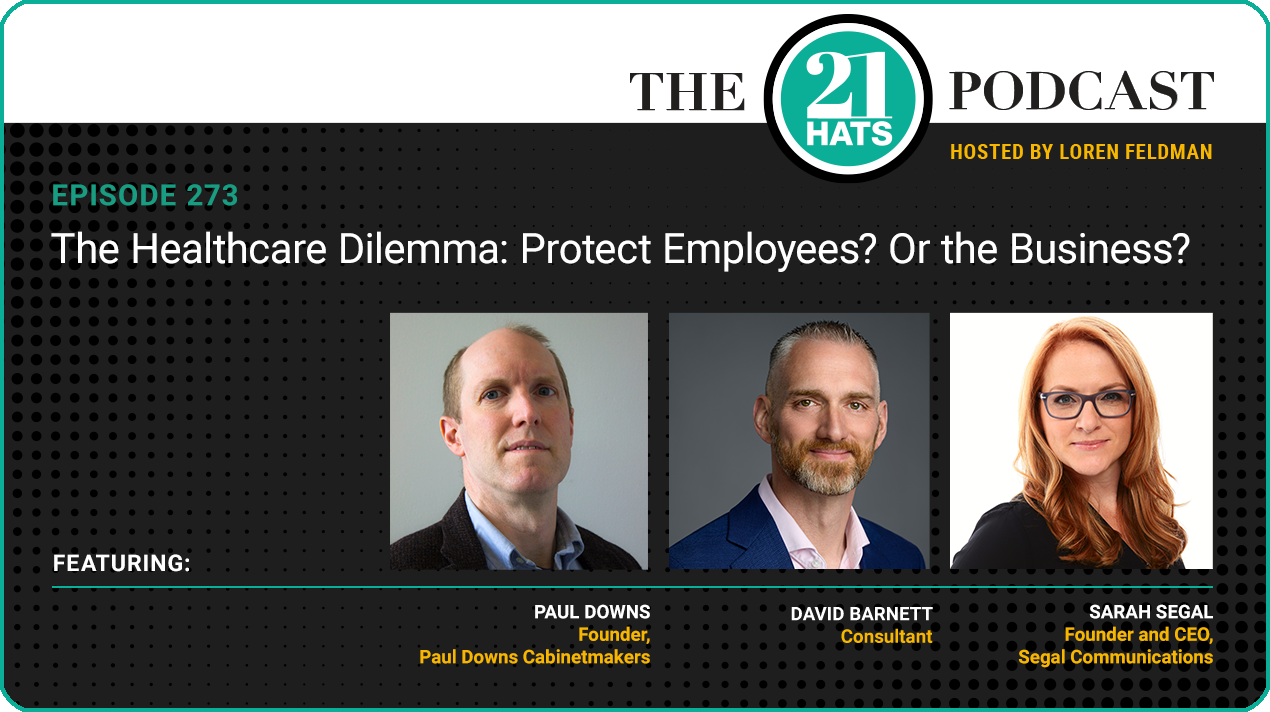
Introduction:
This week, David C. Barnett, Paul Downs, and Sarah Segal tackle health insurance, one of the least enjoyable issues business owners confront. It’s renewal season, and the three owners are seeing different systems, different pressures, but similar frustrations. Paul tells us he’s facing the largest premium increases he’s seen since the Affordable Care Act—double-digit hikes that will cost him an extra $15,000 to $25,000 next year. Sarah hasn’t received her numbers yet, but she’s preparing for the worst. And David gives us a cross-border view from Canada, where universal coverage eliminates the pricing drama but introduces its own set of complications. It’s a candid conversation about what’s responsible, what’s sustainable, and what business owners are supposed to do when the numbers don’t leave good options. Plus: We also talk about what it takes to get a business ready to be sold. While BizBuySell recently reported that more owners are looking to get out—even if it means dropping their asking price—that’s not exactly what David is seeing in the marketplace. “The truth is that small businesses sell for relatively low multiples of cash flow,” he says. “And so, the real benefit is not actually in the exit. It’s in the owning.”
— Loren Feldman
Guests:
David C. Barnett helps people buy and sell businesses.
Paul Downs is CEO of Paul Downs Cabinetmakers.
Sarah Segal is CEO of Segal Communications.
Producer:
Jess Thoubboron is founder of Blank Word.
Full Episode Transcript:
Loren Feldman:
Welcome Dave, Paul, and Sarah. It’s great to have all of you here. I wanted to start today with a quick question about health insurance. This is that time of year when many businesses are receiving price quotes for next year’s coverage, and we’ve been warned in a tsunami of stories to expect very big price hikes, much bigger than usual. I’m especially interested in Dave’s thoughts on this, for reasons he will explain in a moment, but first, Paul, I gather you got your quotes recently. How do they look?
Paul Downs:
Well, never anything good about getting health insurance quotes. We offer three policies. One of them went up 14 percent, one went up 15 and a half percent, and one went up 11.2 percent. And those are the largest increases I’ve seen since I started keeping track of this data series in 2018. So, is it the end of the world and the sky falling in? No. Does it mean that I’m going to spend probably an extra $15,000 to $25,000 next year on health insurance more than I did this year? Yes. And there you have it.
Now, I do want to give you some context. We are near a very large eastern city, Philadelphia, where the market is dominated by a couple of large hospital chains on the provision end, and the providers of insurance are basically a Blue Cross Blue Shield called Independence Blue Cross, and then the usual United and Aetna that seem to be everywhere. And I only deal with Independence Blue Cross because I’ve dealt with them for years, and I’m used to the particular flavor of bullshit that they deal out every fall. And I don’t really want to experience anything else. All the medical providers in the area are going to take that insurance, and—not that I’m happy with them—I just don’t feel like switching. So that’s me, and I don’t think that what’s happening to me is necessarily what’s going to be happening to others in other markets.
Loren Feldman:
Those increases, which you said are the biggest you’ve ever had—
Paul Downs:
No, no, no, no, no. They’re the biggest I’ve had since Obamacare came up. Now, before then, I sometimes saw 30 to 40 percent increases in the previous regimen.
Loren Feldman:
Ouch. Some of the stories I’ve read suggested that people should expect even higher increases than that. Did you have any expectations going into this when you got your quotes?
Paul Downs:
There are scenarios where if you were a small business owner who was buying insurance through the exchange and taking advantage of the very heavy subsidies that were passed post-Covid—if those get pulled away, you might see a really enormous increase in your premiums, as a percentage basis. So again, my experience has been that everybody is kind of in a different boat when it comes to health insurance, and it really depends on where you are and what you’re doing before you start comparing this year to next year.
Loren Feldman:
Can you describe what kind of coverage you offer your employees? Are you happy with it?
Paul Downs:
I’m okay with it. What we have is a program that’s rolled out by Independence Blue Cross, and they actually did this about 15 years ago, which was that a small business like mine could choose several plans to offer to their employees, and so that we could, to a certain extent, choose plans that might be—if a family’s got a bunch of young kids, they’re going to be one kind of plan better. If they’re young, single, healthy people, then another plan.
And that’s been okay, because my employees tend to choose not all the same plan. Now, getting into the details of it would quickly become kind of overwhelming for one podcast [episode], but let’s just say they’re Obamacare-compliant plans. And going by the platinum, gold, silver, bronze, I’m offering silver and bronze plans.
Loren Feldman:
Sarah, how about you? What’s your health insurance situation?
Sarah Segal:
So, our plans are administered through our benefit system, Rippling, which has been great so far, because I don’t know how they do it on the back-end, but they lump us all together, and then they have a little bit more negotiation room with the benefit providers. So we provide dental, long-term disability, medical, and vision. Our renewal plan comes up on February 1. So all we’ve received so far is the survey of like: Are we going to keep what we have? Or do we want to make any changes?
So we have three options for our employees. We pay for the lowest tier in full, and then anything above that tier, they have to pay the difference. We incentivize our employees to select the lowest tier with funding of their flexible spending account, or their HSA, or whatever it is. And here’s the caveat, though: they like the insurance. I’ve talked to them, and they’re like, “It’s great. We’re super happy with it.” So I’m not going to change anything.
I did this year. My husband switched jobs, and I took myself off of my own company insurance and put us on his benefits plan. Because what we have from my company works really well, because I have a lot of young people who are either just married, not married. None of them have kids yet. So the coverage that I have, you know, it’s still a big chunk every month, but as soon as you get into people with families, that’s just a whole different ball game, which I’m scared about, but we are preparing for the worst and expecting increases.
Loren Feldman:
In preparing for the worst, have you tried to figure out how much more expensive it might be for you next year than it has been this year?
Sarah Segal:
I’m doing kind of a budget plan for next year, and so looking at it, I mean, I was going to estimate an increase of about 15 percent, but that was just a number out of the sky that I pulled. But that’s kind of what I was predicting. I can’t imagine it’s going to go any higher, but you never know.
Loren Feldman:
Okay, so Dave, I’m guessing you got hit with a really huge increase this year. Am I right?
David Barnett:
Well, you mean for my own business?
Loren Feldman:
Yeah.
David Barnett:
I live in Canada, so the government is our health insurance company, I guess. [Laughter] And you know, basically you pay your income taxes. So everyone gets income taxes deducted off their paycheck, and that funds the health care we get from the hospital and our doctors, which is not everything. And so there are companies that still do offer health benefit packages to their employees.
So, many of my employees are married and have access to some of these supplemental benefit packages through their spouses. And so I only have a plan for myself. And so, if I want to go to the chiropractor, that’s 80 percent covered. My drugs are 80 percent covered under that plan. Eyewear is covered, like a new pair of glasses every two years, but I pay for that monthly, which is an extra cost.
Sarah Segal:
Can I ask Paul a question: Do you pay for any of the plans in full for your employees? Or do they pay the percentage of the options they select?
Paul Downs:
First of all, I cover both the employee and their children—because I believe having children is a good thing—and there’s certain lower-paid employees where I cover the entire thing, mostly because the market wage for these employees is not nearly enough for them to be able to afford sharing the cost. For my higher-paid employees, we’ll pick up somewhere between 60 and 50 percent of them and their children, and it’s expensive. It’s an expensive benefit. But I am not sorry I do that.
I think I’ve told this story before of an employee who came in and asked for some time off because his daughter had stage four cancer, and we were able to get her all the care she needed, because he was fully insured, and his family. And this is a guy who never would have been able to buy insurance on his own. And the interesting thing is that I’m paying him, at the moment ,28 bucks an hour, because I value him extremely, but the health insurance to cover his family costs another $12 an hour. And so he’s really making $40 an hour, but $12 of it is just buying health insurance.
And again, I’m glad that I had that policy, because he didn’t have to watch his daughter die through lack of care. And it’s all worked out—lovely young lady—but that’s just part of what I think a company owner who can afford it should do. I mean, these guys are the ones making us the money through their efforts, and I want to make sure that they have some security.
Sarah Segal:
I just think it’s interesting that , for the lower-paid, you cover all of it. And then as people become more higher-level, you reduce what you cover. I don’t know that I’ve thought about that option.
Paul Downs:
It’s not really—if it wasn’t so expensive, I wouldn’t do it that way. If there was some easy way for, let’s say, a $20- to $25-an-hour worker to actually afford health insurance, other than me throwing everybody off and they go get it from Obamacare—I don’t know what the current state of the penalties for doing that is, but I just decided back in the day that I’m not doing that. So I want to make sure everybody’s got insurance, and I want to share the costs as much as possible. And I couldn’t come up with a single fair way to do it that would allow the lower-paid people to actually afford to do it. So that’s where I am.
Sarah Segal:
Makes sense.
Loren Feldman:
Dave, are you happy with the situation that you have in Canada?
David Barnett:
Do I have any choices? [Laughter]
Loren Feldman:
Well, I’m assuming you’re well aware of what businesses in the U.S. deal with. Would you prefer that?
David Barnett:
I mean, it obviously just throws a whole range of uncertainty into everything. I mean, we work with American clients, and when we look at financial statements, and we see wages and salaries, and we see employee benefits, to have that line jump by 30 percent without any real control over it, I mean, that’s tough to manage as a business owner. And if you’re in a business where you’re having a hard time, or it’s hard to raise prices, etc., then that’s going to eat right into your bottom line.
You can compare the different systems based on what you get, as far as the deliverables, like if you get sick. I’ve been very fortunate, and other people in my family have had things work out pretty well when we’ve needed the healthcare system. But I know other people who would be more inclined to say they were disappointed, based on their experiences, too. So it makes it easier to plan, I think. But like I said, I don’t have a choice. Like, we can’t even choose to pay for health care if we want to. And so there are lots of cases where people have to wait for a long time to get something like an MRI, for example, and they might even travel to the United States and pay cash for it—just to speed the process along sometimes. So, I mean, that’s not a very good outcome either.
Loren Feldman:
All right, I guess what I’m hearing from the three of you is there are no easy answers to this.
Paul Downs:
I have a suggestion for David: Every time you find yourself complaining about the Canadian health insurance, take out $1,000 and put it in your pocket—because that’s the equivalent. [Laughter] I’ve got to pay for this crap system out the nose. And, yeah, there’s some things that nominally are good about it, although it took me 18 months to get a colonoscopy, because they were so jammed up. And so it’s not nirvana over here, but it’s definitely incredibly expensive. So, that’s my advice.
David Barnett:
This is what I hear when I talk to Americans. If I’m traveling in the states and I’m just having a conversation, people will invariably ask me about health care in Canada. And I’ll say some people have to wait a long time for certain things. I gave the example earlier of an MRI. So some people will have an ache or a pain, and they’re not sure what it is, and their doctor might want them to have an MRI. And that person might wait months for that.
When my mother was being treated for cancer, she was getting an MRI every week, basically to gauge the progress of her treatments. So there’s a triage mechanism of some sort that’s in play to try to make the use of that machine as efficient as possible. And if, for whatever reason, your ranking on this system isn’t high enough, it can definitely feel frustrating.
We often hear up here that with private medical care—because it’s a business and you’re paying for things—that you obviously get sort of better treatment, like any sort of private business. But every American I’ve spoken to says it’s not like that. Just like you said, you had to wait 18 months for a colonoscopy. It seems like you guys have a lot of problems with the service delivery as well.
Paul Downs:
Absolutely. And I happen to be in a major market with a lot of providers. If I was out in the middle of South Dakota, you’re in a much worse position, in terms of getting anything.
Sarah Segal:
I think it depends on where you are, because I, too, am getting a colonoscopy. Woohoo! My first one in my 50s.
Loren Feldman:
Congratulations.
Sarah Segal:
Thank you. Thank you. Very excited. Gotta get it done.
David Barnett:
The preparation is worse than the procedure. That’s what I’m gonna say. [Laughter]
Sarah Segal:
Yeah, I haven’t started that part yet. But no, getting it scheduled was like, “Do you want it next week or the week after?”
Loren Feldman:
Yeah, I haven’t had a problem with that one either. All right, let’s move on to another topic. BizBuySell, the online marketplace for selling businesses, recently released a report that indicated that sales of businesses are up considerably in the U.S., but the prices they’re attracting are down. This was a month or two ago. There was some suggestion that owners were looking to get out of their businesses ahead of potentially bad news. This was before the shutdown, and you know, given the unpredictability of the tariffs and other things going on, I’m curious, Dave—this is your world—does that track with what you see?
David Barnett:
Well, I mean the idea that you’re going to build a business up and potentially run it for 10 to 30 years and then decide to sell it in one quarter versus another because of some kind of macro economic thing you see happening is—I think it makes a great headline, but it’s not really the kind of thing that I ever see. The truth is that small businesses sell for relatively low multiples of cash flow. And so the real benefit is not actually in the exit, it’s in the owning of them.
So the top five reasons why people sell a business, the number one thing is burnout, boredom, and fatigue. Then there’s divorce, poor health, the need to relocate, and finally, retirement. I guess if you were thinking over the last year that you might want to retire, and then you felt there was something maybe negative on the horizon, it might give you an incentive to act a little more quickly, but I don’t think you can say that there is a bunch of business owners sort of waiting for the right market conditions to pull the trigger on a deal. Most people are operating their business because they need it, and they need the income it provides. And then one of those five things I just mentioned kind of happens, and then they need to go to market.
Loren Feldman:
Paul, I think maybe a year or two ago, you told us that you had started to think about preparing for an exit and that there were things you wanted to accomplish with your business to get it ready for a possible sale. Are you still thinking along those lines?
Paul Downs:
Yeah, absolutely. And I think that there’s two possible paths for my business. One would be selling it to somebody who doesn’t work here now, some external party, and there’s things about my business that would make that attractive to some buyers, particularly that we have this very good SEO position with Google that we’ve been able to maintain for 20-plus years now that reliably delivers somewhere between 1,200 and 1,300 potential buyers every year.
Loren Feldman:
Paul, the last time you were on you told us that you’re terrified that you might lose that advantage as people start—
Paul Downs:
I’m always terrified that I might lose that.
Loren Feldman:
Well, especially now because of the rise of AI.
Sarah Segal:
I have a lot of opinions on that. But keep going.
Paul Downs:
Okay, so that’s the main asset that’s independent of anything else on the business. In other words, if you bought the URL and you controlled it, you would have the opportunity to talk to 1,300 people and figure out whether you could find a way to add that to an existing business or whatever. Here’s the stream of people.
The second thing would be an internal sale to somebody on my team. And I’ve been a little skeptical about whether anybody was interested in doing that, or capable of doing it. But I just did a round of reviews a couple of weeks ago, and two people who are longtime employees expressed interest. You know, I got a lot of questions about, “When are you going to retire? What are you doing?” And I tried to be clear that I saw two possible ways to do it—you know, sell outside to a stranger or keep it inside. And both of these people, I think, could do it. They couldn’t do it by themselves, but they could do it together. And so that would be a much simpler sale, just basically sell them the stock and I would be perfectly happy to hang around and continue to help them out. And I presume there would be some kind of note I would have to issue to them that they would pay off over a period of years.
And I’m leaning towards that, at the moment, just because the 1,300 calls are a thing, but how you turn that into product is a much more complicated process and really relies on maintaining the team we have now and expanding on it. In other words, I think if you were just an outside buyer, and you walked in here and tried to run the business without knowing as much as I do about the business, I think it would be difficult to get going in a successful way. You would probably see defections from critical people, or just the lack of understanding of the business and the technical aspects of it might cause some issues.
So in order to prepare, they’re two very different things. For the external buyer, it would be highlighting the strategic value of acquiring, and then making sure that all our systems are airtight so somebody could walk in. For the internal buyer, it’s mostly about educating them as to what I actually do all day, and then making sure that somebody is doing those things. Does that make sense?
David Barnett:
Yeah, I mean, I understand what you’re getting at. What you’re trying to decide is what your exit plan is going to be, your exit path. I actually did a presentation on this Tuesday morning in front of a bunch of business owners, and I plot the different exit strategies on an XY axis chart, with one side being how lucrative the strategy might be, and the other axis being the degree of control over the timing and the execution. Because if anybody puts a business up for sale, they’re relying on this stranger who’s out there somewhere in the wilderness appearing in a timely manner with the resources and the desire and the ability to make a deal happen, and perhaps, make a banker happy to advance funds for a loan.
If you have two prospective candidates inside your business who could take over your business, then you could sell it to them, but it doesn’t necessarily have to be a one-moment-in-time event. You could create a multi-year succession and sale plan where they come on as small minority shareholders to start with, and then increasingly take over management jobs that you do. And then, over the course of several years, they could buy successively more and more shares from you, and eventually buy the business. And, you know, that kind of exit plan can have a great degree of control, because you can actually sit down and make a plan with them.
And you can also avoid what is a potentially big killer of any small business, which is a huge amount of leverage. Because if they are buying the stock from you little by little over time, then there may not be a need to go and get a big bank loan. Whereas if they are going to buy it in one transaction, then likely they’ll have to borrow some money. And then all of a sudden, they’ll experience a great degree of stress having to make those payments. And, I mean, you’ve talked on this show about the ups and downs in a particular business .That added stress of a bank payment can really make the difference between someone being successful or not.
Paul Downs:
Is there some third path? I mean, I suppose, just keep the business until I suddenly drop dead is a third path.
David Barnett:
There are variations on it, like some people will sell in small tranches to the buyer, and then once they reach a certain level—like, maybe if these two people own 40 percent of it, then they go buy the rest in one fell swoop. There’s different variations on this idea. But once they have been in the business and doing all the different roles that you do, it becomes easier for them to, number one, run the business, but number two, to then qualify for financing. Because a lot of the fears that lenders have have to do with: Can this buyer run this business? And if these are insiders who actually are in the business and know the business, it becomes easier, again, for them to borrow.
Loren Feldman:
Paul, this would be less of a concern if you follow the scenario that Dave just laid out. But if you were selling to an outsider, one issue, I think, might be how dependent the business is upon your personal efforts in the day-to-day running of the shop. Have you been thinking about trying to extricate yourself from the day-to-day a little bit?
Paul Downs:
Well, I already have, in a lot of ways. And the operational role of salesman and engineer and delivery—I mean, I’ve done everything in the company, and I don’t have an operational role at the moment. Now, I do dip into sales now and then, when it’s a project that I think has potential, but nobody else on the sales team wants to touch it. And I do quite a bit of just sort of maintaining a lot of behind the mechanical things that somebody needs to do, like maintaining our GSA contracts.
They’re not rocket science. Somebody needs to do them. I do all the HR, and I manage all the money. And none of those things are so complicated that I couldn’t teach someone else to do it. I mainly do them because I don’t particularly want to pay somebody to do it right now, because it gives me something to do. And I still enjoy going to work. You know? I like being there.
I think that the biggest intangible is that people are used to working for me, and I have a very particular idea about how I want to run the business, and the people who are here seem to like it. So if new people took over—and this would be a huge problem if it’s an external buyer—that’s the most likely thing to cause problems, that they just bring in a different culture and a different approach. But that’s where I’m at with it. I’m mostly doing things that I like to do, or I’m willing to do, because they’re too much of a pain to explain to anybody else.
Loren Feldman:
Sarah, you’re still young. You’ve never even had a colonoscopy. [Laughter] But have you started to think at all about a possible exit?
Sarah Segal:
I love that I’m in my fifties, and I’m still young. Thank you. It’s all that Botox. Hello, I live in California. So my husband and I actually went to a financial planner yesterday, and the guy’s sitting there, and it was kind of our intake session, and he looked at my husband, and he said, “Well, when do you want to retire?” My husband had a more concrete vision. And then he looked at me and asked me that question. And I was like, “I dunno.”
But here’s the thing is that there’s two things that I’ve been thinking about a lot: At one point, I want to be able to have my company set up in a way where I can suddenly look at my team and go, “I don’t work Fridays anymore,” where I’m like able to trust the internal infrastructure to keep things going and a little less of a rigorous work week. And then the second thing I’m starting to focus on is—and I haven’t touched this really—what are all the metrics and numbers and data that a potential buyer would be looking at if I were to be bought by a larger entity? I have been bought once before, but I was much smaller then. So it was a little bit more of a funky process.
Loren Feldman:
You sold your business to a larger company, and then you actually bought it back.
Sarah Segal:
I did, and it’s interesting—that’s apparently not rare. This IR firm I worked for a long time ago, they were bought by a larger entity, and like the owner just posted on LinkedIn, saying, “Hey, we bought ourselves back.” I was like, “Okay, but I wouldn’t want to.” If I sell, it’s selling for good, right? But I want to be able to have resources. And perhaps you guys can send me the right direction of, like, what are the 10 to 20 things that I need to have really dialed in to be very attractive to somebody who would want to buy us?
I don’t want to sell today. I have no intention of selling tomorrow. But when I get to that point where I’m like: I don’t love it as much as I do., or my age is starting to show, who knows? I want to know that I’m not going to have to figure that out at that time. I want to make sure that I can push a button, pull a report together, and be like, “This is us.” So that’s kind of my story right now.
Loren Feldman:
I bet Dave has a ready answer about what you should be thinking about.
Sarah Segal:
Give me answers!
David Barnett:
Well, I’ve got a whole program called Exit Ready that you should go through, because it exactly does all of this. And I tell people they should go through it like two to 15 years before they think they might want to exit. But in particular, all you have to do is put on an empathy cap and think about your business from a buyer’s point of view, because there’s basically two questions: The first question is: What is the demonstrable, steady cash flow coming out of this business? That’s going to determine the price of your business. The second question is: Will this cash flow continue under the new owner’s stewardship?
And that’s the prickly question, because that’s when you get into, well, are there systems and procedures and all this kind of thing in place? Is everybody dealing with Sarah, or are there employees who do these things? Is there a customer concentration problem here? So, do you have five clients representing 50 percent of your revenue, for example? And so all of those questions are going to basically help the buyer determine if they want to do the deal at all, or if they’re going to need to structure the deal to manage the particular risks that they turn up.
Sarah Segal:
Yeah, that’s really interesting. I don’t want to interrupt you, but like, I have this conversation on a regular basis with my team where I’m like, “Listen, I’m really resistant to any one person becoming too connected and bonded with one client, because it doesn’t do anybody any favors.” Because if that employee leaves and the client’s like, “Well, where’s my person?” Or it just causes problems in that space. And so, my clients, I don’t think there’s any clients that are like, “Sarah’s the person.” I really try to make sure that the team is showcased for their contributions, and then I’m just there for the vast knowledge of having worked in this business for a really long time. I can help turn things different ways. So I do think I have that.
David Barnett:
Do you have one client that represents a big chunk of your overall revenue?
Sarah Segal:
My old story is that I used to and then that imploded in my face in 2023 where I had three or four large clients with huge retainers all leave at the same time for different reasons—like VC money running out, they made a bad investment, whatever it was. It wasn’t based on our work, and I had to lay a bunch of people off because of that.
And I had been told by so many other people, “Don’t go to the end of the driveway for less than $10,000 a month in retainer,” or whatever. And I listened to that for a really long time. And so after having gone through that terrible experience of having to let go of people who I really, really liked and valued and were great contributors, I reworked our entire thing. So now our retainer levels are much more modest, but we have a lot more clients. So the balance of that is that we have to have a ton of systems in place to find those efficiencies. Because right now, we have 22 clients.
David Barnett:
Yeah, so it sounds like you’re doing a lot of the right stuff, and the buyer of your business is either going to be someone else who’s already in your industry. Maybe they’re looking for a footprint change, so maybe looking for a West Coast office or something like that. You know, I recently helped a client of mine make an offer on a janitorial business, and the business had one client that was 30 percent of revenue. So it kind of mirrors what Sarah was saying about her business a few years ago, and the buyer ended up making an offer with a large degree of seller financing with an offset amount if that client ever left or the revenue went below a certain level in the first three years after the acquisition. And the seller didn’t like that and ended up rejecting my client’s offer and didn’t want to talk to him anymore. My client followed up with the broker about a month later and found out that the subsequent two buyers made similar offers, because everyone who’s going to buy a business sees the same problem.
And Sarah, when you lost those four big customers, you were able to lay off some people and get your costs in alignment, and you survived. But if you were approaching that year with those four big clients, and you had a giant bank loan that you had just taken out to buy the business that you were running, and you lost those four clients, no amount of job-cutting would have saved you. You would have ended up having to close your doors. You’d have been bankrupt.
Sarah Segal:
And the way that I do things now is, yeah, we have some bigger, mid-size, and smaller size and whatever, but any one client—I don’t like clients leaving. We spend so much time getting to know them and really diving deep into them. But things happen, and budgets shift and change, but no one client should have an impact on my staff. I don’t want that to ever happen again.
But it also gives me the flexibility of being like, “Hey, client, I see that you are having some other things, and I don’t ever want my services to be a burden on you. I want my services only ever to be a benefit to you.” So we sign contracts, but I am probably one of the most flexible agencies out there, because I’m a small business. I understand the challenges that pop up and I get it. And I’m always happy to work with people, because I’d rather have the continuity than the cash.
Loren Feldman:
The tricky thing there, Sarah, is with all those clients you have now, some of them are going to grow and do well. And without your even noticing it, initially, they may become a bigger part of your portfolio than you realize. Have you thought about what you would do in that situation?
Sarah Segal:
No, but I’ll let you know what I do. [Laughter]
Loren Feldman:
It’s not a terrible problem, I suppose.
Sarah Segal:
No. And knock on wood, we’ve got some interesting things coming to us next year that I’m really excited about, that, because we have a lot of we have a lot of kind of small to mid-size businesses, we have a couple marquee brands that may be coming our way, that we’re really, really hopeful for. And those are the clients that, when we get those, they’re going to take us from being—I think I’ve said this before on the podcast—my business is a pimply teenager. And we’re looking for all those opportunities to figure out how to become an adult. And I don’t know what I don’t know, but I know that, at some point, there needs to be more structure in everything that we do so that we can continue to scale. Because if we don’t figure that stuff out, it’s going to be really hard to scale.
David Barnett:
Can I bring us back to an earlier part of the conversation? I had mentioned earlier in the podcast that the benefit in owning a small business is in the operation, not the sale. And so Sarah, your question was about an ideal exit, or what buyers are looking for, etc., etc., if you got a whale of a client showing up on your doorstep that was going to be 40 percent of your revenue, for example, according to what I just told you, that wouldn’t be good for the resale of your business. But if you knew you were going to be serving that client for the next three or four years, it would be better for you to take that client and earn the money from working with them and then have a quote-unquote disappointing exit when you go to sell because of the position you put yourself in, because the the money you would put in your pocket over the three or four years that you serve that client would more than offset the reduction in value that you might face negotiating with a buyer.
Sarah Segal:
That makes sense. Yeah, I’m not going to turn people away. If they’re like, “Hey, we want to sign a three-year contract and give you all this money,” and it aligns with the stuff that we do, I’m not going to turn them away. It’s just being more flexible and having a larger retainer and retainer options has made me feel more comfortable, in that I don’t worry about a particular client staying or going, because my P&L is fine without them. But that’s a good point.
But hopefully, over the years, my modest retainers will become a little bit higher, and my modest retainers will be a little bit different. And then I’ll have a variety of larger modest retainers as I grow. But, yeah, I’m not gonna turn people away. You want to hire us? I will figure out how we’re gonna do that. Bring it on.
Loren Feldman:
Sarah, we exchanged emails earlier this week, and you said something about feeling as though you are building your plane while you’re flying it. What were you referring to?
Sarah Segal:
It’s exactly this. I mean, I did a lot of things this year that I didn’t mention. I hired a fractional CFO, a fractional HR person. Actually, this is my favorite recent thing: The first person I ever hired recently came back to us, and I’m so excited. And she fills an operational role in the company, and a lot of the systems for my company are things that she created. So it’s nice to have that, because I just don’t have the bandwidth to do that, and nobody else really—that’s not their thing.
But building while you’re flying is not just finding those efficiencies for the client work. It’s also figuring out: How do we think about what we’re going to be doing in five years and build the process now? Because I know Paul was talking a little bit about the traffic that he gets to his site. And then, of course, being the curious person I am, I went and I looked at his domain authority. And I looked at the amount of organic traffic that he has coming to his site, which is good, but it’s not based on external links. It’s based on internal content, information that you’re providing to people. So you’re doing really well on your keywords. You’re not thriving based on backlinks from authoritative websites like The New York Times and Washington Post and all that kind of stuff.
Loren Feldman:
Well, he had a lot of links from The New York Times a few years ago.
Sarah Segal:
I know, but—
Paul Downs:
Can I just jump in? I mean, first of all, we got put into decent or excellent organic positioning way back in 2002 and 2003 just by sheer luck. And without doing anything smart to maintain that, we got all the way through to when Loren hired me. And then I had a period of four years when I had a zillion backlinks from The New York Times. And that was kind of like a turbo booster, and that ended.
But we’re pretty dug in. And I think that that’s a big part of success on the web: How dug in are you? How long have you been successful? So now that we can do that helpful strategy, which is, in my mind, should be the baseline for every website. But how I got there involved some very authoritative backlinks.
Sarah Segal:
But here’s the thing: It’s shifting now. Because when somebody used to go into Google and search for a new conference table and go through the first and second page of Google, they’re now switching to “Hey, ChatGPT, where’s the place that I can buy a conference table and have it custom made?”
Paul Downs:
Well, we’re aware of that. I mean, last week—and I don’t know whether you heard the episode, but—we specifically talked about my recognizing that this is the issue, and a home brew strategy for trying to address it. And I would invite others to refer to that episode, rather than me going through the whole thing again. But yeah, everybody can see that coming. It’s just that nobody knows exactly what the playbook should be.
Sarah Segal:
But it’s a big problem for my industry as well. Because how do we quantify the work that we do with traditional media, influencer, social media, all that kind of stuff, in terms of its searchability on these platforms? Like, it’s no longer impressions. It’s no longer backlinks. How do we say: What we do for the company has value? And so my industry is spiraling a little bit because we know that earned media is still very key.
Loren Feldman:
So those links do still matter.
Sarah Segal:
They still matter, but they don’t—
Loren Feldman:
It’s third-party validation, which—
Sarah Segal:
Yes, but you can’t track it, because somebody who finds something on ChatGPT is not necessarily clicking a link. Nobody’s gonna see that it’s being driven to your website.
Loren Feldman:
But you can take on faith that getting that kind of—
Sarah Segal:
[Laughter] You think I can report, “Hey guys…”
Loren Feldman:
I understand that this remains something of a mystery, but my suspicion is that many of the things that helped you with your SEO will also help you in this brave new world. And I think being linked to by The New York Times will remain a good thing, even if it’s harder to measure.
Sarah Segal:
Yeah, no, I’m just saying that I can’t go to my clients—and this is where I’m trying to think about five years ahead of time—I can’t go to my clients and be like, “Well, you know, we think that it’s good, and it’s giving you brand awareness and driving traffic to your site. We can’t give you metrics behind it, but like, we think it’s good.” So that’s where everybody in the PR and comms industry is like: How do we quantify this? How do we prove to our clients that everything that we’re doing actually is valuable to them? Because when it comes down to it, they want to know that they’re getting their dollars’ worth.
Loren Feldman:
We only have another minute or two. Dave, have you thought about this, and are you concerned about being able to track where your leads are coming from?
David Barnett:
No, because, when I was in university studying marketing and sales and advertising, when the internet was first born back in the early 90s, and when the internet came along, they had this great idea that somehow we could attribute every customer we ever met to exactly a moment in time when they click the link. And I know that’s not true, because when we get a consulting engagement, we have a little space on the engagement agreement where we ask, “How did you ever hear about us?” And people will put all kinds of different things. Sometimes I’ll put that person’s email into my MailChimp account and find out they’ve been on my email list for two years, but on the engagement agreement, they’ll put that it was YouTube, right? So, which team gets the score or the check mark? Was it the email list, or was it YouTube?
The fact is, you do all kinds of stuff to make sure people know about you, and it’s really difficult to absolutely know where or how somebody found out about you, especially because we still have a lot of offline loops in how people function. People spend most of their day offline, and if somebody is listening to me on YouTube, and a friend of theirs expresses an idea or concern that I can help with, and the friend says, “Hey, I’ll follow this guy on YouTube you should check out,” that’s not going to show up in any kind of attribution. So I’m not that worried about it. I do stuff to make people aware of us and the work that we do and hope that it works, I guess. It’s kind of like, Paul, don’t you sacrifice some money every month to the Google gods, or something like that? Isn’t that what you said before?
Paul Downs:
Absolutely, I throw cash at them. I don’t expect anything from it, other than they don’t completely remove me from my position in organic.
Loren Feldman:
So Sarah, on a scale of 1 to 10, how big a crisis do you see looming for your industry in particular, in terms of the attribution issue you raised?
Sarah Segal:
Well, I think people know that the value of what we do is there. It’s just the magic of finding the secret sauce of how to quantify and report on it. Because we’re in reporting season right now, where our clients want to [go], “Hey, how did we do this year?” And all those metrics, they’re still pretty standard. We have to kind of reinvent the wheel a little bit and figure out how we’re going to do that going forward. And all of the platforms we use, they’re also trying to figure that out. What are the triggers and levers that they can track that give us an ability to say, “Hey, more people are finding you directly because of us”?
Loren Feldman:
Well, I’m sure we will discuss that further. For now, my thanks to David Barnett, Paul Downs, and Sarah Segal. Thanks for sharing, everybody.

