

The Old Rules of Hiring Are No Longer Working
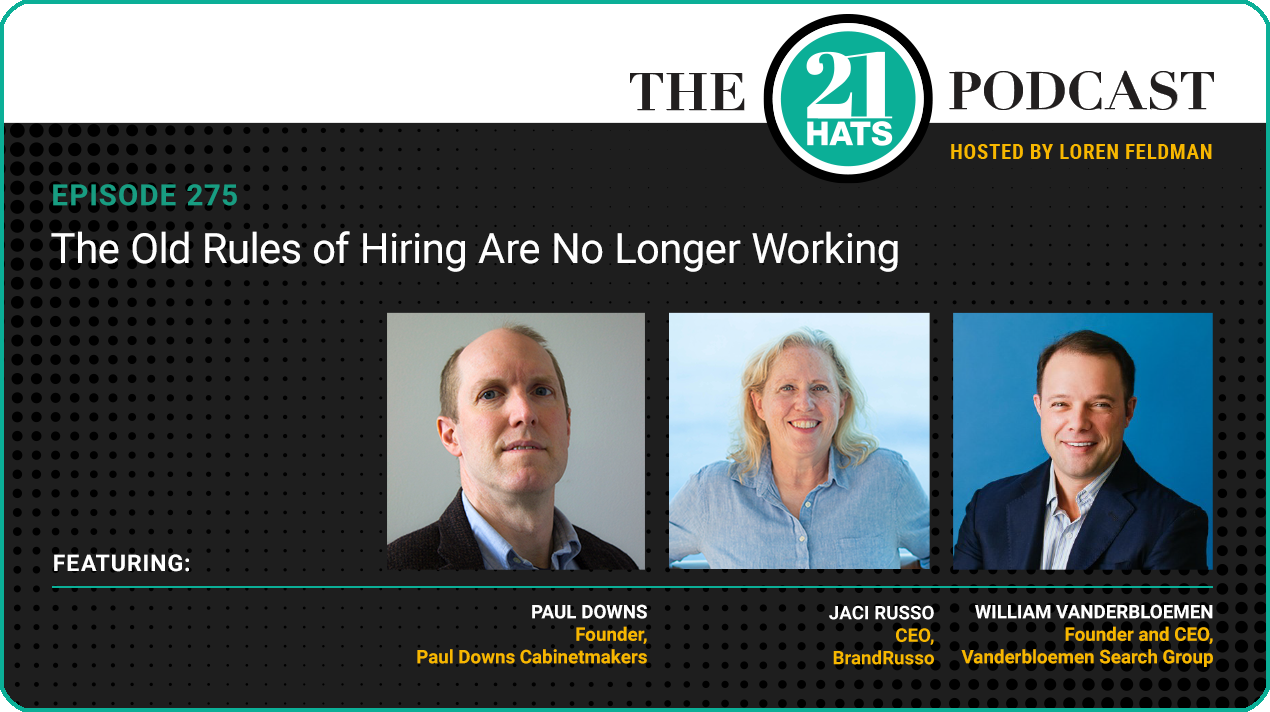
Introduction:
For years, business owners have been told to follow a familiar playbook when it comes to hiring: Take your time. Be selective. Hire slow, fire fast. But more and more owners are discovering that those rules don’t fit the reality they’re facing right now. This week, William Vanderbloemen says employers can no longer indulge the luxury of hiring slow. “The shortest sermon I’ve got,” says the former pastor, “is candidates are more fickle than ever, and owners need to realize that.” Paul Downs says he’s trying to figure out what’s gone wrong with his hiring process: Is it the way he uses Indeed? The way he approaches candidates? Or the differences between hiring white-collar and blue-collar employees? Jaci Russo believes companies should always be marketing their brand as an employer and always be on the lookout for good people—even when they’re not actively hiring. Plus, in a wide-ranging, end-of-year discussion recorded in December, the three owners talk about whether they hit their numbers in 2025, whether they use a formal budgeting process, what they expect in the year ahead, and how far out they can realistically see when they try to plan for the future.
— Loren Feldman
Guests:
Paul Downs is CEO of Paul Downs Cabinetmakers.
Jaci Russo is CEO of BrandRusso.
William Vanderbloemen is CEO of Vanderbloemen Search Group.
Producer:
Jess Thoubboron is founder of Blank Word.
Full Episode Transcript:
Loren Feldman:
Welcome Paul and Jaci and William. It’s great to have all of you here. Let’s start with you, Paul, I gather you’ve had some hiring issues of late, something I think perhaps Jaci will be able to relate to. Paul, what’s going on?
Paul Downs:
Well, I should have tried to hire a skilled cabinetmaker earlier this year, and I didn’t. And so we’ve—
Loren Feldman:
Let me stop you right there, Paul, because you were laying people off earlier this year. Why should you have hired someone?
Paul Downs:
Why was I laying people off? Okay, I laid people off in March when sales had been so slow in the first quarter that we just had way too many people for the amount of work, and I was concerned about running through my backlog and running through my cash. So I did a big layoff, which was not much fun for anybody. And then a week or two after I did that, then sales suddenly revived, and they’ve been strong ever since. And that put us in a position where I had to bring back office staff to handle all these incoming orders. So we needed the full sales team, we needed project managers, we needed engineers, but we were still somewhat short-handed on the shop floor.
The project managers and engineers and sales staff were people who easily came back and were reintegrated, but now I’m paying a full office staff. And with a diminished production staff, what started to happen was that we were having difficulty hitting our revenue targets. In other words, sales coming in are great. Someone sends you checks and you’ve got all the money for it. And that’s one way to think about: Are you doing well? But it can be very beguiling in a bad way, if you’re running a manufacturing concern.
You really also need to pay a lot of attention to the value of what’s going out the door. If you can’t get work out the door, then you end up in the situation that we are in, which is sales are piling up, the backlog is getting bigger and bigger, and we’re not actually operating profitably. But the good news is we do have work and we do have cash.
So having had to lay everybody off in the first quarter, I was very loathe to go right back up to the same level of staffing, because there was so much, let’s say challenging stuff, coming down the pike in the greater economy with tariffs and what have you that I was not convinced that our sales would remain strong. And I was really trying to avoid hiring a bunch of people and then immediately having to do a layoff again. So at this point, the sales have just stayed strong, and I absolutely need to get more people onto the shop floor. And so now, for the last four weeks, I’ve been running ads on Indeed, and have received about 250 applications. So that’s a lot just to wade through. But the biggest problem is, out of that 250, maybe 10 people are actually qualified for the job.
And when I reach out to these people and say, “Hey, I want to interview you.” Let’s say, out of 10, eight would respond. Two would not. And then of the eight that we set up interviews with, only four would show up. And so I’m wondering whether I’m doing something wrong, in terms of how people want to be responded to when they make an application through one of these platforms. Because I just feel like my normal thing would be: I like you. I’m sending you a message. Let’s do an interview—but not getting as many people showing up to talk to as I would have expected from that.
So, I don’t know. Anybody got any ideas about what’s the best way to use a platform like Indeed and how you should respond to people you want? Do they need to be coddled? Do they need to be begged? Can you just say, “Hey, here’s who we are. Take it or leave it. We’re the best. You’d be lucky to work with us”? So any advice would be quite, quite welcome.
Loren Feldman:
Jaci or William, any thoughts about Paul’s excellent question?
Jaci Russo:
Yeah, I want him to do the last thing he suggested, where he says, “We’re the best. Just come here.” And I want him to record it and share it with us, because I want to see how well that goes.
Paul Downs:
So you only want to do it to see whether it works not because—
Jaci Russo:
Oh, no, I want to do it because when it doesn’t work, I want to see the reaction. You know, I don’t think it’s Covid times where it’s lopsided one way or the other. It feels more balanced than it has been the past few years. But I definitely think the mindset has shifted.
And, you know, I do all that consulting work with the Edward Lowe Foundation, and a big part of that is the recruitment, training, and retention of teams. And so what I see is, it doesn’t matter the geography. It doesn’t matter the industry. The companies that are perennially open for hiring, meaning they’re always putting the word out—they don’t have a spot yet, but they’re always putting the word out for qualified, talented people—they’ve got a backlog of applicants. And so then when they do have an opening, they start with that stack first, because there’s already a relationship there.
Paul Downs:
How long do you think someone’s going to wait if they’re on the job market?
Jaci Russo:
Oh, I don’t think they’re going to wait. I think they’re going to leave the place that takes them for granted and come to the place that is, in their mind, positioned as the crème de la crème opportunity.
Paul Downs:
No matter what? So somebody leaves a job or decides they need to leave a job, and let’s say that only happens when the current situation is intolerable for some reason, and they don’t have unlimited savings. And meanwhile, I’m plucking one applicant who’s been sitting around for six months off my pile every now and then. Like, that just doesn’t strike me as being realistic. People who are looking for jobs tend to take jobs because they need them, right? So how long can you wait?
Jaci Russo:
I think we’re talking about two different things. You’re talking about the people who are in the market right now. Those people, they’re only going to be in the market until they get scooped up. But I’m talking about people who are looking, and they may be in an okay job, and they’re going to keep looking until a great opportunity comes along. And if you’ve built a place with the culture and respect and systems and processes that make it a great job, then when you do have the rare opening, people will jump ship to come to you.
William Vanderbloemen:
Totally disagree with you, Jaci. Totally disagree with you.
Jaci Russo:
All right, bring it.
William Vanderboemen
I one hundred percent disagree.
Loren Feldman:
Tell us, William.
William Vanderbloemen:
And that’s a new reality. Let me give you a little background. The problem with saying, “Tell us, William,” is William is a recovering preacher. So it’s gonna be long and three points, and it all starts with the same letter. There might even be a poem at the end. Who knows? [Laughter]
But in 2020, long before it was a thing, we called—at the end of 2020, we said, “There’s gonna be a great resignation.” And it was my Forbes column. It’s probably the most read thing I’ve ever written. It happened. The pendulum has swung back now to the great clinging, or whatever you want, a phrase that sticks. People are hanging on to their job. They’re not willing to leave as quickly as they did. Okay, so the pendulum swings. So maybe you don’t lose somebody who job hops immediately. But I have never, ever seen, in almost two decades of doing this—executive search—candidates who are more fickle than they are right now.
Jaci Russo:
Fair.
William Vanderbloemen:
And I think there are a lot of contributing factors, and I’m incredibly bullish about Gen Z—despite all that’s written about how they don’t know how to interview and they don’t know how to dress, and they don’t know how to look people in the eye. We can fix all that. They work hard—very bullish.
However, in their world, these are the first iOS-native people, right? Gen Alpha, Gen Z, and Millennials, to some extent. And they make up the bulk of the workforce. When I grew up, there were three channels to watch, unless you happened to watch PBS, which I did all the time. So there were four. Saturday morning was, what do you do on Saturday morning? If you’re our age, everyone on this call would say: Oh, that’s when we did what? We watched cartoons. Because that’s when the cartoons were on. Ask someone who’s young in the workforce right now when the cartoons are on. The answer is, “Whenever I want them to be.” And if I don’t like one, I’ll go to another one.
Loren Feldman:
Preacher? Preacher, I’ve got to interrupt you. I don’t hear you disagreeing with Jaci yet.
William Vanderbloemen:
I think that if you have a quality candidate, and you need to hire them, you’d better not wait. One of the longest standing phrases in my world that I didn’t make it up is, “Hire slow, fire fast.” I don’t think you get the luxury of hiring slow anymore.
Jaci Russo:
Agreed.
William Vanderbloemen:
I think we’re in an on-demand generation. If they see it and they want it, they go do it. And if it’s not you and you’re not ready for six months, then you need to be ready to hire whoever’s ready when you’re ready.
Jaci Russo:
Oh, let me, let me clarify—
Loren Feldman:
Can I jump in here for a second, Jaci?
Jaci Russo:
Yes.
Loren Feldman:
I want to defend you.
Jaci Russo:
Thank you.
Loren Feldman:
You’re talking about something that’s come up here a little bit. Shawn Busse has said things along these lines, too. If I hear you right, you’re kind of suggesting that Paul do a form of marketing, except instead of marketing his product, it’s marketing his place as a place to work and build up a reputation for being a great place to work. And as a result, create interest that maybe forms a backlog that he can tap. And no, not everybody’s going to still be there on the list when he’s ready to hire, but maybe someone will be. Is that what you’re talking about?
Jaci Russo:
Yes, and it may not solve today’s problem, but it means today’s problem doesn’t happen again, because you’re proactively building a stable of talent, and you’re building your brand as a place people want to be. And there’s a scarcity mindset. And so when a job happens at a place that’s awesome, Paul has a better chance of getting qualified candidates to say yes next time.
Loren Feldman:
Paul, you’ve talked many times about creating a great place to work, you know, a place where people really want to stay, and that all makes sense to me. I’m curious, have you tried to spread the word about that? Have you tried to create a reputation for being the place you are?
Paul Downs:
Well, sure. I mean, no, I haven’t tried to create a reputation. I’ve tried to create a great place to work. Because if you just try to create a reputation, you’re wasting your time. If you try to create a great place to work—
Loren Feldman:
Well, it’s marketing. You believe in marketing.
Paul Downs:
Well, we are a great place to work, and I do have a great reputation within my narrow industry. But I think that the efficacy of that approach is going to depend on the industry, and particularly whether it’s a blue-collar or a white-collar job. And blue-collar hiring is, I think, just different, in that most good craftsmen are going to be highly valued wherever they are, and people are quite slow to switch to another company without an excellent reason. The reputation of all my competitors is good enough to keep their best people.
The other thing about blue-collar hiring is that the expectations for careers, I think, are a little bit different. And the overall way you communicate with the kind of workers I need is not at all like what white-collar people do. And what I fear is that the approach that Jaci described, if I deployed it, it just misses the mark with people who are used to a whole different culture of work. And now, that said, I regularly get approached by people who want to work for me, and if they seem like a good fit, I hire them. And those have been some of my most successful employees.
But you can’t rely on that all the time. Like, I just haven’t had the right people walk in the door in the last six months. So yeah, I’ve got to go out and throw a net out there and see what kind of fish come in. And that is a process where I feel like I’m not connecting. And part of it may be that I’m working through a platform like Indeed. And part of it may be that it’s hard for a company to establish a reputation and communicate it through whatever channels blue-collar people are ordinarily looking at. None of the people who work for me are reading The New York Times or Forbes or any of that. They just aren’t. They’re just a different breed of cat.
And then, particularly, if you need to hire for somebody who’s an even lower-level job—you know, somebody who’s going to be pushing your broom, again, is not hooked into the whole written culture in the way that those of us at the top of these companies are doing. So I wish that just having a good reputation and being a good place to work would have a line of people out the door every day and make my choice. It’d be great. We wouldn’t even be having this conversation. But what I’m saying is, I feel like I’ve got a good job. There’s people who want it. And there’s something happening in the communication that I’m not responding fast enough, or I’m responding too fast, or I’m doing something, and it’s very difficult for me to put my finger on it. So I think that I would actually be curious to hear whether either of you ever hire blue collar.
Jaci Russo:
No, but I have clients that we’ve done that for, and you identify a couple of fair points. We did change their process to what I’m talking about, and it was very effective for them. But the other thing that we identified in talking to either employees who they lost or candidates who they missed out on, we identified a huge gap in how the company talked about benefits and salary package, total compensation, and their understanding.
And so these employees were leaving for a quarter more an hour, not understanding that they were giving up health care, 401(k), because they saw no value in that. And so we created marketing materials that explained the value of the different elements of the compensation package and gave it numerical values, and all of a sudden they saw their total employment package. And we stopped having that problem.
Paul Downs:
And you were just what? Putting a sign on the wall that said, “We’ll pay you $28.75 an hour?” What?
Jaci Russo:
Well, no. We ran ads. We recruited from competition. We kept our ads going, our website open for applicants year-round, and they had a stockpile of resumes when a position came up. And they would steal from competitors because we were now showing a higher compensation package, and that made them come to the client.
Paul Downs:
You know, I will say one thing you just said, is on target.
Jaci Russo:
Oh, thank goodness. I was gonna be so sad if it was the whole hour and I had nothing of value to contribute. [Laughter]
Paul Downs:
No, I just realized that we have never put anything about hiring on our website. And I don’t know why, just because it really hasn’t been so difficult in the past. But that’s something that I need to do. We need to explain to people, “If you want to work here, this is what we’re looking for.” So thank you, I appreciate that.
Jaci Russo:
And your socials and your email. You should market your company the same way you market your products.
Paul Downs:
That’s a good point, and I have been bad at it.
Loren Feldman:
William, I’m curious, you have a very specialty area. Do you use Indeed or one of the platforms?
William Vanderbloemen:
We use every platform. I mean, it’s a very different thing, Loren, than even what Paul’s talking about with craftsman hiring, or blue-collar hiring, or however you want to label it. People hire us when they say, “I need a chief marketing officer, and we cannot miss, and I don’t care how long it takes. I want the right person.” That’s usually the reason people call us. So it’s a very different thing. So, what I would say is our work—I hate the white-collar, blue-collar delineation, but I get what we’re driving at. Our work’s probably white-collar, C suite-ish sort of things. It’s a squishy way of saying it, but that’s for this conversation.
Maybe I’m not helpful to Paul, but here’s what I know: The blue-collar work that we’re describing is more transient than executive hiring, and so the people we work with should be more stable as a candidate pool than what Paul is looking for. I’ve been in a meeting all morning with our leadership team saying, “Why is it that this year, more than any other year, it’s taking us longer to complete a search than ever?” Our net promoter scores are as high as they’ve ever been. So people are happy with our work. Our brand reputation is, thankfully for the moment, it’s in a really, really, really good spot. People want to come work here. People want to hire us to help them. So why is it taking us longer and longer to place a candidate?
And the answer that we keep coming to is: Candidates are dropping out like they never have before. And if employers aren’t aware of that and won’t just own up to it, then they’re going to be in the same predicament Paul’s in now. White-collar or blue-collar, it’s a fickle market. There are more choices than there’ve ever been. And if you find someone good, you need to move on it. And if you get in your spot where you don’t have anyone, and you’ve got an opening, I wish you the best.
Paul Downs:
All right. [Laughter] Well, I definitely need to start putting something on our website so that people understand who we are and what we’re looking for.
William Vanderbloemen:
Paul, sorry to interrupt, but one thought that came to mind: We tell our clients all the time—and let’s use our most normal example: a church hires us to find their pastor, and so they’re nervous as all get out, because none of them have hired a pastor. They don’t know what to do. They don’t know, and they’re scared to death they’re going to bring the wrong person in. Many times we’re replacing somebody who colored outside the lines and got fired, and so they’re nervous. “We can’t get the wrong person.”
And I have to remind them, “Look, you’re going to wear two different hats through this process. On one hand, you’re wearing a hat that’s a discernment hat. Is this the right person? Are they going to fit our culture? Are they going to do quality work? Are they good enough for us? But on the other hand, you’re going to have to wear a recruiting hat, too. This is an awesome place to work. This is where you want to be. We really want you.”
And sometimes one hat gets worn more than the other. And I think right now, in the current climate, employers need to be more ready to put the recruiter hat on than the discernment hat. You’ve got to do both. But I think that that even we, who’ve had a line out the door of people who want to work here, we’re having to up our ante on why you should want to be here, so that when the time comes—as Jaci very rightly said—the reputation’s out there, and it goes. But underneath all that, the shortest sermon I’ve got is, candidates are more fickle than ever, and owners need to realize that.
Paul Downs:
Okay.
Loren Feldman:
I want to move on to something else, but Paul, I just wanted to clarify one thing. You said earlier that you have a significant backlog of work, and you referred to the layoffs you made, so I think you still have fewer employees than you had when the year started. But you also said you’re not operating profitably. Can you explain why you’re not operating profitably right now?
Paul Downs:
Yeah, it’s pretty simple. The business model of a manufacturer is you’re basically selling production hours at some rate of money, and when you’re fully operating at full speed, you’ve got X number of hours times X number of dollars. That’s your accrued revenue, and the expenses you have to cover with that are whatever they may be. And, you know, like the rent and my salary and all of my office staff who are not hourly, productive employees, they cost Y. And if Y is greater than X, like even if you could get everybody to work 100 percent all the time, you just don’t have enough people to cover that nut of the expenses. You’re going to be operating unprofitably on an accrued basis. That’s where we’re at right now.
Now, what does that look like? It can look pretty good if you’re selling faster than you’re building. You can have a kind of a backlog of cash coming in, because cash could be arriving faster than you’re spending it. It can be very difficult to realize that it’s not that you’re making money. You’re just bringing in money a little faster than you can book it as revenue. And that’s the position we’re in right now.
It’s not the worst place to be. I’ve been there before, and now I know what to do about it, which is we need to put more hours out on the shop floor so that we can cover the fixed expenses of dealing with the first parts of our sales process, which is all expense. It’s people who are on salary. And so, I don’t even know if that makes sense, but it’s a subtle thing I’m trying to describe.
And it’s not true of all businesses. This is in manufacturing, where your accrued revenues tell you what your factory is doing. In other words, you could sell $100,000 in a month, and if you only build $40,000 in a month, you’re losing money, particularly if your factory costs $80,000 a month. So we’ve got to be able to build enough to cover those expenses, and we’re just not quite there at the moment. Does that make sense?
Loren Feldman:
Yeah, sure. Okay, William, I have a follow-up question for you, too, that I think will then lead into our discussion about what all three of you are expecting in 2026. So, my question for you, William, is, you told us that this is an unprecedented situation, that it’s taking longer to fill roles. What impact has that had on the performance of your business in 2025, and how is it affecting your looking forward to 2026?
William Vanderbloemen:
I think that what we’re finding is candidates are more fickle than ever, so we’re having to break the process that we’ve trusted for the last 18 years and rebuild it in a different way that’s more agile. And I guess I’ve been saying this forever, but when we studied the very best candidates we’ve ever met, we tracked the most successful people we’ve ever encountered. And it was our top 30,000, and we distilled their habits: What do they do that’s different from all the rest? What makes them a one-percenter instead of everybody else? One of their things was a commitment to agility, which goes away with time. And if you don’t believe me, try doing some touch-your-toe stretches now. [Laughter] Well, was it easier when you were five or now? Nature causes calcification with time.
And I think what we’re learning is that with our process, which has been so sturdy and thorough and all this, it has gotten calcified. And the day is different, so we’re having to break our process apart and rebuild it and do the standard analysis, meaning: What’s working? What do we need to stop? What do we need to start? That kind of thing. We’re doing that with our entire process.
Having said that, we’re setting different sales expectations with clients. When they call, we say, “Listen, we’ve never seen it this hard, ever, and we’ve been doing this a long time. We’ve completed 4,000 executive searches. So if you sign with us, you’re better off with us than without. But it might not be a super quick fix.” My friend Dave Ramsey says, “Every customer satisfaction problem is usually a sales problem.” That’s a really great line. I don’t know that it’s categorically imperative, but—
Jaci Russo:
One hundred percent.
William Vanderbloemen:
Well, you could just make a bad product.
Jaci Russo:
Then communicate its badness. If you clearly communicate, that is marketing, and that avoids all customer service issues.
William Vanderbloemen:
Well, then we’re saying the same thing. But I think, Loren, what we’re doing is, we’re calibrating expectations. We’re breaking our process open to say: How do we do this faster and better? And then we’re super convinced that the solution to all this pain in hiring is us having a lot of—you know, there’s B2B, B2C. I don’t know if I’ve made this term up or not, but H2H, human-to-human contact with the clients, with the candidates, like really reaching out in absurd ways, on birthdays and anniversaries, and that sort of thing. That, to us is, what’s, for right or wrong, where we’re putting a lot of our eggs in that basket.
I think people are starving for more of that, I think, as the world gets more automated and more AI-driven. People are dying to hear from another person with a personal call. I mean, we’ve gone to handwritten notes, which is crazy, but alongside that, we’re adopting AI more and more every single day to buy us time to be able to do the H2H thing. And I think if we look at the searches that have been done the best—this is more than you want to hear, but super interesting. On an exit interview with a client, they’re so happy with us: What’d we do well? “Oh, the communication, talking to people. It was just so good.” When a search goes bad and people give us a bad review, and we say, “Well, what was the worst thing we did?” They say, “Oh, it was the communication.” So our best asset and our biggest liability is the same thing, and it’s human-to-human contact. So we’re scrambling to say, “What can we automate so that we have more time for human-to-human contact?” And then, probably more importantly, we’re calibrating expectations with our clients on the sales end.
Loren Feldman:
William, did this issue keep you from hitting your numbers this year?
William Vanderbloemen:
Top line, no. Bottom line, yes. The top line’s growing. I’m very pleased with where it’s going. I’ve had to invest in more people and more technology this year, which will be probably more of a CapEx investment than an OpEx. It’s not going to be an increased evergreen, if that makes sense.
But we sunk some money into tech to be able to free us up from some of the mundane tasks that were ruining our labor hours, and we’ve hired some more people to be able to do more H2H. A year from now, we won’t have those. Those expenses won’t be repeated, so I don’t see it affecting the L side of the P&L as much as it has this year. But the top line continues to move up and to the right.
Loren Feldman:
So what are your expectations for next year, based on everything you just told us, but also your outlook for the economy in your sector?
William Vanderbloemen:
Well, my sector is like, you know, one little row of a can of beans inside a Walmart, so I don’t know that my sector predicts the economy. [Laughter] I’m very bullish for us going forward for a number of different reasons. And I won’t bore you with all the details, but our idea, which, when I started this 17 and a half years ago, 18 years ago, was a brand new idea to church. Church and new ideas are not roommates. They don’t really get along. So I thought it’d be 30 years before we were a normal idea for churches. We’re now normal.
We’ve had a tipping point happen, and it’s very normal. We don’t have to sell the idea of our service anymore. So in that part of our little world, I’m very bullish. Private school is through the roof right now, and we do a ton of work there because everyone’s mad at public school, no matter what side of the aisle you’re on. Very bullish there. I’m very bullish with values-based businesses that want someone—not discriminatory hiring at all, but—who fits the way we think around here. And that doesn’t mean voting and pro life or pro choice or those kinds of hot buttons. It’s like, do they have the same core values we do? So I’m very bullish about my little row of cans of beans on aisle 128 of Walmart, but I don’t know what the rest of Walmart looks like.
Loren Feldman:
Understood. Jaci, how about you? What are you expecting in 2026?
Jaci Russo:
I am expecting some growth. I mean, I expect that every year, and most years I get it. I, like William, had to do a lot of soul searching and shifting and some hard work, in terms of figuring out who we’re growing into this year. And that took time and investment, but I think it’s going to pay off dividends long-term.
Everyone’s heard the saga of our new hire that failed miserably and cost us a ton of money, but the positive outcome of that is it caused us to totally revamp our entire process, systems, platforms, everything, and now we do more, better, faster. So I love that, and we’re seeing that pay off already. I don’t want to be a 150-person agency. That’s not my dream. So to continue to be profitable with a smaller team, that’s not wearing everybody out, to keep our four-day work week, continue to enjoy what we do, continue to help our clients grow, that’s the goal.
Loren Feldman:
Jaci, do you pay any attention to the economy at large? Or do you think that your results are independent of that, and that you’ll be able to do this regardless of where the economy goes?
Jaci Russo:
I think that everybody should pay attention to the economy. I think it’s important. For my particular business, it doesn’t hit us sometimes as hard as it hits our clients, and so I pay attention to it primarily because of how it’s going to impact them. And how do we plow through that? That’s my job.
Loren Feldman:
Do you have a formal budgeting process that you go through at the end of the year looking into the next year.
Jaci Russo:
You know, we have had years where we do and years where we don’t, and the years where we do, we’re better off for it. How do you become more profitable if you don’t know where your expenses are? And really, the thing that I think so many of us are grappling with is not the big expenses. It’s not the overhead, it’s not the mortgage on the building, or the health insurance, or the commercial property insurance—although those are all really big numbers that I have to pay attention to. It’s the subscription to this software and that tool and that piece that an employee signed up for that’s not here anymore, or we signed up for a client and they’re not using it anymore. And so that annual go through and figure out all that stuff, those are a bunch of pennies that turn into dollars.
Loren Feldman:
William, do you go through a formal budgeting process?
William Vanderbloemen:
We do. I’m in the middle of it right now.
Loren Feldman:
How does it work?
William Vanderbloemen:
You know, I’d love to say we do zero-based budgeting, but that’s just not what we do. We don’t have a supply chain. We don’t have manufacturing. I mean, we’re a pure service organization. So we are people and laptops and office space and travel budgets. And so, scaling up people is the only place that we would scale up. And I’m kind of careful to do that, because if the scale up doesn’t last, scaling down means firing people, which is no fun and hurts the business and hurts people and all those things.
Now, this is gonna sound crazy, Loren, but we usually say: Let’s look at our OpEx for this year. We would like to budget to spend 90 percent of that number this next year. And we believe we’re going to grow, but we’re going to live underneath our means. And then every quarter, we revisit the budget based on sales, based on marketing. We’ve got a pretty good window. You know, the funnel has not lied to me for 18 years. I can usually see when a surge of business is coming, and it’s time to hire.
So there is a plan that’s laid out each year. It doesn’t vary a lot. I can’t change the rent. I can change a few subscriptions. I’m with Jaci. I’ve got way too many tech subscriptions—probably could reduce that. But it’s more of a: What are we gonna do about salaries this year? And how are we going to budget in a way that if we shrunk by 10 percent, I wouldn’t have to go firing people?
Loren Feldman:
Are you expecting to hire people next year?
William Vanderbloemen:
Yes. I have every year, except 2020. I don’t think I hired anybody in 2020.
Loren Feldman:
How about you, Paul? You’ve had such an up and down year. I can easily imagine you being a little gunshy about projecting what next year is going to look like. How are you thinking about it?
Paul Downs:
Well, you nailed it. I can think whatever I want. I actually expect it to be a reasonably good year, and what I worry about is just how it’s going to start off. But for the first time ever, we had a year where how it started off is not at all how it ended. And I think that the shock of whatever was happening in the news at the beginning of last year has now become the new background noise. So insanity from the top, everybody’s shrugging at this point. My military clients continue to spend money. I think they will continue to do that. And the private clients, the municipalities, and all that, they seem to be spending money. We should be in good shape.
I think that the long-term trend for my industry is that the number of people who can do what we do is going to continue to go down, and it’s going to go down real fast in the next five years. Because I know for a fact that some of my competitors, the owners are in their late 70s to 80s, and the shop floor workforce is in their 60s, and they’re just going to be gone. And so we’ll be there to pick up that business. Now, what that looks like on any given day could be good, could be bad, but I have reasonably good hopes for the next few years. And, yeah, I mean, it’s been a crazy year, but we ended up in decent shape, which I did not anticipate, and I’m happy about it.
Loren Feldman:
Do you go through a formal budgeting process looking ahead?
Paul Downs:
Not really, but there’s almost no point, because it’s difficult to predict what the nature of the different jobs is going to be during the course of the year. But I have great records on what previous years are, so I can always tell when things are starting to get weird, because I can just look at it and say: What was normal? Well, normal was material costs between 18 and 21 percent. If suddenly material costs were looking like 25 percent, I’d be like, “Huh, that’s a problem.” What would we do? Raise prices.
If everybody came in and demanded a raise, what would I do? Raise prices. I mean, the answer is almost always just raise your prices. So why bother? And then look and see how we’re spending money and how we’re doing profitability-wise as the year goes along. Because I keep my books up to the every day, and I have a very good idea of whether we’re profitable or not. And I have targets of where I want to be, and I’m willing to kind of ride the waves as they go up and down and see what happens. Now, that’s probably not the smartest way to run a business, but that’s the way I’m used to doing it, and I’m comfortable with it.
Loren Feldman:
Do any of you look further out than a year? Do any of you stop and think where you’d like to be in five years and what you need to do to get there?
William Vanderbloemen:
I do.
Jaci Russo:
I do.
Paul Downs:
I do. I always do. One of the things, a concept that was explained to me a couple of years ago, which is kind of interesting, is called timespan. And it’s the ability of people—and this varies by person—to anticipate the future and what they think of as a normal envelope of what they want to think about. And I think that most entrepreneurs and bosses are going to tend to have longer timespans. And a lot of employees are going to have shorter timespans. And some people have extremely short time spans, like my disabled son has a timespan of about 15 seconds. Most people are going to think in terms of weeks or months for what they’re thinking ahead and maybe a couple of years. But I think business owners are almost always thinking—like, I generally think 10 years out, minimum, what needs to happen.
Loren Feldman:
So where do you expect to be in five years, Paul?
Paul Downs:
Hopefully half retired, and with my business on its way to being in the next generation’s hands, and with me starting to not be at the office as much and do more traveling and sort of start to rest a bit. I mean, I’ve been doing this for almost 40 years now, and I’d like to dial it back a little bit.
Loren Feldman:
What has to happen for you to get there?
Paul Downs:
Well, I need to develop somebody who understands how to actually run the business, and/or explore external buyers. Because I think that we could potentially be sold as a strategic acquisition, although I think there’s a lot of pitfalls for whoever decides to do that. I would like to identify some people who are internal, who are working here already, and kind of groom them to take over and then figure out a way for them to purchase the business from me. That would be my preference.
Loren Feldman:
How about in terms of the performance of the business? Does that have to change?
Paul Downs:
Well, manufacturing like we do is just a tough business, and you’re doing pretty well if you can do a seller’s discretionary earnings of 15 percent. And sometimes it’s lower than that. But if you’re doing $5 million, and you’ve got an SDE, that’s $750,000 to play with. That could finance an acquisition at a price I would be comfortable with.
I don’t anticipate that there’s going to be some magic change to the way we do business, or that robots are going to take over the shop floor, or AI is going to eliminate all my office staff. I don’t see any of those things happening, because what we do is so labor intensive and human intensive and not amenable to any kind of automation, and that’s what produces the value that our customers want. So I don’t see any huge changes in the business model and the overall cost model. Now, that could be different, like Jaci’s probably looking at a whole different way of doing business if she wanted to go down that path.
Jaci Russo:
Correct.
Loren Feldman:
Jaci, I think I heard you say that you do look ahead five years.
Jaci Russo:
Oh, yes.
Loren Feldman:
What are you seeing?
Jaci Russo:
A different business. We made the transition into B2B 10 or 15 years ago because we saw B2B stable and growing, and B2C crazy, madness. And B2C is a $6 trillion business, and B2B is a $20 trillion business. But 70 percent of agencies focus on the consumer side, and only 30 percent focus on the business side, and that’s been a smart play for us. We made the commitment to be high-touch, high-value, high-cost, compared to the $500 social media agency that has to have hundreds or thousands of clients. We don’t. We have dozens, and that’s a better model for us.
And so that has a little bit insulated us from a lot of the AI changes. But we’ve been at the forefront of—you know, for two years now, we’ve been talking about AI. We’ve been using it. I’ve been taking advanced classes as I’m teaching entry-level classes. And I don’t think that’s going to change. But I do think that our business continues to shift, just like when we all got computers, internet, etc. The tools are going to make the people who want to just do it themselves have more opportunity to do it themselves. But the people who don’t have the talent, they will continue to need us. And so our H2H is going to continue to be very successful, and that’s where we’re focused.
Loren Feldman:
What looks the most different when you look out five years, just in terms of your daily life, the operation, the office? What do you see?
Jaci Russo:
I see people continuing to want to work, some from home, some from a community where we are together. And we’ll continue to support both of those endeavors, as we have for 25 years. I see us focusing more and more on professional development, for that culture and team-building and continuing to position ourselves as a place to work. I see the need for the cross-training that we kind of a little bit started to do more of this year, to really ramp up. Because rather than the team approach we’ve had all along where a brand developer serves as a team lead, and then there’s somebody for social media, somebody for PR, somebody for graphic design, somebody for copy, somebody for—it won’t be like that. There’ll be a creative on the account, but we’ll be able to use the tools and not there will be seven people doing seven different things. One or two people will do seven to 10 things.
Loren Feldman:
You’ve told us in the past that you anticipate turning the day-to-day operation of your business over to your son within five years. Is that still your thinking?
Jaci Russo:
That is still my plan, and as far as I know, it’s still his. We’ve been, for two years—it’ll be two years in January—slowly stepping into that. But that’s 25 years of institutional knowledge that I have to figure out how to download. And so we’re taking it in baby steps. He’s working his way through the company, taking on different roles, different jobs, different lessons, and starting to take on more and more responsibility. And as long as he keeps wanting to do it, we’re gonna keep heading down that path.
Loren Feldman:
Is there any aspect of that that concerns you, that you’re most focused on figuring out?
Jaci Russo:
Oh, Loren, so many parts of it. There’s some things that I am really good at naturally, that he’s having to learn the skill. There are things he’s really good at naturally that I never got good at. So it’s a lot of reconsidering the position. The title may be the same, but the tasks are going to be different. He’s not going to do my side of a He Said, She Said podcast [episode]. You know?
Loren Feldman:
Well, maybe “He Said, He said.”
Jaci Russo:
Well, but maybe not. Maybe it’s not Michael and Jaci, and it’s not Jackson and somebody. Maybe it’s two other people altogether. Or maybe that’s just not the thing anymore. I mean, it’s been great for us, but maybe five years from now, that’s not a tool in the toolkit. And so I am doing my best to not hold on to any sacred cows. I am figuring out what the new leadership team will use as their tools, and they won’t be my tools. They’ll be different.
Loren Feldman:
You’ve really thrown yourself into figuring out what impact AI is going to have on your business and how you can use it to your advantage. Are you bringing him along on that journey?
Jaci Russo:
It’s a solo trip for now. No one in this building loves it as much as I do, or believes in it as much as I do, and that’s okay. I have taken on the responsibility that it’s my job to figure it out and implement it. They’re doing their part. Don’t get me wrong. They all have tasks and have roles. But you know, he’s not just half me, he’s also half Michael. And so that is a cross for everyone to bear, because we are so very different in how we approach things.
Loren Feldman:
Michael’s been a little more resistant to adopting AI.
Jaci Russo:
That’s the kindest way to say it, Loren: a little more resistant. It’s quite a bit more, I think, dramatic than that. But yes, for sure.
Loren Feldman:
William, how about you? Do you look out five years?
William Vanderbloemen:
Well, I’d like to think I do, but I don’t know anyone that can, so I’m trying, but the rate of change is—I mean, this is no shocker—just faster than I’ve ever seen it. And it’s going to keep getting faster. Maybe that means I’m just getting older, but five years out is hard to see. I am trying to prepare us for whatever comes. I think leaders might do well to think: I have a five-year goal; What’s the very next best step toward getting toward that goal? I don’t know that I know how to roadmap five years from now. I know the end zone, though, and the end zone for me is that this is a sustainable company. In five years, I’ll be looking at entering my 60s, and we will probably need younger leadership—but how we get there and what that looks like?
There’s a whole AI piece to what we do that I don’t think we’ve unlocked yet. I’m in three different cohorts with business owners trying to learn AI. I’m taking classes. I’m trying to figure out how this integrates in a cohesive, strategic way. There are a lot of places it’s going to speed us up. We will probably double in the next few years, and we won’t come close to doubling our head count, because we do have efficiencies. But as I mentioned earlier, the ball game for us is to figure out how to help AI buy us time so we can use that time to be more human with other humans. And there are days where I go through AI cohorts and I say, “Oh my gosh, we’re living in The Terminator. This is about all in. Everything’s gonna get taken over.” Then there are other times, where I’m like, “It’s just not there yet.” So I don’t know how fast the AI train is actually going to move for my sector, but we’re preparing as if it’s going to accelerate very, very quickly.
I don’t think it takes the need for our business away, but I do think it requires some changes now so that we’re ready for what it looks like in a few years. And as I’ve said many, many times on this podcast: I cannot be the lid to this thing. I have to be replaceable. Unfortunately, it’s been far easier than my ego would like. But I’m trying to build out a future where, five years from now, if I want to do an ESOP, great. If I want to hire a CEO and just be an owner with passive income, great. If I want to sell to another investor, great. And that means I’m walking this tightrope of: How involved and essential do I need to be? And of course, the shadow side of it is, you could just not be involved and be negligent and miss one of the biggest windows of change, I don’t know, in the history of business, this AI thing.
So the end zone is, we will need younger leadership in five years. Will we have different ownership? I don’t know, but I’m trying to position myself as someone that is more of a founder than a daily, in-the-weeds CEO. And I think we’re moving in that direction. You know, my job description is: I work on new things and on broken things. And right now, we’ve got a few broken things, and I have to dive into the weeds to do that. But on the balance, I think we’re moving in a decent direction toward me not having to be here for this to live for a long time and continue to help our clients long after I’m out of the equation.
Loren Feldman:
All right, my thanks to Paul Downs, Jaci Russo, and William Vanderbloemen. Thanks for sharing, everybody.

