

The Real Payoff May Be in Owning, Not Selling
Introduction:
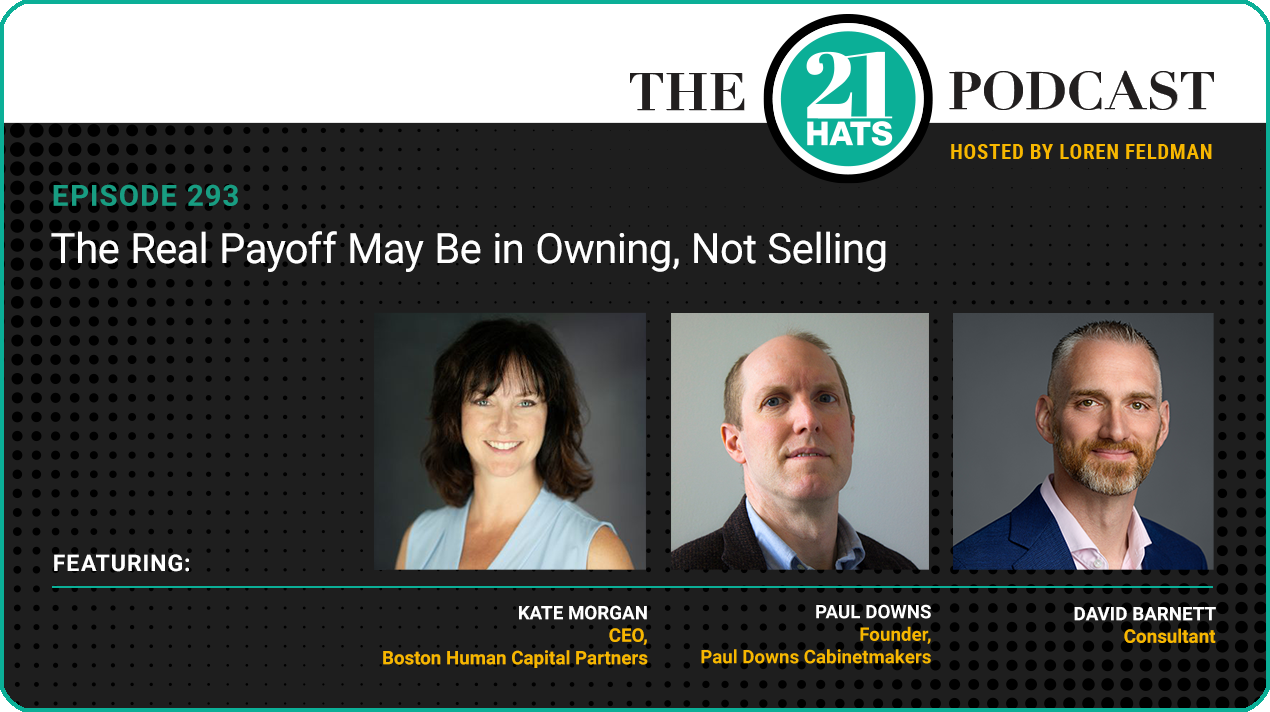
When Kate Morgan started thinking seriously about selling her business, she assumed the big payoff would come at closing. But as she tells David C. Barnett and Paul Downs this week, she’s come to understand that the smarter move might be not selling—at least not yet. Why? Because if the business keeps performing and she can gradually remove herself from the day-to-day operations, she may ultimately make more money by continuing to own it. That’s partly because, as David explains, small businesses often sell for lower multiples than owners expect. Which means the real value may not be in a clean exit, but in continuing to collect profits while slowly transitioning ownership to key employees. “So you’ll be selling the business,” says David, “and you’ll be collecting dividends or distributions on top of that. This is one of the most lucrative exits there can be.”
Of course, delaying a sale comes with its own risks. Markets change. Businesses cool off. Buyers get nervous. “You have to make the decision and make the sale happen while you’ve got a full head of steam,” David warns. Wait too long, and the numbers can start sliding in ways that dramatically reduce what buyers are willing to pay.
Plus: A Reddit post raises a brutal management challenge: What’s the best way to lay off a relative? “It really can’t affect your decision,” says Paul. “Because if it needs to be done, it needs to be done.” That doesn’t make it easier. It just means you may have to live with both the business consequences and the family consequences at the same time.
— Loren Feldman
Guests:
David C. Barnett helps people buy and sell businesses.
Paul Downs is CEO of Paul Downs Cabinetmakers.
Kate Morgan is CEO of Boston Human Capital Partners.
Producer:
Jess Thoubboron is founder of Blank Word.
Full Episode Transcript:
Loren Feldman:
Welcome Dave, Paul, and Kate. It’s great to have you all here. Kate, I want to start with you. You’ve been telling us lately about your evolving thinking about whether you want to sell your business or not. What’s your latest thinking?
Kate Morgan:
Okay, I know I’m not going to do anything with this company for five years. You know, I had originally been thinking about selling sooner. I talked to my team, and they encouraged me not to, because they’re just enjoying it. And you know what? I do love my team, but I need to have an exit plan. And in thinking about this now, I’m sort of morphing, because I do want to give it to my team.
Loren Feldman:
Give it to your team?
Kate Morgan:
Well, let’s put it this way: ESOP programs are super complicated, and so I’m starting to investigate other ways of how I could make something like a perpetual trust for my employees. And so, that’s when I started talking to my business coach, and he was recommending something, I think, I don’t know if it’s new or what. It’s not something I’ve encountered before, but it’s called an employee ownership trust, and so I figured I’d kind of bring this to you guys and see if anybody’s experienced with this—the pitfalls, if there’s any gotchas, or just how to start to think about it in that way.
Loren Feldman:
It is something we’ve talked about on the podcast before. Last year at the 21 Hats Live event, we were in Ann Arbor at Zingerman’s where Ari Weinzweig, one of the co-founders, talked about how Zingerman’s went through the process of becoming an employee ownership trust. And at one point, Jay Goltz was thinking about it, too, and I had him on with somebody who knows a lot about it, and talked it through. It is a lot simpler than an ESOP. Dave, this is your area. Is that something that you’ve encountered?
David Barnett:
Well, there’s more and more people talking about it. It is relatively new in the U.S., and then the same idea has just been introduced in Canada as well. I think one of the things about these trusts is that the first assumption that is made is that you have a business that will be enduring for a really long, long time, and that everybody who works in the business is at some point going to be able to meet the standards of benefiting from the ownership. And I think it’s a really interesting idea, and I can see how people are attracted to it.
I can tell you, though, it’s a lot simpler, if you really want your employees to buy your business, to just sell it to them. And I’ve seen various iterations of this over my career, where maybe it’s not all the employees that want to become part of the ownership group. Maybe there’s just a series of middle or higher leaders who you think, together, should be the owners of the business. And so I’ve worked on deals before where people have sold to groups of three, four, or five people who work for them, who together form sort of a partnership of sorts, to become the acquirer.
And then if you want to, you can always go down the path of selling parts of the current business to some employees, helping them come on as shareholders, and then maybe have a succession plan over several years where you increasingly sell them more and more of your stake. There’s lots of variations that you can do without having to get into some of these different tools that have a certain kind of structure associated with them. Some of them have tax advantages. I mean, this is something you talk to a CPA about, but it doesn’t have to be as complicated as learning a new tool if you really just want to sell your business to some of your employees.
Kate Morgan:
Here’s what I was sort of dialing into, Dave, on your response, and I really appreciated that. It was sort of selling out sort of incrementally. How do you usually structure it, as far as understanding when to start doing that? If I’m looking to exit in five years, do I start to think about selling out in parts sooner, or wait until the five years when I’m like, “Okay, now”? And then, that way, if I can still be taking some sort of level of compensation out of the company.
Because this is where my naivety really comes through. I do have a highly profitable business, and so there’s not a lot I need in five years coming out of this, but I do want to set my team up for absolute success. So, sort of in the back of my mind, I was like, “Well, if I’m planning on taking out what I need over the next five years, maybe what I do is have them take me on as an advisor. I get my health care. I get my 401(k) from them.”
David Barnett:
The very first thing to get your head around is the idea that working in a business and being its owner are two different things. So if you imagine Coca Cola, their shareholders, they’re getting dividends based on the profitability of the company. A person who drives a truck for Coke might go and buy some of their shares, but it doesn’t mean that they earn a different salary than the other truck drivers, right? So, that’s the very first thing you have to tackle: What are your roles and responsibilities in the business, and what are those worth—as though you were an employee running those responsibilities in the business.
If you start to give employees equity in your business, it can be a very hard thing to undo. So I always recommend that there needs to be some sort of hurdle or gate to the very first actual real allocation of shares. So you might want to consider some sort of bonus program or challenge to get this ball rolling. So for example, you might create certain targets or performance of the business or different areas within the business, and you might say to your employees, “If you achieve these goals or targets, your bonus or reward for this particular thing will be that we will issue you some stock in the company.” And so that gets the foot in the door. Then they are actually part owners with you. And it might take a year for this to occur.
Then you have to create some kind of schedule as to how often these additional tranches of shares will be sold. Now that they’re owners, they’re going to be entitled to part of the distributions or dividends of the profits of the company. So the reason you want to create some kind of event where they buy in or are able to earn that original piece of stock is so they can start to get part of the distributions. They can then channel those profits into buying more stock from you. And so it all depends on how quickly you want to pull this off. But you could have, for example, a plan over a decade where every two years you go through a valuation process and you say, “Here’s now how we value the business.”
And then these minority shareholders could choose to buy more stock from you, and that might mean that they’re going to use the dividends they’re earning from the company to buy shares from you. It could mean that they’re going to save up their own money to buy shares from you, or that you’re going to sell them shares. And maybe you’re going to finance the transaction to sell those shares. But over the course of time, increasingly they will own more and more of the business. You will earn less and less. And as they earn more and more, they’re going to get an increasing share of the profits, the dividends that come out of the business. And so it really just depends on how quickly you want this to happen.
And you know, staying in as a part-time advisor with health benefits, for example, that’s just part of this plan. For Kate to be a part-time advisor to the business is worth this amount of money, for example, or maybe it’s just worth the health benefits. I don’t know, whatever you decide. But that becomes part of the normal cost structure of the business. And people who own a business in the United States who have an LLC or an S Corp sometimes have a hard time really realizing what part of the cash flow from the business is their salary versus what is the profit, because often, people just take money from the profitability for their regular income needs. But you have to start thinking of it as two separate things, because it’s really the distributions that are the money that gets shared with the other shareholders and yourself initially.
Kate Morgan:
Yeah, I certainly get all of that. What I’m looking for is simplicity. You know, I went through the process of going through an acquisition before, when I was going to exit, and I am still very proud of coming out of that and having the broker be, like, “Wow, I’ve never seen financials so tight in a small business.” But my thing—I’m just going to say it—everything that you just talked about, I understand it from a perspective that people often are, like, “You’re leaving money on the table.” I think I told you my daughter’s in private equity. She’s always like, “Mom, it sounds like you’re going to be leaving a lot of money on the table. You should have some sort of earnout.” I look for simplicity over anything.
David Barnett:
Well, this is a very lucrative exit, because not only will you be selling the business over the course of these transactions, but you’re also going to be collecting your portion of the profits over time as well. So you’ll be selling the business, and you’ll be collecting dividends or distributions on top of that. This is one of the most lucrative exits there can be. If you’re looking for simple, it would be, gather some employees together and have them take out a loan and buy your business—just like you would sell it in an individual transaction to somebody else.
Kate Morgan:
What are your thoughts around seller financing?
David Barnett:
Well, it’s a way to get the deal done. It’s a tactic. I don’t necessarily know. Some people will come, and they’ll say, “Hey, do you think I should seller finance my business?” And it entirely depends on who the buyer is, because in that role—we talked about the two hats, you know, working in the business and owning the business. Now we’re talking about being a banker too, which is, again, a different hat.
So it really depends on who the buyer is and how much confidence you have in them. And I can tell you that sellers of small businesses who say, “I need to be paid all cash” typically get a lower price because buyers will try to negotiate all their worries about different risks into the price. But if you say, “I’m willing to finance some portion of the deal,” and maybe there’s an offset clause in the seller financing against certain key risks that might exist, then buyers are more comfortable with a higher price because they know that there’s there’s a contingency later if it turns out that something was misrepresented or something isn’t the way it should be. There’s a way for them to, post-close, get a better deal. And so people are comfortable with a higher price in those regards.
Loren Feldman:
Paul, you’ve spoken here a few times about your hopes to eventually sell the business. Have you had any further thoughts on how you would hope to structure that sale?
Paul Downs:
Well, it depends on what form it actually takes, and there’s two possibilities. One is I sell to a couple of the guys who work for me, and that’s pretty much in line with what we just discussed. And in that case, I suppose I could see whether they could get an SBA loan to do a single transaction, or seller finance. And I would be pretty comfortable seller financing with these two, particularly if I retain some of the stock until that period of the buyout was over. In other words, I sell them 90 percent—45 percent to each—and I retain 10 percent. So I’m basically the decider if they can’t agree on something. Because that’s what I worry about most, having been through a partnership. There needs to be someone in charge of the business.
And now the other possibility is I go out to some unknown buyer—just take it to market and see who shows up. And I don’t really know what that might look like. There’s a lot of ways that it could happen, but it would probably be something like, “We’re going to hand you a check, and then you go away. And we’re going to destroy your business after that.”
Kate Morgan:
Have you ever taken your company to the market?
Paul Downs:
No. I mean, people are after me. I get a million emails all the time, but I pay no attention to those. I think that’s just business brokers emailing everybody with a pulse and seeing if they can get their hooks in. But I have not made a real effort to identify possible buyers and reach out to them and do a dog-and-pony show. I think that’s a little premature. I’m just not ready to do that yet.
Loren Feldman:
Kate, how many employees do you have?
Kate Morgan:
Now, all total, 11.
Loren Feldman:
You told us on a previous podcast [episode] that you had talked to your leadership, and I think there were two people in particular, and they took some time to think about it and came back and told you that they like what they’re doing and they don’t want you to sell. How are you thinking about whether you would prefer to sell just to the two of them, versus finding a way to sell to all of your employees?
Kate Morgan:
Well, so I think there has to be some sort of gate to determine. And the two that are in this leadership role, they’ve both been with me for five and a half years, and they are deeply committed. We have our leadership council meetings. They’re dialed in. They’re helping think about growth. They have that growth mindset. So they’re my natural go-to.
Now, in five years—because we’re in a growth stage right now—as we continue to bring more people on, could there be somebody else? Potentially, I don’t know. I just want to know how I should think about doing this in a simple way that makes sure that they know that I’m serious about this without, again, making my life harder or adding complexities to my practice.
David Barnett:
Well, how much time do you need to spend there right now?
Kate Morgan:
So that’s the interesting thing. For the last three years, we’ve been kind of having to hunker down. So I’ve been very much in my business. Now I’m starting to remove myself from the day-to-day. So, like, the last three weeks, it’s been, I mean, damn near euphoria. I went to Dublin. I went to Malaga. I actually took a two-week vacation. So I’m feeling like I’m in a better spot where I can be focusing more on the scale, to get this to a happier point again. But again, that’s why I want to turn to these two in particular and say, “Okay, let’s think about what it means if I exit in five years.” We need to plug those holes, and part of that will also help with developing our scaling strategy.
David Barnett:
So I think I’ve said on this podcast a few times that the benefit of business ownership is not in the exit, it’s in the owning. And if you can get people on your team to be taking care of most of everything that needs to get done, and you’re putting very little time into this, and you can just own it for the next five years while doing a few meetings a week—you know, having a very manageable level of input—over the next five years, you will earn probably more than you can sell it for.
Kate Morgan:
Yeah, and that’s exactly why, when they came back and they were like, “No, we want to keep it.” I’m like, “Well, hell yeah.” Because I make more money keeping this than selling it.
Loren Feldman:
So why do you want to sell in five years?
Kate Morgan:
Because I have a husband who’s 10 years older than me. He’s going to be fully retired, and I do want to—I want to reinvent myself. How’s that?
David Barnett:
So then you could, if you wanted to, just run it for the next five years, while giving them more and more responsibility to the point where you’re comfortable that they are absolutely qualified to run everything to do with the business. And then in five years’ time, you make a deal with them, and they pay you over time. You hold the note on the whole deal, maybe collect payments over 10 years. It becomes sort of a retirement annuity, and you will have had a very successful exit for a small business owner.
Kate Morgan:
And that’s kind of the seller situation, yeah.
David Barnett:
Here’s what could go wrong. [Laughter]
Kate Morgan:
Of course, Dave’s gonna come up with it.
David Barnett:
Well, but you have to be prepared for this, because one of them could get a terrible illness in the next five years that takes them out of work. Someone could have an accident. There could be some radical change in your industry from technology, or a change in the customs of how things are done.
There’s all kinds of things that are potentially threatening to how your business performs, that we face every day in all businesses. And those same things, those same risks, are going to be there for your employees after they become the owner. So you’re still facing all these risks. That’s why people decide to sell. It’s because they say, “I want to move on to something else, and I do not want to continue to carry all of the burden of the risk of this business.”
And if you sell the business and you get 70 percent cash on closing and hold a 30 percent seller note, well, you’re not exposed to risk on the money you got. So it’s all degrees of how much risk you’re willing to expose yourself to. Paul, in your situation, even if you decided to do seller financing for your employees, you’ve got a lot of equipment in your business, different kinds of saws and other apparatuses. You could probably get some money on closing day by having the buyers, for example, bring a leasing company in to do a lease financing on all that gear. So there could be a way to turn some cash in on closing.
Paul Downs:
Well, in the woodworking world, used equipment isn’t worth much. There’s a million and a half dollars worth of equipment out there, but it’s depreciated value is probably under $100,000 at this point.
David Barnett:
Right, but it’s not the depreciated value that people lend against. It’s the fair market value, which, with the inflation over the last couple of years, could be quite a lot more than you think.
Loren Feldman:
Why is that?
David Barnett:
So a bank might lend a percentage of fair market value. A leasing company might lend against a percentage of orderly liquidation value. The value of equipment does not equal what’s on your balance sheet, which is what we call the book value, especially if people have used bonus depreciation to try to manage their tax bill and things like that.
So I’ll give you a quick example, because we do machinery and equipment appraisal here. There was a potato farmer, who unfortunately lost a tractor to a fire. He had bought this tractor just before the pandemic, and it was five years old at the time. He paid about, I think it was $350,000 for it, and unfortunately, just a couple years ago, it burned down, when this building burned down. And then he made an insurance claim. And guess what? The brand new version of those tractors has gone up incredibly with all of the post-Covid inflation, supply shocks, tariffs, etc. So the new version of that tractor is now over $900,000. When he went shopping for the same model year of his tractor, today, the purchase price is over $450,000.
So his used tractor actually went up in value over the course of time that he owned it, rather than going down in value because of the replacement cost of what the new ones go for. And used equipment is always valued vis a vis what it costs to buy new. And if you think about when you go shopping for a car, the reason you look at a used car is because you say new cars are very expensive. If new cars get even more expensive, then the value is still there, even if used cars go up, too. So we’ve worked with a lot of people over the last couple of years, in particular, who have been blown away by the value of their plant and equipment in their business.
Paul Downs:
Well, that’s a very interesting idea, and I think that for many industries, it might be a great idea. I would be pretty surprised if, for woodworking equipment, there’s much value there. Because the fact is that the industry overall is contracting, and there’s always quite a bit of used equipment on the market. And my equipment is pretty old. Our major pieces are in the 20-plus-years-old range.
David Barnett:
You got a bunch of that old Green General stuff?
Paul Downs:
No, it’s, it’s, um—well, let’s not go down that road, because if we start talking about woodworking brands, I think everybody’s just going to go to sleep. [Laughter] Let’s just say I’ve got a bunch of old equipment. And it’s an interesting idea, which I’ve never thought of before, and maybe because of that, but maybe the reason is, I’ve never heard anybody in woodworking talk about that, and talk about their equipment as a store of value, because it’s generally considered to be just a scrap value when you liquidate a plan.
David Barnett:
Well, that’s when you liquidate, and this is the difference. Because when you appraise equipment, there’s different definitions of value. So there’s fair market value, which is what something would trade at, maybe if you were going to go buy something from a dealer. And then there’s fair market value in continued use, which actually also considers the delivery and installation and setup cost of the equipment too. Because if somebody is going to use the equipment in its current location, then these added advantages actually add to its value. So we appraised all of the equipment within a wooden window factory three years ago. It was significant. It was several million dollars.
Paul Downs:
How big a factory was it?
David Barnett:
They were like 20,000 square feet or so. That kind of size.
Paul Downs:
As I said, I’ve never even considered that. I think that, in my mind, the value of the company is not the equipment. It’s the people who know what to do with it, because the equipment itself is relatively generic. It’s our business which is valuable. But if there’s somebody willing to overlook that inconvenient fact and just write us checks because we have equipment, yeah, bring them on.
David Barnett:
Well, so, but what we’re talking about here, you’re talking about the enterprise value of your business based upon its cash flow, which derives from your position in the market and from your ability to deliver products people want. Right?
Paul Downs:
Yeah.
David Barnett:
The enterprise value is what someone’s willing to pay for your business if your business has goodwill. What that means is that the enterprise value is greater than the value of the equipment, because the definition of goodwill is the difference between the value of a business and what the tangibles are worth inside of it. So for you, that would largely be equipment and inventory, materials, that kind of stuff. And so what I’m saying is that because that collateral exists, there’s an opportunity for a buyer to use it to borrow. And so if you wanted to sell to your employees, at least the equipment value provides some kind of basis for some real lending, outside of like the SBA program, for example.
Paul Downs:
Well, I think that—I mean, this is all a revelation to me, and it certainly sounds like I should look into it and see how would one go about contacting—I guess your company does this—but getting some idea of what that number is.
David Barnett:
Well, I would say you want to start with the probable lenders. So just talk with the bank you have a relationship with. And just say, “Hey, you know, if I sell my business, what does it look like for using my equipment as collateral? What would you require? What kind of loan to value are you guys willing to look at and have that conversation?” And have that conversation just to see what they’re saying.
Because to get the appraisal done is going to cost money, but you want to have an idea of what potentially could be the outcome. And do you need to get the appraisal done right now? Probably not. The bank will want it if they ever do such a deal, but by looking at what things are selling for new—you know, a rough estimate is that used equipment is like between 35 and 50 percent of what new equipment is, so you can kind of ballpark it on your own.
Paul Downs:
Well, it’s interesting because I just had a long session with my bank that spanned several months of trying to increase a line of credit from 200 grand to 400 grand. And they asked about every single thing you could possibly imagine—except there was not one question about the value of the equipment. So is this something that only certain banks even think this way? I mean, clearly the people at my bank couldn’t care less what the value of the equipment is.
David Barnett:
Well, are you giving them a balance sheet that shows the equipment’s worth nothing?
Paul Downs:
It’s a balance sheet that shows depreciated—we expense a lot of equipment too, because—
David Barnett:
Right.
Paul Downs:
Basically the balance sheet would not show it. They were looking for every possible thing to collateralize this loan. My personal this, that, the cars. Like, do you own a fish tank? Like, whatever. [Laughter] But nobody asked about the equipment. And so I’m just kind of surprised. What you’re saying makes perfect sense. Yes, the equipment helps the business run, and it’s worth something. And yeah, you could have an auction and sell it, but it didn’t seem to be of the slightest interest to my bank.
David Barnett:
It could very well be that the person you were talking with just didn’t think of it, and there was no number on your balance sheet that kind of drew their attention toward that as a potential asset. Were they more interested in assets outside the business, like your personal assets? Because the first thing they look at is whether you’ve got the cash flow to support the payments. That’s kind of number one. And if you don’t, then they will often go looking for assets outside the business as kind of part of that owner’s personal guarantee backing it.
Paul Downs:
Okay, so again, what I just went through is maybe not the poster child for all seller financed lending, but we’re just talking about increasing a working capital line of credit from $200,000 to $400,000. And this is a line that I’ve had since 2017, and I’ve only drawn down on it maybe once or twice, but I knew that we had some upcoming need for a bigger backstop than 200 grand. And so there wasn’t any issue with repayment.
I have personally, in my checking account, enough to write them a check for 400,000 bucks any given day. It’s no problem. It was still more that their process was so bizarre. I mean, the guys came out to the factory, and I gave them a tour, and they were extremely excited. They loved it. They’re like, “Oh, I’m a woodworker.” But it never came up as part of the whole evaluation of: Could I repay this loan? I mean, on the face of it, I can repay the loan. There’s no issue. It’s just a question of: I would rather have the business have a line of credit than have to write checks to it myself.
Loren Feldman:
Did you get the increase, Paul? Did it go to $400,000?
Paul Downs:
It did eventually, but goodness, it was an ordeal. I mean, I’ve been banking with these guys for almost 15 years, maybe even longer, and they could see we make money. Shouldn’t be a problem, but—
Loren Feldman:
Did you have to use personal assets, as Dave asked, to backstop it?
Paul Downs:
Yeah, I mean, when you sign an agreement like that, eventually—down there in the fine print somewhere—you’re backstopping it with your personal assets. But I wasn’t too concerned about that, because there’s pretty much a zero percent chance that we’re not going to be able to repay the line of credit. It was more that we just accepted a very large job, which would kind of tie up the shop for a number of months and prevent us from the ordinary flow of business where we do smaller jobs, take deposits, ship them out, get the balances. So we were going to have kind of a pause in the ordinary pattern of payments, and so that’s why I wanted to have the backstop and line of credit. I’m not sure I’m even going to draw it down this year at all.
David Barnett:
When I work with Americans who are buying businesses, we always look at the assets within the business. Because if there’s sufficient assets to collateralize a loan for the acquisition, it means that they have the door open to a conventional bank financing versus SBA, and conventional is always cheaper, like, sometimes three percentage points cheaper on the interest rate. And so that’s the one advantage that asset heavy businesses have, is that this door is open to more conventional financing because they’ve got this collateral there.
Paul Downs:
Well, David, it sounds to me like you’re a hell of a lot smarter than my bankers. [Laughter] It doesn’t surprise me at all, but I think this is very interesting. I’m glad you brought it up. I just thought of something.
Loren Feldman:
Paul, do you have a fish tank? [Laughter]
Paul Downs:
Not anymore.
David Barnett:
It’s in the lobby of the bank.
Paul Downs:
It was the sweetener. I got it across the finish line. Like, take the fish tank, gentlemen.
Loren Feldman:
Before we go on to something else, Dave, do you have any other suggestions for Kate, just in terms of her thinking through what structure makes the most sense for her? Is there a path you suggest she might follow, or our listeners might follow, to just understand all the options that are out there for an owner looking to sell?
David Barnett:
Yeah, you have to consider what it is that’s pushing you, because in my experience, small business owners don’t sell to cash out in the way that Mark Zuckerberg might sell his Facebook stock, right? Small businesses sell for relatively low multiples of cash flow. And so people really need to have a pressing personal concern, in my experience, to actually do a deal. And, you know, you got right to the finish line on a deal that you backed out of, right? And this is not the first time we’ve been on the show where you’ve been talking about this.
So, the big thing would be making the decision of: Do you want to sell, and why is it a pressing personal concern for you? Because if it’s not a pressing personal concern, you are always going to have probably hundreds of thousands of reasons every year not to do this deal. Because owning the business is very lucrative to you, right? And so, if you’re not there, where you need to sell the business, because you want to turn this chapter in your life, then think about ways to get the management structures in place so that you can continue to own it and continue to benefit from the business, knowing that it is a risky asset. And if one of those things I talked about earlier would happen, the business could end up in trouble, or what have you. But if you can run this business without investing much of your time for three, four years, well, you’ll already clock the amount of money, probably, that you would have received in a sale.
And so you really have to reflect on whether you are truly motivated to do this deal or not. And then, once you make the decision, then you have to act quickly, because if you mentally check out from the business, what will happen is your energy will go off, and the employees will pick up on that. And the way that they behave in the business, and how they treat the customers, and everything will be affected all the way down. And then you end up with a decline in sales and earnings. And then that’s the thing you have to avoid. You have to make the decision and make the sale happen while you’ve got a full head of steam. Because once things start to slide, everyone’s going to look at the sliding financial performance, and they’re going to assume it’s going to carry on, and then people don’t want to pay you as much.
Loren Feldman:
All right, so I had another big question that I was going to throw at you guys that we clearly do not have time for. But I’ve also got a little one, one that I think is relevant to a lot of business owners. It comes from a post that I read on the small business subreddit, and it’s about having to lay off a relative. Let me read what this owner wrote:
“Ugh. I knew I’d be in this situation at some point. We have to make some staffing reductions, and need to lay off some folks. One is my relative, not immediate, but a degree away from a cousin. I know my family will not be happy about it, but it needs to be done, and they are the appropriate person based on skills, how well they fit in with the team, etc. It’s the best thing for the business, but it’s just going to stink, as they are a good person, but best one to go right now. Any sage advice? Other than not to have hired them in the first place?”
Anybody?
Paul Downs:
Oh, boy. Laying anybody off, relative or not, is difficult. And I went through, not a relative, but a layoff last year, and I think the first thing is to make the case for why you’re doing it. In other words, to understand: What is the company now? What are its revenues? What are its expenses? Why are you doing this? And then to be very clear about what happens if you don’t do it.
Because at the end of the day, the job of the business owner is to defend the group, not the individuals in the group. And if you’ve got too many people, and you’re running through all your working capital, and—because you’re too kindhearted—you don’t do tough things, then the whole business fails. And then everybody’s worse off.
Now, that doesn’t make it any easier when you choose the ones who have to go as opposed to the ones who get to stay, but it’s just reality. If you were in a good position, you wouldn’t be doing layoffs. And I think also, don’t be flippant about it. Don’t try to make any jokes while you do it. Make sure that you understand and sympathize with the gravity of being laid off. I’ve never been laid off, but I’ve done it, and I’ve watched people walk out, and it’s pretty clear it’s devastating, particularly if they’ve been chosen from amongst a group of peers for rational reasons. It’s basically a way of grading your employees, and nobody wants to be at the back end of that list of people.
And so it’s a terrible thing, and I’m very sorry that you’re having to do it. Having it be a relative is even worse. But it really can’t affect your decision to do it, because if it needs to be done, it needs to be done. And now you’re going to see this person at parties and what have you. It’s just going to suck. There’s no way around it. And hopefully that’s motivation to make other changes, to make sure that you’re not in that position again. That’s what I would say.
Loren Feldman:
Paul, you started by saying that the first thing to do is to explain to this person why it’s necessary.
Paul Downs:
I would explain to the whole company why it’s necessary. Because if you’re just disappearing people one by one, and not providing the information to why that’s happening, then people are going to start making up stories. And this is one of my hard and fast rules of business ownership: If you don’t provide a story, everybody else will make one up. And you probably won’t like what they make up. So you’d better fill in the gaps and make sure everybody’s clear on the situation.
Loren Feldman:
There’s a second question there, though, Paul. The first thing is why it’s necessary for the business to lay people off, especially in this case, a relative. I think the next question is: Why is it necessary to lay me off? How do you deal with that?
Paul Downs:
Well, it’s easier if it’s more than one person being laid off. If you had four people that only one was getting laid off, it’s hard for that person to not draw the conclusion that they’re the least valued employee, because they are the least valued employee. That’s just the way the world works. But if you can do something to make sure that everybody is clear that this is a bad situation and that, unfortunately, the fix involves eliminating people, it’s possible you can spread the pain. When I did a layoff, I laid off six. Everybody else took a pay cut of 10 percent, and I said, “I’m taking a pay cut of 100 percent because we’ve got to get through this.” And then defining a fix and saying, “Here’s how the fix will work. If we can cut our expenses, we can be in business long enough to see what else comes in the door.” That was the message I gave people.
I’ve been around for a long time. I’ve seen months that were bad, but generally it comes back in some way. Now, if the reason the business is in trouble is because the owner is screwing up, or the market is disappearing and will never come back, that’s just a different situation. But at least being clear about why you’re doing what you’re doing is very helpful to both the person and the other people. I was able to say: There’s nobody at fault here. We’re just experiencing a bad market. It’s not my fault, it’s not your fault, but somebody has to go. It’s the way it goes.
And I think that most people actually have more ability to absorb trouble than owners realize, because that’s just human existence. And we’re all more resilient when we need to be than you would have thought. If you think that you can avoid it, you’re like, “Well, I couldn’t possibly do this or that.” And then when you’re in it, you’re like, “Look at me. I’m doing this and that,” and I think that’s just part of being a human being.
Loren Feldman:
Kate, you offer HR services to businesses. Do you have any advice on how to lay off a relative?
Kate Morgan:
Well, it’s funny, because emotionally, on a personal side, I’m like: It would probably be easier for me with family. [Laughter]
Loren Feldman:
What does that say about your family, Kate?
Kate Morgan:
So, I’m kind of with Paul on this. It’s always got to be about the fidelity of the company. So we’re just very, very clear on why this is happening in making sure that we know that it is not specific to the individual.
Loren Feldman:
Dave, do you have any thoughts?
David Barnett:
I do. I agree with everything that’s been said here. My only added thought is that once a decision is made, you can’t delay. The person who is working there, whether they’re family or not, is an adult who is engaging in what is supposed to be a mutually beneficial relationship. They’re selling you their time. You’re paying them. You’re supposed to use their time to the benefit of the company to make earnings and all that kind of stuff. If the decision has been made, you’ve got to let them know as fast as possible so that they can undertake their own agency and decision making and figure out what they’re going to do.
And I find a lot of the times, business owners develop this position where they feel like they are responsible for or need to take care of their employees, forgetting that these are autonomous people with agency and decision making ability of their own. And you don’t know what else is going on in that person’s life, or if they just turned something down because of their loyalty to the company. Once a decision has been made, you’ve got to bring that person in as soon as possible so they can start to act on that news and try to clear the path for whatever outcome they’re able to determine for themselves.
Loren Feldman:
My thanks to David C. Barnett, Paul Downs, and Kate Morgan. And a special thanks to our sponsor. This episode was brought to you by Grasshopper Bank. Thanks for listening, everyone.

