

We Can’t Afford to Wait on AI
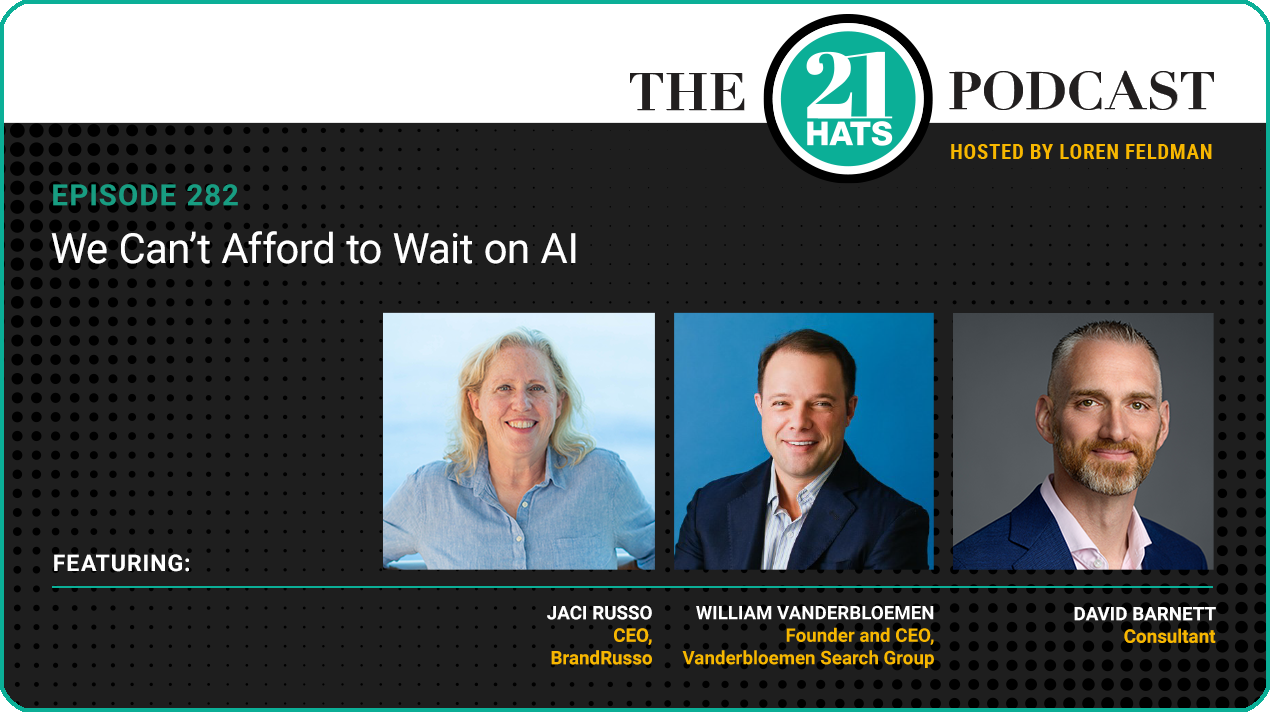
Introduction:
A lot of business owners are taking a wait-and-see approach with artificial intelligence. They’ve heard the hype—but they’ve also heard about the slop, the hallucinations, and the research suggesting many AI projects fail to deliver. For plenty of owners, that’s reason enough to assume this might be another passing obsession—like Y2K, Clubhouse, or the metaverse—and to sit back until the dust settles.
But not these three owners: David C. Barnett, Jaci Russo, and William Vanderbloemen have decided that waiting is the bigger risk. They’re taking courses, they’re teaching courses, they’re building agents, and they’re rethinking processes and workflows—all in search of an edge that may not be available forever. And they’re already seeing results.
In this episode, they share what’s actually working so far, including some early experiments that could reduce their reliance on Google AdWords. They also talk candidly about what they won’t do with AI, how they sidestep the slop, and why each of them believes this is one of those rare moments when experimentation isn’t optional.
— Loren Feldman
Guests:
Jaci Russo is CEO of BrandRusso.
David C. Barnett helps people buy and sell businesses.
William Vanderbloemen is CEO of Vanderbloemen Search Group.
Producer:
Jess Thoubboron is founder of Blank Word.
Full Episode Transcript:
Loren Feldman:
Welcome Dave, Jaci, and William. It’s great to have you here. So all three of you have been exploring AI, and I’m eager to compare notes on what you’re trying and what you’re learning. I guess I’ll start with you, William. I gather you’re in a cohort with other business owners. I think you said in an email that you’re drinking from a fire hose. What’s going on?
William Vanderbloemen:
Yeah, so I read a book. I guess it was about a year ago, a friend of mine, who’s usually out in front of trends pretty well, said: Hey, there’s a book, and I’m not a coder. I’m not a computer expert, but it’s called The AI-Driven Leader. And if people are wanting to figure out where that is, the author’s name is Geoff Woods. And I found it really helpful, because it’s not focused on, “Robots are going to change your factory.” It’s more like: How do leaders and owners take a role of saying, “Let’s become thought leaders who drive AI so we can go faster,” rather than just, “Oh, it’s all going to automate, and we’re in a prequel to The Terminator, and everything’s going to end pretty soon.”
And so, I read the book. I actually listened to the book on Audible and then went and read the book so I could mark it up, which I guess is a thing now with books. And then, you know, I end up on their email list, and they figure out they’re in Austin, we’re in Houston. They’re starting a collective of owners, and invited me to be a part of that. I paid. I paid a lot.
Loren Feldman:
How much did you pay, William?
William Vanderbloemen:
I don’t know if he wants that advertised or not. It was in the five figures, but it’s limited to 150 business owners, and we’re in two groups, so it’s 75 at a time. And it’s a lot. We do two on-sites a year with each other, and then we have monthly calls, and it’s: What are the new things that are happening in AI that relate to your industry? You’re around people who are trying to adopt, and we’re all learning together. So it’s like: What are you trying? What are you trying? What are you trying?
And it’s been really helpful to me. I think I’m in a constant pendulum swing between: “This is going to be amazing,” and, “We are cooked.” [Laughter] So it just depends on what day you catch me, which mood I’m in. But I love learning new things. One of the biggest pain points that the owners have is: Okay, I’m on board. I’ve got some younger people who are on board, but how am I going to do the change management to get people who are still using a legal pad okay with doing things in a new way?
And I’m just not much help there, because a year and a half ago, I said, “Next year, in 2025, every department needs to show me every quarter something new they’re doing with AI. And you don’t have to be uniform about it. You can use whatever you want. You’re probably going to get approved for any expense you submit, within reason. Just go start using it.” And so ‘26 is the year of saying: Okay, we’re all sort of in this swim together. Now, how do we start to think about a more cohesive set of tools and strategies, where we’re all sort of working from the same framework, which, of course, is changing every day? So that’s way too much babbling, but you can tell I’ve been drinking through a fire hose.
Loren Feldman:
You said, sometimes you’re feeling like you’re cooked, sometimes you’re feeling really excited about where this is going. Tell us about both of those. First, what are you thinking when you’re worried you might be cooked?
William Vanderbloemen:
That doesn’t last really long. It doesn’t. And you know, everybody of the panelists knows my wife’s battling stage four cancer. And one of the interesting things that happens when you’re going through that as a family is you will have days where you go down the hole of despair. And you know, their counselors will say, “You’re going to go down there. What if she dies tomorrow? What about the kids? What about? What about? What about?”
And there’s a level of saying, “Well, if that happens, then I need to plan for this.” There’s a part where you have to feel the grieving, but at the end of the day, well, okay, so what? She died, and that’s horrible, but like, there’s nothing to do to fix it. And that sounds super simplistic, but if we really are cooked, if we really are in a prequel to The Terminator, what difference does it make what we do between now and then? Not much.
Loren Feldman:
So when you said that you feel like you might be cooked, were you talking about society as a whole, or your business in particular?
William Vanderbloemen:
Yes, yes. Society as a whole.
Loren Feldman:
Okay. Last question for you, and then we’re going to move on: What’s your goal in doing this? Why are you taking the course? Why are you investing so much time? What are you hoping to get?
William Vanderbloemen:
Yeah, well, I tell people, you know, whether it’s scriptures from the Jewish faith or the Christian faith, there’s a problem in the Garden of Eden with an apple, right? And if I’d have been there and God had said, “Don’t touch the apple,” that would have been fine. But if he had said, “Now, don’t touch the latest product from Apple,” I’d have been done. [Laughter] I’m like a tech geek. I love the new. I had a Newton back when that was a thing. I had the Palm Pilot when that was a thing. Now all your younger listeners are dropping off by the second, but that’s part of it, is I am the target audience for this kind of thing.
But underneath that, our biggest growth as a company, historically, is when we try something new just before everyone else does. It was true with social media. It’s been true with HubSpot. It’s been true with blogging. And this feels to me like either the biggest head-fake ever, which I don’t think it is—like it could just be nothing. Remember Y2K, that whole fiasco? It could be that—I doubt it—or I think the other possibility is it’s going to make the Renaissance look kind of like a non-event. And if that’s about to happen, I want to be out in front of it as a tech junkie and as a company that does things well when we get out in front of each other. If you want to know why we’re doing it, we’ve decided, as a leadership team, we get paid for human discernment. And AI frees us up to have time to do more discerning.
Jaci Russo:
Exactly.
William Vanderbloemen:
That’s our mantra company-wide. So I have a little bit of an advantage. Our market is churches, faith-based schools, faith-based nonprofits, faith-based for-profits. They’re generally not the first to market with new ideas. Usually, I can just watch what’s happening in the business world and sort of adopt it a few years later, and we’re ahead of the curve for our clients. But this time, it feels a little more pressing.
Loren Feldman:
Jaci, you’ve talked here in the past about the course you took with Alan Pentz, who’s been on this podcast. You came out of it with agents set up that, I believe, were producing 10 client leads for you every morning. And at the time you told us about it, you’d already gotten two new clients as a result of that. What’s happened since then? How’s that going?
Jaci Russo:
That is still happening, and we are still going through our leads. You know, I was the guinea pig test case, and that’s now expanded to everyone else on the team who has anything to do with new business.
Loren Feldman:
And so they’re all getting 10 leads a day and pursuing them?
Jaci Russo:
Correct. Now, we’re about quality over quantity. You know, a great year for us is six new clients. I mean, we’re not looking to gain a client a week. That’s not our thing. We’re high-touch, high-value. And so we are very careful with vetting someone before they even get into our system. And so these are very well-vetted, multiple ranges of BANT scores and criteria that they go through before they become one of the 10. And then, once they become one of the 10, they are again going through filters and outreach, contacted. So I’m not looking for quantity. It could be 100 a day if I was looking for quantity. It could be 10,000 a day. Ten a day’s plenty, because we’re busy taking care of our current clients.
Discernment is the word that I use too, to Williams point, and I think that is the value that we bring. Sure, I teach AI-for-marketing classes. Yes, I firmly believe AI makes us better in so many different ways. And as it was so eloquently stated, it gives us time for the human things, because the human things are where we really excel. If I could get the AI to do the dishes, it’d be a whole other layer of human time I would get back, which would be awesome. But my AI doesn’t stand and walk and load a dishwasher yet. But so, much like all the rest of us, I’ve taken classes for years now. Alan’s class was another in that series. And every time I learn more, and it gets better, and I’m able to use more.
The teaching that I’m doing around AI is strictly around marketing, because people still don’t understand personalization. They don’t understand capturing voice. They don’t realize how necessary it is to use different tools for different executions. There’s no one-size-fits-all. And so, I think that still means there’s a place for humans to be involved. And sure, I could guess that 10 years from now, everything will be done by AI. But I’m interested to see how AI is going to come to my house and fix my AC unit. You know, I think there’s some jobs that are safe for a while.
William Vanderbloemen:
Yes, but Jaci, we were touring Adrienne’s primary cancer doctor’s lab, I don’t know, a couple weeks ago. We’re going to raise some money to help him extend his research, which is a whole other thing, but he has this amazing—I’ll call it—a camera or microscope that you can put all these tissue samples into and see all this genetic sequencing. It’s amazing. There are only five of them at MD Anderson, and he has one of them in his lab. And so he was showing it off to us, which is amazing. And his techs, who are wicked smart, couldn’t figure out how to open it. And I took a picture of it and asked Gigi, my AI assistant, to tell me how to open it. And then we opened it.
Jaci Russo:
Sure.
William Vanderbloemen:
So your AC is not as far off as you think.
Jaci Russo:
Absolutely. And so the human still has to be the one who opens it. And so, that’s to me, the collaboration. That’s where the beauty comes from.
Loren Feldman:
So Jaci, when you walked out of Alan’s course with those agents that were producing leads for you, I know you got help from Alan to create that. Since then, you’ve set the same thing up for the rest of your team. Is that something that you are capable of doing yourself? Are you setting up agents and having them vet leads and deliver them first thing in the morning?
Jaci Russo:
I have done it. I don’t think that my work is as clean as it is by other professionals who you know. I think that there’s programming mindsets, and I think that the people who are working in Codex and n8n are doing really amazing work. They think like programmers. I have started to get more into using a voice dictation—it’s called Whspr—where I talk through exactly what I want to create, and then I let it go create the code and go build itself. That’s magical. That’s the stuff where I think the real good is happening, because I don’t think like a programmer. That’s not how I’m wired. And when I can just tell it what I want to accomplish, and then it can go build the program, that’s magic.
Loren Feldman:
Well, that’s the whole point of Claude Code.
Jaci Russo:
Correct. That’s where I do it.
Loren Feldman:
And that’s actually what I’m working on now in Alan’s second cohort. So you don’t have to think like a programmer. You just have to know what you want.
William Vanderbloemen:
But three years ago, moving on four, I went to a thing—it’s called Praxis, and it’s basically a Shark Tank for Christian entrepreneurs. That’s the easy way to say it. And they had the Shark Tank part at night and breakouts during the day. So this was three and a half years ago, like, think back that far, if you can, about AI. And they had one breakout, and the breakout was titled, “So what do we title this?” Which is a brilliant title for an AI breakout. But I went and it was all coders. They only let 50 people in there. It was 49 coders and me, and they asked all their Python and backend and blah, blah, blah, things I don’t even know. I’m not even using the words right. And I just sat there.
And at the end of the session, it was a woman—and at the time, she was in charge of pretty much all the AI initiatives for Google—she looked at me and said, “You haven’t said a word. Do you have a question for us?” And I’m not a coder, so I just said, “I have a high school senior. What should I tell him not to major in in college?” And everybody got real quiet, real fast. And they never answered the question, but all three of the people on the panel, who were equal heavyweights, said, “Liberal arts is what he ought to do.” And the coders in the room deflated pretty quickly. It’s like the whole STEM thing? That is probably moving toward automation.
The ability to be well-versed and talk to other humans and offer discernment and critical thinking, that’s what you got to focus on. So it’s really interesting to think about, as I’m putting kids through college. You know, I’ve got a good friend whose kid just graduated with a computer science degree and can’t get a job.
Loren Feldman:
All right, Dave, your turn. I gather you have actually started a business based on AI?
David Barnett:
Well, I have. I guess it could be a business one day. But I’ve been using AI to do a lot of analysis of things going on in my business. And one of the things I’ve been noticing is that for our appraisal service, which is more of a regional business around me, the results that we’ve been getting out of Google AdWords has really been going down over the last year.
And so I started to daydream about different ways that I might be able to get more bang for my marketing buck. And the people who I want to reach through my messaging are business owners or business people, centers of influence, like bankers, lawyers, accountants, etc.—generally, people who have an interest in business. And so I went looking for a media that I could advertise some kind of business, journal, podcast, website, something or other. And I really struggled to find just the right sort of thing. Then I realized: Hey, why don’t I just create the thing that would be the right medium for me to advertise in?
Loren Feldman:
Were you looking to reach people in a specific geographic area?
David Barnett:
Yeah, in Atlantic Canada. So I was able to register the domain atlanticcanadabusiness.news. And so we now have AI agents that scrape the internet looking for news-related articles for this region. And I’ve got a guy named Peter who has had a long career in journalism, and he decides which stories are fitting, and he collates the ones he wants, and he uses AI to create a script, and he records it every week. And so the whole idea is, it’s a brief, 15-minute news-headline kind of program, just for this region, for business people in this part of Canada. And hopefully it’s going to grow an audience of the people I’m trying to reach, because my company is the sponsor of the show. And we’re doing it all, including paying Peter, for far less than I was putting into Google AdWords, which we’re having a declining result over the course of time.
So, you know, I say it could be a business one day, because if it ever did really grow a big audience, I could always sell advertisements to other people. It can become a profit center of its own. But right now, if it just grows an audience and ends up bringing us business and the costs don’t increase while the audience increases, then I think it will be a worthwhile experiment or endeavor for us.
Loren Feldman:
How are you spreading the word? How are you trying to attract listeners?
David Barnett:
We’re trying to leverage the current social media presence that we have, so my own LinkedIn, for example, where I’m connected to a lot of business people in this region. I have an email list, which is people all over North America, mostly. But I sent an email out to them today, telling them about what I was trying to do with this project and how it works for my business. And maybe they could look at something like that, too. But if they were interested, here’s how you go and find it online. And it’s available on YouTube, LinkedIn, all the popular podcasting apps. So I’m hoping that just the name will also help it be discoverable for people who are in the region and are looking for that kind of content. But this is just the most recent of the long series of things that we’ve been implementing AI into here.
I was trying to make a list for you, Loren, getting ready for today. I mentioned before that I’ve created a strategic advisor project in ChatGPT. I also read the Geoff Woods book. It gave me a lot of great ideas. We initially started using AI to help us with marketing, content stuff. I’ve found that AI is really poor at writing stuff, but it’s really great at summarizing or handling or creating outputs from good inputs. And so what we’ve been having great success with is having it use transcripts of old videos that I’ve made, and have them turned into a case study. It seems to do a really good job at that sort of thing, so we’re repurposing old content with it.
And then we started to do enhancements to some of our online learning programs. So we have upgraded one of our business buyer offerings. It’s called Business Buyer Advantage, and we’ve now included several GPTs in that program that actually execute some of the things that we teach people how to do. So for example, there’s a due diligence GPT in there.
Loren Feldman:
Tell us what a GPT is, for anybody who’s—
David Barnett:
Well, it’s like a programmed ChatGPT thing. So if you click the link, it will open up a ChatGPT window. But it’s been programmed for specific tasks. So what this due diligence GPT does, for example, is you put in the name and address of any real world business, and it will go and do research on that business, and go look for customer reviews and all kinds of stuff. But then using the industry and the type of business, it will then create a custom due diligence checklist of things that a buyer should be looking for to examine that business.
And what is driving it is this exhaustive 300-item due diligence checklist that I used to give to people. I used to say, “Here’s a general due diligence checklist.” But now what the GPT is able to do is it’s able to customize the output so that it’s asking for things that specifically relate to that business and to the specific geography, or state, county, etc., that the business is in. So those have gotten a lot of really great feedback.
In our consulting business, we do a lot of research on the businesses we’ve been hired to analyze. And we traditionally were going to a lot of different websites and downloading things and looking up statistics on government websites and stuff like that. And now, we’ve automated all of that with, again, another GPT that we built. And so, now I just go in and I say, “Here’s the business,” and it goes to all these places that we programmed it to go to, and it collates it together in a standardized format report that is now easier for us to use, because it’s always laid out the same way every time. Because it’s based upon sample templates that we programmed it with.
Loren Feldman:
Let me stop you there for a second, Dave. I think I heard you say that you used to hand out a list of 300 things that people need to check in due diligence, and now you’ve created this GPT that does it automatically and does it specifically about a company in question. Is the GPT reporting back to you, or are you turning the keys over to somebody else to use it?
David Barnett:
No, no, the user is using it themselves.
Loren Feldman:
Well, how do you charge for that?
David Barnett:
We used to just give them the list. We’d say, “Here’s a complete due diligence checklist of things that might apply to your situation.” What I used to tell them is, I used to say, “Go through the list, pick out the things you know, cross off the things you know don’t apply, and then get feedback from your attorney and your accountant on things that they might want to add to the list.” And so now what happens is they get a much more concise list to begin with, and the GPT outputs the list for them, and then says to them, “You should run this by your CPA and your attorney to see if they want to add other things to this due diligence checklist.” But it’s about trying to make things easier, more expedient.
Loren Feldman:
I interrupted you. I think you were going to give us another example?
David Barnett:
Well, the latest thing that we’ve started is when we do the consulting projects, like when somebody hires us to do an analysis of a business that they’re going to buy, we do the research on the business. We take the financial statements. We go through a normalization process. We have a lot of Excel models that we built over the course of time to help us do these analyses. And when we’re finished with it, we meet with the business owner, and we do a Zoom call. We walk through our findings. We walk through the spreadsheets. We show them the results of our analysis and what we think are fair offers for that business, what we think are red flags, things to look out for, that kind of thing.
And the call is recorded, so that when it’s finished, we can deliver back to the customer a copy of that spreadsheet, a copy of those reports we used with the research, the copy of the transcript, but we’re now also delivering a GPT. It’s a post-delivery analysis GPT where the customer can then upload, if they choose, the transcript of our call, the spreadsheet, and the industry reports. And then they can query the GPT and ask further questions after our debriefing has happened. And so, it’s like a post-delivery support to, again, help deliver more value to the client.
In our weekly meetings, we actually have an agenda item—and I know, William, you said that you’re looking for your people to come up with new ideas every quarter for AI. But in our weekly meeting, we have a topic called “This week I used AI for this new thing.” And not every week do people come up with something, but we try. Like, we’re trying to question everything. You know, at one point, when we work with sellers, we do evaluations called “the most probable selling price evaluation.” And what we were doing a year ago is we were sending people a 120-question questionnaire. And sometimes we would be able to go through it and delete questions we knew didn’t apply to them, but business owners hated it. They absolutely hated it because it was like schoolwork. And some people would get it filled in right away, and we’d be able to proceed. Other people would take forever, and then they’d get it to us, and it would be incomplete, etc.
So what we’re doing now is, we now have a four-page questionnaire. It’s only got 40 questions, and all 40 of those questions are questions that every business owner would know the answer to off the top of their head, like: What is your website? How many employees do you have? Where are you located? What is your industry? What are your terms of sale with your customers? Do you ask for a deposit? Just stuff like that people know off the top of their head. And so, we ask for that—we call it a quick intake. Now, we ask them to fill that in. It comes in, and then we get a GPT to use that information, compare it with the old 120-question questionnaire we used to do, and then it creates a much-reduced interview questionnaire.
And so, now we meet with them on Zoom, and we have a conversation with them about the outstanding questions. And at the end of those meetings, we’re now being left with—sometimes we have three or four real data items that we need to get. Like, “Okay, we need you to get your W-2s for these years,” kind of thing. And so it’s a very specific short list of data they have to get to us for us to be able to move forward. And we’re getting it back much quicker. The whole experience is much more pleasant for the entrepreneur that we’re working with. We’re really reducing the delivery times on the whole process, and it’s because of that GPT.
And of course, we record those interviews so that I can feed the transcript back into a project that we have set up that helps us move through that data in answering our questions as we process the file. So what we’ve been trying to do is, literally, we mapped out the process for all of our standard consulting packages that we do. And what we’ve done is we’ve gone each step, and we’ve tried to figure out: How can we do this better? How can we make it more pleasant? How can we make it more efficient? And it’s all these AI tools.
Loren Feldman:
So Jaci, I want to ask you, Dave’s first example was a marketing-related example where he realized that Google AdWords was no longer producing, so he created his own DIY marketing service to try to attract potential clients in a different way. He could have gone to a marketing agency, but he didn’t. How concerning is that to you?
Jaci Russo:
Not at all. Agencies have always been a part of the mix. But unlike the laws that require you to hire an architect for blueprints, or a licensed attorney for your legal work, we’re not the end-all-be-all for everyone, and I’m okay with that. There’s a very low barrier to entry. If you have an Apple product, you’re a marketer. It’s about that hard these days. So we shine, and I think most agencies do, when there is a client who doesn’t have the time, inclination, interest, or wherewithal to do it themselves. But the people who want to do it themselves, I say more power to you. Learn it on your own. I’ll teach you. I mean, I have an entire company that just teaches people how to do their own marketing.
But for the people who want a real custom experience, they want that discernment, they want talent. Because to fix a piece—my social media is now better; my digital advertising is now better—that’s great. I still see the success coming from a 360-view, 365-day proactive strategic plan that unites all the different pieces. And that’s not for everybody, but for the people that it is for, they’re going to find it to be very successful for them.
Loren Feldman:
One of you said that you don’t think AI is very good at writing. Who was that?
Jaci Russo:
It wasn’t me. I think it’s great now.
David Barnett:
It was me, and I write a daily email to my email list. And it’s something I look forward to. I really enjoy doing it. I actually spend Friday mornings doing my emails for the week. And I did an experiment over a couple of weeks where I tried to program a project to use my old emails to write for me, and it just wasn’t me. And so, the engagement actually started to trail off. And then when I started to do it again myself, things picked back up. Now, that could be that I’m not maybe as good at programming, that kind of thing, but I found that there was something lacking there in the way that it was creating the emails.
Loren Feldman:
I’ve found it really useful. I don’t just ask it to write things, and I think if you do just ask it to write something, you’re likely to be disappointed. But if you work with it and go back and forth, that’s where I get value. It sounds like, Jaci, you like it? William, do you think it’s useful for producing decent writing?
William Vanderbloemen:
Not that’s externally facing. Internally facing is fine.
Loren Feldman:
You don’t use it at all for external facing, not even—
William Vanderbloemen:
Maybe a little bit, like when we do a search, we’ll do the job specs. And there’s an “about living in Princeton, New Jersey” section. You know, that kind of stuff that is kind of a pain in the butt to write that people can go look it up anywhere. That’s fine. And the reality is, I can write it or not. They’re going to ChatGPT about Princeton, New Jersey, one way or the other.
I do know this: if I read the news, if I do Google News in the morning, which I do after my morning routine, I can tell when AI has written it. And it doesn’t take long. It’s just not quite there.
David Barnett:
Yeah, there’s some humanity not coming through, some feelings.
William Vanderbloemen:
It’s all clickbait. They use all the superlative adjectives for everything. And I can read it and say, “This is slop.” I was in this consortium two weeks ago in Austin, and we had experts come in to talk to us about what their tool is doing with this tool, that tool. We even talked to a headmaster of a school where all of the content is delivered through AI, every piece of it. Interesting.
But during that time, we had all this highly-technical stuff with the panel, and then we had rapid-fire questions. Gotta answer on the spot. And one of them was: 10 years from now, will the internet be more fun to read or all AI slop? And every one of the panelists said, “AI slop.” It’s just sloppy. And I have not found that it carries the humanness that our clients are looking for.
But internally facing? I’ll use NotebookLM. We do a search. We record everything. It collates everything. It makes it into a podcast that our consulting team can listen to about the highs and lows and the stress points, so they can all chip in and help with the search. Internally facing, if everybody knows AI is producing it, and then kind of looks past the sort of fakeness of it, it’s very, very helpful.
Loren Feldman:
I gotta tell you, I’ve spent most of my career as a writer and an editor, and I feel like I mostly know what I’m doing. While I agree with you 100 percent that I can recognize the slop when it’s slop, I find it really helpful in almost anything I write, whether it’s internal or external. And I don’t go to it and say, “Here, write an article or a post about this.” I usually create a draft first, or I give it very significant inputs, and then I go back and forth with it, especially over something like a headline or a title. I treat it like a colleague, bounce ideas back and forth. And believe me, I hate to say this, it often comes up with a word choice that I didn’t think of and that’s better. It comes up with a structure, connects dots that I didn’t think to connect. It makes me a better writer and a better editor.
William Vanderbloemen:
Well, so I’ll stand corrected, Loren. Titling, it’s phenomenal at. It’s just really good.
Loren Feldman:
Not if you just take their first response, in my opinion.
William Vanderboemen
No, no, no, no, not if you don’t provide context. I mean, context is everything, in all caps.
Jaci Russo:
So y’all are generalizing AI, and I want to be more specific, if I can. Which platforms do you think are bad writers slash good writers, or better writers?
William Vanderbloemen:
Well, so for starters, thank you. I read another book that was really helpful. I don’t know if you’ve read AI Snake Oil? A really interesting title. AI probably came up with it. But you know, what’s real, what’s not? And the first thing it says is: Let’s not talk about AI as a whole. They’re all different. There’s generative, there’s all the different families.
So within generative AI and within LLMs, I haven’t found one that’s better than another. I think Gemini sees more of the internet, and that’s just a feeling I have. I’ve read some things like that, but Gemini is not nearly as good in my setting for tracking all my previous conversations and synthesizing, you know, buying a piece of furniture for the house: “Well, I remember you just painted that room cream.” So, you know, pulling up historical conversations, ChatGPT seems to be the best. And then Claude and Perplexity are both very good as well. I’m kind of the tip of the spear for our company, so I’m just trying them all and seeing what works.
Loren Feldman:
Jaci, what do you think?
Jaci Russo:
Claude. I think Claude has really become a very good writer in the past couple of months. I think that Perplexity is where I turn to for deep research, and I am consistently blown away by what it gives me, and ChatGPT is my generalist. If I need something quick, it’s there. But if I want to go deep, and if I want to get good, it’s absolutely going to be Claude.
I do like NotebookLLM. I’ve enjoyed some of the photo and video work. Nano Banana has been great with imagery. I mean, I’m not firing any graphic designers anytime soon, because it’s not even close to what they can do, but for me to tell them what I need and be able to show them what I’m thinking, it helps me coalesce my thoughts. And then they are starting from there, instead of starting from scratch, and I like that.
William Vanderbloemen:
I just did that with cover ideas for a new book I’m writing. And I use ChatGPT because they just integrated Acrobat inside ChatGPT. So it generated covers that looked like AI generated the covers, but I took them to our meeting with our publisher, and it took 10 minutes instead of an hour to say, “This is the general idea. Now, go humanize it and make it wonderful.” But again, that’s internally facing general content, not externally facing.
Loren Feldman:
Dave, do you see differences between the various offerings?
David Barnett:
So I’m using Gemini and ChatGPT most of the time, and I do use NotebookLM as well. I really like that. I love the podcast features. I find it’s great to throw a bunch of stuff on a certain topic into there, and then be able to to listen to that. I have also started to take advantage of my downtime, like my driving time, more. So I’ll put a bunch of stuff into NotebookLM, prompt it for a certain kind of podcast recording, which then takes time to generate. But I’ve got the app on my phone, so then later, when I get my car, I can open it up, and it’s usually ready by then. And I can listen to that in the car.
Loren Feldman:
So that topic that you want to explore, you’ll throw in information, and then let it create a version of it that’s easily digested while you’re driving?
David Barnett:
Exactly, like a 25-minute podcast conversation between the two hosts that they have there. And so, between Gemini and ChatGPT, I have to say, honestly, I prefer ChatGPT. Like I said before, I agree that if you give it something to work with, the results are usually much better. I was trying to give it the body of my entire history of emails that I’ve written for the last few years, and then I was trying to prompt it to write emails on certain topics. And it just didn’t work.
And so, you know, because I’ve been doing it so long, and I’ve been writing so long, I can sit down and make one in like 20 minutes, and I enjoy it. So at the end of the day, when I realized the engagement was going down, I figured people probably weren’t enjoying them as much as they used to when I was writing them myself. I said, “You know what? I’m just going to go back and do it myself,” and I enjoy it.
Loren Feldman:
And when you do it yourself at the end, when you’ve produced it, do you ever throw it into NotebookLM, or one of the others, just to do a quick read and see if it can improve it?
David Barnett:
No, no, I reread it myself, and I usually end up making some edits, but I’ve not gone through and iteratively filtered it like that. I have done stuff like that before, on other writing projects, that are more substantial, like presentations or slide decks for training and things like that. So I’ve had that back-and-forth experience you describe.
William Vanderbloemen:
Well, we’ve had a number of clients, whether it’s a school or a nonprofit or a church, where maybe they’ve got a board-led situation, where the board really makes a lot of directional decisions, and the leader, whether that’s the CEO or the headmaster or senior pastor, uploads into whichever tool they’re using as much as they can about every board member. And then they’ll run their slide deck through the mocked up AI-driven board to see: What are the questions I can anticipate? What’s negative Nancy going to say about this?
And I’ve tried to do the same with my writing, this time, of the book. And I’ll do a chapter and I’ll say, “Okay, the target for this book is the frustrated person who’s tired all the time, who wants to get ahead in life, and they’re 20 years old, and they’re 30 years old,” or whatever. “What are they going to say they do connect with and don’t in this chapter?” And that’s been helpful. So it’s not writing the text for me as much as taking the role of a critic in a very specific demographic I send, which I would imagine marketers are already doing, and then bettering my writing to fit that persona.
David Barnett:
I’ve used the personas before. So I had mentioned that I created a strategic advisor project for my company. One of the things I had ChatGPT do was to do, for example, a workup on a persona for Alan Weiss. He’s a guy who’s written a lot of books about consulting businesses, and there’s a lot of content online about him. And so it was able to pull together a five-page report on things that Alan has said and his concepts and frameworks, etc., for consulting businesses. So that’s loaded into that project so that when I’m discussing ideas with that project—or sometimes it will just volunteer, “Alan Weiss would probably say this about that.” And so it’s very interesting when you try to get it to mimic certain characters that you go program it with.
Loren Feldman:
Well, we’re just about out of time. My last use case that I will tell you about is I’ve taken to taking podcast transcripts and feeding them into ChatGPT and asking it to rate my performance. And you know, everybody complains about how ChatGPT is so positive and reaffirming and overly complimentary, but it doesn’t bother me at all. [Laughter]
Jaci Russo:
Well, you really should go into the personalization settings. Because now, in the past couple of months, it allows you to assign it a personality so it can be very direct, very effusive, very critical, and so you want to tell it how you want to interact with it.
Loren Feldman:
I want praise!
Jaci Russo:
I know you do. I did not pick that choice. I have given it a list of 50 words it’s never allowed to use. I’ve finally gotten rid of the em dash and all the crazy formatting and emojis. The more you work with it, the more you’re going to be able to personalize and customize it, so it stops being AI slop and starts being a useful tool.
Loren Feldman:
Well, I know you’re all dying to hear how my performance gets rated. I promise to let you know as soon as I have a transcript.
Jaci Russo:
Yes! I do that for all my client calls.
Loren Feldman:
Interesting. And do you think it’s changed the way you handle them?
Jaci Russo:
Oh, 100 percent. Absolutely. I am so much better.
William Vanderbloemen:
You’re recording all your client calls?
Jaci Russo:
Yes.
William Vanderbloemen:
And they know that?
Jaci Russo:
Oh, absolutely. I mean, you see my notetaker right there and the notes.
William Vanderbloemen:
And do you feel that people are more or less open, as a result of that?
Jaci Russo:
Well, based on the things they say, I think they have no concern in the world, because I’d hate to see it if they were more open than that. [Laughter]
William Vanderbloemen:
Right, right, right. Okay.
Loren Feldman:
My thanks to David Barnett, Jaci Russo, and William Vanderbloemen. Thanks, everybody, for sharing. I really appreciate it.

