

We Had to Become an AI-First Company
Introduction:
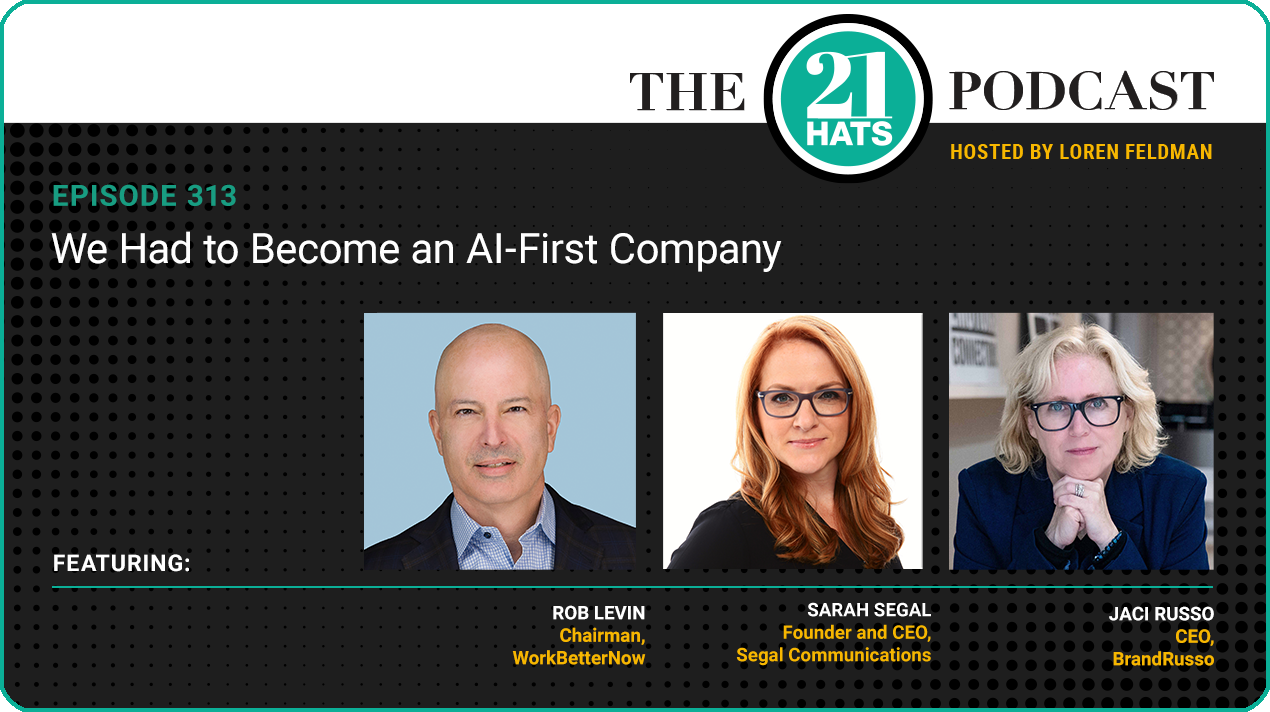
This week, we welcome a new regular to the podcast team, Rob Levin, co-founder of WorkBetterNow. I first met Rob more than 20 years ago, when we were both experiencing the decline of print media. I was an editor at Inc. magazine, and Rob had started a regional publication for business owners called The New York Enterprise Report. “Starting a print publication in 2003 was not one of the smartest things I’ve done,” Rob says. But he learned from that experience. In 2018, Rob and a partner started WorkBetterNow, which helps American businesses hire Latin American talent. The business took off during the pandemic and has continued to grow rapidly. But in recent years, Rob began to see another disruption looming. If artificial intelligence can increasingly perform the kinds of tasks his company supplies people to do, what happens to WorkBetterNow?
Rob tells Sarah Segal and Jaci Russo how seriously he took that question, what he decided his company needed to become, and how he’s trying to position WorkBetterNow for whatever comes next. We also talk about why referrals are no longer enough to sustain the company’s growth, what went wrong when Rob tried to build an outside sales force, and what he’s learned about managing remote workers. Plus, in another Beyond Small segment brought to you by Grasshopper Bank, Sarah, Jaci, and Rob compare how they manage the cash they keep on hand—and Jaci explains why she’s sleeping better since adopting Profit First earlier this year.
— Loren Feldman
Guests:
Rob Levin is chairman of WorkBetterNow.
Jaci Russo is CEO of BrandRusso.
Sarah Segal is CEO of Segal Communications.
Producer:
Jess Thoubboron is founder of Blank Word.
Full Episode Transcript:
Loren Feldman:
Welcome, Jaci, Sarah, and especially Rob, the newest regular on the 21 Hats podcast team. It’s great to have all of you here. Rob, you’ve started several businesses. Tell us a little about your journey. How did you get to WorkBetterNow?
Rob Levin:
I won’t give you the whole long, boring story. Let’s fast-forward to 2003. After my work as a CPA and then a CFO, COO, of a few different businesses, I started my own company. It was the first time I started my own company. It was called The New York Enterprise Report. It was a magazine, events, really a media company for business owners in the New York area. I ran that for about 10 years. I sold it. It was a very, very small transaction. It was not a successful company, even though it looked wildly successful on the exterior. And I had a few businesses after that.
Loren Feldman:
Wait, go back a second. That’s intriguing. First, why did it look wildly successful? It was a print publication at a time when print was beginning or in the midst of struggling, as I know well. Why did it look successful?
Rob Levin:
So first of all, I picked and I ran a great business, but I did it at the wrong time. Had I done that 10 years earlier, it would’ve been a totally different story. But the other reasons it wasn’t successful—and this is in my book, The New Talent Playbook, and I talk about this all the time, because I’m over it—is I really never focused on the culture of the company and building a great team. That was a big part of it, in addition to the overall timing. Starting a print publication in 2003 was not one of the smartest things I’ve done.
Loren Feldman:
Okay, keep going.
Rob Levin:
And it looked successful because we had national advertisers, we had local advertisers, we had an audience of 100,000. We did the small business awards in New York and a bunch of other events. Now, it wasn’t successful from a financial perspective, and that of course is very important, especially for 10 years while I’m raising a family in New York City. Now, that said, what I’ve learned and the connections that I made, present company included, over that period of time has been invaluable. Now, here we are 23 years later.
Loren Feldman:
Makes sense. What did you do next?
Rob Levin:
When I sold the magazine, I kept an arm of our business that I started a few years before the sale, which was helping large businesses market to small companies. So we used to do a magazine for Time Warner Cable Business Class. We did content for Mutual of Omaha, for SAP or a few divisions in SAP, stuff like that. And I ran that. There was maybe another business or two in there.
And then in 2018, I decided to start WorkBetterNow, which I did with my partner, Andrew Cohen. That started out as a business where we provided assistance to business owners. Our tagline was, “Every business owner should have an assistant.” And that was based on my experience, not only having an assistant starting in 2013, which changed my business and changed my life, but also that assistant was employed by a company in El Salvador. And I did not like that company. I didn’t like the way they treated her. I didn’t like the way that they interacted with me. And at some point, I just said, “I can do this better.”
So we started it in 2018. We really got going in 2019. Things started to take off at the end of 2020 when businesses went remote with the pandemic. And then a year or two in, we pivoted. And where we are today, we now offer 39 different roles of high-performing talent from people working out of their homes based in Latin America for U.S. small and mid-sized businesses.
Loren Feldman:
Thirty-nine different roles—what are the most popular ones?
Rob Levin:
Executive assistant is still popular. We get a lot of people who want people in the finance department, so that’s bookkeeping, AR collections. Marketing coordinators are pretty popular. We’re doing a lot of work in the construction area. We’re seeing estimating coordinators and people supporting all sorts of construction there. Logistics, we get people that need dispatchers. So those are some of the bigger ones. We’re also seeing a big trend now with departmental assistants.
So, particularly when you have what I call specialists, when you have people on your team who are highly paid, typically, and you really want them focusing on what they do really well and what drives a lot of value, what Dan Sullivan from Strategic Coach would call their unique ability. And the idea behind the departmental assistants is you take some of the administrative workload off of them, just like an owner does with their executive assistant, and you can really increase productivity, as well as overall job satisfaction, when people are focusing on what they really do. So we’re seeing that as a big trend over the past year.
Sarah Segal:
I’m looking at your LinkedIn, because that’s what I do. You were talking earlier about, like, appearing bigger than you are. So your LinkedIn says you have between 500 and 1,000 employees. I assume that most of those people are 1099s, because it sounds like you work with a lot more consultants or freelance people. What does your core company structure look like? I’m just curious how that works.
Rob Levin:
Sure, so yes, the bulk of those people, about 630 or so, are what we call WorkBetterNow certified professionals. They’re the ones working for our clients. Our team is about 60 or so people. I’m losing track. It’s about 60 people, with most of our team, 75 percent of our team, based in Latin America, including half of our leadership team.
Sarah Segal:
Great. That makes sense.
Loren Feldman:
Tell us about the trajectory, Rob. Did the business click immediately, or did you have to change some assumptions?
Rob Levin:
So, growth has been great. We’re three times, past three years, Inc. 5000 list. Growth has been fantastic. What we’re dealing with now is we are now realizing that if we wanna keep up our growth rate, we can’t do it by referrals, which is what we’ve really built the business on. So we’re now trying and exploring a lot of different avenues to at least maintain the growth rate that we’ve had, if not increase it.
Because the market’s really ready for what we do. And we call it we’re going from early adopters, in terms of small and mid-sized businesses hiring people from offshore or near shore, in our case. And I like to say that offshore is just an extension of remote, because it is. So we’re seeing more of those companies overall going from the early adopter phase to now what’s called the early majority phase, where it’s becoming—you’re hearing more and more about it. It’s becoming the “normal” thing to do. You can’t see the air quotes around normal, but—
Sarah Segal:
How are you tackling AI, though? Because I would assume that a portion of just the admin workers that you have, like some of that work is being—the demand for it might lessen, because people are looking to other sources. I was just listening to a whole thing about Meta’s new Muse and how that’s saving people time. It’s a little scary, but how are you incorporating that into your business structure?
Rob Levin:
It’s a great question, and I’m very excited about things like Muse and Dot, just personally, as well as in the business. And it’s funny, it sounds like it’s a weird thing now where you’re just gonna have this device that’s always on, and like a lot of things, it’ll be the normal thing, I think, in six months. To answer your question, Sarah, which is a great question, what we are doing: What we realized probably in early 2024, after ChatGPT had their big release, is that this was going to impact our business one way or the other, and which way did we want it to go?
Obviously, we want it to go where it’s gonna help our business. That takes a lot of effort, which we started back then, and I won’t bore you with all of that detail, but let me tell you where we are today with all of that. There’s no question that a lot of the work that our WorkBetterNow certified professionals can, and over time, increasingly will be done by AI. So we had to come up with a strategy for this. So what we did is we said, “Look, first, us ourselves need to become an AI-first company.” And Jaci and I met when we took Alan Pentz’s course. I think that was… Was that a year and a half ago? Two years? It was a while ago.
Jaci Russo:
It feels like it was the early days of AI. We were on the cusp.
Loren Feldman:
I think it was only about a year ago.
Rob Levin:
It might have been a year ago. So we were already doing stuff with AI. We were encouraging our team to use AI. But then I realized, you know what, I’ve gotta do a deeper dive. And I took this course along with Jaci, Alan’s course. What that did for me is, it made me realize a couple things. Number one, it made me realize how things were changing in AI during the course was so fast. It was tough to keep up with that. It made me realize that the pace of change is gonna skyrocket, and it’s already very fast.
It also made me realize that for people to really understand the capability of AI, which all CEOs need to do—they don’t need to be AI experts, but they have to understand what AI can do—is you have to build something with AI, which we did in Alan’s course, and that was an eye-opener. So, that’s when I said, “We’re gonna become an AI-first company,” and we started it then. Our head of IT became the head of AI, and she hired somebody to run our IT department.
Now, that doesn’t work for everybody. Not every IT director is gonna be really good with AI. Ours is. And by the way, she started at the assistant level, and she’s now on our leadership team, side note. And so what that did is, we provided a lot of training for our leadership team and the rest of the team, where now, I don’t know the number, but hundreds of our workflows are now done by AI.
Now, that’s important because if we’re gonna help our clients with AI, which is our ultimate goal, we have to be amazing at it ourselves, right? So we decided to become an AI-first company. We trained our people, we gave them the tools, and we’re doing all of that. And of course, that’s a never-ending journey. The next step, which we just recently launched: We’ve had this thing called the WBN Academy, which is our continuous learning program. And quite frankly, in the past we didn’t really do a good job with that. That’s our continuous learning, not only for our team, but for what’s now our 630 and growing WorkBetterNow certified professionals. So we now redid that, and we’re still evolving it, where there’s a lot of AI courses.
We’re gonna be introducing some new things over the next few months so that our WorkBetterNow certified professionals are really good with AI. We’re tentatively calling it AI-enabled, where they can actually build things. So they can actually help. As our clients are doing more and more with AI, our people will be able to help them with that journey, as opposed to just, “Hey, I don’t need that person anymore.” No, actually, I need this person because they really understand AI, they know our business. And part of that, by the way, is prepping the workforce, our workforce, to go from doing the work to overseeing the AI that does the work. So sorry for the long-winded answer, but I hope I answered your question.
Loren Feldman:
Rob, who do you have teaching your people AI?
Rob Levin:
It’s a combination. We do some internal—I’m very big on upskilling, for those people who follow my Substack or my podcast. I talk about upskilling all the time. It’s in my book. So upskilling can be done internally or externally. So, right now, it’s a combination of some internal training, because we have some people who are just great with AI, as well as our WorkBetterNow Academy team finds great courses that they integrate into the academy.
Loren Feldman:
You told us your core team has about 60 people. Can you give us a sense of how big the company is, in terms of revenues?
Rob Levin:
Yeah, with the number of our certified professionals and our pricing model, somebody can do the back of a napkin calculation on their own. This year, we’re gonna be somewhere around 20 million in revenue.
Loren Feldman:
And it’s been a pretty steady growth trajectory from day one?
Rob Levin:
You know, it was slow in the beginning. Neither my partner nor I were doing this full time. And then the pandemic hit, and a few months after that, things started to take off. Those phone calls that I made earlier to my network saying, “Hey, I’m doing this.” And they were like, “Oh, that sounds great, but you know, it’s not for us.” That changed very quickly during the pandemic when the job market tightened up and everybody got comfortable with remote. Since then, I don’t know if it’s been steady, but we’ve been growing aggressively ever since—like I said, enough to be in the Inc. 5000 for the past three years. And our latest ranking is about 1,600, which is still a pretty good growth rate.
Loren Feldman:
What was the bigger challenge, finding customers in the U.S. or talent in Latin America?
Rob Levin:
Funny question, because I did say when we started the business that it’s gonna be harder to find talent. Fortunately, we have an amazing recruiting team, and we’re able to find the talent. So our big challenge right now is we’ve grown almost exclusively by referrals. It’s growing the client base outside of referrals. And in fact, we have a consultant starting today—today being the day we’re recording this, October 1st—who is helping us figure out our options. Because some of the things we’ve done in the past have not worked well, the latest being we staffed up for an outside sales force and, for a number of reasons—I’m not against outside sales forces at all—that did not work out well.
Loren Feldman:
What didn’t work?
Rob Levin:
I think we had the wrong people and the wrong playbook.
Loren Feldman:
Can you tell us a little more? I mean, a lot of people struggle with that. What lesson did you learn?
Rob Levin:
So many different things. Number one, we hired our go-to-market marketing person after all of that. If you’re gonna put your outside sales force in the market these days, they need the air cover from marketing. And we didn’t have that in place in time. Number two, I think we hired the wrong people. I can’t really elaborate on that. And number three, maybe most importantly, we didn’t have great playbooks in place.
I think any time you’re putting a sales playbook in place, you’ve got to pilot something until you get it right, and then you’ve got to build a playbook around that, where you’ve got to remove as many of the variables as possible. You’ve got to really find out what works, which is everything from how you approach a prospect, what happens before then, what do you say, of course, who are the prospects? And we’ve done a lot of work, in terms of refining our ICP and how do you engage them, et cetera. And we didn’t have the right things in place for that.
Loren Feldman:
Jaci, you’ve had some experience with hiring salespeople and the challenges involved. Does that resonate with you?
Jaci Russo:
It really does. And Loren, as you know, I’ve managed to do it five different ways, and all of them were the wrong way. So I think I’m the common denominator. And as we were talking, I’m writing down, “Reach out to Rob and ask about potential for this.” What I have deduced in our own experiences is, one, we need a better process with better technology, and so that’s where ProspectDaily came from.
Two, we need to do a better job of leaning into networks, and people having a network and knowing how to build a network. We’re talking about a high-ticket item that takes a while to develop a relationship and trust. It’s not just gonna be an overnight decision. And so we’re working through that and I think getting better all the time. But I think Rob’s system and process is one that’s going to work for a lot of people.
Rob Levin:
Jaci, which system and process are you referring to? And by the way, I’d love for us to connect and maybe we can start—
Jaci Russo:
Oh, we will.
Rob Levin:
It sounds like a combination of, “Hey, let’s talk about what’s working,” and a support group for all of the people who have tried multiple things and none of them working.
Jaci Russo:
Man, all of the above. My choice has been that everything I try is more expensive than the last thing, so I’m heading in the wrong direction.
Sarah Segal:
I feel like 21 Hats is the support group.
Jaci Russo:
It’s my therapy.
Rob Levin:
Good point.
Loren Feldman:
Thank you, Sarah.
Sarah Segal:
Everybody here has the same problem.
Jaci Russo:
Yes, yes, and we’re all just holding each other’s hands while we figure it out. But Rob, in answer to your question, process and system, the way that you have—because I’ve talked to a lot of companies that use out-of-market talent. But what you’ve done that I think so many of them miss is the training and certification, so now I can trust that someone is actually being suggested who has the qualifications and skills that I need. That’s missing from a lot of them. And then, I like the way that you have talked about the recruiting process and ongoing support, because it’s like you’re not a fly-by-night, dip-and-go guy. And so, I like that whole setup.
Rob Levin:
Thanks. So when we started, all of our clients were friends of ours, right? You don’t want to disappoint them. Well, we don’t like to disappoint anybody. So what was important to us from day one is, we took really good care of them, and we built processes. A lot of those were manual at the time.
So for example, my partner in the beginning was interviewing every single candidate who we put in front of somebody. Now, obviously, we have a recruiting department. There’s a lot of technology involved and stuff, and obviously still interviews, but what we did—well, I kind of jumped ahead a little bit, but—what we did is we said: All right, this is the kind of outcome we want for people. Let’s take these manual processes and then build processes around that are scalable, because that was always the intention from day one. And that maintained the level of quality that we had since day one.
Loren Feldman:
Rob, you’re obviously a big proponent of remote work—and not just overseas remote. I’m curious, in running your core team, have you solved some of the challenges involved in hiring remotely? For example, just paying lots of people in different states can be quite an administrative challenge. What have you figured out?
Rob Levin:
Well, the paying people part, yeah. Paying people offshore, there’s a number of options for that. We played around with a bunch and we have a really good system right now. That really should be the least of people’s problems, because there’s companies around to help you with that, if you don’t work with a talent partner like a WorkBetterNow.
Loren Feldman:
I hear it all the time, though. People complain about it. What don’t they know?
Rob Levin:
Well, first of all, if you’re paying people in different states, there’s a million payroll companies from Gusto, ADP, Paychex. There’s a ton of companies that do that. That’s easy.
Loren Feldman:
And they do it well?
Rob Levin:
Yeah, and you know, you’re gonna hear about a nightmare here and there, but like, if any company’s doing their own payroll domestically, you’re out of your mind. And I’m being nice in saying that. You should not be doing your own payroll. That’s insane.
Loren Feldman:
Jaci, you hire remotely. Do you do your own payroll?
Jaci Russo
Well, to Rob’s point, I agree 100 percent, and no I would never do my own payroll. And all of my people out of Louisiana—nope, that’s gonna be a lie—all of my people out of the U.S. are 1099. All of my people in the U.S., we use a payroll service for, and I am grateful every day.
Rob Levin:
But the bigger issue is, how do you make a remote team work? And of course, we think about this a lot. You know, I would actually flip it on its head where people are like, “Oh, you can’t have a good culture in a remote team.” It’s bullshit. You can. We’re doing it. We have a phenomenal culture, and I’ll tell you some of the things that go into it. And remember that nearshore or offshore is just an extension of remote. If you’re gonna treat your offshore team differently than your U.S. team, you’re making a big mistake. Do not bifurcate. It’s one team.
So, number one, as I just said, you want to integrate everybody. Even if you don’t have anybody offshore and you just have remote people, you integrate them with your office team. So that means your staff meetings, there’s people on Zoom. They can ask questions. They participate like anyone else. That’s number one, fully integrated.
Number two, there are times when you have to over-communicate. Obviously, you need a chat setup, whether that’s Slack, Teams, or whatever the Google software is, or whatever other system you need. You need chat. You need email. You need to hop on video calls as if you were popping around somebody’s office. If you get those couple of things right, along with just basic practices of building a good culture, you can have a really effective remote or hybrid-based team.
Loren Feldman:
Are there are states where you simply will not hire people because of the employment regulations?
Rob Levin:
Yeah, that’s—
Sarah Segal:
Ooh, tell me, California?
Rob Levin:
So, okay, all right. I’m not gonna get political here. Look, I’m in New York, and my partner’s in California. These are two states that are not employer-friendly, all right? Period, end of story.
Sarah Segal:
Nope.
Rob Levin:
That’s an understatement. And if you’re in a place like New York City, it just adds onto it. That said, we hired a head of partnerships out on Long Island earlier this year. So I don’t love to hire from those states, but I also want the best people who I can get.
We outsource part of our HR, our U.S. HR, compliance, and all of that stuff. We have a company that helps us stay on the straight and narrow with respect to all of these regulations, many of which are ridiculous. Look, if I had two candidates who were equal and one was in a state like Florida and one was in a state like California, I’d hire the person in Florida.
Jaci Russo:
I’d like to put in a plug for the flyover states for a minute please. Typically we are full of talent. We often have little to no personal income tax at the state level, and with what y’all pay your people out there on the coast, you can hire the best of us, because we have such a low cost of living that your salaries make us feel like kings and queens.
Rob Levin:
I think that’s a great point.
Loren Feldman:
Sarah, any defense of California?
Sarah Segal:
Well, first of all, I don’t hire any remote people. I only hire people who I can meet in person here in the San Francisco Bay Area. That’s because I’ve not had a good experience hiring remote people due to accountability, mostly. We have too much stuff that we do to support local clients for me to force our clients to have to fly in a team to do an event here.
I hire a lot of young people too, right out of college, and I feel like it’s really important to be able to give them that in-person experience. So, we have two physical offices and we come in, and they learn by sitting next to us and learning. And it’s just the nature of my particular business. I do think there is a huge value in hiring people remotely for certain kinds of industries. It’s just not my particular industry. California is not easy. I do use a payroll service, and even with that, there can be headaches. But yeah, California is not a cheap place to run a business, but there’s a lot of business to be had, so that’s the trade-off.
Rob Levin:
I wanna just weigh in with a couple of comments based upon what Sarah said. First of all, what I tell business owners—I had a business owner come to me, and he had a sizable business. He just sold it for over nine figures. He and I know a lot of the same people, including a lot of my clients, and he said, “Look, Rob, somebody said I have to come speak with you and that I should hire from you.” Because a lot of our clients hire three, four, five—we have some of our clients that have 30 people. And he has, again, a sizable business. His name is John, and I said, “Well, do you have anybody working remotely now?” And he said, “No.”
And I said, “Here’s the question: Are you able to find great people who are willing to work in your office?” And he said, “Yes.” I said, “You know what, John? I’d love to have you as a client. You do not need to hire offshore—unless there’s a whole margin issue and pricing issue.” Although Jaci made a good point about you can find people for a lot less money in the middle of the country.
But if you do not have to hire offshore, and you don’t feel like you need to, then you don’t have to do it. Because, really, what hiring remote and offshore, among other things, one of the things it does is it widens your talent pool. Sarah, if you’re able to get the people that you need locally, and it all works economically, the economics all work out, then that’s great. A lot of companies struggle with it.
Sarah Segal:
No, and it’s not easy at all. But it’s not easy to manage people off-site either. So, I made a decision, and it’s benefited me. But again, I think that there are a lot of other industries where offshore works really, really well. And so I have no prejudice against it.
Loren Feldman:
Rob, do you have a goal in mind for your business? Do you have a sense of how big you’d like it to be or what you’re trying to accomplish?
Rob Levin:
You know, this is gonna sound corny, so forgive me. And if you guys want to pile on after, go ahead. So our mission is to help awesome talent and awesome companies fulfill their dreams by expanding their capability. So we really want to help as many companies, and in the process, amazing talent in Latin America, fulfill their dreams.
And the more companies that we can do, as long as they meet our criteria—we don’t work with companies that have bad cultures—most companies are great companies. There’s no limit to how big we can go. As long as we feel comfortable that we can continue to scale, and we’ve built this company to scale from day one, then we have some pretty ambitious goals.
Loren Feldman:
You don’t work with companies that have bad cultures. How do you usually figure that out? What’s the giveaway?
Rob Levin:
Yeah, so there’s two ways. One way, and it’s harder for my—I have an inside sales team. We call them client consultants. It’s harder for them to do this than for me. For me, I can spot this in about maybe 30 seconds tops. Just by the way somebody talks, I can kinda tell. I’ll give you a quick example.
I was at CoachCon, that strategic coaches biannual conference in June, and somebody walked up to me and said, “Oh, I heard you’re the nearshore guy.” And I said, “Yeah, I am.” I said, “How can I help you?” And he said, “Well, what’s your hourly rate for your people?” And that was already a flag. So I said, “Well, let me ask you something. What are you looking for? Are you looking for the lowest rate, or are you looking for great people?” He said, “The lowest rate.”
Now, that’s not necessarily indicative of a bad culture. I have examples of that too. But I knew right away this was not the right fit for us. So I said, “You know, I’ll tell you what. We charge by the month, but I can tell that there are companies that can help you better than we can.” The reality is we find out when there’s a problem with the culture more often after they’ve become a client, when we get feedback from our certified professionals. Because we have a department that works with them, they’re called talent coordinators. And if we’re hearing the same thing over and over again from multiple WorkBetterNow certified professionals, we’ll have a word with the client.
And what we’ve done, we’ll never pull certified professionals from a client, because that’s devastating. But in cases where we’re concerned about a culture at a client, we’ve told a client, like, “Hey, So-and-so just quit. We’re not gonna replace them because we’re not putting anybody else in the pool.” Now, in some cases, clients have turned that around, and it’s actually been a catalyst for them to do that, but that’s also kind of rare.
Loren Feldman:
All right. Next topic. It’s time for another edition of Beyond Small, brought to you by our friends at Grasshopper Bank. As you guys know, the idea is to have my guests address a question related to managing their business finances. I select the questions with Grasshopper’s help, and their only request is that you guys answer candidly, which I know you will. Today’s question is about cash. When you look at cash sitting in your bank account, do you primarily see security or money that should be working harder for you?
Sarah Segal:
I know it’s the wrong answer, but I say security, and—
Loren Feldman:
There are no wrong answers, Sarah.
Sarah Segal:
No, but it is kind of a wrong answer, because it’s very shortsighted. But I still look back to 2023 and having to lay off people, and I don’t ever want to—I have anxiety about it. And I don’t have a huge amount, because I’m in a service-based industry, but I look at it as, I don’t wanna touch it. I also want it to be nicely padded so I am not worried. I never want to have to worry about making payroll ever again in my business ownership experience, because that period where I had to go through that was so stressful for me as a human.
Loren Feldman:
How do you decide how much cash you need to have that level of comfort? Is there a percentage you have in mind or some other way of thinking about it?
Sarah Segal:
No, that’s a good question though. I’d love to know what other people do, because I don’t—there’s just a feeling. I’m like, “Okay, that’s a good number. I’m okay with that.” But no, there’s no specific fraction that I look at.
Rob Levin:
Sarah, are you on your company’s payroll or do you take regular distributions?
Sarah Segal:
So that’s an issue. So, I am an LLC, and I’m on regular payroll, but really, I’ve talked to a handful of people, and it has been suggested that, at this point in my growth, I should consider becoming a C corp instead. And so I’m exploring what that might look like.
Loren Feldman:
Why, Sarah? With what goal in mind?
Sarah Segal:
It’s the taxation and it’s literally—I can’t explain it, because I’m not a tax professional, but I come out more net positive in the end if I move to C corp, if you’re above a certain revenue number. And that’s how it’s been explained to me. So again, I’m in the beginning phases of kind of exploring this. If anybody knows a lot about this and went from an LLC to a C corp and wants to give me advice, I would be happy to listen to them.
Loren Feldman:
We do happen to have a CPA here. Rob?
Rob Levin:
Well, not practicing, so I’m not going to go too deep into this, but I’m surprised somebody didn’t say S corp, where there are some slight advantages.
Sarah Segal:
You know what, no, I’m lying. I meant S Corp, not C Corp. I don’t know why I said C.
Rob Levin:
That makes more sense and the reason has to do something with payroll taxes. We are an LLC, taxed as an S corp for that reason. But I think it’s great that you’re on payroll, meaning you’re taking some money out. I’ve seen too many owners that are like, “Yeah, I only take money out when there’s enough cash in the business.” And that’s not a business, by the way.
I’ll tell you what we do, and we’re an S corp. We have some money that gets distributed through payroll. I mean, that’s our salary, and then we take distributions, because the distributions don’t have the same impact on payroll taxes.
Loren Feldman:
Let’s get back to the question at hand. Jackie, how about you? What do you think when you look at the cash you have on hand?
Jaci Russo:
Well, Loren, as you know, we switched to Profit First, and so my question would be: Which account? Because we do that differently now, and it has made the answer to that question so much easier, because now there are accounts for capital improvement, for reinvesting in the business, for growth, and there are accounts for security and safety and being able to sleep at night.
Sarah Segal:
Wait, explain that to me.
Jaci Russo:
So Profit First—and I’m gonna bungle it, so I just recommend you read the book, but I will explain it—Profit First recommends that instead of following the typical—and Rob don’t even listen, because I don’t want your CPA judgment here. [Laughter] Instead of following the typical protocol that people do—which is you look at your P&L, and there’s the money you make and there’s all the expenses and whatever’s left at the bottom, there’s your profit—this reverses that.
This says—and I read the book long enough ago that I’m not gonna tell you exactly how he recommends doing it. I can tell you the system we’ve personalized for ourselves. Every two weeks, I go in, and I look at what our top-line revenue has been, what our real hard costs are—like media buying. That’s not my money. So I don’t look at that, because that’s not my money. I’m just holding that to give from the client to the media outlet.
And then I take percentages—or it’s actually automatically routed percentages —from our holding account that everything gets invested into these specific accounts that are designated for shareholder distribution, which we call owner’s pay; for taxes, so that’s easy to pay now, because the taxes just come right out of the tax account; and then for our long-term investment growth account; and for our rainy day fund emergency account.
And so now, when I look at accounts plural, they each have a different purpose. And so when the capital investment account gets to a certain point, which really every month I look at it and say, “Where do we need to reinvest? What are we gonna use this money for to grow?” Because that’s what it’s for. And then the rainy day fund I don’t touch, because that’s for a rainy day, and that just grows every month. And then, once it got up to a certain point of so many months of rainy days, now I don’t put anything into that. That money now routes to a different account to do other things with.
So when I look at our accounts plural, they each have a different purpose, and we’ve never had this level of comfort, because we’re just paying ourselves first. And I don’t know the science behind this really weird thing, but there’s some kind of a law of abundance and the science of wealth and blah, blah, blah, whatever. But at the end of the day, the money just keeps coming in because I’m putting it in the right places, and then it’s growing.
Loren Feldman
Rob, what’s your CPA judgment on that?
Rob Levin:
I’m totally going to be judgmental here.
Jaci Russo:
Please.
Rob Levin:
I was hoping to disagree with you and start a big fight, but this Profit First concept is awesome. I wish every business owner would do this. I think it’s genius.
Jaci Russo:
You made my day.
Loren Feldman:
Do you do it?
Rob Levin:
Uh, no, we don’t. By the way, as I think about it—well, I take that back. We do have a target net margin that we’re going after, which is very similar to what I understood about what Jaci said about Profit First. So we do have that target net margin that we’re going for, as opposed to: We’re gonna run the business and whatever it is, it is. So in a way, we do have a similar approach. Not exactly the same, but similar.
As far as cash goes, so first of all, I think people have to understand that the answer for them is gonna depend on their personal circumstances and their company circumstances. For example, my business is a recurring revenue business, and it’s growing. So that means we know what’s coming in every month, even if we don’t bring in new clients. It grows naturally because our clients’ head count grows, therefore they’re adding people with us all the time. So even if we don’t bring in another client, we’re growing.
Plus—and this is also really important, very, very important—we don’t have a working capital issue because we charge in advance, and that was by design in the beginning. Remember, I used to own a magazine. I had ad agencies paying me in 90 days and 120 days and ran into all of those headaches that Sarah was referring to about making payroll and reaching into my pocket and all of that stuff. So I learned from that.
Jaci Russo:
Rob I’m just gonna jump in real quick and tell you that I was at a pitch a while back, and the prospective client told us that they were Net 365. And I said, “Is that a typo? Do you mean 36.5?” And they said, “No, 365.” I said, “So you expect an interest-free loan for a year on your media bills?”
Rob Levin:
Well, they’re basically saying, “We’re not interested in working with you.” At least, that’s probably what you heard.
Jaci Russo:
I was not interested in working with them. That’s what I said.
Rob Levin:
For so many reasons. Obviously, they don’t care about their vendors or their partners. Well, partner is probably not the right word. Vendors.
Jaci Russo:
Not for them.
Rob Levin:
When you take the recurring revenue business, and the model that we have, in terms of we really don’t have receivables, that changes things. It’s important for people to realize that, because if you have a business where you have receivables or you have inventory, you can be growing rapidly and you will outstrip your cash balance very quickly. That’s just math.
So anyway, to understand how we deal with cash, I got a great suggestion from a very successful friend of mine. He was telling me what he does, which he’s been doing for, I think, 30 years. He puts X number of dollars aside every week. That number that we’ve been putting away every week—and I’m not gonna say what it is—that’s grown, and we put it into a savings account. Number one, we get better interest on that. We negotiate that interest with the bank.
But what do we do with that account? Well, it’s there for a number of things. It’s there for distributions, because we have to make not only our monthly distribution—because we take part of our salary in payroll and part of it in distributions—but we also have to make distributions to cover taxes, because we are a flow-through entity, like an S corp or an LLC. It’s also there for investments that we don’t necessarily plan for. It’s a little bit there for a rainy-day fund for, “Hey, we didn’t expect this to happen.”
And then when we have enough, anything extra, we can make additional distributions—distributions that go above and beyond, distributions we need to make for tax purposes. And on top of that, we have a credit line.
Loren Feldman:
Jaci, I have a question for you. The Profit First idea sounds great. You’ve been doing it, I think, for all of this year.
Jaci Russo:
Correct.
Loren Feldman:
Have you had a month where you set aside money, you set aside that profit first, and then ran short at the end of the month and had to scramble to figure something out?
Jaci Russo:
No, thankfully, knocking wood. I have not. And I have in the past 24 years—this is our 25th year in business—in those years, there have been times where we’ve always had a kind of a savings account, because I’d rather not have to borrow money. I try to avoid that at all costs. And not that I’m against it, but just in principle, I’d like to be able to be my own quote-unquote line of credit. And so, yes, we’ve had to move things.
What has been fascinating to me watching this year is that there’s something about the logic of it, and I cannot explain it any better than the law of abundance, because I’m pulling money out. It’s disappeared. I mean, I’m putting it over here in these accounts that I don’t check their balance regularly. I don’t have them connected to my online banking apps. I’m not looking at them, and so it’s literally out of sight, out of mind.
And every two weeks, they’re moving. And I equate it to the envelope method, which we’ve done at home. From the early days, we realized—Michael and I; my husband, Rob, for your benefit—look at money very differently, and so that was a way for one of us to be kept in check so the other one didn’t kill them. And it worked out really well because we’re still married and both alive. And this is that same principle of: Put the money into the envelopes every two weeks, and then that’s the money to spend.
And so, there’s no move-the-money-over-for-emergencies account. That’s all dedicated to things, and then there’s just always plenty left over in the checking account. It’s not that we’re killing it, and over-shooting our goals. We’re right on track for the year. But out of sight, out of mind means I’m not touching it, and it doesn’t exist. And then it just keeps growing.
Rob Levin:
How much is too much in that hidden account? At what point do you say, “You know what, I’m gonna take some of that out”?
Jaci Russo:
I’ve set some goals, because we are reinvesting in our team. We’re all in on AI. And so we’re always looking to add to those tools and training around those tools and making sure we’re leveraging those tools. But I think that they each have different goals. Our emergency kind of rainy day fund is six months of operating, making sure that, as Sarah was saying, I don’t wanna think: “What if I can’t make payroll today?” So that’s not a worry. That’s over there. That fund balance makes me feel safe and secure. Everything else, it has a purpose and it has goals, and when it reaches that goal it serves its purpose, and then we start rebuilding it again.
Loren Feldman
Sarah, were you starting to say something before?
Sarah Segal:
Yeah, I was just saying that every time I come on the podcast, I feel like a terrible business owner. I’m just like, you guys are so much more sophisticated than I am, like, in terms of the approach to it.
Loren Feldman:
Sarah, last time you were here you told us your business was growing exponentially.
Sarah Segal:
It is!
Loren Feldman:
That doesn’t sound too terrible.
Sarah Segal:
No, I’m not putting my money in the right places. I’m not doing Profit First.
Jaci Russo:
Sarah, I figured this out in the 25th year! 24 years I did it the other way.
Rob Levin:
It takes a while.
Jaci Russo:
Yeah!
Sarah Segal:
That makes me feel better.
Rob Levin:
Well, hang on a second. I guess we’re doing an intervention here. So Sarah, is there something that you heard today that got your attention, that got your interest, that says, “Hey, maybe I wanna try this”?
Sarah Segal:
Well, I like the idea of the different accounts. I kind of think that’s cool just to have the money out of sight, out of mind. But I don’t think I’m there yet. There are a lot of other things I need to prioritize first before I get to that point. Like, I need to just educate myself a little bit more about growing in the right way and making sure that there are metrics that help me make my decisions. There’s a lot of gut instinct at this point, but I’d like to be a little bit more systemized, in terms of how I make my decisions.
Like, for example, we won a client yesterday, and I just found out we won a client this morning. So we have two new clients coming on. But one is a short-term run. It’s a project. And the other one’s a retainer. And I need to look at my team and go: Okay, well, they’re kind of at their bandwidth. They’re almost at their bandwidth. What do I do? Do I hire on another person? And, you know, with the understanding of, I don’t know if that’s gonna continue into the new year or not.
There’s a lot of just kind of that: What do I do? I don’t have anything that I can look at a calculator, type into that calculator, and be like, “I’m gonna hire a person.” I don’t have that set up yet. So I need to figure out that stuff before I’m like, “Oh, let’s set up different accounts and invest in this and that.” So I’m just not where you’re at. That’s all.
Jaci Russo:
Hey, Sarah, two things: Text me your address, your mailing address, because I’m sending you a copy of the book. Also, we’re not talking about putting 30 percent of revenue into each account, because that would be like 150 percent, and I even know math well enough to know that doesn’t work. You may start with a half a percent or 1 percent for this account and 1 for that account. And then you do that for a few months and then you do one and a half percent. So it’s not like you’re going from zero to 100.
Rob Levin:
If you go with Jaci’s approach, you do that, the separate accounts, and then you go, “I’m gonna put X number of dollars or X percent away every week or month,” or whatever it’s gonna be. However low that number is, sort of the same thing I’ve done with my kids and how I encouraged them to save when they were younger. Just get into the habit. I know when my friend told me to do this, we started with, I don’t know, like maybe $500 a week, and we’re way ahead of that now. It was just a habit.
Jaci Russo:
Right. And $500 a week doesn’t feel like a lot—until you get to the end of 52 weeks, and it’s all of sudden become a whole lot.
Loren Feldman:
Sarah, before we go, do you have any other questions? Is there anything else along these lines that you wanted to raise?
Sarah Segal:
No, I’m good. I love this. I love this. Because I like not being the smartest person in the room, because it gives me room to grow and educate myself. So, I’m absorbing it as much as I can. And since I started being on 21 Hats, things have changed.
I mean, I look back to those initial days when I was on this, and my business was a much different beast then. And every year, I get a little bit better at it. And I attribute a lot to that to the connections and the camaraderie that I’ve had. So welcome, Rob, to the fold. You’re in good hands, and we will argue, support, and tell you when you’re right and wrong all day long until you say, “Stop.”
Rob Levin:
I don’t think you’re gonna hear, “Stop,” from me. Let’s do it. I’m looking forward to the next call.
Loren Feldman:
My thanks to Rob Levin, Jaci Russo, and Sarah Segal, and a special thanks to our sponsor, Grasshopper Bank. And thanks for listening, everyone.

