

We Want to 5X Our Business in Three Years
Introduction:
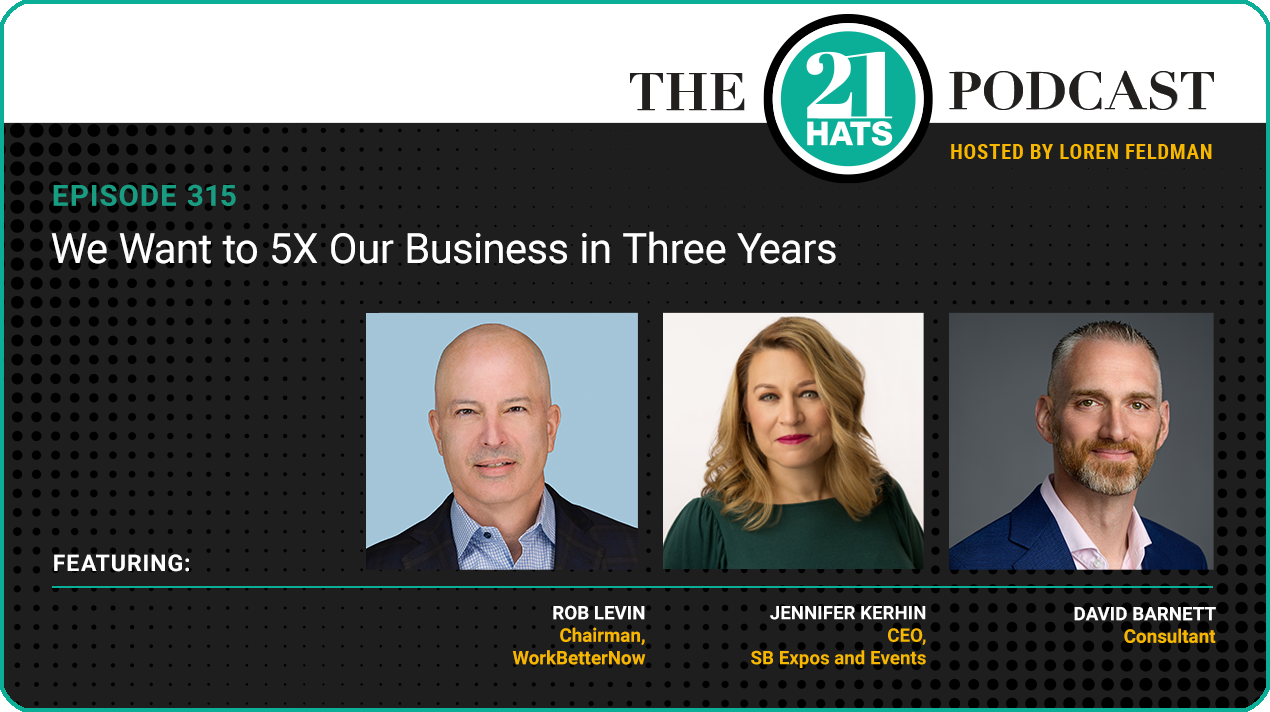
This week, David C. Barnett, Jennifer Kerhin, and Rob Levin compare notes on three very different approaches to growth. Dave, convinced that people are craving more personal connection in an increasingly digital world, is experimenting with an in-person conference. He’s hoping the event will at least break even and, more importantly, help him attract consulting clients. Jennifer, meanwhile, is investing in leadership training to increase her company’s capacity, but she’s also wary of growing too quickly. A few years ago, her company grew 145 percent in a single year. “That almost killed all of us,” she says. And Rob has hired a consultant to develop a marketing strategy that he hopes will help him quintuple his business in just three years. “The market is ready for what we do,” he says.
Along the way, the owners also discuss why charging more can make an event more attractive, what makes a business partnership work, why Jennifer is still reluctant to launch her next big idea, and where they turn for support when facing high-stakes decisions. “Well, I make my decisions with ChatGPT now,” says Dave. “Does that count?” The episode is brought to you by Grasshopper Bank.
— Loren Feldman
Guests:
David C. Barnett helps people buy and sell businesses.
Jennifer Kerhin is CEO of SB Expos and Events.
Rob Levin is chairman and co-founder of WorkBetterNow.
Producer:
Jess Thoubboron is founder of Blank Word.
Full Episode Transcript:
Loren Feldman:
Welcome Jennifer, Dave, and Rob. We’ve got a lot to discuss today. Let’s start with you, Dave. You’ve spent years advising people on buying and selling businesses. You’ve written books, produced an enormous amount of content, built an audience, and now you’re putting on a small business conference. What’s the idea?
David Barnett:
Well, it’s part of the brainstorming that I was doing at the end of last year when I was seeing how this AI stuff is starting to change the landscape, and I think, as well, just seeing the feedback from people I’ve been working with and sort of the levels of inquiries and things. I don’t know what might be going on, but I think there’s a little bit less confidence in the economy generally right now. And I was just brainstorming different things to do. You know, my phrase that I’m using is “double down on humanity”—or my humanity, anyway.
So I thought, “Maybe I should be doing something to put myself literally face to face with more people.” And I’ve been traveling around for years, going to different conferences all over Canada and the United States, and I’ve seen a lot of really cool things, a lot of really cool ways that people organize things. And there was not really a small business owners conference event, like the kind I would imagine here where I live, and I just thought, “Hey, you know, maybe it’s time to put one together.”
Loren Feldman:
Remind us where that is, Dave?
David Barnett:
Yeah, so I live in a city called Moncton in New Brunswick, and we’re just east of Maine. And it’s a metro area, like if you stretch it 45 minutes out, probably about a quarter million people in the region. But we have two other cities that are an hour and a half away and another one that’s two hours away and Halifax is two and a half hours away. So we’re a central place.
And I decided early in the spring that I wanted to do this. I managed to link up with some partners to help defray the costs and de-risk it. And when those partners came on board I said, “Let’s go.” And it is going to happen a week from right now, when we’re recording. So I’m pretty excited about that.
Loren Feldman:
What’s the format?
David Barnett:
We’re calling it the SmallBizRIOT. And RIOT stands for Revenue, Innovation, Operations, and Team. And so the day is kind of divided into five periods, let’s call them. Like your high school day, for example, if you remember that. And so people come in in the morning, there’s coffee, and we sit down at different tables. There’s actually assigned seating. And so people sit down with a group of people. We have two different speakers for revenue, and then there’s a discussion period, and then there’s a break time, and after the break time, before the innovation period starts, people change seats.
So the whole idea is that during these five periods—revenue, innovation, and then lunchtime, and then operations and team—people will get to sit at five different tables with five different groups of people and maximize the networking aspect. We have a total of 13 speakers throughout the day, most of them speaking for only 15 or 20 minutes. And then we finish it up with a little networking cocktail party that goes ’til about 6:30. And we’re gonna see how it goes. I mean, so far, the feedback from people who’ve bought tickets has been very positive. And it’s the first year for the event, so I’m pretty happy about how things are going, actually.
Loren Feldman:
How many people are you hoping to attract?
David Barnett:
We planned around the idea of 100, which really would have maxed out the space that we got. We went with an event space in a co-working facility, and the reason we chose it was because they had built-in audiovisual, and that meant another cost we wouldn’t have to cover. And you could probably jam 100 people in there, but it would be very comfortable at 80.
And so we planned for 100. I just checked. We just sold another ticket. We are now at 65 registrations. As I said, we’re a week away. Eventbrite, which is the ticket platform we’re using, has told me that events like mine typically sell 40 percent of their tickets in the last two weeks. And I believe it, because a week ago, when we were two weeks out, I had only 40 registrations. So, within the past week I’ve got another 25, and we have basically 15 left and a week to go. So I’m pretty optimistic. But even if we cross 70, I’ll be happy.
Loren Feldman:
Jen, you know a few things about events. Do you sense that Dave’s right that people are looking for that personal in-person connection?
Jennifer Kerhin:
Yeah, I was thinking, Dave, I was going through all the things like check marks and then questions for you on it. One, great name. I think the name’s easy. It ties into the plan for the day, fantastic. I think the one-day format’s good. You know, travel gets expensive, and so you’re coming from a local area where people can drive in. Long day, but still makes sense. I love the way you split it up.
One hundred percent agree about last-minute registration. I think that, one, good for you for a brand new event getting 65 people. That’s fantastic. And absolutely, we are seeing it in conventions of 2,000 to 3,000 people where a tremendous number of people are signing up in the last few weeks. So, no doubt, if it rains you probably get—but if it doesn’t rain, people see what the weather is, and people will sign up the day before, right? You’ll probably even have on-site registration, if it doesn’t rain.
I think the only thing I would caution you on is the amount of speakers. I think the way you set it up makes a lot of sense and moving tables. That’s a lot of speakers. It becomes overwhelming sometimes. So you might want to take an editor’s view to that and come back to it. Some of the event strategy these days is putting in more blank space so people can network freely. So just think about that. But really, great job. Your first event, fantastic. And it sounds like you have something that can really grow from. So great job.
David Barnett:
Well, thanks for that feedback. We have already prepared our surveys, for both the sponsors and the attendees, for after. And I’m totally open to the fact that we’re gonna get some commentary and stuff, and I’ll be looking out for that particular feedback about the number of speakers.
But really, what we were doing this year is just trying to create some kind of minimum viable product, and see if we could pull it off and get people to come out. And I agree, if the day turns out to be as great as I think it’s gonna be, I could definitely see this becoming an annual thing. And hopefully, that means it makes it easier to fill every year.
Loren Feldman:
How have you marketed it?
David Barnett:
Well, that’s interesting, because what we’re told is that if you put the right kind of social media posts and you pay the Facebooks and the Googles and the LinkedIns, that they will magically deliver customers to you. But that, in fact, has not been my experience at all. In fact, one of the great things about Eventbrite is you can create an unlimited number of tracking links that allow you to specifically know where people clicked to buy their ticket. And the paid online platform advertising, I think, right now, has delivered five people.
And the vast majority of the attendees have come from my personal outreach—I’ve probably sent hundreds of emails one-on-one—and leveraging relationships. So reaching out to someone who I know runs a mastermind group, for example, and saying, “Hey, would you like to talk to your members about coming?” And sort of leveraging connections in that fashion. Those two methods have been the biggest way people have come. And then I’m hoping that if people have a really positive experience, I’ll be able to then leverage this year’s attendees to try to get more people invited through their relationships maybe for next year.
Jennifer Kerhin:
Dave, what’s your registration price?
David Barnett:
So we have two different tickets. We have one ticket, which is for business owners, and it’s $139. And we have another ticket, which is for vendors, people who want to prospect amongst the business owners, and that ticket’s $40 more.
Jennifer Kerhin:
Do they have a tabletop display?
David Barnett:
No, the way that it works is that the sponsors have tables named after them and they are able to decorate their table any way that they want, and they can have additional materials there. So if you can imagine a business owner, they might come in and they might spend the first period at the credit unions table and then the next period at the lawn-care companies table, and so they get sort of face-to-face with these other businesses. Those are the sponsors.
The vendors, they simply are not moving the tables. So the business owners are moving about, but the people with the vendor tickets do not. And so it’s going to minimize the number of double connections they might get.
Jennifer Kerhin:
Do they speak, too?
David Barnett:
Some of our sponsors are, some of them are not. And we did not tie the two things together.
Jennifer Kerhin:
I think you’ve got a really good beginner model, and I think you’re on the right track.
David Barnett:
Well, I tried to steal all the best concepts and ideas I could from all the events I’ve attended. Because again, I’ve never done it before. So, the R&D department, what is it? Rip off and duplicate?
Loren Feldman:
Rob, you’ve done business events aimed at small business owners in the past. Do you do events now with WorkBetterNow?
Rob Levin:
We very rarely do. We did an event for clients a couple of years ago in New York and our clients are all over the country. We are thinking about doing maybe some virtual events again because our people are all over the country. I do agree that I think live events can be really appealing now because people do want to get out.
I’ve got a question for you, Dave. You’re thinking about maybe an event for next year. Have you thought about what happens in between the events, and this idea of building an audience with this base, and maybe leveraging the content from the event, stuff like that?
David Barnett:
Yeah, we’ve got a videographer who’s gonna be recording everything, and part of those recordings are gonna be used maybe to market next year’s event. But one of the questions on our post-event questionnaire is actually about that: Do you want to see other events throughout the year, maybe smaller events, that are going to bring the same community together?
I have an idea for a couple events over the winter. I’ve also got this idea about how to encourage more early registrations. Jennifer, maybe you can answer this for me. I was thinking next year, if I did something again around this time of year, sometime in October, towards the end of October, but then I did something else that was maybe just an evening in September, if I said to people, “Hey, if you register for the RIOT, you get to come to this other thing for free.” Do you think that would have any appeal?
Jennifer Kerhin:
Doubtful.
David Barnett:
Okay.
Rob Levin:
Yeah, and I’m gonna jump in here. I would be careful with the free concept. You’re dealing with business owners, and we all know that you have business owners who are sole proprietors and then you have bigger business owners. I don’t know what you’re shooting for here.
I like to take the opposite approach, and I did with some of my events, not all of them. I used to do about a dozen events a year. But if you’re going after the slightly bigger business owner, the higher the price point, in a way, the more appealing it gets. Because it tells me who else is going to be in the room.
David Barnett:
Hmm.
Jennifer Kerhin:
Agreed, agreed.
David Barnett:
Yeah, and this is why I prepared a post-event questionnaire for the sponsors as well that is different. And one of the questions on there is about who they’re meeting and if it was the right crowd of people, et cetera. So, yeah.
Jennifer Kerhin:
You don’t have that many sponsors, right? What are we talking about, less than 50?
David Barnett:
No, sponsors that have paid money is like six.
Jennifer Kerhin:
Yeah, I wouldn’t do a survey. I would just get on a Zoom call with them.
David Barnett:
A conversation? Yeah.
Jennifer Kerhin:
You don’t want them to fill out a piece of paper. You want to ask them a couple of days later, a week later, in detail what they liked, didn’t like, how they can help you grow it, what they need. Don’t do a survey for them.
David Barnett:
Thank you. That’s good advice.
Jennifer Kerhin:
I’ll just add: I agree with what Rob said. Rob said business owners can invest in their own knowledge to help grow their company, right? So I agree from a price point and benefits, he’s on the right track. You’re not going after a consumer. You’re going after somebody who wants to grow their business. That’s why they’re coming to the meeting. Raise your price and do a nicer lunch or something. I think he’s right on with that.
Loren Feldman:
Dave, I’m guessing the goal here is more about marketing your services, helping people buy and sell businesses, than about making a profit on the event. Is that right?
David Barnett:
Yeah, I almost thought that the event, even if it just broke even but was successful and everyone enjoyed it, would be worthwhile because it’s going to open the door potentially for me to work with some more consulting clients. So that’s the ultimate goal for me.
Rob Levin:
Just a word of advice. So just so everybody knows—I know Loren knows this—I owned a media company for business owners in New York for about 10 or so years. And I wrote about it in my book, how it seemed wildly successful and it wasn’t. It was not financially successful. I know you’ve got other goals here, but I will tell you that, whether it’s an event or doing what Loren does—but particularly with events when you’re rubbing elbows with people—it can get really addictive. You’re gonna get such a buzz from being in the room with your fellow business owners, and of course the prospects for you. Just be careful. It gets really addictive and just make sure that this is really working for you, whatever your goals are. Because I did it for too long.
David Barnett:
Yeah, no, I totally get that. It’s like, I get invited to go and speak at a lot of conferences, and of course a lot of them want you to come and do that for exposure. And in Canada up here, people die from exposure. [Laughter]
So, eventually, it’s like, no, if you’re gonna take me out of my business for two days, I have to actually earn some money doing this. But you’re right, it’s a lot of fun, right? And in the first dozen or so times people invited me to come and do these events, I was like, “Yeah, I get to go do this. I’m gonna meet all these people.” But then eventually you realize, “You know what? It has to make sense financially.” You’re right.
Jennifer Kerhin:
David, one small tip too. Since this is your first event, do a little bit more signage than you think. Your signage on site is your branding for this. And so, there’s nothing like somebody coming into like a boring-looking hotel room, meeting room, center room, wherever it is, and there’s like a little 22-by-28 sign on an easel. If you can put a little bit more pizzazz to that, it’s like the gift wrap on a package when they walk in. They have that emotional sense of it.
I don’t know, we do DJs where people are walking in the morning for registration, just to get that enthusiasm up. Don’t underestimate that first impression coming into your meeting. So whether it’s balloons, some iPad music, some speakers with some exciting walk-in music, and some signage, don’t minimize that.
Loren Feldman:
Well, we will be eager to hear how it goes, Dave. Moving on, Jen, you’re always working on interesting and ambitious projects in your business. How’s it going?
Jennifer Kerhin:
Well, thank you, Loren. Thank you.
Loren Feldman:
Well, it’s true. What’s going on?
Jennifer Kerhin:
Right now, what I have been working on for the past year is leadership development. So on an earlier podcast [episode], we talked about how I made it through the Valley of Death, which has been fantastic. But during this transformation, I have availed myself with a lot of resources for CEOs. I’m in a Vistage group. I go to different conferences for myself. I do a lot of reading, a lot of learning, listening to this incredible podcast, reading your newsletter, Loren.
Loren Feldman:
Thank you, Jen.
Jennifer Kerhin:
You’re very welcome. But you can’t grow by yourself. And so developing leaders who are at all different levels and skill-sets, and so, putting them on a path to develop their communication skills, their financial literacy, their staff management and supervision skills is something I’ve really been working on this year with minimal-moderate success and looking forward to doing a lot more of that in the next year.
Loren Feldman:
What was it that prompted you to do this, and how is it progressing? How much success have you had?
Jennifer Kerhin:
Some. I’ve had some success. I wouldn’t say no. But I would say I got a fractional CFO back when I was very small, $600,000 in revenue. And she has taught me many, many things over the past eight years. And so some things are natural when you talk about financial literacy now that aren’t to other leaders.
And you realize, “Okay, well in order for you to become a better leader, let’s teach you some of this.” Same thing with staff supervision. We get a new client. How do we assign the work to different people? How do we say, “Okay, you know what you’re doing for a smaller show, but for a bigger show you need a little bit more oversight. It’s not that we doubt you but you just don’t have that experience.” So where does micromanagement versus oversight and supervision and training them?
Let’s say you were a good leader for two people. Well, we grew. Now you have four people. That changes things a bit, right? The experience of staff versus the complexity of client work. So I would say minimal to moderate. It’s a work in progress, but it’s something that it’s not just me being trained anymore. It’s training them and me going out to be more thinking about the opportunities up there.
Rob Levin:
I think this is terrific, Jen. We’re doing the same thing. You know, I think that as an employer, I have an obligation to help my people be better. But then you can get a little selfish about it too—and selfish probably isn’t the right word—and I’ve given this a lot of thought, and I talk about this in my book: the idea of upskilling your people. And it’s not just making them better, but everybody can benefit from this. So the way I like to think about this is in terms of capabilities. And as the pace of change in business keeps increasing, we need to acquire new capabilities throughout the company.
And that almost always comes in the form of people. And those people can be new people, they can be consultants. Of course, they can be your employees. So if you have a capability you need to acquire—AI-related ones are very hot right now, and they’re gonna be like that for a while—and you can provide training, whether it’s internal training or it’s external training, that person then has the opportunity to acquire some capability, bring it into the company.
And then if they do that, usually you’ll have no problem giving them that raise and promotion that they want. So that’s the double win. The triple win is when you provide training opportunities that come with internal mobility opportunities, the research shows that employee tenure goes up 60 percent. So you’re on to something really big here.
Jennifer Kerhin:
That’s great. I’ve been really big on teaching the staff the skills for our industry. It’s a very niche industry, very specific skills. But I’ve never had a training program because we have a lot of how-to videos training aspects about the work we do. But I like the word upskilling—of upskilling people that are managers to get them to the next level of leaders. And I’m willing to put in a lot of time and effort and financial resources because I have a great group of leaders—fantastic.
And just like I was a couple years ago—and still to this day in different areas—I would say I’m still weak on the financial portfolio of debt and credit. But for them to learn some different types of financial ratios, operating ratios, some better staff supervision and accountability, I’m willing to invest in it. Because I know we can’t get to the next level without having them have that expertise, which means training them. And they’re the right people to train.
Loren Feldman:
How many employees do you have, Jen?
Jennifer Kerhin:
31 now.
Loren Feldman:
And how many leaders are we talking about?
Jennifer Kerhin:
Six.
Loren Feldman:
You still operate completely remotely, right?
Jennifer Kerhin:
We do, so we’re in 14 different states now.
Loren Feldman:
Which adds to this challenge.
Jennifer Kerhin:
Yes and no. We travel quite a bit for our work. And so there is a challenge of, like, you’re not sitting next to somebody and just hearing how they talk, or osmosis, or being at the coffee machine or at lunch. But because we travel, we can see people in their element doing their work more often than you would just see them planning the event. You can see them on site at an event. And honestly, no one in my industry anymore goes into—or very rarely goes into—an office because of our travel schedules.
Loren Feldman:
That’s interesting. How do you think about balancing the need to actually get work done versus the need to go through the training process?
Jennifer Kerhin:
Well, you know, I think you said something, Rob, that was interesting to me. The concept of investing in yourself or having your employer invest in your skills with the promise of continued mobility and compensation is there. And people have to look at their own career. And people have said to me, “I don’t want to go that next level. I’m just happy where I am.” Okay, no problem. But then the promise of future promotion and compensation isn’t there either. So it’s never a smooth line.
But if my leaders, who right now are all incredibly ambitious and smart, I figure out what their weakest areas are, let’s work on that first, and then let’s move forward. I also look at business development. So if I know one department can onboard a new client faster, I’m probably gonna try to sell more of that service than if another department is still trying to work out the kinks of onboarding new clients, then I’m gonna slow down that business development. But it’s never perfect.
Rob Levin:
What you just said is really interesting because you’re basically making decisions out of capacity versus what the market—and I’m not saying it’s wrong, by any stretch of the imagination. You’re making decisions based upon capacity versus what the market demand is.
Jennifer Kerhin:
And Rob, I don’t know if that’s the right way, but I struggle. Because I think if I wanted to, my company could be twice the size in a year, from a revenue standpoint. But I don’t know how to operationalize that growth. And I have heard many times, not only is not enough sales a bad problem for your company, but too much quick sales is just as bad, right? Too much growth can be bad. And so I have been for the last four years struggling to find the right percent of growth that doesn’t kill my team.
One year, a couple years ago, we grew 145 percent. We are a professional services agency, not software as a service, not manufacturing. That almost killed all of us. And I’m not gonna do it again. But what is the right amount of growth that’s good for, from the market, that you can do it and also good for your team? I haven’t found the right percentage yet.
Rob Levin:
What are you solving for there?
Jennifer Kerhin:
What do you mean?
Rob Levin:
Well, there’s a lot of things you can solve for. You can solve for maximum growth, which is off the table. You can solve for, “I want to make X number of dollars net,” and then back into it, right? You can solve for a certain growth rate. You can solve for a new market penetration. You know, what do you want? And then you can kind of figure out what the plan is from there and what the numbers look like.
Jennifer Kerhin:
I like that way of thinking.
David Barnett:
One of the best determinants of whether companies can have long-term sustained growth is that they have had a long track record of growth of some degree. So just like businesses have any kind of process in the business, you know, accounts receivable, marketing, whatever, growth is also sort of something you can design a playbook around and actually have it as a competency within the business.
And so if you’re if you’re growing 10 percent every year and that 10 percent growth has the same sort of characteristics every year—like we onboard so many new people, we have to change these processes—if you’re continuously doing that same kind of step up every year, then your people get better at actually implementing that exact kind of step up. So maybe the question is, for example—I don’t know how you’re organized—maybe you have some kind of project manager or customer managers who handles certain events.
Jennifer Kerhin:
Yes.
David Barnett:
So maybe there’s a certain bandwidth of each new person, and so your goal could be: We want to grow at a rate that allows us to onboard two more of these people every year, or something like that. And so then you’re actually measuring growth with respect to the plumbing in your business that goes behind managing or facilitating those clients.
Jennifer Kerhin:
I will say, I need to do a better job on that. We are constantly playing catch up. And even when I slow down sales, I feel like I just get caught up, and then boom—which is a nice problem to have. Please don’t take this the wrong way—it’s a great problem to have. But it is an issue. And so I need to look at this better. Rob, I’m really gonna think about that. I think I know the problem I’m trying to solve.
Rob Levin:
It’s not even a problem, it’s just: What are you solving for?
Jennifer Kerhin:
Yeah, right. It’s not a problem. It’s: What’s the priority to me? I like that thinking. I’m pretty sure I know what it is, but I’m going to go back and think about that a bit more.
Loren Feldman:
Jen, what rate have you been growing at in recent years?
Jennifer Kerhin:
Between 20 and 25 percent.
Loren Feldman:
And when you’ve chosen to slow down growth, how have you done that? By reducing marketing or turning away jobs or—
Jennifer Kerhin:
Turning away jobs, yeah. Raising prices. And it doesn’t matter sometimes. I think after that 145 percent growth, I really slowed down accepting new work till we could get a handle on it. And since then, I would say, we’re averaging like 23 percent.
Loren Feldman:
So given what you’ve just said about your capacity to handle the work and the need occasionally to slow things down, I go back again to the question of: How do you prioritize the time of your leaders so that they are both handling the work they need to do to keep the business on track, plus get the training that they need?
Jennifer Kerhin:
It’s a constant balancing act, Loren. So I’m a bootstrapped company, 100-percent owner, and so balancing cash flow with investment. The best way to give leaders a little bit more time is to hire a staff member, right? Like, hire a coordinator to take something off their plate so that they’re freed up a little bit to do it.
But again, that’s a combination of—this is my weak area of investment in it. What’s my comfort level of investment, whether it’s debt or investors, for the percentage of growth I want? And how do I free up their time to get that? It’s an interesting next phase of this company, and my personal journey as a CEO is that exact issue.
Loren Feldman:
Let’s take a little time for another edition of Beyond Small, brought to you by our friends at Grasshopper Bank. Each week we take a question about the realities of owning a business and ask our owners to reflect on their own experiences. Here’s today’s question: When you guys make a high-stakes decision that keeps you up at night, do you feel as though you’re carrying the weight alone?
Jennifer Kerhin:
I will say the person who helps me carry the weight the most is my husband. Because as a CEO, if you’re the owner and founder, all the risk of a high-stakes decision is on you. It’s not to say the employees don’t worry, but they worry about it differently. It’s not just a job, it’s my retirement, it’s my asset. And so the person who’s freaked out with me is my husband, because it’s his retirement asset, too. And so, I’m not carrying the weight alone, but I’m carrying it with my spouse, which sometimes isn’t fair, because he has no control over the decision.
Loren Feldman:
Does he have a background running businesses?
Jennifer Kerhin:
Yes, but still I don’t let him make any decisions in my company. But my decisions affect our future, and so he’s in the worst-case scenario of listening to me freak out with not being able to make any changes but support me. He does it well, though.
Loren Feldman:
Do you guys have similar instincts?
Jennifer Kerhin:
Absolutely not. [Laughter]
David Barnett:
It’s probably easier on him than you think, because you’ve brought this entirely outside of his zone of control. If he can’t have any input that affects the outcome, then he’s probably not as worried as you think. He’s there for you. He’s your cheerleader.
Jennifer Kerhin:
Yeah, good point. Thank you.
Loren Feldman:
You’re also doing well, which has to be meaningful to him.
Jennifer Kerhin:
That’s true. That’s true.
Rob Levin:
As somebody who didn’t do well with a business for many, many years, I can tell you that makes a really big difference.
Loren Feldman:
Dave, Rob, how about you guys? Do you feel like you’re making decisions on your own?
David Barnett:
Well, I make my decisions with ChatGPT now. Does that count? [Laughter]
Loren Feldman:
Sure. Is that your sounding board?
David Barnett:
You know, if it’s a really big decision, I have a network of other business friends and people who I’ve gotten to know over the years that I will bounce things off of, bounce ideas off of them. But I’ve also got a couple of projects I’ve built in AI that I’ll sometimes go to to try to get some ideas or elaborate on thoughts or help to mull over different ideas. I particularly like the vocal interface, like driving in the car or going for a walk and chatting with the AI.
But at the end of the day, you know, it’s your business. I’m the one in charge. I’m the human in charge. And so yeah, I make the decisions and I have to live with them.
Loren Feldman:
Rob?
Rob Levin:
Yeah, for me, I have a business partner. I’ve owned my own businesses by myself, and this is the first business I’ve had with a partner. And so I have somebody to do this with and to talk it through and all of that. In addition, I’m in a couple of peer groups, and I have countless people who I can turn to when I want some input. And like Dave, I actually will also use AI as a sounding board, as a friend of mine says, to think with me. So yeah, I feel pretty supported all along, but mostly through my business partner.
Loren Feldman:
As I’m sure you are well aware, Rob, not every business partnership works out the way people hope it will. It sounds like yours is working. What have you done right?
Rob Levin:
In the past, I’ve thought a lot about this, and I think it comes down to having similar values. I think that makes all of the difference. We’ve known each other for a long time, all the way back to college. So we know each other well, and we’re very different people. We’re very good friends, but I think it’s the values piece. We have the same values, and we want the same things. Without that, I don’t know how successful it would be. But with that, I could tell you that it’s a really good partnership.
Loren Feldman:
Have any of you ever had the experience of knowing what you want to do but sharing your thinking with someone else who convinces you to go in a different direction, against your instincts?
Rob Levin:
I won’t cross my—I mean, I’ll listen to what somebody has to say. And somebody may convince me to change my thinking on something. When I started the magazine—Loren, you know Norm Brodsky. He changed my thinking in literally a 30-minute conversation. This was 20-something years ago. But I really try not to go against my instincts on a big issue.
Jennifer Kerhin:
Loren, I have the opposite problem. I have an idea, a new venture, that I’ve been slow-rolling for years. And everybody’s like, “Just do it! Stop talking about it.” Except none of the risk is on them. And so when this high-stakes decision is on me, I am slow-walking, probably too slow-walking.
Loren Feldman:
I think we’ve talked about this a little bit over the last couple of years, Jen.
Jennifer Kerhin:
Yes. Yeah. And I’m finally getting off the ground doing it, but I am doing it so slow because the risk is 100 percent on my head. And people are very keen to tell you to do something when they have no financial stake in it. So I’m the exact opposite.
I agree with Rob. I don’t think anybody’s convinced me to do something against my instinct. As a CEO, you’ve got to stand pretty strong sometimes against prevailing winds. It doesn’t always come out right, but you’ve got to be strong.
David Barnett:
You know, Jennifer, you can really test people’s concepts or feedback by asking them the question and just saying, “You know, I’m thinking about opening this up to a couple of investors. Would you like to partner with me? Would you be willing to put in 50 or 100 grand?” And then just see how they react.
Rob Levin:
I like that.
Jennifer Kerhin:
So I just did that. That’s so interesting. [Laughter] And they said yes. So now I’m even more scared.
Loren Feldman:
Why does that make you even more scared?
Jennifer Kerhin:
Loren, at the beginning of the new year, I will have a different podcast [episode] for you on this new venture. Oh, because I’m a baby about it, I’ve never had investors. And maybe—
Loren Feldman:
And you’re nervous about losing somebody else’s money?
Jennifer Kerhin:
No, I don’t care about that. [Laughter] I’m more worried about losing control than money.
David Barnett:
But you don’t have to take their money. That’s the whole point. I’m just saying when you ask the question, it changes the way they process the answer.
Jennifer Kerhin:
Good point.
Rob Levin:
That’s right.
Jennifer Kerhin:
Good point. Okay.
Rob Levin:
That’s awesome.
David Barnett:
Because the people who will cheerlead you and then back up and become afraid if you ask them to put money in, that helps you frame what they’ve been saying.
Jennifer Kerhin:
I love that. I hadn’t thought about it that way. I thought about it more to minimize my stakes, but not to qualify their true thought process on it. Love that, David.
Loren Feldman:
Jen, I look forward to getting into this in more detail whenever you’re ready, but just one more question. My recollection—and correct me if I’m wrong—is that the amount of money that you’re talking about risking wasn’t that large here. Am I wrong about that?
Jennifer Kerhin:
Okay, no, but Loren, let’s not forget my house did just burn down last year. I’m a bit, you know, in the midst of, like, fearful of my future retirement. So it is not a ton of money—
Loren Feldman:
But I also know that you are always over-insured on everything. And I’m guessing that was the case with the house as well. [Laughter]
Jennifer Kerhin:
Good point. Yes, it was. It’s just, you know, when you’re putting your own money on the line, as every CEO knows—and Loren, I think you said this years ago. You were surprised at how many CEOs you met who had to put their house on an SBA loan, as collateral.
Loren Feldman:
How many are willing to do it, yes.
Jennifer Kerhin:
Right, and so when you’re a small person, you’re not a big capitalist who is getting $10 million dollars or something like that. I think too small sometimes. I will be the first to admit that. I think too small.
Loren Feldman:
Rob, when you appeared on this podcast as a regular for the first time a couple of weeks ago, you told us something that I found intriguing. You told us that your business has reached the point where referrals are no longer enough to continue driving your growth and that you need a real marketing plan. Can you tell us more about that? Are you working on the plan? Do you have the plan? Where does that stand?
Rob Levin:
First of all, referrals are awesome. We just made the Inc. 5000 third year in a row, and the referrals really got us there. But they’re also awesome not only as a way to generate business, but also, it’s a bit of validation on the impact that we’re making on our clients, which is really what matters so much to us. And I’ll also say that we have more opportunities with referrals than we’re doing right now. Even though we have a referral program and all of that stuff, we’ve kind of done them passively. And I’m very big on processes and playbooks. And one of the things we’re gonna do is we’re gonna improve how we get referrals.
I don’t remember if I mentioned this on the last show, but we hired a go-to-market consultant, and she’s smack in the middle of a four- to six-week project with us on figuring out—we’re actually looking potentially at 5Xing the business in the next three years, because the market is ready for what we do. And we want to help as many companies and as much talent as possible, so she’s right in the middle of it right now. Interestingly, about a year ago, we developed an ICP, an ideal customer profile. And I won’t bore you with the details on that, but so far she’s confirmed that what we’re thinking there makes sense, and now we’re about to get into the nuts and bolts about how we’re gonna go after that market.
Loren Feldman:
How did you choose this person?
Rob Levin:
Really interesting process. We had a VP of sales for about 18 months, and he didn’t work out. And we called a recruiter who we’ve worked with in the past, somebody I’ve had on my podcast recently, a guy named Jeff Hyman. I think he’s out of Chicago, and we said, “Hey Jeff, we need another one.” And he goes, “Slow down, guys. Like, it’s clear you guys don’t know how you’re gonna go after the market. So you don’t really know who you need to hire.” And we were like, “Yeah, you know what, that makes a lot of sense.” He goes, “Why don’t I line up some go-to-market consultants?” I didn’t know such a thing existed.
Loren Feldman:
What is a go-to-market consultant?
Rob Levin:
I think it comes out of the tech world. It’s somebody who will basically take your goals and help you figure out: Well, what’s the way that you’re gonna actually get there? That’s everything from number of clients, to the strategies and tactics that you’re going to get those new clients, as well as maybe expanding existing business, which is a big part of our business as well. So that’s what a go-to-market consultant is. He introduced us to a few. We interviewed I think seven, and then we hired one.
Loren Feldman:
And what was the assignment that you gave this person? Was it that you wanted to 5X your business or something else?
Rob Levin:
Yeah, yeah. It was that we wanted to 5X the business.
Jennifer Kerhin:
Rob, I love that enthusiasm: 5X in three years. That’s like, God bless you.
Loren Feldman:
How’d you pick the number?
Rob Levin:
We kind of picked it out of a hat. But you know, here’s the thing: We probably need under a thousand new clients to get there. That’s really interesting when you run the numbers. And when I threw out some really big numbers to my team, I remember a few years ago, they were like, “Wow, that’s crazy.” And then, you start to break it down. Well, how many clients is that? Because we’re in a recurring revenue business, so that changes things a bit. And you know, it’s a doable number. We just were not sure how we go about doing it.
Loren Feldman:
Did you tell your consultant how much money you want to spend on this plan?
Rob Levin:
We didn’t give her a budget, but we said that we have the money to invest. I think on the last podcast that we did together a few weeks ago, I talked about how we put money away every week. So we have a good cash flow business, and we have money put away to invest in just about anything that she’ll come up with. I don’t think it’s a money issue. I think it’s a tactics issue. It’s gonna cost some money, but I think it’s a strategy and tactics issue. That’s where we needed the help.
Loren Feldman:
And do you have a sense where that’s headed?
Rob Levin:
Not yet. We’re getting closer. I think in about a month or so we’ll have, or a little less, we’ll have a much better idea.
Loren Feldman:
Jen, does this give you any thoughts about how quickly you can grow your business?
Jennifer Kerhin:
I don’t know. Like, am I the limiting factor? That’s the question I’m asking. I don’t know.
Loren Feldman:
Why do you suspect that might be the case?
Jennifer Kerhin:
I think it goes back to what Rob said about my question of: What do I want? Do I want to be a fast grower, and I’m willing to put in the hours and stuff to take it? Because to do that your structure has to fit everywhere, to grow that much. Can your financial structure fit that? Right, Rob? Can your onboarding fit that? Can your staff turnover fit that?
Rob Levin:
You have to check all of those boxes.
Jennifer Kerhin:
Right, that’s what I’m saying is: Who’s gonna do that? You as the owner have to put those systems in place. And so, are you willing to put the systems in place to grow that fast? And then you can’t do everything. So then you have to put somebody in place. Maybe your accounting isn’t skilled enough yet to do it, so you’ve got to get to a different level. We just hired a controller this year for the first time. So that’s all. It’s maybe speed and effort by the CEO of how fast you want to grow.
Loren Feldman:
Rob, do you know, if you do come up with a plan to 5X the business and it succeeds, will you have to 5X the number of employees you have?
Rob Levin:
No, we won’t have to. Well, there’s two parts to that answer. I don’t know if everybody knows what we do. We provide high-performing talent from Latin America for U.S. small and mid-sized businesses. And the number of people that we provide to our clients, that will go up significantly. It may 5X. It might be a little under that, I’m not sure.
In terms of our team, which right now is, I don’t know, somewhere around 60-65 people spread over 20 or so countries, that probably will not need to 5X. And the reason for that, well, there’s a few, but one of them is we’re very process-driven. We’re very technology-driven. We automate where we can. We’re on this journey of becoming an AI-first company, where we’re gonna have automation and AI do as much of the work as possible. So I think, with all of that, we probably won’t have to 5X headcount.
Loren Feldman:
I’ll throw your question back at you, Rob. What were you solving for when you chose to set this goal?
Rob Levin:
I think it was a few things. One is that our mission is to help awesome companies and awesome talent fulfill their dreams, and we want to execute on our mission. There’s a lot of great companies out there, and we wanna help them get the talent that they need to make their dreams come true. We love that. And of course, yeah, is there a financial side to this? Of course there is, but that’s what we’re solving for.
Loren Feldman:
Well, I very much look forward to hearing how all of all of these initiatives play out the next time you guys are on. For now, my thanks to David C. Barnett, Jennifer Kerhin, and Rob Levin—and a special thanks to our sponsor, Grasshopper Bank. And thanks for listening, everyone.

