

We’re Trying to Outgrow the Valley of Death
Introduction:
Almost every growing business experiences a moment when success starts creating as many problems as it solves. Sales are up. The team is bigger. The product line is broader. And suddenly, the systems that got you here start to break. That’s where Liz Picarazzi finds herself right now. “We’re in the valley of death,” she says. “And we really need help.” Liz’s company, Citibin, made the most recent Inc. 5000 list, but Citibin has also hit that dangerous in-between stage—too big to run on improvisation, too small to have put in place all of the processes it needs.
So Liz is trying to grow her way out of the valley. She’s hired a marketing agency. A growth consultant. And two AI advisors. She’s testing new domestic fabricators. And she’s rebuilding her website from the ground up—because right now, it’s generating no more than 10 percent of sales, and she knows it can do better. The site hasn’t kept up with her expanding product line, and it isn’t even optimized for search engine discovery, let alone for generative AI discovery.
Talking it through with Paul Downs and Jaci Russo, Liz confronts some uncomfortable questions: How much copy is “enough” for AI? How transparent should pricing be—especially for a premium product whose prices could scare away some customers? And who has a better feel for the company’s story—the owner who’s lived it or the agency that has more experience helping businesses connect with customers? Not surprisingly, Liz and Jaci have different instincts on that one. What follows is a candid look at what it takes to rebuild a growing business at the dawn of a new era.
— Loren Feldman
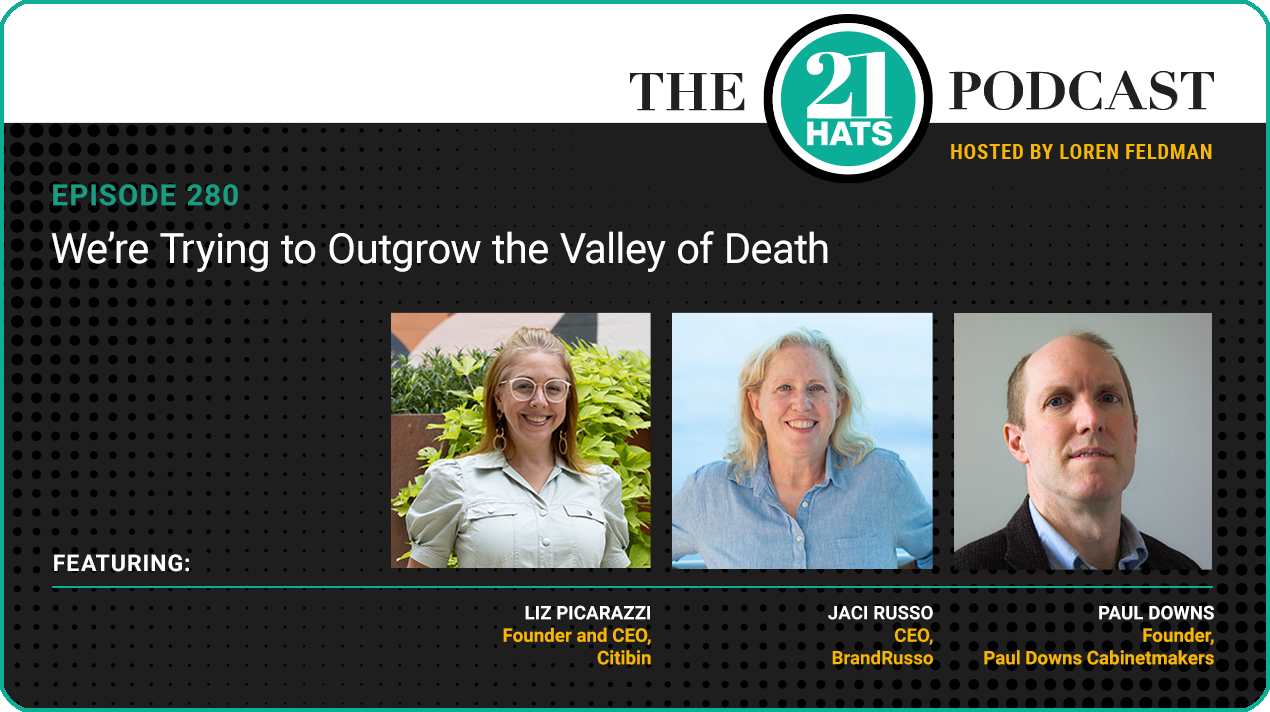
Guests:
Liz Picarazzi is CEO of Citibin.
Jaci Russo is CEO of BrandRusso.
Paul Downs is CEO of Paul Downs Cabinetmakers.
Producer:
Jess Thoubboron is founder of Blank Word.
Full Episode Transcript:
Loren Feldman:
Welcome Paul, Liz, and Jaci. It’s great to have all of you here. So Liz, I gather you’ve come to the conclusion that you need to completely redo your website. This feels—to me, at least—like a very interesting time to be doing that. So much is changing right now, both in a general business sense, but more specifically, in terms of the technology. So I think this could go in a lot of different directions. I’m really eager to hear more, but let’s start with: Why? What prompted this?
Liz Picarazzi:
So there’s a couple reasons. It started from the recognition that my website was not very SEO- or AI-friendly. There are a lot of errors. There’s a lot of custom coding. There’s a lot of Band-Aids. It’s a Shopify site that we’ve had for four-plus years, and we don’t have a ton of sales on it. Only 9 to 10 percent of our sales are from online, and we know it can be more. So I engaged a marketing agency to help me sort of evolve the website and sort of make it more AI-friendly.
But going through and working with them, we realized, fundamentally, that the Shopify site was not going to be up to speed with what we needed—and not only because of the technical requirements, but also in terms of content. When we built that website, we only had a residential line of business, so our trash enclosures had been around for 10 years. The website was built for the residential customer. And then four years ago, we launched the municipal business, for cities and parks. And then last year we launched the GrizzBin business. So I suddenly have three product lines, whereas when I first built the site, I only had one.
So if someone goes to my website right now, they’re going to think it’s for residential customers. They’re going to have to dig around quite a bit to see that we have three distinct product lines. So as we’re looking at the content and how does the information architecture in our current site work, we realized that trying to force that structure into the template—as they call it, with Shopify, the theme that we had—wasn’t going to work. And so we looked at new Shopify themes. And new Shopify themes have many, if not all, of the bells and whistles that we wanted, much easier to lay out the information, much more mobile-friendly, and importantly, also optimized for AI and SEO.
I would say that there is one other reason, and that is that you sort of get website envy when you look at other businesses, particularly for me, anything in furniture, outdoor furniture—not competitors. Like, my website is a lot better than my competitors’, I gotta say, knock on wood. But you see what can be done on a website, and you realize that some of the features that those sites have are those that you want.
And so those were all factors that drove the decision. The agency I was working with quickly pivoted to move it to a whole new website, chose the theme, made the decision before the end of the year—also because I wanted to pay for the development. I had some taxable income that I wanted to put toward marketing. And, you know, two months ago, when I got this started, I never would have thought I would have been doing a whole new website, but it’s firmly the way to go.
Loren Feldman:
Paul, it sounds like this is kind of similar to a situation you found yourself in. Like Liz, your offerings changed and your target audience changed, and you made the decision to create a whole new website while maintaining your previous one, correct?
Paul Downs:
Yes, and that’s worked out reasonably well. I mean, first of all, Liz, I’m on your site right now. It’s not that bad. It’s attractive, and it shows the product. There’s the thing that says “municipalities” right at the top, and not that much about bears, but it’s on the drop-down. Anyway, I would invite anybody who’s listening to this to go to Citibin.com, and see what she’s talking about.
So, yeah, we had come to a conclusion that we had one site, which shoots a lot of Google searches our way, and I didn’t want to mess with that. And then we had another audience that was not approaching us that way, and had a very different aesthetic set of preferences. So we just put up a different site with two different URLs.
So I’ve got customconference tables.com, and I’ve got pauldowns.net. I also have pauldowns.com, which feeds to the customconferencetables.com site. And so we went through the effort. We put up the second site, and lo and behold, without any real attempt, it’s starting to get some organic traffic, but the main thing was to be a portfolio that we could send to a very particular target audience. So I don’t know, Liz, whether your municipal buyers are really all that different from your ordinary buyers.
Liz Picarazzi:
They are.
Paul Downs:
How do you see separating those two streams of purchasers?
Liz Picarazzi:
So at the very top of the site, we actually have an illustrator that we work with, and we had him essentially design tiles for our three different segments that you click into to get to basically the separate, I guess you could say, merchandising or pillar pages for each of those three audiences. The product is different, actually, and that may not have been what you’re saying, but for municipal, we definitely highlight things about ease of opening. We talk about sanitation workers. We have different types of doors and latches and locks, definitely different talking points.
The motivation for municipal clients is not as much design and attractiveness, although that’s part of it. It’s: How does it beautify the atmosphere, so the streetscape? The photography has Times Square in the background, or, like, GrizBin has mountains in the background, whereas residential has a lot of photography with actual homes. So those three different paths, it’s sort of like the buyer motivation is different in each case. And I want to make sure that the copy corresponds with what their buyer motivations are.
Loren Feldman:
Jaci, you run a marketing agency. You build websites for people. I’m curious, is this kind of situation something you see all the time?
Jaci Russo:
It is something I see all the time, and I’m just sitting over here recovering from the fact that my love for Liz is unrequited and that she’s cheating on me with a different marketing company. [Laughter] Probably, you know, I will eventually recover. But for now, while the pain is deep—no, I think Liz is right.
Loren Feldman:
Jaci, I have to ask you, how many trash enclosures have you bought from Liz?
Jaci Russo:
Oh, that’s a good point. The crazy thing is, we don’t have any trash enclosures. In downtown, there’s a dumpster that the city provides next door, so I don’t deal with that. And at home, we have a very specific truck with an arm, and so you have to use their cans to come by and pick up the arm, and that’s it. That’s all the trash in my life.
Loren Feldman:
Okay.
Jaci Russo:
But if I was buying trash enclosures, I’d buy them from Citibin, because I’m loyal to my friends. No, I am totally kidding, totally kidding. I think there’s plenty of business to go around. I love that you found somebody that you like. That’s what it should be. And whether you already knew what you were doing or they’ve given you good advice, you’re approaching it absolutely the right way.
And Paul, I know, looking at the website, you’re right, it looks great. But there’s a real strategy behind having it sectioned off to your audience. And so, approaching it with a real understanding of who your target audience is and your target audiences are, there is a different language. They have a different want and need. They come to it from a different position of concern. You’re solving different problems. The photography is going to be different.
We try really hard not to drop people on homepages anymore. We want to drop them on the path that gets to the thing they need and care about. If you’re going fishing, you want to have the right lure and the right bait in the right body of water. You’re not taking worms to the Gulf, and so, same thing in websites.
Paul Downs:
Yeah, I do have a couple comments on the existing site. First of all, you don’t have a client list, which I think has been a big feature of our success. Like, I have a theory, which is that the main thing you’ve got to overcome is demonstrating to people that somebody like them has your product. And so a client list of—okay, you got New York City, but do you have Chillicothe, Ohio, or something smaller, more of a range of different people?
And then the other thing is, you’re not really shoving testimonials in anybody’s face, and I think that that’s something you absolutely want to do. You’ve got good Google reviews. You’ve got testimonials. But on our sites, we have the testimonials running in like a streaming banner on the bottom. We try to make sure there’s a quote on every page, and we have a client list that’s so long that you just have to scroll for, like, two minutes to get to the end. Because it’s not even who you sell to. It’s just, like, how many you’ve got. So all those things would be things I would add to the new site.
Liz Picarazzi:
Yeah, both of those are incredible suggestions, and the client list, in that way, I hadn’t really thought of. But you know, we’ve got Times Square. We’ve got—
Loren Feldman:
People have heard of Times Square. [Laughter]
Liz Picarazzi:
Yeah, we’ve got Harvard, Central Park, Epcot, and none of those are residential. But those are big names.
Paul Downs:
Right. I think that’s a mistake that a lot of small companies make, which is, they land a contract from some big deal company, and that’s the only thing they put on their client list. So if all you’ve got is Central Park and God Himself on your client list, then people are going to look at it and be like, “Great, it’s Central Park. I’m not Central Park.” That’s why I try to add every single person, and we go through at the end of every year, just add another 150 people to the end of the list.
And I also have a map that shows the location of every client. And that’s incredibly powerful, when you’re talking to people. Like, okay, we’re not just doing New York, but if you wanted to see it in New York, you could zoom in and see like 6,000 of these. And I would also, for SEO, make sure you’re linking your Google reviews into the site, because I’m pretty sure that Google really pays attention to people who leave reviews on your business page.
Jaci Russo:
One hundred percent. And they like the videos, since they bought YouTube.
Paul Downs:
Yep. Like, I just searched Citibin on Google Maps and then clicked on the location. I see a bunch of really great reviews. And so we have a little tab in the corner of both of our websites that has something that just feeds those reviews right into the site. So when you’re on the site, it’s always hanging there at the bottom, and if you click on it, it expands, and you can see all the good reviews we get. And then, someone has to be making an effort to get reviews so that they’re not all 10 years old.
Liz Picarazzi:
Yeah, we have a whole process for that, a really good process for that.
Paul Downs:
Yeah, but if you’re getting them, you want to be putting them on that site, because I think it’s all about trying to figure out what makes Google feel happy and do that. And that’s often things that are a little bit different than you would do just for human beings.
Jaci Russo:
Well, that’s the thing. You have three audiences now. You have humans, you have Google, and you have AI, and they each have different wants and needs, and so you’ve got to approach each of them very strategically.
Loren Feldman:
I want to get into some more of that. But first, Liz, could you just tell us: What stage are you at now? When did you decide you needed a whole new website and how far have you gotten?
Liz Picarazzi:
I made the decision probably a week before Christmas, and had a very kind of a light requirements meeting, because we took a two-week vacation, and now came back, and we’re starting to populate all of the pages. I have my virtual assistant and our graphic designer kind of going through all the photos to get the very best ones for the site. The testimonials are coming in, although I don’t think they’re coming in through a Google widget. I think that they should.
And then, I mean, the other thing I should have mentioned is that I’m not going to AI the copy on this. I want to write it myself, at least foundational things, because the voice is so different for the three different clients. One thing I’m also learning is that when you redo a website, you’re forced to think about your product hierarchy and your customer needs and what are your different value propositions? And so you get into just what you think is a website project, but suddenly you also are like, “Wow, I have so many different communication streams that need to reflect this differentiated messaging.”
And so I already know for my salespeople that I want to get them on board with the different messaging for each demographic. They’re really good on it most of the time, but there’s a lot of residential speak that I see going out in emails or I’ll hear in the office, and this is a good way to flesh that all out and really have everybody align around the three different customer types in how we communicate in any stream, any path. That wasn’t something I would have expected from this project.
Loren Feldman:
Liz, you said that your current site wasn’t really optimized well for SEO, and you want the new site to be optimized both for SEO, and for what I guess is being called GEO—AI discovery. What’s that conversation been like?
Liz Picarazzi:
That’s been very illuminating also. And I’ll give you one example. On our current website, you’re going to get a form that says we have this buyer’s guide to trash enclosures, and you submit a form with your email address in order to get access. It’s a PDF. It’s a great resource. It’s actually sort of product-agnostic. It’s all about what materials you want. Do you want metal? Do you want wood? Do you want plastic? Do you want a composite? You know, if you’re buying a trash enclosure, how much space do you have available? What are the sizes of your trash cans? All of these considerations.
Well, we quickly realized that that material should be available on the website without someone needing to fill out a form, because that’s what AI wants. AI wants to know, if someone comes in there and says, “What should I consider when I’m buying a trash enclosure? What are the things I need to know about buying a trash enclosure?”
The problem with the approach we have now is that great content in the buyer’s guide to trash enclosures is essentially trapped in a PDF that’s guarded by a web form. And the web form, we see it as these are great leads for people who want this resource in order to make a decision. But some people don’t want to fill out a form to get that information, and AI wants that information easily accessible.
Loren Feldman:
And what’s informing this decision? Is your marketing agency telling you what kind of content you need to put on the site to get AI excited and discover you and share your information?
Liz Picarazzi:
So that’s something I can attribute, not to my agency, but sort of my own growing knowledge about AI and how AI wants to get people answers easily, quickly. And if I have a great resource, I’m going to want it really front and center and easily accessible. So when I do searches, I see how it lays the information out. I know that AI also likes FAQs, which we have, but we haven’t updated our FAQs in like six or seven years. There’s a lot of new information for the two other product lines, which are not in FAQs. Well, that’s an imperative for an AI-friendly site. So anything having to do with a resource for people to make a decision about my product is it needs to be accessible.
Loren Feldman:
Paul you redid your site before AI exploded and became the thing that everybody’s talking about. Are you concerned about that?
Paul Downs:
Sure. I mean, nobody really knows how this is going to work, but one of my goals in the second site was to move away from the text, the language being written more for SEO, and try to make it more human. And for those of you in the audience who don’t know, I’ve written quite a bit, both for Loren and The New York Times, and then also a book. And I just have a particular voice that I like to write in. And so my new site is very much the way I write, and the old site was very much me getting slapped on the wrist, and then having a bunch of keyword stuffing.
And so it’s not clear to me that the keyword stuffing is still a bad idea, but it certainly would make it harder for somebody to just lift language off that side as a quote, and the new site is much more like that. But when you write well, you don’t necessarily explain every single thing, every sentence you put down. It’s sort of like when you watch a movie, there’s usually a little bit of exposition about who this person is and when they went to school and all that at the beginning. But if it was happening all through the whole thing, it would be pretty annoying. And so once you get divorced from the first sentence that says we’re talking about conference tables, all the other sentences don’t necessarily reference that. And that’s bad for SEO, but it’s probably good for AI. But we don’t know that yet. We just don’t know how these things are going to work.
Loren Feldman:
Jaci, what have you figured out about making a site AI-friendly?
Jaci Russo:
Well, I think that, in a lot of ways, Liz and Paul are both right. And there are some subtle nuances that bear discussion, one of which is: Liz, not using AI to completely generate all your copy? 100 percent agree. I think proper setup, proper personalization, the class you’re taking right now is going to help. You can get pretty darn close. I still don’t want you to use AI to write the whole thing, but the brainstorming of it, how to build out the structure so that you have clearly defined the audiences you’re talking to, the search terminology that they use, and attributing each page of your site to answer one of those questions that’s a match for the search term—that structure AI is great at. And it’s going to be really helpful.
Paul, you’re right. We don’t want to keyword stuff, but we do want to make sure we’re applying all three audiences’ needs to every page. And so, making sure that we have a clear path of what keywords, what meta tags, what alt image checks, what H1, H2, H3 headers—you know, all of the logistics of it, those things become really important. And so I think that this conversation is what helps other people make better choices with their websites, because a lot of times people think they’re their only audience. So that’s a big miss, and then they don’t realize—
Loren Feldman:
What do you mean by that, Jaci?
Jaci Russo:
Well, this is the example I use all the time when somebody asks, because it actually happened. I’m working with a pretty big regional bank, and I’m in the boardroom with—you know, as I look around the table, in my mind’s eye, there were, I think, 11 or 13 60-to-70-year-old white men. I mean, that was the board, right? So that’s it. And we were discussing target audiences, and they were explaining to me that they did not like the picture in this one ad, and this copy, and all the stuff. And I said, “But you don’t like it. This campaign is first-time homebuyers. Do none of you own a house yet? Like, really?” And they all kind of laughed, and there were some uncomfortable silences, and they’re like, “No, but I want to like the ad.” And I’m like, “I want first-time home buyers to like the ad. Y’all have vacation homes, mountain lodges, and yachts. You are not the audience for this.”
And it turned into a thing where, you know, we kind of have a three-strike-you’re-out policy here. So I can educate you the first time on how you hired me to do a job and to let me do it. And I can kind of go toe-to-toe with you the second time on some real specific reasons and data and rationales on how this is the right choice based on the expertise of my 30-year career. And then the third time, I’m just going to maybe put it up to a survey or have the target audience weigh in, and at that point, it’s your money to spend as you want. I’ll do your bidding, but it’s not going to work the way you want it to, because you’re not listening to anybody who’s giving you good, sound feedback. And so we went through the second and third strike with them, and then I was like, “Okay, I will go put the ad in your gated Country Club community where no first-time home-buyers live, and we’ll see how it works.” [Laughter]
Loren Feldman:
How did it work?
Jaci Russo:
Not so good.
Loren Feldman:
Okay, any other thoughts about what you do to try to make a site discoverable on AI?
Jaci Russo:
Well, we’re back to the AI part. So mobile, we spent years and years and years explaining to people how important mobile was. 85 percent of search was kind of one of the highest statistics of the past couple of years. So if you’ve got 80-85 percent of people using a mobile device to search, do you feel like your site should be mobile-friendly? I mean, call me crazy. And so, we’re at that same precipice right now with AI. We’re watching it gain rapid traction.
To Paul’s point, there is no published set of rules like you can get for Google. Google’s pretty clear with their rules. AI is not. Well, because you’ve got a lot of different AI platforms, and now one of them is starting to sell ads. And so it’s a whole thing. But common sense is prevailing. Good content is prevailing. Not trying to game the system, and just making sure that if you’re sitting at a kitchen table answering the basic questions that your clients/customers ask you on a regular basis in easy to understand language. You know, one of the things that they’ve started to kind of make real clear to us is pricing. If people are vague about pricing, “Call for pricing,” that is going to be a big no-no. They want clarity!
Liz Picarazzi:
That’s something that I don’t love, Jaci.
Jaci Russo:
No one does, Liz.
Liz Picarazzi:
Yeah, high price, premium product, and I don’t want to scare people away. But I do know that AI is looking for that.
Jaci Russo:
Yes.
Liz Picarazzi:
If you have a product, they’re absolutely looking for it, and I just need to get over that resistance.
Jaci Russo:
And so, you know, I think in a lot of ways, we have to decide who we are. And so if I had a construction company right now, which I don’t, I would have to think long and hard about abandoning the policy of: We are incredibly detailed and all in from the beginning, because we don’t believe in the get you to sign up and then hook you with the change order method of profitability—which we actually talked about on this podcast maybe two years ago, Loren. And so, that is how some construction companies work. That’s not the kind of construction company I would run.
And so, Liz, same thing. You sell a top-of-the-line product at a high price. Paul’s tables are not in Walmart. These are high-quality craftsmanship works of art. My work? High touch, high value, high cost. And so all three of us have that same challenge of: We want to be clear and transparent with pricing, but we don’t want someone to use AI to apples-to-apples—I just made air quotes right there—analysis, because they’re not comparing apples to apples. And so it’s about language. It’s about finding an entry-level product where that’s the price you really want to put out there. It’s about finding a way to explain with clarity what things cost.
Loren Feldman:
Paul, how do you approach pricing on your site?
Paul Downs:
Well, since it’s the number one thing people ask about, we have a page that talks specifically about pricing, what it is that drives pricing. It has examples of what we call the three grades—standard, premium, and ultra—and actually gives you a dollar amount per foot of length for each of those grades. And so it’s got a lot of information in it without being specific, because one of the things that we do is we work with a really wide range of clients, and some of them have a ton of money, and some of them have very little money. And so we figure out ways to deliver what we can do to people with less money by controlling the design.
So we have quite a bit about it. But it’s not just like, “Here’s a table. This is what it costs.” We’ve tried that in the past. When I first rolled out a website in 1999, I did that when nobody else was doing it. And it was helpful, because it would qualify the clients, and they would be like, “I can afford it,” or, “I can’t afford it.” And then they wouldn’t bother me if they couldn’t. And what we found when we did that with conference tables is that we would have a bunch of pictures of conference tables up on the page, people would inevitably click on, like, the craziest, biggest, the one we made for God. And then the number right there would scare the crap out of them.
So we had a huge drop off in traffic when we launched the new site and put the pricing on each table. And then when we took it off, the traffic came right back. And then we had the conversation when people contacted us. So instead of just throwing it on the web, a human person explains pricing options to each client, depending on exactly what they’re asking for. And that’s a much better way to do business, but it’s not an AI-centric way to do business, because AI wants the answer before without context. They just want something on your site. I hope that what we have is good enough because there is an explanation, there are numbers, but they’re not specific.
Liz Picarazzi:
One other thing that I’m doing is more with bundles. We are modular, so we have both trash enclosures and package lockers, planters, mailboxes. And in our current configurator, even though it’s called a configurator, it’s sort of hard to configure what you want in sort of a custom way, bundling together. So we’re going to have a page that is going to essentially merchandise probably eight to 10 of our most popular configurations, with a focus on the add-on modules.
So people can look at the thing and say, “Yeah, I want this with a planter,” and you see the whole thing together, instead of having to build it in a configurator and then get the price at the end. That will be one way to show pricing that we’re going to do. We’re working now with a growth consultant, and raising the transaction dollar amount is one thing we’re going to be working on in 2026. So we’re going to be doing a lot more bundling, and the website makes that pretty easy to do, and also shows the price in a very straightforward way.
Loren Feldman:
Is the growth consultant at the marketing agency, or is this a different element altogether?
Liz Picarazzi:
This is a different element, and that’s probably a different episode, Loren, but I actually have four different types of growth help, consulting-type people I’m working with this year, because we need a lot of help. You know, we’re in the valley of death, as you call it, and we really need help.
Loren Feldman:
Explain what you mean by the valley of death.
Liz Picarazzi:
So when you’re in that like $3-to-6-million-in-revenue range, and your revenue is growing, but your systems don’t correspond with that growth. We have disjointed systems that don’t talk to each other. We’ve got processes that haven’t been documented. A year ago, we had sort of one and a half factories that we were working with. Now, we have four. So our supply chain has gotten a lot more complicated. We’ve got two U.S. factories that we’re now working a bit with, not a lot with. But we are experiencing that, and it comes out of a good thing. It comes out of growth.
But not having a handle on it has just personally become pretty miserable. Like, I already know this weekend, I’m going to work the entire weekend, because the stuff is just piled up. And a lot of it is stuff that, if I had it operationalized, or had delegated, or we had AI more involved—but yeah, this Q1, at least, we’re going to be engaging a lot of different people to help us. And the growth advisor is totally separate from the others. And I actually met the growth advisor—this is so weird—at the Inc 5000 two years ago in the Jacuzzi. [Laughter] Yeah, it was pretty cool, because Frank and I are in the Jacuzzi in between sessions, and you just meet so many great people. And this is someone who struck up a conversation—not in a sleazy way, like he was trying to sell us or anything, but we kept in touch. They kept in touch with me over a couple years, and it just became very obvious that we needed their help, and now we do. It’s twice a month, two-hour session, so four hours a month with the growth consultant, and so far so good.
Loren Feldman:
You’re right, that probably is a topic for another podcast [episode], but I’m just curious, with four different people throwing advice at you, have you gotten conflicting advice yet? Is that an issue?
Liz Picarazzi:
So they’re not like four different growth advisors. It’s just four different types of help that we’re getting now. So we have this outside marketing—I wouldn’t even call it like a big agency. They’re a little bit more of a spot project-based company. We’ve got the growth advisor. We’ve got two AI people who we’re working with. And we also got Frank into the COO Alliance, so he can become a better COO. So all of those things are sort of bringing in—these are the things that we need to improve upon.
And I’m delighted that Frank finally joined the COO Alliance. I’ve been pushing it for years—you know, somewhat similar to EO—but he’s attended his first couple of sessions, and he’s learned so much already. And some of the operational things that he wasn’t always taking action on, now he sees the imperative. And he hears the stories of other COOs and how they’re handling their growth. So yeah, a lot of new expenses on that, but I feel pretty good that it will do the return on investment that we just need to spend more to make more. We need to spend more to stay sane.
Loren Feldman:
Can you give us a sense of what you expect to spend redoing your website?
Liz Picarazzi:
It’s actually a very low amount. I can just tell you, and Jaci’s gonna know, I am getting a really good deal on this. I’m paying $6,000.
Loren Feldman:
What?
Jaci Russo:
That is a very good deal. You could not have hired me for that. [Laughter] You made a wise choice.
Liz Picarazzi:
Yeah, so, I mean, we’ll see. But it came out of an EO friend who works with them, and they do a really good job for her on her e-commerce site, and I decided to look into it. I got the price. I started working with them more. As I said, we didn’t plan on the website. It became an obvious thing to do. And I know it’s a great price. You guys know, that’s an amazing price.
Jaci Russo:
Amazing.
Loren Feldman:
How do you explain a price like that? It seems too good.
Liz Picarazzi:
It’s leaning on the Shopify theme. You know, current Shopify themes are really, really good—nothing like when we started working with Shopify, whatever, six years ago. All the bells and whistles that we want are plugged in. Some stuff that you want custom is not that difficult to do. We’re already doing a little bit of customization. I mean, I think that’s it. And they’re porting over a lot of our existing assets and then adding new for the two other product categories. They also have a developer that’s overseas and is really strong. They don’t have a big team of like 10 people working on it. They only have two people working on it, and that is lower cost.
Loren Feldman:
What’s the process like? How are you going back and forth? I’ve been involved in a couple of projects, and it’s always scary to me how quickly it moves, how you can get locked into something, and a week later realize, “Oh, I wish I’d done that a little bit differently.” How are you managing this?
Liz Picarazzi:
So I think I need to get into it a little more to fully answer that, because we’re still sort of early on. I need to input a lot on this. So I feel like, this weekend, I actually like to go straight into the site and write the copy in it—obviously not the live site—because then you get a sense of how it looks on the page and how much text you need for a particular section. If I write copy outside of the page, I often write way too much, and then I realize it and rewrite it or or keep it long and just say, “Oh, I’ll deal with it.” I don’t know if that’s something that people normally don’t do. Jaci, you might know that. But I like being inside the site and playing with different things and seeing what looks the best.
Jaci Russo:
We have a running joke around here that the fee is one thing, if we do it. It’s a little bit higher if we do it together. It’s a little bit higher if we watch you do it. [Laughter]
Loren Feldman:
And how do people respond to that?
Jaci Russo:
Kind of with an uncomfortable laugh, like Liz just gave. [Laughter]
Loren Feldman:
And what do people usually choose?
Jaci Russo:
They let us do our jobs.
Loren Feldman:
Except for the bank.
Jaci Russo:
Oh, the bankers. It’s not the bankers. The bankers are great. It’s the board of the bankers.
Liz Picarazzi:
Okay, Jaci, let me ask you this, though. If you do all of it, does that mean that you do all the writing and the photography, the graphics creation?
Jaci Russo:
Yes. Yes, absolutely.
Liz Picarazzi:
So that is something, like, we’re pretty strong with our photography, and we also have someone who does great creative assets. I know that’s a pretty big cost, if you’re working with an agency and have that sort of overhead.
Jaci Russo:
Well, it just depends. So we would say, “Show us your photography,” and if it’s good, then, yeah, take that off the list. You’ve got it. Sometimes it’s a collaboration, a good collaboration, in the sense that the client has taken some pretty good photos, but we need to do some editing, not over-filter. They should always look natural, but just clean them up a little bit, making them web-ready. Because people want to upload these super big, high-res photos. Well, those aren’t mobile-friendly, and those are going to wreck your Google scores. So it should be a collaborative effort, and so we’re never going to insist on doing it our way so we can make a dollar. We want what’s best for the client and the project.
Loren Feldman:
Liz, you faced a pretty big decision when you decided: e’re not just going to freshen up our existing site. We’re going to start over. Do you have any decisions pending that you’re concerned about that you’re going to have to figure out? Is there anything that you’re not sure which way you’re going to go on?
Liz Picarazzi:
Actually, not really. We’re going to use a lot of illustration in the site, which I always like. I’m very fond of illustration on the website.
Loren Feldman:
As opposed to photography?
Liz Picarazzi:
No, both. But it’s an element of the website that’s new. And as much as I like it, I know I’m probably going to get some stuff from my illustrator that I don’t like right away, but it’s a minor thing. You know, I’m not scared of it. I know Shopify well enough to go into the new theme and see what needs to go where.
My dependence on my team to pull the assets together is probably the thing I’m most worried about, because we have absolute chaos in our Google Drive, and I actually have no patience to find anything. So I always have my virtual assistant find anything I need, like I won’t even look for it. And I don’t know, call it a diva move or something, but if you don’t have those creative assets organized when you’re doing anything creative, which I do all the time, it feels like quicksand.
And that’s also something with my AI coursework I’m doing. I want to find a better way to keep creative assets, and I think Gemini is probably going to be really good with that. But it’s a little bit with, internally: How do we get the assets needed into the site? Because we have a lot of photography, like a lot. Every installation we do, we do photographs, and we also take a lot of pictures just in the wild.
So if I’m walking around the city and I see a really great bin, I will take photos of it. And it usually just sits on my phone, and it doesn’t go anywhere. And I have a lot of that on my phone, but I also have this sort of, “Well, how am I going to get it exactly from my phone into the Drive?” Because I have a ton of photographs on my phone that have nothing to do with trash, believe it or not. But probably 50 percent of the photos on my phone are of trash enclosures or trash.
Jaci Russo:
Your kids are like, “Oh, it’s the other kid.”
Liz Picarazzi:
Yeah, well, I have an only child, one daughter, and if she looks at my phone, she knows how many trash photos I have. Even when I was in Europe on a trip a couple weeks ago, I was taking photos, especially in Barcelona, of their trash-containerization systems, because they’re sort of the world leader, with municipal trash in particular. And I really admire what they’ve done. New York City is going to be doing some of it. But every time I saw one of their really sophisticated bins, I took photos.
Paul Downs:
Well, I wonder whether AI is going to be able to help with that, because when I think about trying to describe the photos we take, they’re all conference tables. [Laughter] So what differentiates them? To me it’s a bunch of very subtle, technical things that I’m not sure an LLM knows anything at all about. I mean, Jaci, you tell me: Can AI currently organize thousands of tables, thousands of pictures of basically the same thing?
Jaci Russo:
It does a really good job. For example, if you have your Google Photos connected to your ChatGPT paid account, and you have the paid Google account, the amount of search that is possible and the things it can do are ridiculously impressive. But I’m regularly impressed just by the basic Google search, Google Photos search.
I needed a hand-drawn picture of a sunset or sunrise—I’m still not really sure—from my now-23-year-old daughter when she was a kid. I don’t remember if she was 4, 6, 8, 10 years old. I mean, she was little, and I have 40,000 photos. And so I just described it, and it took, you know, .4 seconds, and there it was. And I was like, “Oh, yeah, it’s exactly the picture I was looking for.”
Loren Feldman:
Liz, when is your site going to be completed and up live, so that anybody listening to this can take a look?
Liz Picarazzi:
So we did our yearly strategy retreat on Tuesday, and the deadline for the website is March 31.
Loren Feldman:
Deadline to have it up live?
Liz Picarazzi:
Yes, and I think we’re going to hit that, but we’ll see. We’ll get a little further into it.
Loren Feldman:
Jaci, is this kind of a tricky time to be redoing a website? I just have a sense that so much is evolving. If we were having this conversation two years from now, is the conversation going to be the same or very different?
Jaci Russo:
No, it’s going to be the same. What I actually love about this time, and the people who maybe skipped a couple of years of updates and so now they’re like, “Oh, wait, I am way behind,” this is the perfect time. Because it’s still kind of the Wild West. And now’s the chance to go plant your flag on the Oregon Trail and stake your claim in the AI search answers. And so I think Liz is absolutely doing the right thing at the right time.
Loren Feldman:
All right, unfortunately, for this episode, we are out of time. But my thanks to Paul Downs, Liz Picarazzi, and Jaci Russo. Really appreciate it, guys. Thanks for sharing.

