

When Employee Violence Walks Through Your Door
Introduction:
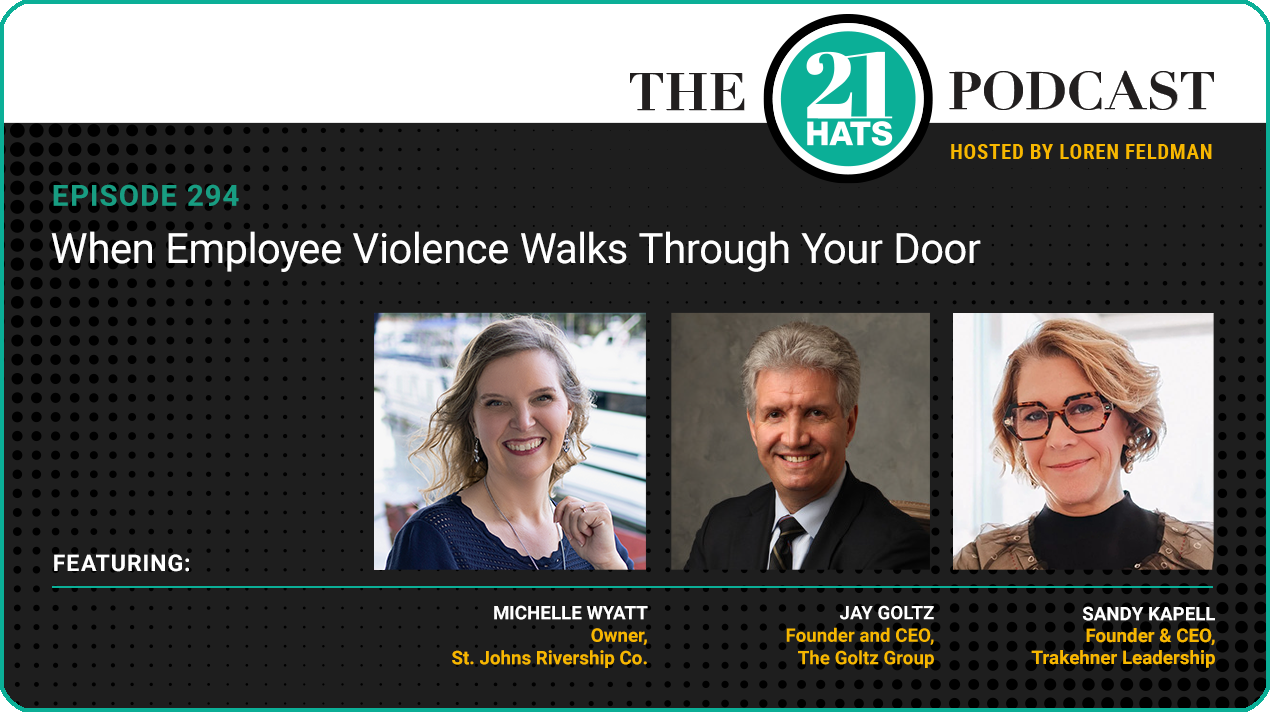
Michelle Wyatt has replayed the events in her mind countless times, looking for warning signs she might have missed. But even now, she can’t find any. Both employees had passed background checks and drug tests. Both were considered trusted, valued members of the team. And yet, within a span of months, two violent incidents involving employees left Michelle and her company reeling. In this week’s conversation, Michelle joins Jay Goltz, who has dealt with employee violence in his own business, and special guest Sandy Kapell, who’s made a career leading human resources, to wrestle with a question that haunts a lot of business owners: How much responsibility can you reasonably bear for the actions of your employees?
The discussion goes beyond hiring practices and background checks. Michelle talks candidly about the grief her team experienced, the guilt of wondering whether she should have seen something sooner, the relief that the violence didn’t occur aboard her riverboat cruise ship, and the unsettling realization that no amount of experience truly prepares you for something like this. “Please stop torturing yourself,” Jay tells Michelle. “From what you’ve said, there’s just nothing you could have done about this. It’s part of business, unfortunately.”
— Loren Feldman
Guests:
Michelle Wyatt is owner of St. Johns Rivership Company.
Sandy Kapell is founder of Trakehner Leadership.
Jay Goltz is CEO of The Goltz Group.
Producer:
Jess Thoubboron is founder of Blank Word.
Full Episode Transcript:
Loren Feldman:
Welcome Jay, Sandy, and Michelle. It’s great to have all of you here. Michelle, you’ve had a tough time of late with several employees, and you’ve been generous enough to offer to share your experiences here. Before you tell us about those experiences, tell us a little bit about your business background. You built and sold a technology business in Maryland. What did that business do?
Michelle Wyatt:
Sure, so in 2000 my husband and I co-founded a technology business that’s still around today. It’s called Cadmium, and it did software for events and conferences. It helps to basically gather and then distribute to the attendees information about speakers, exhibitors, other attendees, that type of stuff.
Loren Feldman:
And how many employees did you have when you sold it?
Michelle Wyatt:
Approximately 75 employees. And then I was with the company—we sold it January 30 of 2020, so 40 days before Covid shut down the world, especially the world of events.
Loren Feldman:
The sale closed 40 days before the pandemic?
Michelle Wyatt:
It did.
Jay Goltz:
Nice work.
Michelle Wyatt:
Yes, yes. So Peter, my co-partner and spouse ,and I stayed with the company for approximately two and a half years after that. So we left at the end of June of ‘22, and by the time we left, we had approximately 200 employees, because a private equity company that bought us rolled us up with four other companies.
Loren Feldman:
And you moved to Florida and you bought a very different kind of business. Tell us about that business.
Michelle Wyatt:
Sure, so yes, when we sold the company—and I think any parent who has had a child go to college can relate to this. Once you have a child go to college, it’s really hard thinking about starting with a newborn again. And I would say the same goes with companies.
We built Cadmium from scratch. We started off in a bedroom, and it grew into something big. This time around, I did not want to start something from scratch. So I looked around, and I found a really awesome dinner and cruise experience. It’s called the St John’s Rivership Company, based out of Sanford, Florida, which is just north of Orlando. So we do lunch and dinner cruises, and it’s been in operation here in Sanford since 1982. And I am the fourth owner of this business.
Loren Feldman:
How many employees do you have now?
Michelle Wyatt:
Approximately 45, depending on how you want to count full-time versus part time. But there’s approximately 45 people on the payroll.
Loren Feldman:
When did you buy the business?
Michelle Wyatt:
I bought it in September of 2023, and I bought it from the children of the original founder. So the original founder brought the concept from Michigan, and he moved it to Florida, just because in Michigan, obviously, with the winters, it was definitely a business that could only operate about seven months of the year. So obviously, moving it to Florida, we can operate year round, which was a huge attraction. And then it passed to another family called the Hopkins family. And then the children of the original owner took it over in 2012, and then I bought it from those children in 2023.
Loren Feldman:
How’s the business been doing?
Michelle Wyatt:
I absolutely adore the business. It’s a lot of fun. Every cruise is an opportunity to make changes, and it’s a really responsive business. So I’ve been able to, for better or for worse, try a lot of different concepts and ideas and get some immediate feedback.
I would say that the biggest challenge that was kind of unexpected is the HR challenges. So I came from a business where, I would say most of the people that used to work for our old company viewed their jobs as a long-term career, whereas many people here—not all of them, but many of them—view this as a job, not necessarily as a career. And there’s a definite difference in attitude, as far as some of the employees are concerned.
Loren Feldman:
So you’ve had a couple of pretty devastating experiences. What was the first one?
Michelle Wyatt:
The first one, we had a maintenance person that had been employed at the company for approximately a year. So, June of 2025, we had 40 chairs come in on a trailer from auction, and we were unloading the chairs, and when I say we, I would say there were approximately six or seven employees. I actually wasn’t physically there, but there were six or seven employees, mainly because it was two o’clock in the afternoon. Here in Florida in June, it’s hotter than Hades, and we didn’t want anyone to be doing it for too long. Many hands make light work, right?
One of the employees was not participating in the activity, and was on his phone. And another employee called him out, and those employees started to exchange insults, and it quickly degraded into one of the employees beating the other one up physically, which was a complete shock for a couple of reasons: One, there was no prior history of any type of violence with this one employee who beat the other employee up; and two, how quickly the situation escalated. It went from essentially nothing to something major in less than three minutes at the most. So it degraded really, really quickly, and it escalated to a beating really, really quickly.
Loren Feldman:
Was the employee who was beat up okay afterwards?
Michelle Wyatt:
So he did go to the emergency room. He was checked out, and there was, fortunately, no long- term incidences. The other employee, I called the police, and he was arrested, and obviously he was terminated. But the thing that I guess amazes me, and continues to amaze me, is how quickly it escalated and that there hadn’t been any prior signs and that it happened when there was a large group of employees present.
So I guess when I think about employee violence, maybe because of movies or television shows, I always kind of think that it happens in this dark corner where there’s no one else present and there’s no one there witnessing what’s going on. And in this case, none of that was true. It occurred literally right around two o’clock in the afternoon. There were six or seven other employees there, including my college-age son who was home for the summer, working on the boat, and there was really no advance warning that there was even an issue between these two employees.
Jay Goltz:
How old are these people?
Michelle Wyatt:
The employee who was physically hurt was 19, and the person that beat him up was in his 30s.
Loren Feldman:
Is the younger employee who was beat up still an employee?
Michelle Wyatt:
Yes, he is.
Loren Feldman:
Jay, you’ve been in business for 40-plus years. Have you had experience with violence in your workplace?
Jay Goltz:
Yeah, sure. Matter of fact, I just had it six months ago with a 20-year-old and a 45-year-old, and the 20-year-old went after him. And in hindsight, my manager’s not strong enough there. He should have seen this coming. In my experience, it’s usually not a one-off. It’s usually like a slow grind, and then one loses it. And the younger kid should have spoken up if there was a problem. But my question to you is, of the six people that were there, were any of them managers?
Michelle Wyatt:
Yes.
Jay Goltz:
What were they doing during this whole thing?
Michelle Wyatt:
Shouting at them to stop. Again, it escalated extremely quickly. I’m amazed, still to this day, at how quickly it went from zero to essentially 60 miles per hour. It was a very short period of time. And the beating—although I’m sure it felt like forever—was less than a minute in length, mainly because they’re all shouting at them to stop it.
Jay Goltz:
What happened to the 30-year-old? He got arrested. What’s the charge, assault and battery? I mean, did they put him in jail? Did anything surface that he had a prior anything?
Michelle Wyatt:
No, and that’s the thing. We ran background checks, and I reviewed his report afterwards, just to see if maybe there was something there that I’d missed, and there was nothing. There was no prior history that was reported for either of them.
Jay Goltz:
Did you talk to him after the fact?
Michelle Wyatt:
I did.
Jay Goltz:
What was his excuse?
Michelle Wyatt:
He lost his temper, got mad. I basically said the same thing that we’ve been chanting and been taught since preschool. You know, “Sticks and stones can break my bones, but names will never hurt me.” And I basically said: People can talk all they want, but you were the one that threw the first and last hit. The 19-year-old never hit him. He just acted defensively, but never engaged in any of the assaults that occurred.
Jay Goltz:
I don’t 100 percent go with the sticks-and-stones thing, because you could say something extremely offensive to another human being that could really set him off. Did the 19-year-old say anything horrible to the guy?
Michelle Wyatt:
He said something about his kids, and he has three little girls all under the age of five. So, yeah.
Loren Feldman:
Sandy, you have extensive experience in corporate PR, and you’ve now started your own business that helps smaller businesses with HR. Have you had experience with incidents like this?
Sandy Kapell:
Yes, and I would say my experience is slightly different than what Michelle’s expectations were. A lot of times, this employee violence does happen with other people observing and unable to de-escalate it. It’s frequently not in a dark corner.
For me, I had a few questions around really picking up on what Jay was saying about what he experienced in his business six months ago. Would any of the managers have been able to see there was bad blood between these two? Was there any? Do they have any training—even like 15 minutes—on how to de-escalate or recognize a couple of employees aren’t getting along so it doesn’t get to this point? But just what sort of the history of the two and how the managers would have known or not known there was something going on there?
Michelle Wyatt:
Again, hindsight being 20/20, these two employees were in different departments. The 19-year-old worked in the kitchen and the aggressor, the 30-year-old, worked in maintenance, so they didn’t really have a lot of interaction. But I will say, the 19-year-old did abuse his cell phone quite a bit, to the point where he’s lost all cell-phone privileges, while he’s clocked in at the company. But other than that, other than the fact that the 19-year-old was on his cell phone and wasn’t participating in unloading the chairs from the trailer, especially when the 30-year-old pointed out to him, there wasn’t really anything. There was very limited interaction between the two of them in the past, just because they are in completely separate departments.
Loren Feldman:
Michelle, why don’t you tell us about the second incident?
Michelle Wyatt:
Sure. So this happened in June, and then in early August, we had another devastating incident. We had a waitstaff member who had been with me a little over a year as well, and his name is Jaden. And Jaden worked as a waitstaff member on the boat, and he left work at 3:30 in the afternoon. And two hours later, he was in a road rage incident where he shot and killed a man who was driving too slow. So this happened shortly after 5 pm, again in broad daylight. The gentleman who he killed was visiting from Miami, visiting his cancer stricken mother in the hospital, and had a set of twins who had just started the fifth grade.
This was, again, completely unexpected. Jaden, at the time, was 24 years old. Again, no prior history of any type of violence. A background check was done on him as well. You know, the worst thing that came back on his background check was peeing in a public place while intoxicated. So there was nothing to suggest that there was this type of history.
Loren Feldman:
Was he a good employee?
Michelle Wyatt:
He was. He was a very good employee. His dad is very active in the local community as a high school football coach. Several of my employees went to high school with him and played football with him. So yeah, I would say that was completely devastating for the company as well.
Jay Goltz:
He obviously was driving around with a gun in the front seat. Did he have the gun registered?
Michelle Wyatt:
I’m assuming yes. Florida has very broad right-to-carry laws where you can essentially carry a gun, except into private property, where it’s posted that no guns are allowed, and into private establishments, churches, schools, that type of thing. But in general, there’s very broad laws as far as being able to carry guns.
Sandy Kapell:
Hey, Michelle, when you’re in a state with that kind of legal framework, do you have rules around guns allowed at work and what’s allowed or not allowed on the boat?
Michelle Wyatt:
We do. So there’s clear signage posted that no guns are allowed, no knives are allowed on the boat. And because we’re privately owned, we can post and enforce that. My staff, my captains, do carry a gun. So, God forbid, something happens when we are on the river, if someone were to attack, bring a gun on board, and start shooting. There’s really no place to escape to on the boat, so they would literally be sitting ducks. So we do take it fairly seriously, and we’ve had training from the local police department in how to handle those types of situations.
I will say that I am beyond grateful that Jaden didn’t bring the gun on board, and this didn’t occur while he was working on board the ship. And one of the things I think, as business owners, we definitely have to think about is: How would we handle a firearm incident in our place of business? Jay, you have a furniture store. I’ve been in plenty of furniture stores. They’re huge, typically, and someone could, in theory, easily bring a gun in.
Jay Goltz:
Yeah, I’ve got 115 employees in total, and there certainly is exposure every day to something bad happening. And it’s, unfortunately, a part of being in business. All you can do is try to minimize your exposure, which in my case means we don’t just do background checks. We thoroughly check references, because somebody could very well have done bad stuff but not been arrested for it. And every once in a while, we do catch somebody who we didn’t hire because of it.
And then the second piece of it is I absolutely have had people who—there was a point in my career that I thought—I was putting out fires all day long. I had 40 employees. Every day, there were new problems, and I finally realized the key was to get rid of the arsonists. So we’re good at knowing when somebody needs to go, because present behavior usually predicts future behavior. So people who like to continue to start trouble will always continue. So that’s two, and if you do the first two right, in my experience, your turnover goes down dramatically. So you’re not hiring a bunch of new people. The end of the story is, I have far less drama today with 115 people than I had when I hit 20 people.
It’s calmed down considerably, because my turnover is less than 10 percent. And it’s just, I know who works here, and it’s calm…er. And I would suggest to you, long-term, it will take you a while. It’ll get better, because you’ll start accumulating better people. You’ll be keeping them, you’ll be hiring less, and it will get better. But I feel your pain, because those are two horrible stories.
Loren Feldman:
And there’s no guarantee that nothing like that couldn’t happen anywhere. I mean, the fact that this was a valued employee just makes that clear, I think.
Jay Goltz:
I was going to say, It’s the Pareto rule. I’ve learned 80 percent of the trouble comes from 20 percent of the people. So the game is, get rid of the 20 percent of the people. That’s what I learned.
Loren Feldman:
Although that wouldn’t have applied to this second incident.
Jay Goltz:
No, I’m just saying long-term, slowly but surely, things get better if you keep people around and you’re hiring less.
Loren Feldman:
What were you gonna say, Sandy?
Sandy Kapell:
I was wondering, are you feeling personally supported? Do you have resources for your employees or yourself to recover from such dramatic incidents?
Michelle Wyatt:
I would say no. I think my staff went through the typical grief cycle that you hear about. Even though we all recognize that what Jaden did was truly evil, I would say in general, Jaden was very well-liked, and loved, for lack of better language, by many of the staff members here. And that’s what truly is a tragedy.
So this happened at like 5pm on a Thursday night, and the press release came out from the police department around 5am Friday morning. And by 7am, I mean, all the phones, every one was blowing up everyone’s cell phones, trying to figure out if it was our Jaden. So we were like, “What’s Jaden’s middle name? Because it can’t be our Jaden. Jaden would never do something like this.” And it was. They released his mug shot a couple hours later.
And, you know, there’s that stage of denial, there’s that stage of grief. His mother actually called on Friday saying Jaden wouldn’t be in to work that day. You know, it’s just that full cycle of grief, disbelief. My manager who was on board the boat that day, on Thursday—we normally keep a ratio of waitstaff to guests about one to 20, and we were right at that cut-off. And my manager made the decision to keep Jaden, because he would have been cut that day. And he was questioning, “Well, what would have happened if I’d cut him that day instead of had him work?” And I don’t know the answer to that. It’s one of those things where you can’t reassure. You can just say, “Well, then he could have maybe done it earlier in the day.”
Jay Goltz:
I would make the argument that if a guy loses his temper once driving a car with a gun in the front seat, it’s going to happen again. And so if it didn’t happen that time, it would have happened two months from now, because people are always getting mad at other drivers. I just find it ludicrous that they—in Illinois, you can’t drive with a gun in the front seat. It has to be in the trunk or something. That would have saved a life.
Michelle Wyatt:
Yeah.
Loren Feldman:
Michelle, do you have somebody who handles HR for you?
Michelle Wyatt:
No, we don’t have anyone outside the company, so unfortunately, it’s me and my director of operations who handle the HR.
Jay Goltz:
Which is how it usually is.
Michelle Wyatt:
Yeah, I will say, when I bought the company, I did hire a consultant to help me get it to where I think I felt like it needed to be. There was no employee handbook before I bought it. There were limited employee records. There were a lot of practices that I would say are questionable—one of them being they had fired and rehired the same employee five separate times. Just stuff like that. [Laughter]
Loren Feldman:
Is that employee still there, Michelle? [Laughter]
Michelle Wyatt:
No.
Jay Goltz:
It’s the off week this week. He’s off this week, but he’ll be back next week. [Laughter]
Michelle Wyatt:
No, no, no, no. We don’t play the boomerang. When Michelle fires you, you’re gone forever. You know, there were other practices where they didn’t do the background checks. That was one of the first things I instituted, is we have to do background checks. We need to make sure.
So it was just a lot of what I would call—there’s no formal job descriptions for anybody. There was just, in my opinion, a lot of, I don’t want to say loosey-goosey, but definitely not as buttoned up as I would have liked to see it. I did have an HR consultant come in, but in this case, both employees were definitely my hires. I have to own that they were my hires. They had the thorough background checks done. They did the drug testing. And it still happened.
Jay Goltz:
My lesson after 48 years, which I hope you hear when I tell you this: Please, please, please stop torturing yourself. From what you’ve said, there’s just nothing you could have done about this. It’s part of business, unfortunately.
Michelle Wyatt:
I agree. I just think, as a small business owner, in theory, I wish there were more resources to help. One of the things that I have since read is Department of Labor estimates that there’ll be 4,000 homicides in places of employment each year.
Jay Goltz:
Most of them in Florida. [Laughter]
Michelle Wyatt:
I don’t know if that’s necessarily true.
Jay Goltz:
I will guarantee you a higher percentage. Guaranteed a higher percentage.
Michelle Wyatt:
Well, I think Florida has the third highest population per state.
Jay Goltz:
I’m just saying, if you let people—and I’m not anti-gun or anything—I just don’t think they should be in the front seat of a car when you’re driving.
Michelle Wyatt:
I agree. I agree with that. I will say, it’s very scary to think about. And I will say the one thing I was grateful about with Jaden is his place of employment was never advertised in the news. And I guess that’s something else that, as small business owners, you really have to think about.
Like, I’ll just point out, when I lived in Maryland, there was a business near me who did granite counter tops. And they had an employee who had only been there four or five months, and he came in one day and shot and killed three of his co-workers. And it turned out that the employer had never done a background check on this employee, because if he did, he would have seen that he had had over 40 run-ins with the police before being hired.
So it’s one of those things where I would stress it’s definitely a cost issue. So a lot of these employees I’m hiring are making close to minimum wage before tips and stuff like that. And between the drug testing and the background check, we spend about $200 for each new employee who we bring on board. That’s a lot of money, but I feel like it’s money well worth spending. And then I would also point out even some of the recent news. So for example, the FedEx driver who kidnapped and killed the six-year-old in Texas recently, that’s how he’s referred to—as the FedEx driver.
Sandy Kapell:
Right.
Michelle Wyatt:
Fortunately, FedEx has a huge brand and reputation. But my biggest worry as a small business owner is Jaden’s sin is going to be transferred to me as a business owner. You know, if the person, the man who Jaden killed, was a captain of a charter boat down in Miami—Jaden worked on a river ship—it wouldn’t have been hard to connect the dots and report that they both worked on ships. And then my reputation would have been damaged. The company’s reputation would have been damaged. I feel like in today’s environment, the sins of the employees are frequently transferred to the sins of the employer.
Loren Feldman:
Michelle, when this happened, did you consult a PR person? Did you consider taking any steps to respond if somebody did call you and make the connection?
Michelle Wyatt:
Fortunately, I didn’t have to deal with that, but I definitely thought about what I would have done if it had come out. But I was pleasantly relieved to be—actually more than pleasantly relieved; I would say, ecstatic—that it never really was reported where he worked, which was a huge, huge, huge relief for me.
Obviously, there’s many other people out there where an employee does something wrong and their employer is identified, and there is that association that there should have been something that the employer could have done to prevent that employee from doing an evil deed. And I think that’s something that we have to look at as a society: whether or not we truly believe that FedEx could have prevented that man from kidnapping that little girl or I could have prevented Jaden from going out and killing someone.
Sandy Kapell:
Michelle, I don’t mean to interrupt, but I think the deep personalization of what you could or could not prevent of somebody who was in a road rage incident is—I just want to go back to what Jay said, that it’s really important for you to really think clearly about what you have control over and what you don’t have control over. And you definitely do not have control over people doing stupid things. No business does.
But are there things you do have control over that match your values, that are affordable for your size business, and can you do those things, whatever they are? You know, work with the local police on developing, if there’s a shooting incident—even if it’s 15 minutes or half an hour of training—you can put your head on your pillow that you’ve done it. Half an hour of skill building on de-escalation and how to handle a fist fight, even if you can’t stop it. Are there things that you can do that are bite-sizes and affordable? How do you onboard employees so they know what your expectations are, and it’s clear the type of workplace you want to provide people? That’s the best you can do.
Jay Goltz:
Let’s go back to the other one for a moment, because we can all agree there’s nothing she could have—it’s not like she even knew the guy had the gun in the car. So that one, you couldn’t do anything about.
Loren Feldman:
Although even if she knew he had the gun in the car, she couldn’t have done anything about it.
Jay Goltz:
Well, no, she could have. I have to tell you, one can make the argument, if you have an employee driving around with a gun in the front seat of a car, I’m not so sure I want that guy working for me. But forget about that one. That’s the harder one. How about the easier one: The 19-year-old starts yelling stuff at the 30-year-old, something about his kids. Like, where’s the line there? And I don’t know what he said exactly, but where’s the line there? Should he be working for you?
Michelle Wyatt:
It’s definitely a question. It’s definitely a question I struggled with as well. How much do you want to punish, quote-unquote, the victim? The 19-year-old’s saving grace is there was nothing that he did physically towards the 30-year-old employee. It’s a really hard judgment call.
Jay Goltz:
I mean, what if the 30-year-old is a minority, and the 19-year-old isn’t, and he screams at them an extremely offensive word? I mean, in my world, he doesn’t work for me anymore. I’m not saying that was the case, but I think there is a line sometimes where, yeah, there’s no going back from that.
Sandy Kapell:
I think Jay’s given a really good example of the point I was not making very well, that I think the clearer any business can make their values and expectations for their employees—like Jay, it’s really clear for you, right? If you say stupid stuff, you can’t work for me.
Jay Goltz:
Beyond stupid. Really reckless, discriminatory, horrible stuff. Yeah.
Sandy Kapell:
Then you’re out. If you make personal insults towards somebody, you can’t work here. And so, I think the more opportunities you can take to do that, the more it’s clear who’s going to fit in and who’s not going to fit into these amazing experiences that you’re creating for people.
Jay Goltz:
Because what I’ve learned is, it’s never a one-off. If someone does that, they probably do it all the time. Or they do it quietly at a co-worker. They don’t yell it out at the person, but like, that’s usually a slippery slope. If someone’s got that mentality, I just don’t want to deal with it, I don’t want my employees to have to deal with it. I feel an obligation to protect the safety, not just physically, but emotionally, of my employees.
Loren Feldman:
Michelle, how did the rest of your team react after these two incidents? Does it feel like a different place since then?
Michelle Wyatt:
I think they were very different, so different reactions to it. Obviously for Jaden, so he was initially charged with second degree—and I’m probably going to get the language messed up, but second degree—and then it went to the grand jury in September, and it’s been escalated to first degree. So there’s a good chance that Jaden will now be spending his life in jail or even executed. And to be honest, when you read what happened, there’s a very solid case for it. He shot the man 10 times in the back, and the other man was not armed.
Jay Goltz:
Oh, you left that part out. He shot him 10 times.
Sandy Kapell:
Yes.
Jay Goltz:
Wow.
Michelle Wyatt:
So it’s devastating. I think a couple of my staff members said they went home and cried. I cried. Because we knew what he had done was so horrible. We also grieved for the person that he was and the fact that this 24-year-old threw his life away. My son considered him a friend. My son is 22, Jaden was 24. Other employees on the boat would socialize with him after work hours. They liked him. He was a nice, fun guy. So yeah, there’s a lot of grief. A lot of grief.
Sandy Kapell:
So your employees, basically, every time there’s something in the news or an update on the case, are they sort of reliving the trauma and grief of it?
Michelle Wyatt:
Yes, and everyone is obviously watching to see what happens. The last report was back in September, so it’s been a while, and we’re just wondering, obviously, is it going to go to trial, or is there going to be some plea deal? Or how will it be treated? You know, Jaden claims it was self defense. He didn’t run from the scene of the crime. He immediately called the police. On the flip side, he definitely followed this vehicle for quite a distance, and the other man was not armed, and there were multiple, multiple gunshots.
Jay Goltz:
I wondered how it went from second degree to—I know a lot about this because I watch Law & Order every night. I wondered how it went from second degree to first. But when you just now say that he was followed for a while and shot him 10 times, I get it now.
Sandy Kapell:
Yeah, just from an employee perspective, though, just some thought—and for yourself—into what would some type of support be for you and your employees? Because you’re going to be reliving this every time there’s news, and developing some company protection systems around that might be worthwhile.
Loren Feldman:
Michelle, I’m curious, have you made any changes? Are you doing anything differently in terms of hiring, managing, supervising since these incidents?
Michelle Wyatt:
I wish, Loren, I could say, “Yes, it taught me XYZ.” In Jaden’s case, he was young. He didn’t have much employment history because of that. He had close ties to the community. A lot of people knew him and his family. He knew quite a few of my employees on the boat. He went to high school with some of them. So this wasn’t, quote-unquote, some strange person we hired off the streets who no one knew.
I just don’t know what I would have done differently in either case. With the first one, the 30-year-old, he was actually a temp-to-hire. So I’ve been trying to be really careful about how I go about the hiring process. And this person worked for us for, like, three or four months as a temporary employee, before we made a decision to hire him because he was a good employee—until he lost his temper and beat up another one.
Jay Goltz:
What was his job history before he went to the temp agency?
Michelle Wyatt:
To be honest, I don’t recall all the details at this point, but I will say in general, maintenance people in general do not have a strong education foundation. I will say that many of the jobs on a boat or in the hospitality industry, there’s a lot of them with a GED equivalence, not necessarily even a high school degree, and because of that, a lot of them have limited career options available to them.
Loren Feldman:
Sandy, can you think of anything you would recommend that Michelle think about, in terms of going forward?
Sandy Kapell:
I mean, the number one thing I think she should think about is being kind to herself, and really trying to reclaim why she bought the business and why she loves the business, which I know isn’t really the structured HR answer. But I do think, before you can start thinking about things like skill development or preparing people for violence or management stuff, just the little stuff like: How do you de-escalate a fight? These words are what’s acceptable. These words are not acceptable. I think there’s a wealth of opportunity for you, because it sounds like you’ve gotten the basics in place with a handbook and job descriptions. But then there’s just a lot of words that fill in the space of every day, and those represent a huge opportunity for you.
Jay Goltz:
I still have to focus on: So there’s six people standing there. One guy screams at the other guy, “Hey, put the phone down. Come help us.” Then he says something back to him, brings up his kids. And I’m still wondering, whoever the manager is, what level of manager are they? They didn’t go, “Stop right now.”
I still wonder, even though it’s three minutes, that’s a long time, three minutes. I still wonder—in my case, like, I already admitted, my manager wasn’t strong enough and should have stopped some of it. I still wonder whether the managers have the wherewithal to step in and go, “Stop right now.” Because three minutes is long enough to do that.
Sandy Kapell:
Right, I mean, I think there is some training that’s not hard or expensive, but just giving people language. But it’s also consequences. Like, “If you do these things, you’re not working here,” to try to help modify, get people to think: “Don’t do that, because I want my job.”
Loren Feldman:
Michelle, do you think this will make you less likely to do something like give somebody who was previously incarcerated a second chance?
Michelle Wyatt:
One of my best employees is someone who spent 11 years in jail.
Loren Feldman:
For?
Michelle Wyatt:
He committed vehicular manslaughter while under a DUI. So he got drunk and drove and killed someone. He spent 11 years in jail. He was hired by the previous owners before I bought the company, and he’s one of my best employees.
Loren Feldman:
If he were coming to you today, do you think you would hire him?
Michelle Wyatt:
I think I would consider it if I knew his work ethic. And he’s a good person. He did a stupid, stupid thing 20 years ago, and I feel like he’s paid the price. He had, to be honest, a wonderful career with a Fortune 100 company as a computer programmer, and did something stupid.
Sandy Kapell:
Well, I think it speaks volumes about you as a human being and as a business owner, that after everything you’ve been through, this is how you respond to the question.
Michelle Wyatt:
It’s definitely not a deal killer. And I would also say that my answer may be different if either one of the people who were involved in this past summer had a prior history. Neither one did, and that’s the thing that also gets my head scratching is, you know, everyone—I guess me specifically; I shouldn’t speak for everyone—I always assumed that before it got to the stage where someone would kill somebody else, or someone would beat up on somebody, that there would be a prior history of some sort of violence in their background, and there wasn’t anything. That’s what’s, I guess, the most puzzling and heartbreaking is the fact that it’s not like I took a risk with them. In both of these cases, there just wasn’t the history there.
Sandy Kapell:
I think that that’s becoming more and more common. I don’t have the research on the tip of my fingers here, but I think I have read in a few places that this first-time offender violence is increasing, which I share with business owners to really think deeply about: What are the parameters within their company to protect themselves, protect those employees, and still have people thrive? But I don’t think you’re alone in having to deal with this, sadly.
Michelle Wyatt:
I think there’s also, again, I’m going to point to a huge mental health crisis that’s not really being addressed properly in the United States right now. I personally think that there’s a lot of people out there who aren’t getting the right mental support, or don’t even know where to go to get the right support, or can’t afford it.
Sandy Kapell:
Yeah. Well, I think that is definitely the case, which I think in turn puts more and more pressure on businesses. Because everything that people aren’t getting through society then gets dumped on employers and schools to try to figure out.
Jay Goltz:
Yeah.
Loren Feldman:
Jay, have you had any experience with hiring people who were previously incarcerated?
Jay Goltz:
Yeah, I have one now. He does a good job. I mean, there’s another side to this. If you hire someone who’s got a record, they appreciate it. And—not always, but—there’s a good chance if you hire them, that they appreciate the fact you gave them an opportunity. And they’re good employees.
Loren Feldman:
Michelle, has this changed the way you look at the business in any way? Are you sorry you bought it?
Michelle Wyatt:
I absolutely love the business. As I mentioned at the beginning, it’s very responsive. It’s fun. People come on board to celebrate major milestone birthdays, anniversaries, get engaged, get married. It’s a fun place to be. It’s just, some of the challenges with people specifically I’ve never encountered. I wish there was a how-to book or guidelines about how to recognize when employees might become violent or do the unexpected. Nothing I’ve ever encountered in my past to prepare me for this.
Yes, there’s definitely challenges within the hospitality industry as a whole. We are blessed here in the Orlando area. We have 76 million visitors a year who visit Orlando. The challenge that not only I, but Disney, Universal, everyone in the Orlando area has is: It’s not 6 million people a month. There’s definitely peaks and valleys, and it’s very hard to staff appropriately so that you can service appropriately the peaks and the valleys and not, quote-unquote, starve your employees during the valleys.
For example, summertime, for whatever reason, people don’t want to go sailing in 100 degree weather. Even though the boat’s air conditioned, they don’t want to even walk outside in 100 degree weather. And Universal and Disney both struggle with that, too. Christmas, oh my gosh, if I could operate six cruises a day throughout the month of December, I would be golden. And I could shut down for the rest of the year. But you can’t do that. So it’s just one of those challenges that a lot of the businesses within the greater Orlando area struggle with.
Loren Feldman:
Michelle, I really appreciate your sharing these experiences with us. My thanks to Michelle Wyatt, Sandy Kapell, and Jay Goltz. And a special thanks to our sponsor. This episode was brought to you by Grasshopper Bank. Thanks for listening, everyone.

