

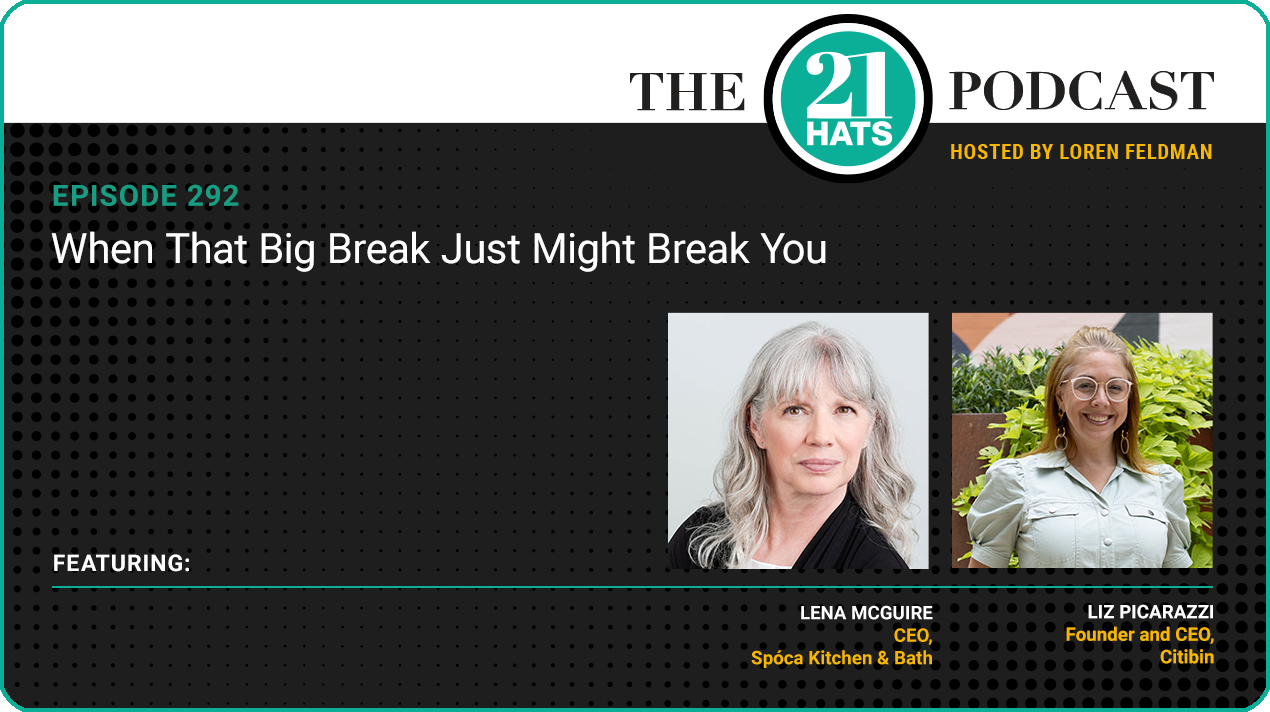
When That Big Break Just Might Break You
Introduction:
Every business owner looks forward to that big break—the moment that you land a big client or a major retailer, or do something that puts you on a national stage. But those opportunities don’t just reward you. They can also expose you—especially if you have to take on debt or ramp up production or do things you haven’t done before. Four years ago, when Liz Picarazzi won a high-profile installation for her trash enclosures in Times Square, it was exactly that kind of opportunity. Her enclosures were put to the test in as public and as challenging an environment as she could imagine. And, by any reasonable measure, they failed. In pursuing that opportunity, Liz took a risk that led to what she calls the worst day of her professional life. It also turned out to be, as she tells Lena McGuire, the best thing that could have happened to her business. That moment forced changes she might never have made otherwise, pushing her to innovate faster and sending her business on a very different trajectory.
Meanwhile, Lena is dealing with a quieter version of the same problem: what it really takes to move your business forward. She knows her systems need an upgrade. She’s bought the software. But like a lot of owners, she’s stuck in the messy middle—paying for the future while still trapped in the past, with no time to bridge the gap. How do you choose between tasks that generate revenue immediately and those that will improve operations over time?
— Loren Feldman
Guests:
Lena McGuire is CEO of Spóca Kitchen & Bath.
Liz Picarazzi is CEO of Citibin.
Producer:
Jess Thoubboron is founder of Blank Word.
Full Episode Transcript:
Loren Feldman:
Welcome Lena and Liz. It’s great to have you here. Liz, you recently published an article on LinkedIn about winning a bid to get your trash enclosures placed in Times Square. It was obviously a very high-profile opportunity. It offered a lot of potential upside as well as some potential downside, which you did, in fact, experience. Could you start by telling us exactly what the opportunity was and how you won it.
Liz Picarazzi:
Sure. So to be clear, it wasn’t like a competitive RFP, at this point. New York City created a program back in early 2020 that they named Clean Curbs, and it was to help containerize the trash that otherwise would be on the curb. You know, in all manners, whether it be residential, commercial, business improvement districts such as Times Square.
Loren Feldman:
Unlike a lot of cities, New York’s policy was to throw trash plastic bags on the sidewalk.
Liz Picarazzi:
Yes, I wouldn’t say official policy, but in practice, that’s how it’s been for many generations, actually. So this happened. I saw it in The New York Times in February of 2020. At that point, I had been making trash enclosures for about 10 years for homes in New York City, and I looked at it and said, “New York City needs its trash containerized. That’s what I do for a living. I think I’m going to go for that.”
And then the pandemic hit, and so for about a year and a half, the project understandably went away. The Department of Sanitation was focused on helping people feed people and take care of all manner of problems in the city. But then the program came back around, and it was focused on, to start, business improvement districts.
So Times Square is one of 78 business improvement districts in New York City. It’s probably the best well-known. I think it may even be the biggest. And so the first business improvement district to containerize was Times Square, the Times Square Alliance. This Monday was the four-year anniversary of the launch of Citibin trash enclosures in Times Square. But like my article said, it was not like just some sort of a little event in the course of my business life. It was actually really the springboard for where my business is today.
And the reason is that by Times Square Alliance deciding they were going to containerize trash, they were going to actually fast track it, faster than I think even maybe the Department of Sanitation or Mayor’s office was ready to. But when they took that action to install these containers, which they purchased from us, then the city sort of rallied behind it and said: This is going to be what we’re going to do for containerization. And next thing you know, there’s a press conference in Times Square, 41st and Seventh, with the new mayor, Mayor Eric Adams, much of his cabinet, and a ton of elected officials all to talk about the war on trash with my baby, my product, as the prop—gesturing to a Citibin as the prop.
Loren Feldman:
Liz, had you been planning on going after municipal business before this opportunity arose?
Liz Picarazzi:
So I had not really thought about it until I saw the article in The New York Times in February of 2020, and then I thought very seriously about it. And then I really planned it all out. I built a website devoted to the clean Curbs Traffic containerization program in New York City before they even officially launched the application process.
Lena McGuire:
Liz, the Times Square Alliance, is that a government agency?
Liz Picarazzi:
It’s a business improvement district, and so that’s a public-private alliance, where property tax assessments from businesses then fund communal public space, beautification, law enforcement—everything around making that public space where all those tourists come through a wonderful place to be, a place where tourists want to come, where there’s no trash, no rats. They have them actually worldwide, and they’re semi-private, where they’re taking care of some of the utilities that the cities themselves don’t take over completely. But it’s public/private.
Lena McGuire:
Yeah, I was wondering if, because it was partly private, that that was part of the push. Because you said that they were going faster than New York City had anticipated. So I was wondering: What was that little push? And it sounds like that was probably it, because they have the public-private alliance.
Liz Picarazzi:
Yeah, well, I don’t want to misrepresent it. It was a program that came up through the government, through the Department of Sanitation, that they were just about ready to start implementing. But Times Square, basically, was like: We’re going to sort of not go to all these meetings and sign all these papers. We’re just going to do it, and we’ll see where it goes.
And it turned out that it was the leap that maybe the city needed to take. Because Tom Harris, who’s the executive director of the Times Square Alliance, was sort of like: I’ll ask for permission if I need to. And he started a real movement, and I happened to be the vendor that was there to benefit from that gesture.
Lena McGuire:
Right. But you were prepared.
Liz Picarazzi:
I was prepared. They had no idea how prepared I was. I’d been thinking about it for years at that point.
Lena McGuire:
That’s one of your things, the deep thinking and being prepared.
Loren Feldman:
You were prepared in many ways, but in some ways, you weren’t completely prepared, because, as you wrote in your LinkedIn post, your product was designed for residential customers and wasn’t quite up to the standard that you quickly realized you would need to put something in Times Square with the use it would get there. How big a concern was that before you took the leap and went after this?
Liz Picarazzi:
So, it was a concern, but it didn’t become as big a concern until, like, two nights before the launch and the press conference, when I started having nightmares about busses hitting it, crushing it. Because it’s aluminum and not steel, knowing that steel would be better for public use, but then knowing that steel tends to rust. So what about all the grime? And in Times Square, would it get rusted? These things kept me up at night: whether or not we had the doors the right way, whether the sanitation crews would like them, or they would feel like it was slowing them down. Isn’t it so much easier for the workers to just take the bags off of the curb and throw them in the truck than have to open a door?
So I had all of these worries, and then once we launched, a good number of them were confirmed. And that was really because you get there and you see what their current process is with the trash, and then you see how the introduction of your product changes their process. And you have to take that seriously, because for people that are dealing with publicly created trash all day, every day, minor things to us, like how a door is shaped, or whether a hinge works, or how fast something works, that is their day. You’re doing repetitive motions over and over.
So the ergonomics on a sanitation worker with the bins are totally different than they are for a brownstone in Brooklyn whose owners take out the trash once or twice a week and lift the doors very gingerly. And they don’t have other people using the can. These are public receptacles that can have all manner of things crash into them, spilled on them, or jumping on them, people getting into them—all the things I had to worry about in the beginning.
I guess where this is going is that we had the benefit of having a very patient client. They didn’t complain, because they too knew that there needed to be adjustments made. But we knew on day one: This residential bin is not going to be good enough for city public spaces.
Loren Feldman:
Did something happen on day one to convince you of that?
Liz Picarazzi:
Well, yeah, one of the very first things I did when I talked to some of the sanitation workers and asked them how it was going, their first remark was: There needs to be a top door. The way containerization works, at least in New York, is that they’re stuffing full garbage bags inside of this huge receptacle. They’re not putting it inside a trash can, inside of a receptacle. So they’re trying to maximize every little bit of space.
And if you don’t have a top door, that means they can stuff less trash into the container, which I immediately understood when they told me that. Because you can see, if you only have the front door to stuff the trash in, then once it’s full, it’s going to start tumbling back out at you. And those were the things that I immediately noticed and realized: We can change these. We’re going to have to fast-track it, but these are things that a municipal worker is going to feel differently about than my typical residential customer.
Loren Feldman:
You said you were having nightmares just a couple of days before this happened. Did you ever think that maybe this was a mistake, that you shouldn’t proceed with it, that you weren’t ready for it?
Liz Picarazzi:
No, I didn’t ever reach that point. I definitely had some points of desperation, the main one being, as I put in the article: In July of that year, the bins had been in Times Square for a couple of months, and someone walked by and took a very unflattering picture of a Citibin. It had bulging trash coming out of the bottom, trash bags seeping out, trash juice around it. It had probably Frappuccino, pizza—everything gross you can imagine in Times Square felt like it was smeared on it. It hadn’t been cleaned. And the New York Post got a picture of it and ran it, and there was a whole article that was basically like Residents and tourists alike are grossed out by the new bins in Times Square.
That was the lowest point in my entire professional career. I was devastated. I was so humiliated. I definitely regretted it, but I also felt very righteous, because at that point, I knew that I had already fast-tracked a bunch of changes that were going to remedy all of those things, and it did. So we created better doors, more industrial. They were tighter closing. They used a totally different sort of latch mechanism that we developed. In response to that New York Post article. We shifted over to using vinyl wraps instead of bamboo boarding. Bamboo boards are used in our residential bins. They really shouldn’t be used in public settings, because it can easily get dirty.
So I guess to answer the question, did I ever think, “Oh, I shouldn’t have done this?” I guess I thought, “Wow, if these fixes that I fast-tracked don’t work, then I’m really in a bad spot.” But I also knew that we had worked really tightly with the sanitation crew at Times Square, like interviewed them, talked to them, watched them, got all of their feedback. All of that feedback went into a request to our engineers to make a couple dozen changes that we worked very closely with them on re-engineering some of these things that may seem like tweaks, but they were very important to usability. So we came through it, but it was that New York Post article that is like, the bane of my—I don’t want people to Google my name, because they’re going to see it, but it’s also one of the best things that ever happened to me.
Loren Feldman:
Did your client reach out to you after that New York Post article?
Liz Picarazzi:
Yeah, they did, and they also were devastated and bothered, because here they are being the leader in containerizing trash for business improvement districts in the city, and they’re getting slammed for it. They also didn’t yet have a cleaning schedule set up. They weren’t power washing it as often as they needed to, so they quickly changed that. But I think the best thing is that they knew that we were working with their workers on how the doors and the latches and the locks could ork the best. And so we basically went through iteration after iteration. We tried many different types of locks to see which the workers like best for ergonomics, for speed, and all of that.
So I would say they were really generous, for a company to be able to be a guinea pig at that level and be that patient with it when they’re getting slammed in the Post. It’s been a really good partnership, because they ultimately got the solution not only that they needed, but they actually sort of, on behalf of the other business improvement districts in New York, as well as nationwide, were able to sort of help us make the adjustment from residential to municipal, which everyone else, most of which have lower budgets than them, were the beneficiaries of those changes. So that was another good thing about it. If we had launched at a BID that wasn’t as high-profile and wasn’t as patient with some of the changes, then we would be in a very different place.
Loren Feldman:
Lena, have you ever had a big opportunity that you weren’t entirely sure you were ready for?
Lena McGuire:
Oh sure. We get into that all the time, as you’re elevating the level of design you’re working with. So if I’m doing a basic kitchen, a pull and replace, that’s pretty easy. But if somebody says, “Oh, I want to have professional grade appliances,” and you’ve never installed a professional grade appliance, it’s a totally different beast. You have to learn about cutouts and having special tradespeople come in to do the installations, because there’s all different kinds of things. So it’s basically like, “Yes, I’d be happy to help you do that.” And then you kind of learn on the go.
And you make mistakes, but you have to be willing to say yes to a customer who is also going to be willing to endure those mistakes with you. If they’re not and they’re just expecting perfection, I will refer them to somebody else and not take on that project. Because it’s too hard, and you’re as good as your last job.
Loren Feldman:
So you tell them, “I haven’t done this before”?
Lena McGuire:
Yes, I do. I say that I have confident people who know how to do this. I have not done—this would be a learning experience for me. I will discount my costs to do this with you, but this is what’s involved. And if I don’t feel that they’re a good partner to do that type of situation with me, then I will just say, “No, I can’t do that.”
So you have to kind of know your customer. You have to know your skills. You have to know who your teammates are, if they’re going to be able to support you in that or not. And in Liz’s situation, it sounds like she had really good support. She was going through that and was confident that she was going to be able to fix these mistakes and be able to fix everything so that it was going to be a wonderful product in the end.
Liz Picarazzi:
Yeah, well, sometimes you have to signal to your customer that you might not be ready for what they want. And you can do it in various ways. One thing that we do now is, if they’re asking for us to do a new type of feature, we really welcome that, because it gives us a chance to innovate. But we’ll say, “We’re going to do this, and we won’t charge you for this, but if you like it, then this is how much it’s going to cost.” So they will take the chance that if they don’t like it, they can just give it back to us. But if they do like it, it can just be easily invoiced, and we’ve never gone wrong with that. Some of our best innovations have come from clients asking us to do things that we didn’t know yet how to do.
And my very first Citibin was the same way. I had a customer in my previous business who wanted a trash enclosure, and I basically just had her pay for materials. I didn’t charge her for labor, and said, “This is our first time doing this. I don’t know how it’s going to go.” And she ended up actually just paying for materials. At that point, I wasn’t smart enough to know you should actually charge them for what you did. That needed to be communicated more in the beginning.
But I think that for businesses that are able to acknowledge that they haven’t done something yet, and that, in partnership—provided it’s not something dangerous—we’d like to prototype this new hinge or this new door with you. And we’d love your feedback for it. And if you like it, then you can pay for it. We didn’t start doing that until a couple years ago, but it’s an approach that works really well for a lot of reasons.
Loren Feldman:
When you say you had to fix the situations that needed to be fixed, are you literally saying you fixed the enclosures that you originally placed there, or did you bring in entirely new enclosures that worked differently?
Liz Picarazzi:
We, in most cases, just changed parts. So the biggest part that’s different for us is the opening mechanism—so all of the locks, hinges, latches, leveling, feet. Those are the elements that are different on a municipal. So we worked for a while on adapting those for public use, and it probably took us a good year and a half until we got to the combination that we now use—the lock that we know does well in all weather.
I wasn’t going to know that right away, because my bins had never been outside in New York City streets with salt and everything all over in all types of weather. We’ve been through four winters now, so we know what locks work. They didn’t get mad at us when the locks all froze up. They didn’t know, we didn’t know it was going to happen, but it gave us an opportunity to find and source a different lock.
Loren Feldman:
Did you change the way you develop products as a result of this?
Liz Picarazzi:
Oh, absolutely. You look at who is the user of the product. And we, right now, have three or four different types of users. The homeowner was just the first one. A property manager is a different type of user. A sanitation worker who works for the BID is one type of user. Then the Department of Sanitation of New York, who retrieves the bags from the bin, is another user. And then we also, now with the GrizzBin, have a user who has a GrizzBin that needs to keep bears out of their trash.
And all of the latching mechanisms are different. Anything that you’re touching and using on the product that has a different user needs to be looked at very closely. So like right now, we’re working on some iterations on our compost bin, and we’re taking a deep dive into the user experience, because we know that they have some different criteria. There’s, like, an ick factor that we really want to solve for. So moving to municipal was the biggest change we ever made, but it gave us the ability to adapt the product to new needs in a way that we didn’t have when we were just doing residential.
Lena McGuire:
And when you’re adapting, are you using the same team for all the different products, like the same engineers, so that they’re familiar with adapting on different types of things? Or do you have different teams for different products?
Liz Picarazzi:
We’ve had the same team for eight years, and the engineering and design team, both in North America and in Asia, primarily in Shanghai, we have our engineers. They were able to help us so quickly in that first year when we needed those iterations. And when the thing with the New York Post happened, I sent them the article, they were sort of horrified, too. And it was in their interest to help us with it.
So, because Citibin is modular, we’re always developing different modules. We make a mailbox. A lot of people don’t know that the mailbox works with our package locker, which works with our trash enclosures, which now works with our planters. And so every time we add on a module, it’s almost like a Container Store sort of an Alpha System, where they work together modularly. You know, like Ikea works together modularly. Having the same engineer for all of that has been a big part of our success.
Loren Feldman:
So can you sum up for us how this experience in Times Square four years ago has transformed your business? What percentage of your business is now municipal?
Liz Picarazzi:
So right now, it’s about 60 percent municipal, 40 percent residential. It’s over half already in just four years.
Loren Feldman:
Would you do anything differently. facing an opportunity like that today?
Liz Picarazzi:
So I would say that one thing I would probably do differently is I would have less self doubt. Even though I sound very confident, happy about how it went now, I went through a couple of years of pretty severe self doubt. Like: You’re not an architect, you’re not a designer. Like, what business do you have making these things? Or: There’s all these people who are involved with policy on trash containerization, and they don’t know who you are. Like, you come in out of nowhere, and no one knows you as a vendor, and suddenly you’re getting all this business. I had to turn that noise off, because I realized after a while that Citibin is containerizing the trash that people have been talking about for generations. We may not be doing it perfectly, but we are doing it.
When you really think about it, who else was more qualified to do trash containerization in New York City than a company, whether it be me or anyone else, that was already doing it in New York City? Of course I’m qualified. I may not need to have a degree, but I’m an entrepreneur, and I take risks, and I talk to users, and I make changes based on user feedback. That’s what someone who is an inventor—I’m an inventor. That’s what I do. So I had a lot of self doubt and imposter syndrome because I came into a place where there were a lot of policy people who had a lot of opinions. And I never really felt that they were super welcoming of me as a business person or of Citibin as a company that was solving it.
Loren Feldman:
If a similar situation were somehow to arise today, with your company bigger and better established, would you say, “Wait, I don’t have a product that’s right for that just yet, but I can get one together”? Or do you think you would take the same steps you did in Times Square?
Liz Picarazzi:
What I would do differently is I would actually plot out what was a realistic timeline to get what they needed done and not go any lower than that. Because that’s where the risk is, especially when you’re dealing with the government. If they try to put you on a timeline that’s unrealistic, it ends up sort of hurting everybody.
So if I knew what the requirements were, and it involved some changes, I would not rush me and my team to do it. I would get a realistic timeline and price, propose it, and it’s sort of like: Take it or leave it. Because at that point, I would be risking a lot if I took on something that could hurt us. You know, we need to protect what we have, what we’ve gained, and taking on a project that could ruin your reputation is not going to be worth it for me at this point.
Loren Feldman:
So in some ways, your approach to risk, perhaps, has evolved since four years ago, and I suspect it’s for the reason you just said. The company is bigger, better established, meaning you have more to lose if something goes awry. Do you think your approach to risk has changed?
Liz Picarazzi:
I would say a little bit, just because, as you get bigger, you have to deal with more legal stuff. So in all manners, as you grow in business, even if you’re the best business in the world, legal stuff flies at you that you never thought you would need to deal with. So that is something that has me a little bit more cautious.
But also, you know, when you have a solid reputation for delivering on what you say and being a good vendor, then you can sometimes take some chances, because you know that people know that it’s a partnership in creating something that doesn’t yet exist. And also, some people like to be a part of that. So some of our clients who had us develop new features are really proud that they were part of that innovation. And I like them to feel like that’s part of the process, because I’m an inventor. I’m a creative person. I love it when my customer comes to me and asks for something that I might be able to do if I put some thinking or some investment into it.
Loren Feldman:
All right, next topic. Lena, you’ve been enduring a very different kind of pain than Liz went through when that article came out in the New York Post, but it’s been more recent, and in many ways, I think, more relatable. You’ve been paying for some expensive software subscriptions for a few months now, and you haven’t gotten around to trying to use them. I’m going to go out on a limb here and guess you’re not the first person who has experienced this, but tell us, what’s the software? What’s the situation? Why did this happen?
Lena McGuire:
Well, I knew that I needed a couple of pieces of new software. Actually, I went to the latest Kitchen and Bath Industry Show with, in mind, I’m going to be purchasing these pieces of software, because it’s what I need for my business. I’ve been researching for a couple of years, and I had made my choices. And of course, when you go to the shows, they offer you these really great deals. So I was ready. I went to the show. I did all the demos. And I talked to people about it. I played with the stuff.
Loren Feldman:
Is this design software?
Lena McGuire:
Yeah, one of them is like a CAD program for kitchen designers. So there’s a steep learning curve on that. And another one is a construction business project management, estimating, you know, the whole shebang. These two pieces of software are big, and they could take up to a year to learn how to use.
Another one I got was for doing digital scanning of spaces. And that one, right now, if I only use it for two projects a month, it’s free. I just had to buy the hardware to use it. So that one’s okay. But there’s still a little bit of a learning curve there. That one, I can learn in two or three days. But these other ones, for instance, the construction software one, it’s 73 videos to watch, and it’s like 50 hours. And then once you watch these, then you’re qualified to take the two day personal learning boot camp.
It’s like, if I took one hour a day out of my busy schedule to do this, it would take me six weeks. And then I have the CAD software, which is also another 30 or 40 hours of videos before you’re ready to actually implement it. So the construction one, it’s setting up the software so that it works for your particular situation. So there’s a lot of feeding in all the SKUs of all the materials, all the vendors, all everything. There’s hundreds and hundreds of pieces of information that have to be fed into it. And that takes a lot of time, and that’s not included in the 73 videos of training.
So I’m overwhelmed with: Which one do I do first? Because I need both of them. And I’ve been anticipating having this work out well, speed up my efficiency and productivity, and it’s just absolutely overwhelming. And in the meantime, the old software that I’m using, I’m still paying for that one. So I’m paying for double, and I’m using the old one, trying to transition over to the new one. And that’s going to be another headache, but that’s for future Lena to deal with. Right now, we just have to learn how to use the new stuff so I can transition it.
Loren Feldman:
Can you give us a sense how much you’re paying a month for the software you’re not using?
Lena McGuire:
Oh, it’s not horrible. One of them is $169 a month, and the other one is $199 a month. But you know, when your revenue is under $500,000 a year, that kind of adds up quick.
Loren Feldman:
Sure.
Liz Picarazzi:
How many projects do you have running through the software?
Lena McGuire:
I put all of my projects through it. So I take on about six to 10 projects a year. So it’s not a huge amount, but the details for each particular project are what makes it complicated. So a little bit of transactions, but each transaction has several hundred components.
Loren Feldman:
In the email you sent me about this, Lena, I think you concluded it by saying: There’s got to be a better way. Do you have any idea what that better way might be? [Laughter]
Lena McGuire:
I would hope so. No, please help. If I had the better way, I think I’d already be doing it. My way to tackle this is to start my day with one hour of learning the software, so that I get at least five or six hours a week into trying to move forward on this. My philosophy is progress. Forward is progress.
So I may not have this right, and I know the first time I learned the CAD program, it was about nine to 12 months before I was proficient at it. And there’s just so much that you have to learn that you have to go through the training. So I start with video number one, or training class number one. And if I don’t understand it, I’ll go back and do it again, because you have to understand that step before you go to the next step. So it becomes even more time consuming if I didn’t grasp it the first time through.
Loren Feldman:
I would think there are support groups, YouTube videos, or something—not to necessarily show you how to use the software, but how to figure out how to learn how to use the software. Have you looked into that?
Lena McGuire:
Well, this is what I’m going through. All these videos are on the YouTube channel. The companies, they walk you through how to do this. They have a dedicated sales rep who will call you every week to make sure that you’re onboarding correctly.
And my thing was, when I bought the stuff at the show, I wasn’t ready to do that. I had other things to work on, and I told them explicitly that I wouldn’t be working on this until the beginning of April. But in the meantime, you know, I bought it in February, and of course, the calls start happening immediately. You could tell the salesperson all the time, “I’m not ready, I’m not ready,” but they keep calling. So now it’s frustrating. There is help out there.
Liz Picarazzi:
I have made a lot of poor software decisions in my time. And recently, because we’re in this valley of death and we need to have better software for CRM, for warehouse management system, bookkeeping, all of our shipping, I finally hired a fractional COO to help come in and evaluate the options for warehouse management systems and to figure out how it hooks into our Shopify, our QuickBooks, our HubSpot, any other systems that are involved in it. Because I know myself that there may exist videos out there for stuff like that, but I know for absolute sure that I’m not going to watch it, and if I assign it to someone else, they might not watch it either.
And so it is a little bit more, but it’s been years now of me making what came to be pretty poor software decisions, even though I thought I had done my research, and I thought I had talked to enough references about the software. There’s always just something in your situation that is different. And I’ve had a lot of relief. We’ve only had our fractional for about a month now, but he’s able to tackle a lot of the things that I know that I not only wouldn’t have been able to do, but would have really resented spending my time on. And that’s another thing that I’ve done a lot more of in 2026. Things that I know don’t come to me easily and I don’t have the time for, I’m getting help on it instead.
Now, if the WMS we choose ends up not being the right one, and I’ve paid a consultant to help me, then we’re gonna have to figure out what’s really going on here. But I knew that there’s such a big category with software with: You don’t know what you don’t know. Like, when you’re buying software, they tell you a picture that makes it seem like they know what you need to know, and they can help solve that problem. But then you sign on, you start paying, and you realize there’s this whole other category of what you don’t know that you don’t know. But they knew, but they didn’t tell you or warn you. And then that’s when the consulting services start being required.
So I always look at software as it’s not only the selection, it’s: What is the implementation? So on our warehouse management system, I’m not just going to pay a licensing fee for a new system. I’m going to pay for a consultant to help onboard us, because of that frustration of: How else am I going to learn this? And is it a good use of my time? But you know, it took me to get to a point with my business where it’s at now, where I feel more comfortable investing in that sort of a fractional COO role. And at this point, I feel like if I didn’t invest in it, then that would be a big mistake.
Lena McGuire:
Yeah, I agree that that’s very helpful. I do that with some other software that I don’t touch. These two pieces of software, I have to use myself on a daily basis, so I have to learn how to do it. And because the software is so complicated, both of the companies I’ve purchased from, they do offer that service of walking you through, and it’s a whole year of training with it. So you get your dedicated sales rep, your training person. You can call them pretty much 24/7. So we do have the support.
It’s really, in my case, just a matter of how to fit it into my schedule and which one do I work on today? Do I work on them both simultaneously? Do I just focus on one and learn that one and then go to the other one? So it’s a little bit of the dilemma of which one do I need more? Which one do I need to be a better expert at it? Because the things that I don’t like doing, that I’m not good at, I’m already hiring out. But these are things that I have to use as the person who is doing the design work and as the person who is the client-facing, as far as making sure that the projects are going smoothly from start to finish. So I can’t pass this one off.
Loren Feldman:
In dealing with the companies, do you get the sense that they deal with this all the time, or do you think, because you’re a smaller business, this is a little more painful for you than it is for their typical customer?
Lena McGuire:
No, I think it’s identical for everybody. I think it’s probably a little easier for me, because I have myself, and then I have a couple of 1099 people who I work with. And it’s different if you have 10 or 12 employees who are already doing this, because it’s got to get set up, and then you have to train, so it’s more of a two-step rollout kind of process.
Whereas I’m putting it all in and I’m going to use it, and then eventually I’ll do the rollout. But when I do the rollout and have employees to have training, that will be a training program, and I will know ahead of time that: Okay, we’re going to need six weeks for them to learn how to use the software before they can start working with customers. But I don’t have the luxury of just spending six weeks learning the software. I am already working with customers.
Loren Feldman:
And do you feel as though, at its most basic level, what you’re facing here is a choice between helping revenue generating customers versus learning software that will pay off in the long run?
Lena McGuire:
Absolutely. Yeah, this is supposed to make my life better. But there’s the growing pains first.
Loren Feldman:
Do you feel like, at some point, you’re just going to have to set the customers aside and focus on the software?
Lena McGuire:
I don’t think I’ll have to 100 percent do that, because what I plan to do is continue with my existing customers using the old software. And then, once I am familiar enough with the new software, then I’ll just start fresh with the next client, so that I’m not going back and forth between two things. I’ll be finishing up with the old stuff, and then as that customer is finished, then everybody will be in the new one. So there’s a progression. Like, say, it’s going to take months to do this, but I just have to figure out how to do it.
Loren Feldman:
Do you have any kind of end goal cut off point in mind where you’re committed, “This is when this has to happen by”?
Lena McGuire:
Yes, I want it done by the end of the year. I want to be proficient, so that every single thing I’m doing starting January 1 will be through this software. All projects are going to run the same, it’s all going to be smooth.
Loren Feldman:
We’re going to have to stop now, because we’re actually operating on podcast software right now, Squadcast, that has been discontinued. And for about two months, I’ve known I have to pick a different software platform for us to do this podcast on. And I think I know which one I’m going to use, but I still have to go through it and get comfortable with it. And every week I say, “This is the week,” and that hasn’t happened yet.
Lena McGuire:
Well, hop in, Loren. I’d love to have company learning new software.
Loren Feldman:
Well, you’re inspiring me. I’m going to try to do it today.
Liz Picarazzi:
I’m going to avoid learning the new software I’m supposed to learn.
Lena McGuire:
Oh, but you’re not alone. That’s one of the great things about 21 Hats. We’re in this together.
Loren Feldman:
All right. Well, I’m guessing that most of the people listening to this podcast have had a similar experience. If anybody has figured out a magic silver bullet solution to this, by all means, please send it to me. Meanwhile, my thanks to Lena McGuire and Liz Picarazzi, and a special thanks to our sponsor. This episode was brought to you by Grasshopper Bank.

