

When Your Business and Your Values Collide
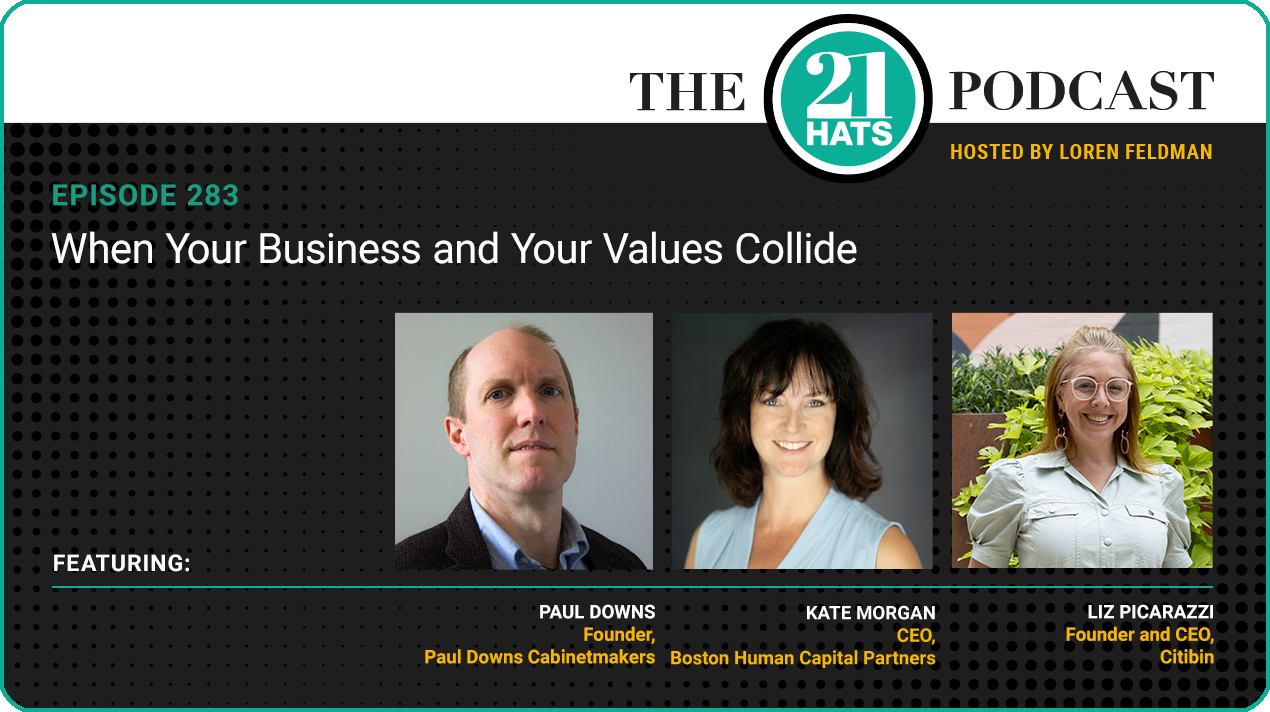
Introduction:
For the past six years, we’ve done our best to avoid talking politics on this podcast. By focusing on the business realities owners confront every day, we’ve tried to create a space where people with very different perspectives—from different industries and different parts of the country—can still learn from one another. That’s something we take seriously. But we also live in the real world. And lately, the real world has been making that separation harder.
On this episode, Paul Downs, Kate Morgan, and Liz Picarazzi talk about those moments when business and personal beliefs collide—and when staying silent may not feel like an option. They’ve each faced uncomfortable questions: What do you do when an employee says something you find objectionable? Are there customers you simply won’t work with? How do you stay true to your values without putting your company at risk? There are no easy answers here. And not everyone will agree on where the line should be drawn. But as always, there’s real value in seeing how other owners handle tricky situations.
— Loren Feldman
Guests:
Paul Downs is CEO of Paul Downs Cabinetmakers.
Kate Morgan is CEO of Boston Human Capital Partners.
Liz Picarazzi is CEO of Citibin.
Producer:
Jess Thoubboron is founder of Blank Word.
Full Episode Transcript:
Loren Feldman:
Welcome Paul, Kate, and Liz to what will probably be the least downloaded episode I publish this year. For obvious reasons, I normally do everything I can to make sure we do not talk about politics here, and we’re going to stick to that today. But we do live in interesting times, and there are times when what’s going on in the country, in the world, can become a business issue, even for the owner of a small business, and that’s what we are going to discuss—not the merits of anybody’s political thinking, but when, if ever, it makes sense for a business owner to speak up, regardless of whatever business risk that might entail.
I want to note that each of you has volunteered for this mission, and each of you has had a recent experience that has raised this kind of issue in your minds, and that’s where I want to start. Kate, I think it’s safe to say that your recent experience was the most dramatic of the three. Do you want to tell us about it?
Kate Morgan:
Well, it’s probably dramatic, because I make things dramatic. Yeah, I wanted to go see the Super Bowl halftime show, and I decided—I’m in a very purple state right now, in Arizona—so I figured: You know what, I’ll go to a Mexican restaurant, because there’s probably a better chance I’ll be able to watch the halftime show.
And I went, and throughout the entire halftime show, there were four women who were loudly carrying on about Bad Bunny and how he was speaking Spanish, and it was just racist remark after racist remark. And it was rather alarming, and I am not one to shut my mouth. I mean, they were specifically trying to draw attention to their ideas. So when it was over, I walked over and I called them out on it. I called them out really hard.
Loren Feldman:
Give us a little bit of a taste. How did you call them out?
Kate Morgan:
Well, I called them racist. I said, “Clearly, your views are steeped in racism, and I cannot believe that you’d come to a Mexican restaurant carrying this and loudly talking about it.” And they quickly were trying to share the, “Well, we’re just sharing our opinion.” I’m like, “Well, I’m here to share my opinion as well.” So, I won’t lie. I’m from Boston. I have a temper. I leaned into it, and clearly I was the aggressor. So I was asked to leave, and as I was leaving, the bartender and the manager were so apologetic to me, and I looked over my shoulder and I saw the entire waitstaff standing in line and smiling and nodding to me, and I just really appreciated that.
And I went home, and I recorded this video talking about it, because I was just so beside myself, and I posted it. And a friend of mine, she goes, “You have a lot of clients and candidates who see you. Aren’t you worried about that?” And my response is, “Why would I?” Because you opened this up with talking about politics. For me, I don’t see that as politics. I see that as social justice. I don’t know how politics got involved in social justice, but it’s now politicized.
Loren Feldman:
How did you answer your friend’s question? Were you at all concerned about the impact that this incident and your posting it—and appearing on this podcast [episode] as well—might have on your business?
Kate Morgan:
No, no, no. Because here’s the thing: I don’t want to do business with people who don’t share my same values. And if you are loudly, in an antagonistic way, objecting to my core values and belief systems, I don’t want to do business with you. I’ll find more business other places.
Loren Feldman:
There are people who might not have agreed with those women, but who do view this as politics and might choose not to do business with you. Does that concern you at all?
Kate Morgan:
No, no, no. Not in the least. Again, I talk so much about company core values. And I extend that into the vendors I work with, the clients. You will never have harmony in your life if you’re having to bump up against these folks, in my personal opinion. Because I run a professional services organization, so my people are everything. I’ve had people that didn’t subscribe to my political beliefs, and I’m okay with that. But when we start talking about racism, then I’m going to have a problem.
Loren Feldman:
Where do you draw the line? What would you disagree with but tolerate?
Kate Morgan:
Well, I think anybody that voted for Trump, quite frankly, would not necessarily be somebody I would want to work with, but I would, as long as they’re not being overtly aggressive with it. Like, I’m not overtly aggressive with my agenda, but if somebody is going to be, I’m going to step up and I’m going to speak my mind. So if people can stay in their lanes and they want to be polite about things, then everything’s fine. I don’t have necessarily a line, just if it’s going to directly target my belief system.
Loren Feldman:
Liz or Paul, any thoughts or questions?
Paul Downs:
Yeah, who threw you out of the restaurant?
Kate Morgan:
The manager and the bartender, but I was the aggressor.
Loren Feldman:
How did they put it?
Kate Morgan:
They were like, “We’re so sorry. You have to leave.” And we walked around the corner, and they’re like, “No, seriously, we’re really, really sorry.” And I’m like, “No, it’s fair. I was the aggressor.” And that was clear. It was just very uncomfortable. And it wasn’t just the manager and the staff—as I was walking out, somebody gave me a thumbs up. You know, because they’re having to sit there and listen to this. And it was just so inappropriate, so inappropriate. Even if they were being quiet about it and talking amongst themselves, but they were there to put a billboard, a vocal billboard of their opinion, to make everybody feel uncomfortable with their opinion.
Loren Feldman:
Have you heard anything from any of your employees? Are they aware?
Kate Morgan:
Yes, and I think there’s a superlative for me that I am the one most likely to get shot or run over in a protest. But they know I’m a very strong person, and if I’m going to see something that’s inappropriate and making other people feel uncomfortable for no reason? Yeah, I’m going to speak up and they support me.
Paul Downs:
Well, that’s a bold move for you. I’m glad you didn’t get shot. [Laughter] What happened to those people? Did they get thrown out?
Kate Morgan:
No, because they were just talking loudly. And, I mean, I think it would have been interesting if it wasn’t in a situation where—I mean, these people? I don’t know if they have undocumented workers at this restaurant. It was a Mexican restaurant. So the way I look at it is, if we were in Boston, I think they would have been asked to leave, or somebody would have said something to them. So nobody was saying something. I interjected.
Paul Downs:
Was anybody else talking while the halftime show was going on? Or was it dead silence?
Kate Morgan:
No, it was pretty quiet, except for these four women. That’s why, you know, there were a few of us just kind of looking around at each other. And, I mean, I was there by myself. I just literally just ran in there to kind of sit and grab a bite to eat and see the halftime show. But watching everybody just rolling their eyes at them and all of this…
But here’s the thing, they say, “If you see something, say something.” Well, you know what? I’m of the belief, “If you hear something, say something.” I can’t go into exactly all that I said to them, but I can guarantee they will be thinking twice before they speak so loudly. Even though there were four of them, and I’m not a big person, I was pretty fierce. And I hope I scared them under their racist rocks that they live and belong.
Paul Downs:
Well, I recommend you never go to Alabama. [Laughter]
Liz Picarazzi:
Yeah, there’s a lot of places you shouldn’t go.
Loren Feldman:
Kate, do you have any rules about political discourse at the business? Do people know what everybody thinks politically? Is conversation encouraged, discouraged?
Kate Morgan:
No, we don’t. I mean, people are certainly allowed to have their opinion. I’m never going to—I mean, you can’t fire somebody for that. It’s not a fireable offense. I remember I had a woman working for me when Trump first was going into office, and we were on the President’s Club Trip, so she was my guest as a trip winner, and we had walked five miles down this beach. And for the whole time she was going on because she knows my political beliefs, and I had to sit there and take it.
And that’s what I did. She was talking about her opinion in ways that weren’t—I mean, yes, she was disparaging some of my opinions. But there are opinions, and then I think there are beliefs, and I think that’s where I kind of look at things. I don’t know if that makes sense.
Loren Feldman:
You said she was aware of your political opinions. Is that because you’re particularly open about them at work?
Kate Morgan:
Yeah, yeah, I’m fairly—I mean, I think I’m not going to necessarily try and sway people, but I’ll make a joke or kind of a side comment, but I won’t necessarily be scathing. Now, I think I’m starting to escalate it a little bit, but I have one employee who’s just totally non-political at all, and that’s okay, too.
Paul Downs:
Well, why wouldn’t you fire someone you disagree with?
Kate Morgan:
Well, you can’t.
Loren Feldman:
Politically?
Paul Downs:
Sure you can.
Kate Morgan:
No, you can’t.
Paul Downs:
Why not?
Kate Morgan:
It’s like religion, race.
Paul Downs:
I don’t think it is.
Kate Morgan:
Yeah, it’s right up there with religion. You can’t talk about religion. You can’t talk about politics, because bad things happen. Yeah, no, it’s definitely not something you should do.
Liz Picarazzi:
I think that would be inviting a lawsuit if you fired someone for their political beliefs.
Kate Morgan:
Yep.
Paul Downs:
I’m not sure it would.
Kate Morgan:
It’s actual federal law.
Paul Downs:
Well, that’s interesting. I mean, my understanding—we have a policy that you cannot engage in conduct that is injurious or bothersome to others. And you could certainly make a case that somebody expressing a disagreeable political belief that is basically disparaging their co-workers would rise to that.
Loren Feldman:
Who defines what disagreeable is?
Paul Downs:
You. You’re the boss. I defined all the policies for my company.
Kate Morgan:
But if you’re saying that you’re going to fire somebody because you don’t subscribe to their political beliefs, that is legally and ethically an issue. Now, if they are attacking people, if there’s cause for termination because of aggressive behavior, yes, absolutely.
Loren Feldman:
But you’re saying you can’t fire someone because you think they voted for the wrong person.
Kate Morgan:
Exactly, exactly.
Paul Downs:
Well, what if you found a reason to fire somebody who you didn’t care for? That happens.
Kate Morgan:
Yeah, I mean, it happens all the time, and that’s what gets people sued. Because then they say, “Okay, well, it was because I was political.” And that’s why you have to be documenting these things, because otherwise you could end up with a lawsuit.
Paul Downs:
I’m curious about this.
Loren Feldman:
Paul, have fired anybody for their political beliefs? [Laughter] You seem more interested in this than I would have expected.
Paul Downs:
No, but it’s kind of the logical conclusion of where Kate’s heading. I mean, you refuse to work with certain clients because of this, and so that’s depriving your employees of the opportunity to make money from those clients. And it’s a continuum.
Kate Morgan:
So again, I want to be clear, I look at social justice and politics separately. So I’ve had plenty of people who have not agreed with me on politics who have worked with me. I have ample clients that, politically, I do not subscribe to what they believe in. But I’m talking about racism. That is an egregious offense to me.
Paul Downs:
I don’t disagree that racism is egregious, but this is one of those situations where, when you erect some kind of boundaries about who you’re going to do business with, you’re having an effect on the overall prosperity of your company and your employees by one step removed. Now, as it happens, I’m pretty liberal too, but I do business with a lot of people who aren’t, and I think that it’s difficult to say exactly where political disagreement shades into whatever I define as racism. But I’ve decided that I will happily take anybody’s money, with one person’s exception, which I do regret.
But you know, we do business with a lot of conservative organizations. We do business with all kinds of people all over the country, all regions. We do business with the military. We do business with defense contractors. I mean, you could make a case, pretty much for almost all of my clients, that there’s something objectionable about them. And just to clarify, the one person I regret taking a dollar from—and this is before I really understood who he was—was Alex Jones, and we made him a table. And I’d never heard of him before. This was like 2007, so he just wasn’t on my radar. It was like, “Send me a check. Great. Here you go.” And also, it’s a table. I’m not equipping anybody to actively do anything in particular.
By making decisions about who to do business with and who not to do business with, you affect the ability of your company to grow and the ability of me to enlarge my tribe and take their money and make it my money and let me take their money and do what I want with it—whereas if I say no, then somebody else is going to get the money. And they’re going to do whatever they want.
Kate Morgan:
Paul, you sell product. My product is my people. And in consulting, there’s this 80/20 percent rule. 80 percent of your clients are going to be amazing. They’re going to be phenomenal. The other 20 percent? They’re just going to suck the energy out of you, your will to live. And no, I don’t need it. And you know what? There have been clients—not for this reason, any political or social reasons—that we’ve cut. And my company always does so much better, because it doesn’t drag on the morale of my team.
Paul Downs:
Well, I would just like to clarify one thing: When you make products, there’s a couple of different ways to do it. One is you run a factory and you’re making tin cans and you’re sending them out in trucks, and you never meet the people who use them. That’s not how we operate. We know every single one of our clients, and we spend significant amounts of time talking to them. So I don’t think it’s all that different from your business in that way. And just to make it clear, I made a decision that I’ll sell them a table, and for the reasons I’ve stated.
Liz Picarazzi:
Yeah, I have an example with this that is very apt. So we started getting calls last year from the Trump Organization for one of his buildings that has a lot of restaurants on the first floor, and the restaurants were making a mess of the trash. It was becoming an issue. And the first few emails and calls, we actually just sort of refused them on principle.
We just didn’t like the idea of it, and then we sort of thought: He’s known not to pay on time. And he’s certainly not involved with this, but if we essentially invoice them for probably some of the hardship they would cause, and we make them pay in advance, it would be worth doing. Because we would actually feel like we were sort of—I hate to say it—we were sort of one-upping them. Like, I’ll be honest, we were going to charge them more than an average client pays. I’ll just admit it. And that would have delighted us.
The issue was that there was a zoning technicality that prevented the job from happening, and I ended up being glad for it, because I did talk to some of my friends and family, and that was sort of like blood money. “Do you really want to take their money? And are you taking a risk as a contractor with someone who is known not to pay his bills?” So for us, it was probably good that it didn’t happen.
But it was a conundrum where this official or this employee of the Trump Organization left Frank, my COO and husband, a message that was like, “Don’t you want to do business with me? I’m trying to pay you to put these trash cans here. Why aren’t you returning my calls?” And Frank maybe got a little bit of a lift out of that, that they were pursuing him so much. And that was an interesting one, though, because I’m sure that our employees would not have really cared. They’re all for, “Let’s all make more money.” But we had sort of an ethical debate about it. It went on for a little while, until we decided: Yes, we’re going to do this deal. And then it ended up not happening, and that was probably for the best.
Paul Downs:
Well, I’ve done business with the Trump Organization—although it was before he became president—and got paid. No negotiations. Everybody was very pleasant. So I think that, you know, you’re going to make the decision you want to make. I think doing business with them is the right decision, and charging them whatever you feel like is also the right decision. So you wonder whether everybody who works at the Trump Organization is exactly aligned with Trump, or are they just like, “I need a paycheck”? And maybe the Trump Organization ends up paying a lot more to get people to work there, and that person is basically doing the same calculus. Who knows?
But I think that the point I would come to is that, when you put guardrails around who you’re going to do business with, you’re affecting the possible prosperity of your team. And you can make a decision for yourself, sure. “I’ll make more money, I’ll make less money.” But if you would like to grow your company, and you can see that half the country is all for whatever you object to, and you’re leaving money on the table, you are depriving your organization and your team of some future level of prosperity. And so I think that’s a decision that every business owner has to make about customers.
Now, the situation that brought me into this conversation was a conversation with one of our employees who surprised me by expressing an opinion on recent events that was completely counter to everything he’d ever said that he believed in before this, but was sort of the easy, “I’ll go along with one set of opinions.” And I’m not going to get too specific about it, but what struck me was that hypocrisy. And this is someone who—a very personable guy—I have enjoyed for many years. He’s worked for me for nine years now. I just enjoyed bantering with him, but after that, I was just like, “You know what? I’m going to cool off a little bit.” I don’t want to run into this again, talking about something and then be surprised by something that I don’t agree with. He’s an employee. I don’t have to be friends with him.
So I just cooled it off, and he noticed. He says, like, “Wait, are you a little—” And I’m like, “I don’t want to discuss it.” And that was it. When you have employees, you don’t really have the right to understand everything they think, but when they surprise you, you’re gonna have to react to it somehow. I mean, Kate, you must have been surprised by an employee at some point in all the years you’ve been in business.
Kate Morgan:
I think I have a pretty high threshold. I had a couple of employees who didn’t want to get vaccinated for whatever reason. And I’m like, “Okay, well, now we have a problem,” because we were going to a conference, and they needed to be vaccinated. And then they had relaxed the requirements, as long as you had some sort of note. And I was like, “Fine, all right.”
One didn’t want to get a note. She didn’t go to the conference. The other one got a note, went to the conference. That’s fine. I can’t impress upon them my beliefs. I can’t fire them for not getting vaccinated. That’s not my point. So yeah, there’s always going to be some situations. Again, if somebody came in and started spouting off racist remarks, uh, no. No tolerance for that.
Loren Feldman:
Paul, you were talking earlier about an owner making a decision that could limit the ability of the business and its employees to make money. If I recall correctly—correct me if I’m wrong—you’ve told us here in the past that you’ve actually put that decision to your employees and asked them, “Do you want to work with this customer, with this client?” Do I remember that correctly?
Paul Downs:
No, I think that what happened was, after George Floyd, there were a lot of companies that were putting out statements on their website. And then the question was: If you’re not making a statement, you’re doing the wrong thing. And personally, I was very sympathetic to that. But as I said, a large number of my clients, if they had seen something like that on the website, that phone would have gone down, it would have had a serious impact.
I mean, I’m going to say 50 percent of my business is with people who I have very different politics with. And I didn’t feel like I could make that decision without explaining to the company: Here’s a thing that we’re sort of being asked to stand for our beliefs. And I’m the owner of this company, so we’re talking about my beliefs, but I’m cognizant of the fact that this would have an effect, a serious effect, on the company.
And it’s not like 2020 was a time when people were lining up to buy conference tables anyway. We were not at all sure that we were going to make it through in any case, so I put it to a vote and said, “Okay, this is going to be an anonymous vote. You just write it down.” I printed up some forms so that nobody’s handwriting or anything could be seen. Just: Let’s vote on it. And the company said vote to make no statement. And so it’s like, okay, that’s that.
Loren Feldman:
Was it a close vote?
Paul Downs:
Not at all. Not even. And keep in mind that, at that time, of 20 people, I think seven were from different countries, some of them recent immigrants, at least one with somewhat dodgy immigration status, which has since been resolved. But they voted the way they wanted to. I didn’t even try to figure out who voted for what, but it was a big relief, frankly. Because if we had put that statement up and business had crashed even worse, then I would have had to lay off half the company. That would have been terrible. So I was glad to have it off my plate, frankly.
Loren Feldman:
Liz, you employ—as you’ve told us here many times—immigrants, especially from Venezuela, I believe, and I understand that’s become an issue, a business issue for you of late, because they’re less comfortable traveling around the city, assembling your trash enclosures than they used to be. Do I have that right?
Liz Picarazzi:
Partially. So they don’t have any issue in New York City. They’ve never been pulled over. You know, ICE is in the city, not a lot. It’s about traveling to other cities where the climate is not as well-known. So as we expand, sometimes we send our installers from New York to do the installations in Boston, D.C., Baltimore, and as ICE is pulling over more and more people, a few of my installers don’t want to travel by van anymore. They’ll work in the city, and interestingly, they will fly, because ICE is not really in airports. So people who have valid papers, like they all do, they’re all able to travel. They’ll travel to California, but they won’t actually travel to D.C., because the chance of being pulled over is higher to travel by a vehicle.
So one I’ve noticed is that, as we grow, we do need to increase our installer network nationwide. We’re training people in other cities to be able to install Citibins. My reason before for expanding the installer network was just due to business growth, and now it’s actually due to racism as well. And it’s upsetting. It’s really upsetting. I have some employees who have relatives in other states who are being pulled over. I have one employee who calls his mom every day when she’s driving to work and when she’s driving home. If you’re a brown person, there’s a lot of risk. If you live in certain places that you’re going to get pulled over—and probably, especially if you’re in a work van. Because there is an assumption that if you’re driving a work van, that you’re somehow illegal, or just there’s a lot of assumptions made.
They have no idea that the men driving around my vans are amazing employees. And the way I see it is they were very brave to come to another country and not know the language, and then yet come here and work really hard and learn the language. Some of my employees, I started five or six years ago, they’ve been promoted multiple times, and they have equal opportunity. The thought of any of them being pulled over because of the color of their skin makes me really, really upset. And luckily, I haven’t dealt with any sort of racists or people who are customers who have ever said anything negative about my employees.
But one thing I have noticed over the years: I primarily in both of my businesses, have hired laborers and skilled workers, skilled tradespeople. And when I had the handyman business years ago, a couple of times when I was hiring—and I took interviews with all manner of people: white people, brown people, black people, anyone who was qualified to come in for an interview.
And a couple of the guys who were pretty far down in the process to be hired as handymen also assumed that they were going to be the manager over the existing handymen.
And I had to sort of let them know: No, these employees, they may not speak perfect English, but they work perfectly. They’re incredible at their job. They don’t need to speak perfect English. And why is there this assumption that because you’re older and you’re white, that you’re going to be the manager of someone who is a younger, Venezuelan, and doesn’t speak great English?
Loren Feldman:
Is that the way you asked them? Did you put that question directly to them?
Liz Picarazzi:
To the Caucasian men? I did. I did that, actually, with two who I remember. One was actually the day after Trump was elected in 2016. I went to the job site. And he knows that I was not a Trump supporter, and he sort of laughed at me and, “Oh, you know, I told you, we all voted the right way, blah, blah.” Well, he was super racist, and so the other guys on his crew really didn’t want him around. He was on a trial job. He was not anyone who I actually hired. But part of the reason I didn’t hire him was his expectation that he was going to be the manager over my employees who had already proven themselves. And you know, that was another instance I saw.
Over the years, I’ve hired people from many, many different countries, and I can say that anybody who’s from another country never took a job away from a native-born American—meaning, Ohio, New York, whatever, they were born in this country. So that’s another assumption that is often made, is that immigrants are taking jobs away. I would love it if more people applied for my jobs of all races, but it just so turns out that a lot of the tradespeople who are coming from Latin America have better skills, have more experience.
And quite frankly, in this country, when we stopped doing shop classes and anything having to do with technical skills, we hurt generations of people who could be working in the trades. Because most people these days, they don’t even own a drill. But my employees were taught by mostly their dads, their grandfathers. It was sort of like: You’re not a formed human being if you don’t know how to do handy stuff in your home. And that means that my candidate pool is going to have more of those people in it, and they are more likely to get hired, because they do have that experience and they have that knowledge.
Loren Feldman:
Liz, are you doing anything differently to check the status of the people you hire?
Liz Picarazzi:
No, I mean, we do the same thing. We use the service. We see their papers.
Loren Feldman:
E-verify?
Liz Picarazzi:
Yeah, and just to be clear, my employees are not worried about traveling because they don’t have proper authorization. It’s just the mode of transportation is more likely to get pulled over than if you’re flying. Like next week, I’m going to Aspen with two of my employees to do an installation. And I asked them, “Are you worried at all about this travel?” And they both said, “No, it’s easy to travel. We don’t worry about getting hassled from ICE. It’s really just with vehicles, with roads, with cars.” And so that was an insight I hadn’t even really thought of before. I mean, who would have thought that traveling by plane was easier for immigrants than traveling by car?
Loren Feldman:
Liz, some immigrants in this country, especially, I think, including Venezuela, have been here under refugee status, which I think the administration has tried to revoke. I’m not sure what the current status of this is. Might that apply to any of your employees?
Liz Picarazzi:
So that’s the political asylum process, and yes, it does apply to some of my employees. They’re a little bit further into the process, and so they’re not as worried. But I do have one employee who has some Italian ancestry, and he’s been taking Italian lessons recently, and he’s an amazing employee. He basically is like, “If I get any trouble here, I’m just moving to Italy. I know that they’re going to be able to take me in. And I don’t want to deal with this.” And I don’t blame him.
One thing that I want to inject here that’s important to this is that not every immigrant is actually pro-immigration. So I have a couple of employees who sort of will classify who should come into the country and who shouldn’t, and have very strong beliefs that they came over here and they worked really hard. But there’s another class of immigrants who have moved in here and are just sort of on welfare. And I’ve tried not to clash over anything like that. I feel it’s sort of problematic to judge who’s a good immigrant and who’s a bad immigrant. I mean, among immigrants of any generation, that has always existed: Relatives who are immigrants who hate immigration. It’s pretty common.
But with politics, with my employees, they’re definitely not Trumpers. And at this point, these guys can’t vote anyway, but they’re very anti-socialism, and so they are really appalled that Mamdani was elected in New York. They’re sort of disgusted by it, actually, and it’s really because socialism messed up their country. So I can understand that, and I also need to be sensitive to that. Because, a couple weeks ago, we posted on Instagram something about the Mamdani administration and how they were doing trash policy. And one of my employees contacted me, and he said, “I don’t think we should be putting that guy’s name on anything, unless he’s literally standing next to a Citibin and it’s something business-related.” And Frank and I discussed it, and we sort of agreed. He’s a great employee. I don’t want to alienate him.
Loren Feldman:
That’s really interesting. Let me ask you all this: It’s tempting to think that running a business is about products and services and customers and employees and all the obvious things. Is this changing the nature of business ownership for you? Or is this just another kind of challenge that business owners confront, or is it changing the way it feels to be a business owner?
Paul Downs:
I think that what’s changed is being a human being. And that’s going to have repercussions in business, like in all the other areas of life. And we’re being subjected to a set of forces that is way beyond any individual’s control. And our businesses exist in that world. And so I don’t particularly love the way, for profit, we’re all being divided and kind of encouraged to fight with each other over every single thing. On the other hand, a lot of the things that I find objectionable have always been around. They just weren’t brought in my face.
So, is this a better world? No. Is it a different world? No. It’s just that it used to be easier to skate to the side of all of these disagreements and think that the public square was someplace that we—there were some boundaries as to what would be considered and discussed. But that left a lot of people in the dust. And in today’s world, we’re much more aware. We’re trying to rectify some of those things. But the desire to do that, to either change things or keep things the same, has been monetized and weaponized in a way that makes it so much harder for us to have any kind of progress. I’m very distressed by it, but it’s not because I own a business. It’s just because of the things that are happening.
Loren Feldman:
Do you feel any kind of obligation to stand up and speak out publicly because you own a business?
Paul Downs:
No, not me. As I said, that would have repercussions that would affect not just me—who can probably afford it best of all the people who are employed—but the others. And I don’t think that if I made an effort to do that, and the predictable consequences happened, that my employees would thank me for it. And my primary loyalty is to, first, my family; second, to my employees. They’re my tribe. We come together every day and work hard to get along and to do something wonderful. And to have politics destroy that, or for me to insert politics in a way that would harm it, I think would be an enormous mistake. So, I’m not going to do that.
Loren Feldman:
All right. My thanks to Paul Downs, Kate Morgan, and Liz Picarazzi. Thanks for sharing, everybody. Seriously.

