

With My New Rent, I Will Clear Nothing
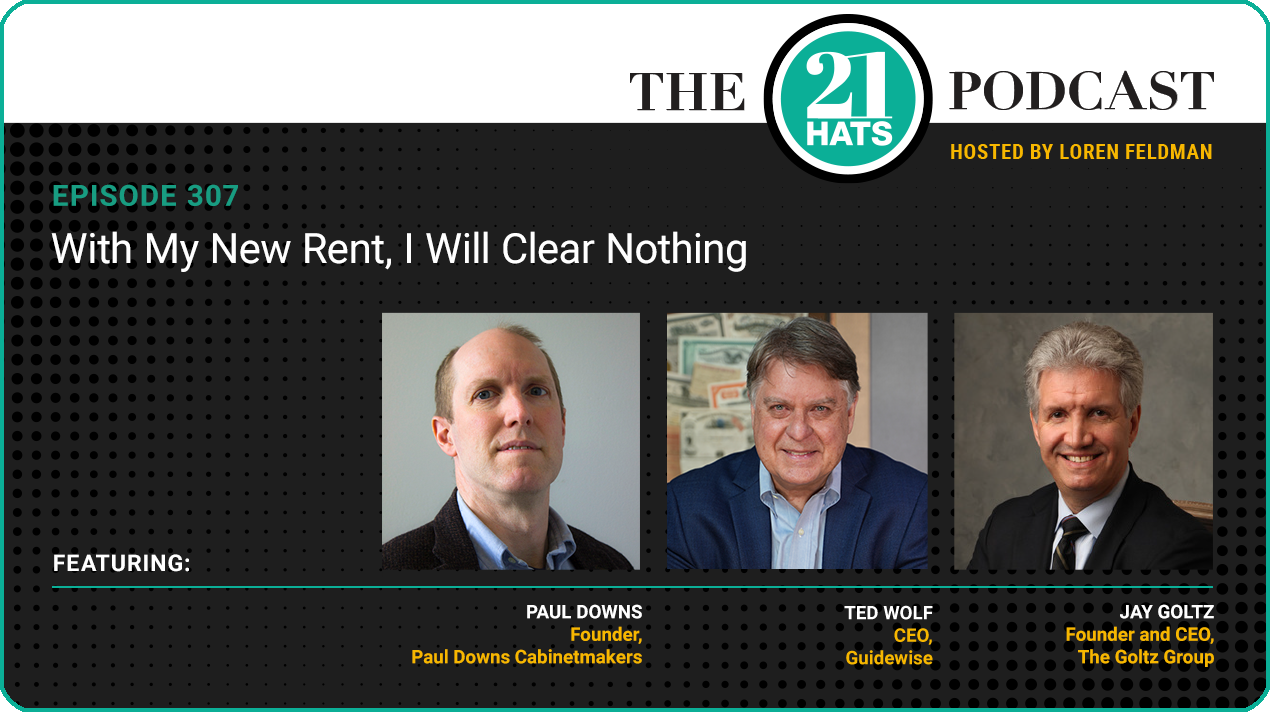
Introduction:
This week, we start with a business owner who’s just learned his rent is jumping 40 percent and who sees three options: accept the new rent and essentially work for free, move and start over, or shut down and get a job. But when Paul Downs, Jay Goltz, and Ted Wolf do the math, they see another option—one the owner doesn’t seem to have considered.
From there, the conversation turns to the choices owners make when the answer isn’t obvious. Paul, as it happens, is wrestling with two of those himself. Before the year began, he developed a plan to start selling his custom conference tables in the Middle East. Then the missiles started flying. Does he still spend $30,000 to see whether the opportunity is real, or should he put that money to work closer to home? And then there’s a potentially lucrative R&D tax credit that Paul thinks could be “a gift from heaven.” He believes his company qualifies for the credit, but he also wonders whether claiming it could invite unwanted scrutiny from the IRS.
Different decisions, different stakes, but the same question: As Paul puts it, “What is your appetite for risk?”
— Loren Feldman
Guests:
Paul Downs is CEO of Paul Downs Cabinetmakers.
Ted Wolf is CEO of Guidewise.
Jay Goltz is CEO of The Goltz Group.
Producer:
Jess Thoubboron is founder of Blank Word.
Full Episode Transcript:
Loren Feldman:
Welcome, Paul, Jay, and Ted. It’s great to have all of you here. I want to start today by asking you about a post I read recently on the small business subreddit. It’s about the owner of a cafe whose landlord is raising his rent by 40 percent. Here’s what the owner wrote:
“Four years in that unit. Built the whole thing from an empty shell. My own money, my own hands. Three months of 18-hour days before we opened. Lease is up. He wants 40-percent more. When I pushed back, he shrugged and said, ‘That’s just the market now.’ And he is not even wrong because a chain would pay it.
“Here’s what makes this rotten: My rent went up 40 percent because I made the street desirable. Four years of me being here, being good, drawing people in is a large part of why this block is now worth more. I improved his asset with my life, and now the improvement is being used to price me out of it. The math: at the new rent, I clear almost nothing. I would be working 60 hours a week to hand him the profit.
“The options as I see them: Sign it, work for free, and hope for a rent I can survive at the next renewal, which is naive. Move, which means rebuilding a fit-out I paid for once, losing every walk-in customer, and starting over on a street where I’m nobody. Or close, take the loss, and go work for someone else. I have eight weeks. For anyone who has faced a rent hike like this, did anyone successfully negotiate one down? And what actually moved the landlord? Has anyone moved and had the customers follow?”
Thoughts, anybody?
Jay Goltz:
Yeah, I just find this remarkable. Like, he didn’t put another option on the table. Let’s assume that his rent used to run 10 percent on sales. That’s probably close. So they’re raising his rent 40 percent. If he raised his prices 4 percent, that would cover it. Like, how is that not an option? And then he is gonna go, “Oh, my customers won’t pay it.” That’s ridiculous. Most will pay it. I mean, he needs to raise his prices if the block’s gotten hotter. I mean, that’s how it works.
Loren Feldman:
I think you’re probably right that he’s not thinking about it for some reason, but just for argument’s sake, I bet all of his prices are going up. I bet he’s paying more for coffee.
Jay Goltz:
Okay, whatever. Then you charge more. I’ve said this numerous times on this podcast. My biggest mistake was thinking, “Oh my God, I can’t raise my prices.” And I think it’s the Achilles heel of most entrepreneurs. Like, you gotta charge what you gotta charge.
Ted Wolf:
I think, today, most people have to look at their pricing mechanism every six months, not every 18 months like it used to be.
Jay Goltz:
Yeah.
Ted Wolf:
Are the prices in line, or aren’t they? You gotta constantly revisit it, because it’s one of the tools in your toolbox that you have to use.
Jay Goltz:
The other thing from this is, it’s a good thing to buy the building you’re in. Being the tenant is a problem, and I’ve been there. And it’s unfortunate, but it’s the way it is. I mean, if one can do it—and especially using SBA loans with 10 percent down—everyone in business would probably be well served to try to buy their building, especially if they’re in a retail business.
Ted Wolf:
I would agree with that.
Loren Feldman:
I mean, I think everybody agrees with that, if you can do it, as you said, Jay. But to a lot of people starting a business, that just seems unrealistic.
Jay Goltz:
Listen, I didn’t buy a building until I was in business for almost 30 years.
Loren Feldman:
There you go.
Jay Goltz: I know, but when I moved in, my rent was literally—I’m not exaggerating—a dollar a square foot, and then it went up up to $12. Because I was in an abandoned factory district, which I made the first retail thing. So I’ve been where this guy’s at.
And the answer is, he needs to charge more, and then he needs to maybe look for buying a building, but maybe not. Maybe it’s okay. If the neighborhood’s so much better now, and he’s giving a good product and service, the people will pay a little more. Not everybody, I would never say everybody. But even if he loses 5-10 percent of his business, he’ll still be okay.
Loren Feldman:
Was it a mistake for him to pay to build out his space in space he was leasing?
Jay Goltz:
He probably had no choice. The mistake might have been he should have negotiated a longer lease. I mean, that is a strategy of landlords: to get a tenant in there, fix up their space. I mean, my friend who’s in real estate told me that years ago, especially with restaurants. That is a strategy, how they make money. This happens every day of the week. And the answer is, if you’re gonna put that kind of money into it, make sure you get it longer than a five-year lease, because that’s not a long enough lease.
Loren Feldman:
Paul, you’re in space that you lease and you built it out with a lot of manufacturing equipment. Did you ever worry that your landlord would price you out?
Paul Downs:
No, because Jay’s math is correct. And also, for the first 18 years of being in here, the lease was so cheap that it hardly mattered if they increased it a little bit. But I think that for a restaurant, it’s a different story, and Jay’s right. This guy needs to negotiate, come back, eat the 40 percent increase.
And I just asked ChatGPT to see what the typical percentage of revenues rent would be for a small independent restaurant. So Jay is correct. It’s less than 10 percent. So yeah, eat the 40 percent, negotiate a 10-year term, and if he’s so confident that he can thrive, raise your prices and move on.
Ted Wolf:
For me, the first five years, we were in a service business in particular, so we didn’t have the needs that Jay and Paul do, as far as real estate and leasing. But we rented and leased, and then after five years, we got our own building. And ever since that point in time, that’s what we were trying and wanting to do. But when we had remote locations, we leased, and you paid it. You had to grow your business, and you had to increase your prices and do all those things that you have to do, because that is the market. And you’ve got to play by the rules of the market. That’s supply and demand.
Jay Goltz:
The other lesson, if I was talking to the guy, I would tell him: Being a tenant is valuable to the landlord. He probably can push back a little bit, because if he has to go re-rent that space, he’s gonna have to pay a broker for three months, he’s gonna have to give free rent for three months. It’s gonna be empty for three or six months. It’s not like it’d be a good thing if he left.
So he does have some leverage with the landlord to say, “Look, I’ll give you 30 percent more.” Because the landlord knows. I mean, the landlords take advantage of the fact that they’re more experienced with this than the tenants, usually. But it’s not like the guy can just go ahead and replace that rent instantly.
The numbers I just gave you are accurate. It’s gonna cost somebody nine months to a year’s worth of rent to replace that tenant between the free rent, the build out, the commission. The commissions are significant. You’ve got a five-year lease, the commissions are a few months. So the guy’s gonna lose an entire year’s rent by replacing him, so he certainly has some leverage.
Loren Feldman:
Is the landlord in this case doing anything wrong?
Jay Goltz:
No.
Paul Downs:
They’re landlords. Sigh.
Jay Goltz:
To use the word mensch, would he be a mensch to cut the guy a little slack? Sure, that would be reasonable. But I can’t say what he’s doing is wrong, if that’s in fact a market rent. I wouldn’t do it. I’d cut the guy some slack, but he needs to stand up for himself to push back on that.
Paul Downs:
My biggest regret is that I haven’t been able to buy a building. And so Jay’s advice to find a place you can own is excellent and should be implemented by anybody who can possibly do it. The improvements we’ve made to our space are mostly just adding electricity. But it’s a fair amount of wiring over the years.
My equipment is portable, and I could move it fairly easily. But when I look at what it would cost me to buy a building, and move to it, and fit it out the way I need to, it’s probably 4 million bucks. So at the moment, I’m paying about $25,000 a month in rent for 40,000-some square feet. And the numbers just don’t work. It’s still cheaper to stay here, but I wish I had different options 22 years ago when I moved in.
Loren Feldman:
Paul, when you look back and think about the situation you faced 20 years ago, say, is it possible that buying space might’ve been a more viable option than you realized?
Paul Downs:
Possibly, but at that time I had a partner. I was a young guy with a bunch of kids and serious family commitments, and moving into this space was actually a huge improvement over my previous situation. And the space I’m in is in a building that’s part of a huge complex, and I would be pretty surprised if the landlord ever wanted to sell this building.
And, you know, the particulars of every situation can get real complicated fast, and this one is complicated. The two sons are now in the business, are gonna go take it over. My landlord inherited it from his father, and I wouldn’t say that they’re the best landlords, but they’re not the worst landlords. And so, they’re the devil I live with. And I know what I’m in for here.
Loren Feldman:
So, Paul, you’ve already kind of given us an example. I’m curious about, for each of you: Looking over your careers, is there one decision that you still think about, that you still wonder whether you should have handled it differently?
Paul Downs:
Well, I mean, there’s probably 50. I think a decision I made a long time ago that everybody assured me was an enormous mistake—which they were mistaken about—was taking a partner. And at that time I was young, and I was sort of topped out on what I could accomplish by myself, and taking a partner had upsides and downsides. But on the whole, looking back, that was a great decision, because my partner brought resources and sort of a point of view that set us on a path to expanding.
And it’s all, over time, worked out very well. But a lot of that was just luck that the partner was a very good guy, and that even when our partnership became highly stressed in the first recession, he wasn’t somebody who looked for any satisfaction in destroying me, which he could have done. And so our partnership dissolved, and I didn’t talk to him for a number of years, but then we did reconcile, and I’m glad of that. He was a good guy.
Another decision was whether to pay attention to this crazy thing called Google that started sending us clients back in 2003 and 2004, and whether shifting to conference tables was a good idea, and that’s turned out great, too.
Loren Feldman:
I was kind of looking for decisions you still wrestle with because they didn’t work out quite the way you hoped they would, Paul.
Paul Downs:
Things that didn’t work out? It’s mostly been people I hired.
Jay Goltz:
Yeah, I’ve got a hundred of those.
Paul Downs:
Or equipment I bought. You know, machines you thought would work, and they just didn’t.
Loren Feldman:
Do any of you have a decision you’re wrestling with right now that you’re not sure which way to go on?
Paul Downs:
Okay, I’ve got two. One is, we have the possibility of doing business in the Mideast, and earlier this year, I had found a more or less a reputable person who was repping a company we do a lot of business with in the Mideast. And we were all set to move forward with him demonstrating our products to his customers, which were mostly the defense departments of the Gulf States, like Oman, Qatar, Dubai, Kuwait.
Well, we were all ready to go in March, and then our esteemed president decided to go to war there. And so the question is, do we continue to move forward at all with this relationship or just say, “Okay, bad luck, missiles are still falling”? It’s not a huge investment, and I’m inclined to do it, but one of my designers—who’s also involved in actually designing for this guy—is like, “Why are we doing this? This is crazy.” Which is a good question. So, that’s one. I don’t have an answer yet.
Loren Feldman:
Tell us, what does that entail? What is the investment? What is the risk?
Paul Downs:
What we would have to do would be to construct some sample pieces and ship them over there for our rep to use in various shows that are scheduled to happen in the fall and over the winter. And the clients would be defense officials in these smaller countries. And when the shows were scheduled, it was like, you know, “We’re sleepy little Gulf States, and we like to spend money on fancy conference rooms.” And I’m not sure that their budget priorities are fancy conference rooms anymore. They’re gonna need to figure out how to stop Iranians from firing stuff at them.
Jay Goltz:
Wouldn’t the freight be terrible on that?
Paul Downs:
To get these samples, yes, we’re gonna have to air freight them. But yeah, the whole thing, let’s say it’s 30,000 bucks. That’s probably about right. So Jay, would you roll the dice with $30,000 on a marketing initiative?
Jay Goltz:
Well, I would argue—I could argue, I will argue—would you not be better off putting your energy into marketing in the United States that’s much easier to deal with because the downside is much less? Is the upside worth the downside? That’s the question. I don’t have the answer to that, but—
Paul Downs:
Well, that’s what my designer is saying. Like, “Why are we doing this when we have customers here who are calling us already, and we could be doing stuff for them?” And I said, “Because they’re calling us already. Like, why bother? Let’s see if we can open up a new market.” I think it’s not a bad idea, but the timing may be terrible because we just don’t know how this war’s gonna end.
Loren:
$30,000 doesn’t sound right. Is that just for the shipping, or does include—
Paul Downs:
We gotta build a couple of pieces. The shipping’s probably, I actually don’t know, but let’s say it’s $6,000 or $7,000.
Loren Feldman:
So you could build the pieces for $25,000?
Paul Downs:
By the time we’re all in, yeah. I mean, they’re not large. It’s mostly that we have to think about a bunch of things that we wouldn’t normally have to worry about.
Loren Feldman:
I know you sometimes charge a lot more than that for a table.
Paul Downs:
Yeah.
Jay Goltz:
That’s cost, though.
Paul Downs:
Yeah, we have to design [and] fabricate them, but they have some particular requirements. They have to be very lightweight. They have to be able to go in the back of an SUV. They have to also fit onto something called a Euro pallet. We have to get Euro pallets. All the wood has to be certified insect-free. There’s like a bunch of bullshit that has to happen.
Jay Goltz:
You mean bullshit like not sending stuff with powder post beetles in it, that kind of bullshit?
Paul Downs:
Yeah, that’s one kind of bullshit. But there’s also registering as an exporter with the U.S government. When you’re exporting, there’s quite a bit of little—
Jay Goltz:
That sounds like a lot of trouble for limited gain.
Paul Downs:
Well, everything’s a lot of trouble, but I don’t see it as necessarily being limited gain. So in my experience, the little pile of trouble that I have to climb over at the beginning of this project is very similar to the piles of trouble I had to climb over to do multiple things that have been very successful for us in the long run—mostly because we were willing to just dig in and do all this crap right at the beginning. All the business I do with the Department of Defense here or the Architect of the Capitol or Lockheed Martin, it all involved a bunch of bureaucratic stuff, a bunch of hoop jumping, a bunch of demonstrating that you could do this or that or the other thing. And that’s the game. You know, you make your decision.
Jay Goltz:
So here’s a question: your salesperson, is he an independent rep? Is he—
Paul Downs:
No, no, no, this is my main designer.
Jay Goltz:
Okay, so one factor I would think, as the business owner, is do you want to keep your salesperson happy who thinks he has an opportunity? I think that’s worth something. The answer to your other guy, “This is why you’re doing this”—because our sales rep found this and I want to support him. That’s an argument to be made.
Paul Downs:
You need to know, like, who’s a risk-taker? So there’s zero downside for him if I go ahead with this. There’s considerable possible upside for both of us. If we open up a new market that wants big, fancy, expensive things, he’s gonna be selling them. He’ll be taking home a decent commission. If we do nothing, nothing happens, right?
Jay Goltz:
Right, that’s why I’m saying it might be worth doing because you wanna support your sales guy.
Paul Downs:
Yeah, sorry, I thought you meant because you want me to agree that this risk is too much risk.
Jay Goltz:
No, no, no. I meant the opposite, that if the sales guy found this lead and he’s excited about it, it’s not great to tell your guy, “Yeah, I don’t wanna do it.” Unless you’ve got some legitimate—you know, it’s a factor, that’s all. I’m not saying I would do it for that reason.
Ted Wolf:
Paul, I think I would look at it, just a suggestion, is number one: Don’t spend more money than it’s gonna hurt to lose. It’s like, “Hey, okay, if I lose this, it’s a flyer. I know it. It’s not going to kill, it’s not a strategic portion of my assets in cash and things like that.” So, if it’s losable money, number one, okay.
Then it’s a matter of timing. When are the bombs gonna stop, and who’s gonna win? Nobody knows those questions, but I can’t believe at some point, they’re not gonna stop. I would say probably sooner rather than later, something will happen because of the mid-terms.
I’d look at it though and say: This could be the sweet spot to get in there. Because when the bombs do stop—and they will stop at some point—some of these people are going to be spending an awful lot money on a very unique rebuild in the Middle East, in many instances. Many countries will say, “Yeah, we gotta go out and now one of the things we’re gonna show off is a conference room,” because I think that does carry a message in some cultures that we’re rebuilding and dedicated. And part of that is: Look at what we’ve done in our facility. So I dunno if it’s that much of a flyer. But it’s a matter of, is it gonna hurt if it all goes bust and you lose your $30,000? Which I don’t think it would. And then what’s the timing look like? Because there will be an opportunity, but I don’t know when. There’s no way of knowing when it’s totally safe and certain, for any investment.
Paul Downs:
I mean, the other thing is that, this year to date, we’ve spent much less of our marketing expenses than we have in the last three years. So it’s like, we would’ve spent this money on something anyway, and if we’re going to market, go ahead and market. You’ve got 2 percent budgeted, and we’re spending 1 percent to date. Why not roll the dice? I’ve rolled the dice on a lot of occasions, and usually it works out well, because rolling the dice is not just doing something stupid and unconsidered. It’s actually approaching an opportunity and then doing what’s required to do it correctly.
Ted Wolf:
I would just consider staying power. How long can you stay at it? Because a lot of times, you put money into an investment, and it takes a little longer to get to where you want. You may have been ahead of the market a little bit, but if you’re there and you’ve done your homework all along, you probably are in a pretty sweet spot. At least, that’s what I experienced. You know, it takes time. Things do unfold, and if you’re smart, you’re listening to the market. You can be at the right place at the right time. Staying power: How long can you stay there?
Loren Feldman:
I think you said you had another decision you’re wrestling with right now.
Paul Downs:
I did.
Loren Feldman:
What’s that?
Paul Downs:
I was originally approached by ADP, my payroll company, and they said, “Hey, we wanna talk to you about the R&D tax credit,” because the Big Beautiful Bill that got passed, whenever it did, completely revamped that program. And I hadn’t really been paying much attention to that, because I had looked hard at it four or five years ago, and it was not really going to yield anything to me. But given the changes in the program, all of a sudden, it looks like we could make a legitimate case that all of our engineering labor, almost all of our shop floor labor, and about 70 percent of our material budget every year qualifies for the credit. And now you’re talking about real money.
If I’m aggressive about what I claim as at-risk activity—in other words, we don’t exactly know how it’ll turn out when we start it, which is almost everything we do, we’re custom manufacturers—then we can get a 10 percent credit on the expenses generated by that. And again, looking at kind of an expansive amount of that, that’s almost 2 million bucks a year. Well, that’s exciting news, and this has all come up in the last week or so. And part of me is saying, “Woohoo, more money from the government.” I haven’t seen anything like that since PPP, and I’m all over it.
But then there’s always a little bit of a voice saying, “Oh, if you go back and claim a huge credit from the government, you’re gonna get audited, and it’s gonna suck and blah, blah, blah, blah, blah.” And then the little voice that criticizes the little voice is saying like, “There’s nobody even left at the IRS. They fired everybody. Like, what’s the actual chance of getting audited?”
Which is not true. But you know what I’m saying. Like, you make decisions about what the downside risk is, and you have to look at the actual percentage of people who are being scrutinized. So I don’t know exactly what to do. I haven’t done anything yet other than thank the ADP people, then go to my accountant and say, “Hey, can you do this a lot cheaper than they want to do it?” And she’s like, “Sure, we can.”
So, it’s not too expensive to refile the taxes for the last three years and set it up for this year. We have all the records to support any assertion we make regarding which of our activities are at risk and involve novel creation or engineering. We do that all the time. That’s almost everything we do. This program couldn’t have been designed as a better fit than for someone like me. So, I don’t know. That’s the decision.
Jay Goltz:
I would suggest you talk to some bigger accounting firms—I don’t know how big your accounting firm is—that have some experience with this, because there’s someone out there who knows whether this is a slam dunk or not. Because they know how the IRS works because they deal with them every day.
Like for instance, my accountant once told me, “Oh, you should get residency in Florida. They never check anything.” And he called me, “Yeah, forget what I told you.” He’s got a huge problem with a client who did that and it didn’t work out well. But they do this all the time and they probably have some experience as to whether there’s been any pushback on it. It’s worth asking.
Paul Downs:
Yeah, I talked to another accountant yesterday, and he’s like, “Yeah, go for it.”
Jay Goltz:
Well, I’m gonna save some money to bail you out either in the Middle East if we gotta get you out of there if you are taken hostage, or if you are in jail from the IRS.
Paul Downs:
I’m not personally planning on going to the Middle East. I did do business with Afghans: “Boy, if you go to Kabul, we can set you up with a ton of customers.” And this is in 2007. I’m like, “Hell no. My wife would kill me if the terrorists didn’t get me first.” I have been to Dubai and Kuwait before, and it was fine. But anyway, I would say that part of this entire discussion is what is the entrepreneur—in my case, me—what is your appetite for risk?
Loren Feldman
What is the risk, Paul? What is your concern about getting audited? Are there things in there that you’re afraid you’re going to get caught having done?
Paul Downs:
It’s just a pain in the ass, that’s all. That’s really it. If we do this, I’m going to go back and—I mean, I gave ballpark numbers to the accountant, but we have records on every single thing we built for the last, I don’t know, 20-some years now. So we can go back and look at the exact—was this something novel? How much of it was novel? What did we spend on materials?
We can do all that and really document that: Yeah, what we do is risky. Every day we think of something risky. I mean, I’ve got five projects on the shop floor right now where we’re kind of like, “Huh, we’re halfway through this. We’re encountering problems. What are we gonna do?”
And so that’s pretty much what the IRS four-part test is all about. Are you at risk for what you’re claiming? And are you trying to think of new things? And that’s what we do all the time. So I’m comfortable with the concept of it fitting. The exact numbers would be more, like down to the penny, what is the credit for each year? That’s more the concern.
Loren Feldman:
Have you asked your friend ChatGPT what it thinks?
Paul Downs:
I sure did. And summarizing: “It appears you qualify for a pretty good pile of money.” So, what’s that worth?
Loren Feldman:
Not a whole lot.
Paul Downs:
But it’s not like, “Hell no, back off, stay away.”
Loren Feldman:
Right. I don’t think you’re facing that much risk here. Anybody disagree?
Ted Wolf:
No, I don’t think he’s facing an awful lot of risk, and I think Paul’s thought it through pretty thoroughly. And I’m sure he knows he’s got timelines. “If it’s not paid off by this time, I’m out. This is what’ll be happening if there’s no activity.” So Paul, I don’t think there’s risk there that you have to worry about going to the Middle East or refiling tax returns in the way that you said. I think they are low-risk gambles, to be honest with you.
Paul Downs:
With the tax returns, there’s a potential huge payoff, too, which would make it way more valuable, what I take to market soon. And so that’s very alluring to just go ahead with this and see what happens.
Loren Feldman:
Paul, you mentioned going back three years and making alterations. Is that because this is retroactive, or because you have to do something to set it up to be able to claim it in the current year?
Paul Downs:
Well, my understanding based on what the ADP people told me and what ChatGPT told me is that we can refile for the previous three years, and then for 2026, we can file. And you can also carry forward the credit if you have a loss the next year. So the credits don’t expire for 20 years or something like that. It’s a complete revamping of this program in a way that’s way more advantageous for anybody who’s spending money on R&D. I think the previous program, if you took the credit, you couldn’t expense the same expenses against ordinary income, and that’s a problem.
So with this, let’s say I’m spending a hundred grand on engineers who think of new things all day. I can still expense that right off the top of a lot of my revenues. Like take an expense. But then the credit would be an additional 10 percent of that. So, it’s just like free money.
The program previously also required you to depreciate the credit, so it was just not worth much trouble. But Trump, in his wisdom, like whatever they decide to do, it’s a way more lucrative thing now, which is why ADP was calling around seeing whether I could possibly be interested, because they were asking for 20 percent of the credit as their payment. So then I went to my accountant, and was like, “How hard is it to do this?” “Not hard at all. You just gotta file.”
Jay Goltz:
My question is, did the accounting firm say, “We’ve done this for 10 other people and it’s all worked out?” Have they done this for other people?
Paul Downs:
Well, nobody wanted to do it until recently, because of this revamp.
Jay Goltz:
Yeah, I would definitely want to talk to some other people who have done this, who are in the middle of it, because I found there’s frequently some inside—not that it’s a bad thing, it might be a great thing. I just would want to test the waters on that.
Paul Downs:
When PPP rolled around, Jay, did you sit around and ask people whether it was a good idea or not, or did you just save some money?
Jay Goltz:
No, I needed the money and I took it.
Paul Downs:
How’d that work out?
Jay Goltz:
I think okay.
Paul Downs:
Absolutely.
Jay Goltz:
I’m not in jail or anything.
Paul Downs:
Sometimes a gift from heaven is a gift from heaven, right?
Loren Feldman:
Paul, I’m pretty sure your investment in selling conference tables in the Middle East will qualify for this, if anything qualifies.
Paul Downs:
Yeah, absolutely. I mean, we do all kinds of things where we’re thinking of a new solution to a problem, and that’s pretty much what we do every day, all day, every day. If my clients could get what they wanted out of a catalog, they’d do it. They wouldn’t spend more to have me do it. I just feel like we’re a good fit for it. And, sure, Jay, I’ll try to find somebody else, but it’s a new wrinkle on an old thing, so I’m not sure how many—
Jay Goltz:
I’m not being cynical. I just would, if you can, see if you can get somebody to have done it.
Paul Downs:
It’s good advice. Sure, I’ll take it.
Loren Feldman:
In the little bit of time left, I’m gonna actually ask for a little advice for myself. As I think all three of you know, I’ve announced a 21 Hats Succession Solutions Workshop. The basic premise is that it’s not easy for business owners to both run their businesses and simultaneously check out all of the succession options they might consider, especially since they really need two succession plans: one for leadership, one for ownership. That is compounded by this: Wherever owners look for guidance, they tend to run into people who are trying to sell them on a specific path.
My idea is to bring together 10 owners over eight virtual sessions, meeting once every two weeks. We’ll do two things: We will have each of the 10 report on what they’ve learned, what they’re considering, and I’ll bring in special guests who’ve been through this and can talk about their experiences without trying to sell anybody on anything. This is gonna start in January, and I’m curious: What questions might you ask?
Ted Wolf:
What’s the experience of the people who will be conducting those work sessions for you?
Paul Downs:
I was gonna say exactly the same thing. Like, who’s the expert?
Loren Feldman:
Great question. Mostly, it would be entrepreneurs who themselves have chosen a path and gone through it and can now talk about how it worked for them. There would also be a handful of people who are in the business of helping businesses go through successions, but they’re people I’ve gotten to know, who I’ve vetted, and who I trust not to come in and give a sales pitch, but to just share the information that business owners need to consider. Does that answer your question?
Paul Downs:
Yeah. I think if you can credibly state who’s gonna be doing it, which particular approaches they’re gonna be discussing, and—this would be bonus points—if you could say, “Here’s some other options you may have heard of that we don’t think are worth explaining,” or, for whatever reason, “we could not come up with somebody to talk about them.” So if your initial promise is that you’re gonna be giving us the universe of options, then I’d like to know if some of the planets are off limits.
Jay Goltz:
I can tell you there’s a huge hole in the market, because every one of these things that I’ve looked at—just the ones I’ve looked at—they’re run by financial places that want to get your money when you sell the business. And I’ve gone to some of these seminars, and they’ve been completely worthless.
And in one case, I even went out of town. They had a trade show about it. And the fact of the matter is, they couldn’t even find one entrepreneur who could actually say, “Here’s what I did.” It was a racket, and I do think there’s a hole in the market for getting honest input—not from somebody who just wants to get their hands on your money when you sell the business.
Ted Wolf:
I think that’s a big part of the market, no question, Jay. The incentive behind that referral of trusted advisors and things like that. But I think it comes down to, Loren, I think you covered your bases: having people that have actually gone through the transaction and the experience of starting and growing and then exiting a business. But that’s only one option, exiting.
Obviously, the challenge is, how do I get my money out of the business? If I can’t get my money out of the business, I’m in trouble. It should be in my private account. So how do I go about doing it? But there’s specific techniques you can use to do it, so your company becomes transferable. In the finance world, they call it optionality. You always have financial leverage if you build certain systems in a certain way. I wish I would’ve known that when I had my business earlier.
We did do a lot of things right, but the one thing we didn’t do is we didn’t start preparing for it soon enough before the actual sale or acquisition took place. And today, you have to understand, only 30 percent of the businesses that are up to be acquired actually get acquired today. You’ve got a 70 percent fail rate. So you better understand what’s going on, understand EBITDA, understand how to negotiate.
But I think it’s up to 60 percent now of all acquisitions, in some way or another, are done by private equity. And if you look at the multiples that were just published I think within the last month, the last year, the average multiple for a business was about 5.5. This year it’s a little over 3.0. Tremendous drop, and they attribute it to people not having good AI implementations. Whether it’s right or wrong, that’s the way the market’s going.
Jay Goltz:
And the problem is, the private equity people are not looking at businesses with an EBITDA of $600,000. They want extremely profitable companies. So the fact of the matter is, the typical entrepreneur doesn’t make enough money to even use private equity, even if they wanted to. And then the advisors who we all use really have no expertise in this. Most accountants, most lawyers, from what I’ve seen, they don’t have—so you really have to go out and look for it, which is why it’s great you’re doing this. Because you have been curating people for years who can help with this, and I fully support it. I think it’s a great thing you’re doing, because I haven’t seen it anywhere else.
Ted Wolf:
There’s a definite hole, a need in the market. There’s a gap there that’s gotta get filled, and there’s organizations that are actively doing that.
Loren Feldman:
Ted, it’s interesting to me that you mentioned that you wish you had started thinking this way a little bit sooner with the business that you sold. I don’t think I’m going to have a problem filling my cohort of 10, but I do keep hearing from owners who’ve reached out to me since I announced this and say something along the lines of, “Wow, this sounds great. I love it. I’m not quite ready for it. I don’t think I need to do this yet. Maybe in a year or two.” What do you think is the right time, Ted?
Ted Wolf:
The day you start your business, you’ve got to know who’s gonna buy it. You’ve got to start putting the feelers out there. What are they gonna buy? What’s value in a business versus just, what’s my EBITDA number? Is the business transferable so a new owner can take it without losing dramatic pieces of the business, revenue in particular?
So I don’t think you could ever, ever start too soon in understanding what EBITDA is, why you need it, and where it gets misused, the whole quality of earnings experience. The first time you go through it, you’re not going to find it a pleasurable experience. But you’ve got to go through it.
Loren Feldman:
Explain what that is, Ted.
Ted Wolf:
Quality of earnings is where they come in, and they actually justify the quality of your earnings, meaning will your contracts hold and do the numbers stand on their own that you’re giving me, that when you leave, the primary mover of the business, I still have a business that’s left so I can transfer it into what I’m doing and how I’m doing that? And first-time sellers are usually slaughtered in the whole choreograph of what private equity has in their playbook to get that multiple down, because they make their multiple by buying a low-multiple company, fixing it up, and reselling it again. It’s like car sales, in effect. I bring it in, I refurbish, buy a loan, and sell it high.
Jay Goltz:
One of the key elements of the quality of earnings is that you don’t have 50 percent of your business from one customer.
Ted Wolf:
Oh yeah, absolutely.
Jay Goltz:
Which is a problem.
Ted Wolf:
All of those things come into the quality of earnings, and you gotta prepare for it. That’s how you build your business plan so one client isn’t 50 percent of your business. You’re right about that. That’s one of the key things of a quality of earnings: What’s your revenue concentration like?
Loren Feldman:
My thanks to Paul Downs, Jay Goltz, and Ted Wolf. and a special thanks to our sponsor. This episode was brought to you by Grasshopper Bank. Thanks for listening, everyone.

