

You Just Lowered the Value of Your Business
Introduction:
Earlier this year, Ted Wolf suggested that Paul Downs should take a serious look at how artificial intelligence might improve his custom woodworking business. Paul was skeptical—but he invited Ted and his team to come visit the shop and see for themselves. This week, Ted reports back. He came away impressed by the business Paul has built but also convinced that Paul has a problem: As Ted sees it, too much of what makes the company work still resides in Paul’s head. Ted believes AI could help capture some of that knowledge, improve everything from estimating to production, and, perhaps most important, prepare the company to run one day without Paul.
Paul remains unconvinced. He agrees that AI will find its way into the business eventually, but he questions whether it can capture the judgment, experience, and nuance required to build one-of-a-kind products. His inclination is to let the next owners figure that out. “So Paul,” Ted responds, “if they’re going to have to deal with it, you just lowered the value of your company.” Which raises a question that goes well beyond AI: If you hope someday to sell or transfer your business, how much of what you know has to be captured before you leave?
Plus: In our latest Beyond Small segment, sponsored by Grasshopper Bank, I ask Paul, Ted, and Lena McGuire what would happen if their businesses suddenly doubled. Would they be thrilled—or terrified? Could they handle the growth? And would they even want it? That leads to a discussion that comes up here fairly often: How big do you really want your business to be?
— Loren Feldman
Guests:
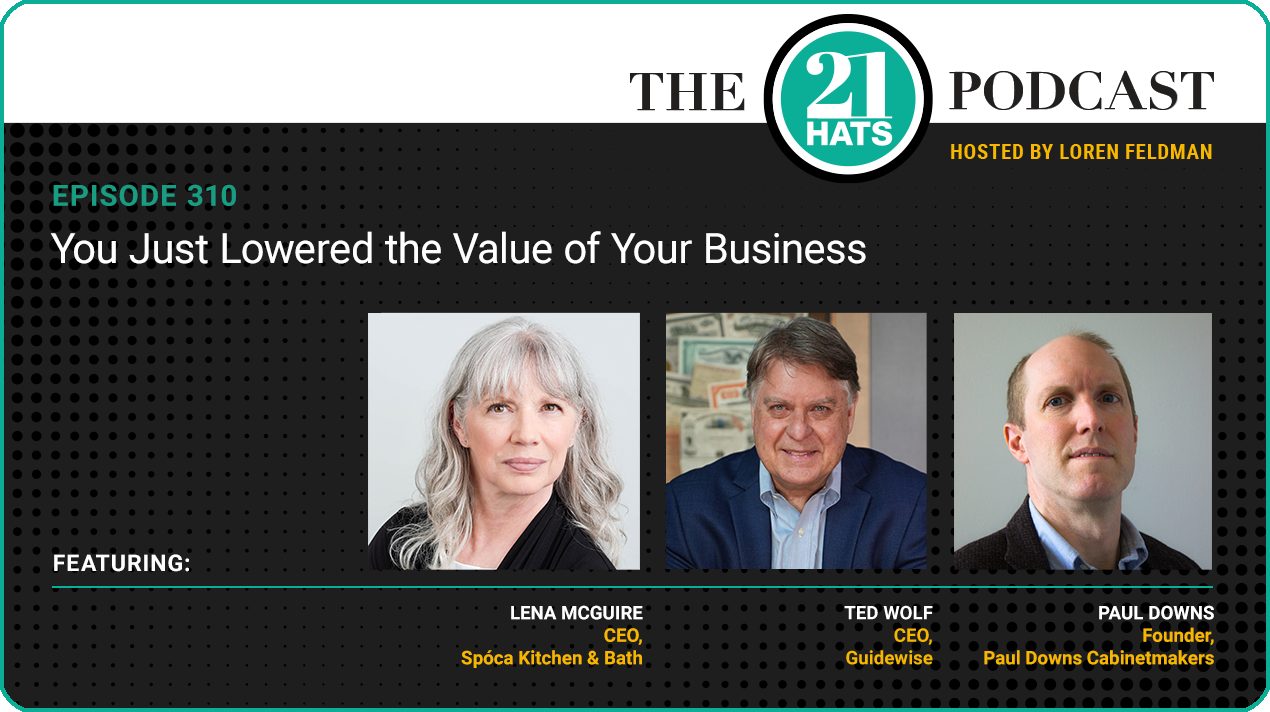
Paul Downs is CEO of Paul Downs Cabinetmakers.
Lena McGuire is CEO of Spóca Kitchen & Bath.
Ted Wolf is CEO of Guidewise.
Producer:
Jess Thoubboron is founder of Blank Word.
Full Episode Transcript:
Loren Feldman:
Welcome, Paul, Lena, and Ted. I want to start today by discussing what I think is a first in the history of this podcast, which is that Ted, you and some of your folks in Lancaster, Pennsylvania, got in a car and drove south almost to Philadelphia, where you spent some time in Paul’s shop. Tell us, what did you think?
Ted Wolf:
I was very impressed. I think Paul has built a very nice business. I think we need more owners and entrepreneurs to follow his lead in some of the things that he’s done. A couple things that I noticed: Number one, it’s very obvious he cares and loves his business. I’m sure some days, Paul, you don’t, but overall, you can tell you are extremely gratified and get a lot of meaning out of the history of the company. I read your book. I could identify with that very, very much. Anybody who’s starting a business should get Paul’s book, because it will tell you what the first year or the beginning of a startup is like.
One of the things I look for when I visit an organization—and I have visited in my career thousands of businesses and did the plant tours, office tours, et cetera—I want to look at neatness, neatness on the shop floor, cleanliness, and things like that. What’s the signage say? I mean, Paul obviously has a big emphasis and focus on safety. He wants his employees to be safe and work in a safe manner. It’s clean. It’s not dirty. It’s very well-kept, I’ll say that. There’s an orderly process to things. People were busy. I didn’t see any small talk, even when we were on the periphery looking in or looking from the sidelines. Everybody was busy. They were intent in what they were doing. And I think that’s a very strong operating organization.
And then when I got into, or we got into, I’m gonna say the administrative operating components—not doing the work itself, but looking at how we’re measuring it, how we’re interpreting it, and what the environment is like—I think the data is very strong. I didn’t see financials. I don’t need to see financials. But I could see how he was doing his quoting, his estimates, and all of those things, and I think that was done very, very well in many respects. So from the business and the person, in the present, I think everything was very, very impressive and very, very good.
Paul Downs:
Thanks, Ted. How would you like your payment to be sent?
Ted Wolf:
Now, I was doing this so your wife could actually hear this recording and give you credit for everything you’ve done, because you’ve done a very, very nice job. [Laughter] And I said to you that day, I mean, there’s not much I would change right now on the shop floor. But what I kept thinking as we were going through the tour—and we were there for a good three and a half hours non-stop. We didn’t take breaks. I mean, it was non-stop. In fact, I don’t think any of us took a bathroom break for three and a half hours, because it was interesting. It was fascinating.
I couldn’t help but think as I went through everything, and particularly when I started looking at the data and the structures and things, what’s the future look like for Paul? What does the future look like for the business? There’s an awful lot of people who build a great business, but they never think about the next step. What’s the end game gonna be? Am I gonna sell it? Am I just gonna close it down? Am I gonna sell it to employees? Do I sell to a PE firm? What do I do? I think that’s the area that most entrepreneurs, or business owners, really need to focus on, particularly in the midsize markets, people who are doing $10 million to $100 million in particular. What does that look like?
Because at some point, whether it’s you want to exit and have a buyer come in, or you’re even going to transition and let your employees run it, if they’re going to be buying it—and I don’t mean with an ESOP or whatever the arrangement would be—they’re gonna have to look at the valuation, and that means the multiple and the efficiency, in particular the technology. Because your business objectives I think are pretty solid. When it comes to the technology, I think there’s some upgrades that need to be done there, and I think they’re a requirement if you want to refinance and do things like that.
Loren Feldman:
Ted, let me stop you there. As I recall, this visit grew out of a conversation on this podcast where, Ted, you suggested that there might be ways Paul could improve his operations by injecting AI into his processes. At the time, Paul was somewhat skeptical, but he invited you to come down and take a look. Having actually seen the business, is this what you’re referring to with the technology? Do you still think there are meaningful opportunities for Paul to use AI?
Ted Wolf:
I think there are opportunities for Paul to build a more intelligent business, and here’s what I mean by that. You have business objectives and business strategy. Then you gotta say: How am I gonna overlay the technology to do it? I can do it with spreadsheets. I can do it with Excel spreadsheets. I can do it with those types of things. That was great five years ago. But today, you need to build an intelligent business, because somebody’s gonna crack the code of the business. They’re gonna figure out what’s going on in the markets, how they’re working. Somebody somewhere is going to crack that code.
So that means you’ve gotta be able to build an intelligent business that’s monitoring the processes a little bit more than on a manual basis or a memory basis and getting rid of the tribal knowledge. So I think Paul is at an inflection point. I think Paul, at that inflection point, needs to be able to say: Can I automate this and still retain the quality orientation and the people concerns that you have? So it doesn’t turn into an automatic: Hey, the bottom line’s the only thing that’s important. I think Paul needs to be able to sit back and say: How do I get AI to move into my administrative, quoting, maybe financial aspects of the business?
Now, someone will say, “Well, that’s not changing his work processes.” It will begin to. You have to start somewhere, and that’s the area that I think needs the most upgrading to improve the quality and the intelligence of the business. And then figure out: How do I start tying in data engineering and data collection on the shop floor processes?
Now, you’re never gonna replace people with a robot for high-level, value-oriented work, and Paul, you’re working in a high-value area of a business. It’s not mass production. So I do think that there are areas that you can improve the administrative, operating, reporting aspects of the business, and that’s the technology that will filter into the shop floor.
AI can take pictures of an awful lot of the raw material, the wood that you use. You have to match up the texture and the design of the wood itself. AI can begin doing that over time, but that’s never where I would start to upgrade and bring the business into an environment where, if you want to sell, if you want to have a succession plan where they run it and you just get dividends all the time, all of these things are gonna have to happen sooner or later.
And that’s the prime area where you’re gonna get your primary return right now. It could be things like quoting, estimating, finding out… I mean, you’ve got a lot of records, as far as people who have inquired or bought in the past, and opportunities for additional revenue there that I think are pretty dramatic. And I mean, you’ve got a huge opportunity if you approach that in the right way, and I think some of your employees are even looking for that from you. That’s my impression.
Overall, I’d give Paul very high grades on running a clean shop, running a good shop, being organized, being involved, loving it, and really working on behalf of everybody—not just him, but everybody that’s in the business. But that layer of technology and people adoption to the changes that are coming in every business, that’s the area you need to focus. The technology, how it’s gonna work, particularly in the admin, accounting, and just that intelligence area of tribal knowledge. How do I get that into a database that everybody can use? And that tribal knowledge, that’s when people figure out on their own from experience what to do. That can be put into an AI model, and that can be a very strong source of good information and guidance directing your people through the construction of the products that you’re selling.
Loren Feldman:
That’s a lot. Paul, what do you think?
Paul Downs:
Well, all the nice stuff he said about me I agree with completely. [Laughter] I do love my business, and I do like my employees, and it is a good business. It’s interesting, and I have no particular desire to get out of it, other than I’m getting older, and sooner or later, somebody’s gonna have to take over. I think that what I would disagree with is what originally I disagreed with a couple weeks ago, which is whether you can actually transfer what you called the tribal knowledge into some form of AI-accessible corpus of knowledge that actually means anything. The example you had of using AI to photograph all the pieces of wood we use and analyze them—it’s hard to imagine that there’s any way to actually do that that would be any faster than just having a person look at them anyway. Because that’s how we do it now.
So, what you’re talking about is somehow replacing human skill, which is built on millennia of biological development of our hands, our eyes, our brains, and our ability to work in groups, and turn that into some kind of database function. And I just don’t see it happening. I really don’t think that a computer is ever going be able to capture the nuance that humans are actually pretty good at. So that’s my main point of disagreement. I think that the need to upgrade technology and sort of stay on top of technology, yeah, I agree with you. But in kind of a general way in that you always have to be doing that, that we’re not using the same stack that we were 20 years ago because the tech has changed.
And so, 20 years from now when I’m sitting in the old folks home wondering when they’re gonna change my diaper, somebody else is gonna be running this company. And they’re gonna have a different approach to it, and the tech’s gonna be different. But I don’t think that the shop floor is gonna look all that different. There’s going to be people talking to each other and people looking at the situation as it is that second and making decisions about what to do next. I think there’s far too much information being generated in the company in every second for it ever to be describable, capturable, or usable by any kind of intermediary tech. That’s my thought.
You know, you brought your team, and they’re a very interesting group of people, and what you’ve accomplished for yourself and for your clients is remarkable as well. I just don’t think that that particular thing is suitable for this tech approach.
Loren Feldman:
Let me ask you to explain one aspect of that. You said something about you don’t think the computers could ever capture the nuance that people can. One of the things I heard Ted say was that AI could conceivably be helpful to you in something like quoting prices. There, it seems to me, it’s not so much about nuance. It’s about the computing power to be able to review all of your quotes for all of your jobs instantaneously and assess a new custom table that you are designing to produce a quote. It seems to me that’s not about nuance. It’s about computing power. Explain to me why that doesn’t make sense to you.
Paul Downs:
Because we can already do that. I mean, we can already look back at now 16 years of data on every single thing we’ve built, down to how many hours it took and who did it and what were the materials—and what conclusions I can draw from having all that data, being able to very easily aggregate it, look at it, compare over different time periods. How many projects was it this year? Was it five years? We can do that.
And what we see is that projects almost always fall into some kind of bell-shaped distribution of they either made the estimate or they exceeded the estimate, and that could be for a number of reasons. You either do better or you’re worse. But there’s no simple way to work back from that and then look at the next thing, because we truly do unique objects. Now, if we were making the same tin can over and over again, and you could pick out trends of, “Oh, on Tuesdays, the machine doesn’t work,” or whatever, that’s only possible if there’s more uniformity in the product. And we simply don’t have uniformity in the product.
And then the other thing is that whatever model we use to price is executed by human beings using highly variable materials in a manufacturing environment that’s subject to a bunch of different disruptions that can come at you from any particular direction. It could be the weather. It could be the elevator breaks. It could be this machine broke. It could be there’s a problem getting materials, and everything gets delayed. And the complexity of the actual environment is such that going from the data and trying to pull out a model that’s actually predictive is extremely difficult. But I can look at the models that I’ve already built and see, on aggregate, how well they function against reality. And that’s fairly consistent, but not extremely consistent.
There’s about a 15 percent swing up or back over whether you overestimate or underestimate in aggregate, and then the individual projects can go haywire or go great in like a billion different ways. And so the lessons of my company are also not, I think, so broadly applicable, because we’re doing something that’s so variable. It may not have been really obvious in a three-hour visit what is the range of things that we do, but it’s a very, very wide range. If you can imagine basically every car plant in the entire world, everything they’re making, the variation of all those products, that’s about half the amount of variation we do, because we just make weird custom things all the time.
So, what’s the conclusion? AI is probably going to surprise me by being useful in certain ways. And I think that the AI implementation and integration into the company is actually going to be done by somebody besides me. Because I’ve figured out how to look at all my data and sort of be the agent that people are trying to write with AI to look at various things, come to conclusions, understand what they mean, and act on them. And it doesn’t take me an enormous amount of time to do that. But when I’m dead and gone, then somebody else is gonna have to replicate my knowledge somehow, and maybe they’ll do it with an AI agent.
I don’t know how they’re gonna do it. But I don’t pretend that I’m the one who can see into the future as to how these things would roll out. Because I know from experience, if I went back 5, 10, 15, 20, 25, 30, at any point in the past, if you had asked me to guess what was coming next, I probably would have been more wrong than right. So I think that, as an owner, I’m queuing the company up to be sold either to an internal group or an external group—I’m not sure which—but they’re gonna have to deal with all this stuff.
Ted Wolf:
Paul, if I may, with respect, say if they’re going to have to deal with it, you just lowered the value of your company and the multiple. You do have a central position in understanding the models you put together. Ask if your people have the trust in those that you do, because that’s in your mind. And there are many things on the shop floor that you can bring AI in in a non-invasive way, but it will build more intelligence.
You can go back and spend a half a day and analyze your data, and you can come up with some conclusions. And with all due respect, I’m sure they’re very good conclusions because you have a high intuitive sense, because you’ve worked in it for so long. But if you go to look at the valuation, if you’re a private equity firm or even the people you have now and they want to buy it, they’re certainly going to bring somebody in to evaluate the business, and they’re gonna say, “Wait a minute, Paul, if you leave, 50 percent of your know-how walks out the door, because you’ve got the majority of it.”
So you’ve got to get that know-how, tribal knowledge, into a system, and we’re doing it every day. Custom manufacturing, construction, is brand new, but there are consistent stages and themes and categories that go with that. You tie that together with your work in process and accounting, you tie that into the sales so that they make better quotes, and you have a history of all the data that you have, and I guarantee a computer can retain more of it than you or any other individual, any of us. It will be able to identify patterns that you can’t.
It will be able to identify: Here’s where you’re consistently losing money and why. And it won’t be tribal knowledge that you put to it and understand. It will be just people saying, “I can’t understand what Paul did, so I can’t replicate it. So I don’t know if I can run this business.” I would say to you, it’s just as important to open up and say: How can we get AI on the shop floor and not disrupt what we’re doing? But how can I get this data—which an awful lot of it is intuitive to you—how can I get that tribal knowledge into a system that can think, feel, and guide us through doing it?
I mean, with AI, the people who are doing it right, they’re building guides that lead people through decision gates, and they have to have process control. Right now, process control is pretty variable. Your foreman, the lead person out there, a very sharp guy, he knows what he’s doing. I could tell it just by the way he’s walking around and talking to the people and looking and seeing what’s going on. There may be a much better way to schedule a job or jobs, and I guarantee just looking at the design of the wood, AI would look at that, and they would give you information and make you think of things that you’re not thinking of right now. And it would be able to say: If you’ve got 20 or 30 percent waste, scrap, on a job, just imagine if I get that down to 10 percent. And I think you could, because that 20 percent is a big number.
Now, again, it’s gonna take a mindset change in yourself to be able to move this forward, because right now you own the business. It’s yours. You should be very proud of it. I said it the day I was there, and I’m saying it today. You should be very proud of it. But your challenge isn’t keeping that business running the way it is today. It’s preparing it so it has a legacy and a life and continues beyond you.
And you might say, “I don’t care about it,” but continuing beyond you, the quality of that is determined by a number and a multiple. If you want an internal group to buy it, an external group to buy it, it all comes down to that. And that’s your challenge now, not the present. It’s the future. How am I gonna get my money out of this business and not give it away or shut it down in a fire sale? That’s your challenge. That’s the way I see it.
Lena McGuire:
Ted, I have a question. With the AI and you’re training it to do things, the computing skills and any other type of skill seems very obvious to me. But I think, being in a similar industry as Paul, the discernment is what concerns me. So Paul has years and years, decades of experience, and when he looks at a piece of wood, he can see where the sweet spot is. And the AI might look at a piece of wood and say, “Oh, to be efficient, let’s use this, and we’ll have less waste.”
But if you’re creating a beautiful countertop, which I would do in my business, or Paul’s making a desk or a table, then there is a grain that looks beautiful, and it needs to be in a certain location, and how does AI discern that? How do you teach it to have a good designer’s eye? That’s where I have a problem with AI. How do you integrate that? I mean, obviously, you can teach it accounting skills and computing skills, but how does it learn discernment?
Ted Wolf:
How do they do it when they use facial recognition? They get into the minute detail, and they look at patterns. And so let’s just say that, Paul, you make a table. You send it out to a client, and they complain about something in the design aspect of the wood, whatever it would be. You’re gonna log that in, and AI’s gonna learn that over time, and they’re gonna say, “Okay, here’s all the things that, Paul, you know intuitively without thinking, or your people, to look for.”
All of a sudden, AI has learned that—if you can get that tribal knowledge into the system itself. And you do it by explaining, talking, prompting, and educating it, so it will then educate itself. And it will be able to go in and select: These are the pieces, the numbers of the wood or the countertops, the grain. Take pictures of it. Here’s how I would use it and put it in place.
Paul Downs:
Well, Ted, it sounds like you should buy my company, because there’s $20 bills lying on the ground there. Without getting extremely technical, it’s possible that what you say could happen, but unlikely. And I think that your analogy of facial recognition is actually a rather poor one for the complete chain that materials pass through when we use them. For instance, when would we photograph every piece of wood?
Ted Wolf:
As it comes in.
Paul Downs:
Okay.
Ted Wolf:
That’s the way other people are doing it.
Paul Downs:
Right, okay, I’m gonna just get a little technical here. A piece of lumber that arrives in our door is unfinished, often unplaned, unsanded, and the characteristics that a client might value of how it shimmers in a particular light is invisible at that point. So we’re gonna be putting it through a process that is gonna dramatically transform what it looks like.
Ted Wolf:
That’s the point when you take the pictures.
Paul Downs:
Well, the connection between what you start with and what you end up with is subject to so many different possible changes in between one and the other that it’s almost an infinite set of possibilities that, again, I just don’t think could ever really be captured within a single algorithm. And so, I don’t really want to drown people in woodworking stuff—it’s gonna get dull real, real quick—but I’m sure that there are products and processes where what you describe is perfectly feasible, and the people in that business, if they don’t take advantage of that, are definitely devaluing their business. I just don’t think that’s true of my business.
So, all the points you said, everything you said is true probably for more people than it’s not true for. But I don’t think it’s true for everybody. And so the listeners out there are just gonna have to decide: What kind of business are you in? Is it one like that, where you’re so strapped trying to get your job done that you never have time to stop and think about it, and having AI pore through your records could actually be very useful?
That’s not the business I’m in. I mean, I have tons of time to think about all the data I have. But I think that everything that you say is based on your experience in other businesses that prove to be valuable, so I’m not gonna discount it. I just think it’s gonna be very difficult to execute any of that on my particular business and what we actually do all day.
Loren Feldman:
I think we get the outlines of this discussion pretty clearly. I think, as you said, Paul, listeners can make up their own mind as to how this all applies to their own businesses. But the one thing I wanted to come back to: Lena, you mentioned that you actually are in a similar business to Paul’s, in that you do custom work. I’m curious, you’re building a business from scratch right now. Does hearing this conversation make you think you should build AI and automation into your processes right now, rather than waiting to retrofit it later?
Lena McGuire:
Yes, absolutely. AI will have a place in my business, particularly because it’s very process-oriented, and that’s where Paul and I are very similar. We start with a process, and you have to get your design concepts together, and you have to create it, and you have to install it. So that’s the same for every single customer, even though it’s a custom bespoke product.
But what’s different is how the concepts come together, how you discern which materials are going to be used which way. And I don’t see AI helping me with that particularly, but definitely the backend type of things—doing the quoting, the estimating, the marketing, accounting, those types of things where it is very computer-based, logic-based, data-based.
But the creativity parts, I don’t really want to rely on AI to create that way, but I would like to use AI to render for me so customers can see what my vision looks like, instead of having it in my head. If I can have it interpreted and put out on paper so I can share that idea with the client, that is very interesting to me, and I’m exploring those ideas already. But as far as using AI to help me co-create something, I’m definitely not interested in that. I don’t see how it can make the choices that I would make. It could go through millions of choices, but it wouldn’t come up with what I would select.
Loren Feldman:
Let’s move on. It’s time for another edition of the new segment we’re calling Beyond Small, brought to you by our friends at Grasshopper Bank. The idea with this segment is to have my guests address a topic and a few questions with two goals in mind: One is to provoke a conversation that will help our listeners think about how they manage their businesses. The other goal is to help Grasshopper better understand the needs of the small business owners they want to support.
I’ve selected the questions with Grasshopper’s help, and their only request is that my guests answer the questions candidly based on their own experiences, which, of course, is what you guys always do. Here’s today’s question: If your business doubled in size overnight, would you be more excited by the opportunity, or more stressed by all the things you’d need to do to support that growth?
Lena, you’re still in early days, as we just discussed. You have contractors but no employees. If something happened and all of a sudden your orders doubled, would that be a good thing?
Lena McGuire:
It would be a great thing, but it would be a very stressful thing, because I would prefer to grow slowly so that I can control as I’m hiring and onboarding new people. I don’t want to have my quality slip as I’m working with clients. We have concierge service, white-glove service. We want to make sure everybody is taken care of, and if you start getting overwhelmed, then the quality of your customer care tends to decline.
So I prefer much slower growth. If it did double overnight, I would have to have more people helping me. I have 1099 people working with me, but I don’t have backups for some of them. I would have to have that in place. So if I knew growth was coming, I would start looking for people to take the excess work on. So that would be a little bit scary, because I wouldn’t be prepared for it, and I would be very concerned about the quality of the work that would be going out and the customer care that I would have.
Loren Feldman:
Lena, you’ve talked to us in the past about having your customers pay in advance. Does that mean you would not have a problem with getting the capital to double your business, were that to happen?
Lena McGuire:
Mostly not. If I have to hire another kitchen designer and they need a seat with the software or they need the computer to have access to the seat, that’s all on them, because they’re 1099. If I were to bring them in-house and have employees, that would be a much bigger decision, and yes, that would affect my capital. But at this point, as long as I stay with 1099 employees, I’m perfectly fine. I don’t have to have that capital investment, and it’s easy to get paid up front.
Loren Feldman:
Paul, the last time you were here, you told us you were still thinking about whether to try to expand your sales in the Middle East. If everything broke right, it’s easy to imagine that that initiative could have a big impact on your sales. I don’t know if it would double them, but if that did happen and it were as successful as it seems plausible, would you be ready for that?
Paul Downs:
Well, let me just go back to the question itself: If your business doubled in size overnight, could you handle it? If I had as much square feet, twice as many employees doing twice as many projects, yes, we could handle that. We have systems that could ramp up very quickly. If sales doubled overnight, then the question is: Can you actually do the work? And that’s a completely different issue. In reality, even if our Middle East thing goes great guns, it’s not gonna double us overnight. I would be pretty amazed.
One of the reasons for that is that people have expectations of how fast you can do stuff, and so it kind of becomes a self-limiting factor. As soon as you tell people they gotta wait six months for the factory to produce their work, they just go away. And so, doubling the business overnight from where we are, which is about six million a year, to twelve million a year, I don’t think that that’s actually possible.
And if people were banging on my door to do that, then it becomes a question of: Can we find people? Can we push it through the plant? How would we do that? That would be quite stressful and would require a commitment of money that I think we could come up with. But I’ve had increases of maybe 20 to 25 percent in a single year, and that was very difficult to manage—mostly because you can’t just dial up cabinetmakers. You can’t just call somebody and say, “Send me some.” These are very highly-skilled people who just can’t be waved into existence, and you can’t get rid of them if you don’t need them anymore. You really have to nurture that workforce. So, it wouldn’t be easy for me to double output overnight.
Loren Feldman:
What if things just went really well in the Middle East—not doubling, but a sizable chunk of business? Are you ready for that?
Paul Downs:
Sure. Because we know the increments that orders come in, and the largest order we’ve ever received was about a million bucks, and we’re actually working on it right now, and that’s a very repetitive group of things, which is unusual for us. It’s hard to imagine that an order for just conference tables would arrive of that size. Now, an order that included other items that we could outsource 100 percent of is feasible. So part of it is like: Well, what did it look like when you doubled? Was it stuff that you could outsource? Were you just buying and selling and passing through? Or do we actually have to manufacture it? Because that’s a whole different ballgame.
Loren Feldman:
Ted, how about you? What would happen if your business doubled overnight?
Ted Wolf:
Well, I’d feel stress and anxiety like everybody else. That’s why we’re building systems to bring in the people who we need to surround ourselves with. I will tell you, growing real fast has stress and anxiety, but when you are losing business real fast, that’s panic, and there’s a big difference between the two. What we’re trying to do is build systems, and we’re eating our own dog food, if you will. We’re building systems that are going to compound our intelligence.
What we’re learning from every single job, every conversation we’re having, where we can record it, we put it into a business mindset, so to speak, and it’s an agent that we’re developing. We’re finding better ways to rethink value. We’re trying to figure out what we’re doing in our business, we’re taking what we’re learning from clients in each engagement we have. What can we learn from it? What would we do differently? But what aren’t they doing that we should be suggesting to them? And we need to do it in a way where they accept it and they develop that open mind, if you will. So would I be anxious? Absolutely. Could we do it? Conceivably, yes. Do I want to do that in a year if you say overnight? No, I don’t want to do that.
Loren Feldman:
Ted, you said it would be anxiety-producing, stressful. What would be the stress point? What would be most difficult, if you did have that surge in business?
Ted Wolf:
I want to maintain the relationships and the quality of the work that we do, relationships with our clients, because once I get a client, I never want them to leave. I want them to be with us all the time, so I’m constantly thinking about how I can bring more value to them. Stressful though is, for us, we’re relying on a lot of internal judgment, experiences that we have. So the stress would be: Are we getting that into our database so we can use it and extract it in a way that increases our intelligence—not just one-off, but compounds on every single project, job, appointment that we have?
Loren Feldman:
Would you have to hire a lot of people if your business surged like that?
Ted Wolf:
Dramatically less than what you would think.
Loren Feldman:
Why is that?
Ted Wolf:
Well, because we’re building intelligence. You know, we can build agents that build things for clients. We’re doing that right now. Someone came to us, a manufacturing organization. Everything they’re doing, everything’s totally custom. And in their project management, they had 66 decision points. A human being can’t follow that, so we wrote a guide, cut down dramatically on how they’re managing each project. The information they’re getting from it and will get from it is significant.
So we’re able to build those agents who will help us think high-value things. I won’t need as many people. I will need people. I want people in the decision processes. I’m not looking to just get rid of people and bring in AI. That’s the last thing I would do or want to do. But what we’re going to be able to do is have a much deeper reach in every organization with a personalized approach, very creative in what we’re doing, because we are teaching our systems critical thinking.
So, it would be stressful to grow like that. I don’t want to do that right now. I don’t think I would in the future, to be honest with you. But I know that we can grow. It would be less stressful than it would be 10 years ago for me to do it. and that’s saying something, because I’m 10 years older. But I still will be able to control that stress, if you will, and the anxiety of everything, and maintain control over the business, the direction, and the quality, and most importantly, the culture of the business.
Loren Feldman:
All of this raises a more fundamental question that comes up here from time to time, and that is: How big do you actually want your business to be? Lena, you spent several years thinking about and planning this business that you’re building. Now, it’s out in the real world getting tested every day. Situations have changed dramatically, even in just the few years that you’ve been doing this. Have your ambitions for the business changed?
Lena McGuire:
My ambitions have not changed. I still want to have personal success, and I still want to have a life of significance, which to me means allowing other women to be able to have a decent work-life balance. I want to help people have that ability to make good choices and be able to balance their life.
So that much hasn’t changed for me, but my husband has retired recently, and how I look at how I fit into my own business now has come into play, and that’s a little scary. So I’ve been doing a lot of soul-searching on: What does success look like today? And how do I continue to reach those goals of having significance through my business?
Loren Feldman:
Explain that, Lena. How, how does your husband’s retirement affect your thoughts about your business?
Lena McGuire:
It comes down to quality of life. We figured out, after working with our financial planner and going through all the numbers, that I don’t have to work anymore. My business, she’s actually asked me to slow down, because I need to move some money around and do some different things to make our retirement plans work.
She doesn’t want to see a big, significant profit this year or next year or the next three or four years as we reconfigure some things. So I’ve had more time to think about what I’m doing with the business and how I want to run it. But having my husband home, it’s not the thing about he’s underfoot or in my way; it’s that he has this time, and I’d like to be able to have the time to spend with him. How much time do I devote to the business that my financial planner says, “Don’t make too much money this year”? My clients are like, “I’m happy, I want to work with you.” And my husband’s like, “Well, why are you working all the time?”
So there’s a different kind of stress I’m feeling right now. I love what I do. I love my husband, and I’m choosing how I want to spend my 10 to 16 hours a day. Where do I spend my time? So that’s becoming a bit more critical as I’m planning my succession plan.
What am I gonna do? I would like the business to live after I’m stepping away from it. How do I involve people? Can I keep running it with 1099 people? Do I need to have a building? Can I switch to a different way? How do I get all this together and still have a good, satisfying life, decent income, so I can do the things I want to do? And then, be able to be charitable, be able to help other people. So yeah, there’s a lot going on in my world right now.
Loren Feldman:
Paul, you told us several years ago that you hoped to grow the business fairly significantly with the idea that that would make it easier to sell. Is that still what your strategy is?
Paul Downs:
Yeah, pretty much. It’s growing. Part of the growth is just raising prices, honestly. But the idea that the company should have value at the end of the day without me having to be here is pretty foremost in my mind. I had in my mind the idea that we’d get to 10 million a year in revenues, and this year, as I said, we’re going to be at about six. I’m not sure we could actually push 10 million through the shop, but we are turning up more and more opportunities to sell and act as a dealer for things that we’re not building.
And I think it’s not unreasonable to think we might be at 10 million in the next few years. Although I would be surprised if it’s a steady 10 million, because that’s just sort of not the way it goes. We’re very heavily influenced by our biggest jobs each year, whether it’s going to be four and a half million or six and a half million. And so, that pattern has persisted for quite a long time. So I think it’s gonna be a somewhat choppy ride, but it’s heading in the right direction.
Ted Wolf:
Paul, if I may offer a suggestion, because we have talked: My suggestion to you, if I was your brother, I’d say, “Paul, you’re doing a great job. Transferability of the business is now more important than the revenue, because you’re gonna look at EBITDA on a multiple to get that value at the end of the day.” That’s what you have to think about, in my mind, going forward in the future. How transferable is the business with you being the center corpus, if you will, of knowledge, experience, decision-making, intuition, and all of those things? I’m saying that with respect to you.
Paul Downs:
Yeah, no, I appreciate that. That’s good advice.
Loren Feldman:
Ted, you’ve already built and sold a sizable business with offices around the country. Are you trying to do that again with your current business?
Ted Wolf:
Well, my mindset has changed, to some degree, in that I want to build a good business that creates meaning in my life, and as long as that happens, I’m here. Revenue is not the only, for me, measure point. I have to get, for myself, those that I’m working with, I’m going to have to say we get a lot of meaning out of it. It means something special to us. But I’m not gonna be impractical.
That dollar value of what we would be getting in the valuation, should we decide to sell it—and we would—you know, I have those numbers in mind, and they change, but that’s not the only definitive thing I’m looking for. So do I look to build, do I want to build a national business? That’s not my goal, in that my business model’s different. I don’t need those things that I had before because I’m doing business totally different because of AI. I mean, it’s a radically different business model. The way I get my best motivation and my most meaning for me is to bring new ideas to people, get them to implement them, see them be successful, and they have a better life and business because of it. That’s my motivation.
Loren Feldman:
My thanks to Paul Downs, Lena McGuire, and Ted Wolf. And a special thanks to our sponsor. This episode was brought to you by Grasshopper Bank. And thanks for listening, everyone. See you next time.

