

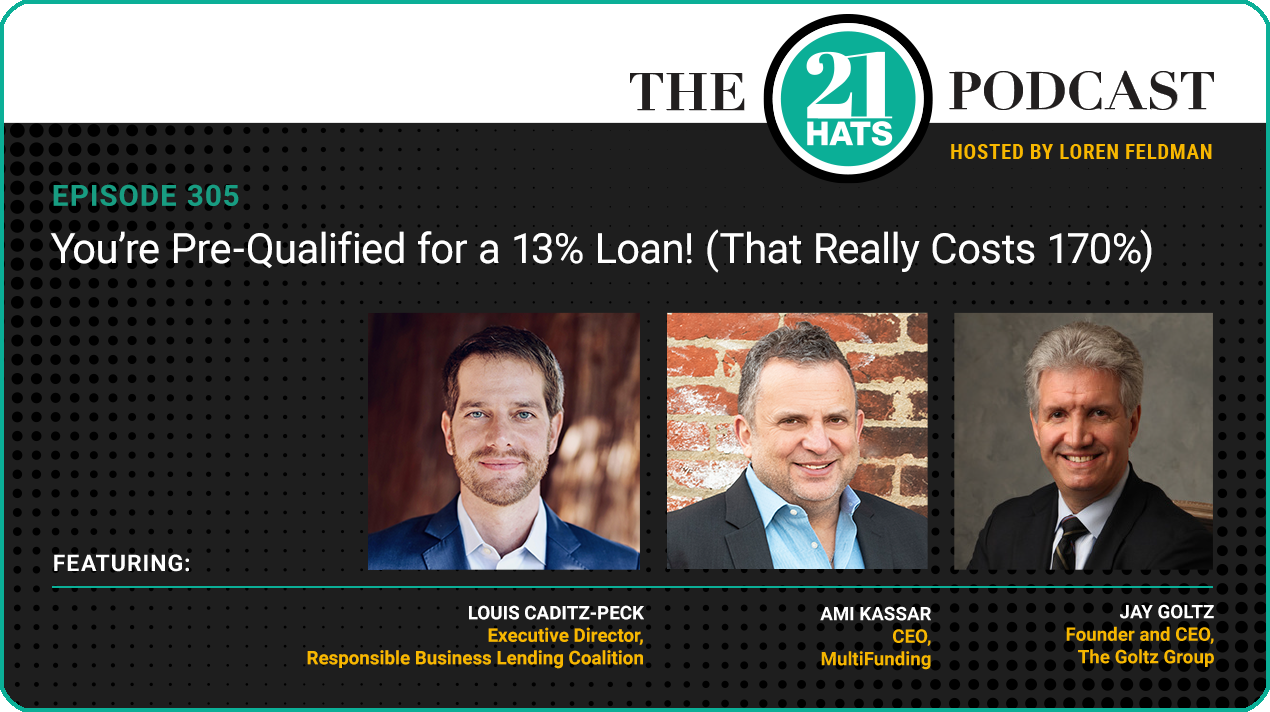
You’re Pre-Qualified for a 13% Loan! (That Really Costs 170%)
Introduction:
This week, we begin with the story of Paloma Corona, the owner of a thriving preschool in Los Angeles who needed money to expand to a second location. She thought she was borrowing at an annual percentage rate of 13 percent. In reality, the effective APR was 170 percent. She also thought she was taking out a loan. Instead, she was placed in a merchant cash advance—an increasingly common form of financing that can sidestep many of the laws governing traditional loans. The daily payments quickly began draining not only the profits from her business, but also her personal savings. Her business survived, but only because a nonprofit lender stepped in to refinance the debt. Paloma’s story is especially troubling because she wasn’t reckless, uninformed, or running a failing business. She was trying to build a good business. But she was up against a financing industry that has become remarkably skilled at making extraordinarily expensive money look fast, easy, and affordable.
My guests today have all been fighting this problem from different vantage points. Jay Goltz owns a picture framing business and a home furnishings store in Chicago. Ami Kassar helps business owners secure SBA and other responsible financing. And Louis Caditz-Peck, who helped build LendingClub’s small business operation, is now executive director of the Responsible Business Lending Coalition.
In our conversation, we talk about why good businesses get steered into bad financing, how brokers can earn more by recommending the most expensive products, why offers embedded in platforms such as QuickBooks, PayPal, and DoorDash can be especially tempting, and what business owners should do before accepting fast money. We also ask what seems like a remarkably simple question: What could possibly be the argument against requiring every small business financing company to disclose, clearly and prominently, the true annual percentage rate it is charging? This episode is brought to you by Grasshopper Bank.
— Loren Feldman
Guests:
Louis Caditz-Peck is executive director of the Responsible Business Lending Coalition.
Jay Goltz is CEO of The Goltz Group.
Ami Kassar is CEO of MultiFunding.
Producer:
Jess Thoubboron is founder of Blank Word.
Full Episode Transcript:
Loren Feldman:
Welcome Jay, Ami, and Louis. I’d like to begin our conversation about alternative lending and small businesses with one owner’s story. It’s a story you brought to my attention, Louis, and I think it makes a bunch of really important points about this issue. Can you tell us about Paloma Corona?
Louis Caditz-Peck:
Sure, Loren, it’s great to be here. Paloma owns Little Sprouts Language Immersion Preschool in L.A. She got in touch with us through one of the board members of Responsible Business Lending Coalition, Small Business Majority, to talk about how she had been ripped off by a merchant cash advance. It almost destroyed her business.
And this one really burned me up because I also personally grew up in a family childcare business that my grandmother started and my mom and whole family worked in. I worked in it. I was a preschool teacher. And what Paloma shared is that her business was going well. She was ready to expand into a second location, and she took out what she thought was a 13 percent loan from Big Think Capital, because it came from Big Think Capital and because the contract said 13 percent on it.
And, the payments, which were daily, they were coming in, and they were so much bigger than she anticipated. And they pretty soon were draining not only the profitability out of the business, but just her own life’s savings to keep up. And she said, “What is going on? What’s happening with this?” And I eventually got to look at the contract and saw that not only was it not a loan, it was a merchant cash advance from a different company, Elevate.
Loren Feldman:
Explain the difference, Louis, between a loan and a merchant cash advance.
Louis Caditz-Peck:
Sure. Merchant cash advances are an emerging kind of financing, which likes to distinguish themselves from being loans by making an argument that they’re not a loan; they’re a purchase of money that you’re gonna make in the future. The difference doesn’t matter that much to the small business taking a loan, but when they are able to say they’re not a loan, that means they don’t have to follow laws that apply to loans.
Merchant cash advances also are typically repaid not with a fixed amount but as a percentage of your future earnings—although in many cases, they end up charging a fixed amount anyway, as they did for Paloma. She got charged $117 a day. And they typically are expensive and short-term. I’ll just point out that the perspective of the Responsible Business Lending Coalition is not that merchant cash advances or any one type of product is good or bad, but that the practices that a financing product comes with need to be responsible, whatever kind of product they are. And that’s what our Small Business Borrowers Bill of Rights is about, that Ami was one of the co-authors of, and I’m sure he’ll weigh in on soon.
But it’s the case that in the merchant cash advance industry, bad practices are more common than not. And that’s what happened with Paloma, in this case. One of the bad practices that’s very common is misleading and untransparent disclosures. So in this case, this company, they didn’t even really say clearly what kind of financing she was getting or what it cost. It looked like it was 13 percent. When I looked at the contract and computed the effective APR, iIt was 170 percent APR, and that might have helped explain why it was so much more expensive than other options Paloma could have taken.
Loren Feldman:
Did her business survive?
Louis Caditz-Peck:
Fortunately, it did. She had a strong business, and she got in touch with another one of the signatories of the Small Business Borrowers Bill of Rights, TMC Community Capital, which is a nonprofit that lends to small businesses. And TMC was able to refinance her, and she’s thriving today. And she’s telling her story, actually, and advocating for a law that we’re working to pass in California, where she’s based, that would help protect other small business owners from getting unnecessarily ripped off.
Jay Goltz:
Can I just say something? You keep saying ripped off. I don’t really think this is ripped off. I think it’s deceptive. They didn’t steal from her, but it’s deceptive. They made it sound like one thing, and they’ve gotten very, very good at packaging it so that it looks like what it’s not.
So I think what they do is deceptive. And the part that’s so frustrating is you go to many of these sites, and you go to the reviews? People say things like, “Oh, they’re so nice. Oh, they were so responsive. I got my money right away.” And none of the people could figure out what the interest rates were. And if they knew what the interest rates were, they’d have very different reviews. But that’s how they get away with it, because people can’t figure it out. It’s extremely complicated.
Louis Caditz-Peck:
Jay, that’s how I met you. As our coalition works to pass truth-in-lending laws around the country—if you get a consumer loan, if you get a mortgage, a car loan, a credit card—by law the lender has to tell you what rate they’re gonna charge, or what the effective rate is. But if you’re borrowing for your business, those laws don’t protect you. So many of the consumer protection laws that we all kind of count on don’t apply when you’re working as a small business owner.
And so we work on passing these, among other things, these truth-in-lending laws to help create transparency in the market. And I read an article, Jay, that you were quoted in. I think this was in Forbes, where you explained really clearly how to compute the effective APR on something like a merchant cash advance. And I thought, “Wow, this guy really gets it,” and I cold-called you.
Loren Feldman:
I want to stick with Paloma’s story for just a moment. A couple of things really stuck out to me. One was—and Ami, I want to get your reaction to this—I found it really noteworthy that her business was not in distress. I think there’s a common assumption that only a business that was really desperate would take on one of these loans, and here’s an example of something quite different from that. How common is that in your experience, Ami?
Ami Kassar:
I joke about it, but I say that when you need financing for your business or you think you need it, you gotta slow down. And I say that, if you go to McDonald’s for lunch because you’re in a hurry, you could have indigestion for a few hours. But if you make a financing decision in a hurry, you could have indigestion for a few years or ruin your business or go bankrupt.
And so part of the challenge is that, again, I don’t know the specifics about Paloma’s situation, but the disparity between how easy it is to get one of these advances or these loans, and especially how easy platforms like QuickBooks have made it to get them versus a couple of weeks to get a proper, well-thought-out, financing package, is for an emotional business owner who’s busy and stressed, is crazy. And I can understand how people easily get deceived by these things, and the assumption that people who get them are desperate or dumb is just not fair.
Louis Caditz-Peck:
And to be fair, someone was paid to deceive her. I mean, Ami—you guys know, Ami is a loan broker. The company that placed her in this merchant cash advance was also a loan broker. She thought it was the lender. She went to their website. Often on these websites, you can’t really tell whether the financing company is a lender or broker. But merchant cash advance companies will pay a broker a 15 percent commission to steer that small business to them so that they can recoup that 15 percent and more by charging what they charged Paloma: 170 percent.
Meanwhile, if you go to Ami, Ami could send a small business to an MCA and earn 15 percent, but he doesn’t. He helps people get SBA loans, and Ami can tell you what the referral he gets is, and I think he does that. I mean, my understanding is it’s maybe 1, 2, 3 percent. And so there’s a break in the market because there’s a misaligned incentive. There’s a conflict of interest where not only brokers, but other—what in the industry you call customer-acquisition channels—have misaligned incentives to steer their customers, small businesses seeking financing, toward not the financing that is best for them, but the financing that is gonna pay the broker the highest rate.
And so, there’s really a conflict of interest driving good businesses into bad financing, the same way as, in the lead up to the subprime mortgage crisis, all these folks ended up in unnecessarily expensive and predatory mortgages—not because a mortgage from Countrywide was the best option that a given family could get, or the only option, but often because that was the worst option they could get that would charge them the most money. And because it would charge them the most money, it had the biggest margin to pay the brokers the highest fee to get to that borrower before better options would.
Jay Goltz:
Which explains why I get five, 10 emails a week saying, “Borrow money at 6.9 percent,” and they’re all brokers trying to suck you in. I’ve got them in front of me. One says, “You’ve been pre-selected to apply for a line of credit,” they call it, and the other one says, “You’re pre-qualified for funding up to half a million dollars.” And those are the words they use.
And if you don’t know any better, it seems legitimate, and people get sucked into this stuff. And the reason why they’re not desperate, quote-unquote? They don’t realize what they’re getting into. It seems like a good—”Oh, you can borrow money for 7, 8 percent, even 12 percent.” Okay, if you can do something with it. They don’t understand they’re getting into a 70 to 300 percent loan
Loren Feldman:
Do any of you think most business owners should be able to tell the difference between a loan with a 13 percent rate and a loan with a 170 percent rate?
Jay Goltz:
I have an accounting degree. I learned it in accounting. I don’t know where the typical entrepreneur would’ve learned how to figure out what interest rates are. If they ask their accountant, I would like to think they’d be able to tell them, but they don’t even ask their accountant. They think it’s a good deal.
Ami Kassar:
Guys, let’s go back to reality a little bit. The reality is that for 99 out of 100 entrepreneurs’ journeys, they will hit some points along their journeys, no matter how well they plan and how organized they are, that, pardon my French, the shit’s about to hit the fan, and they’re stressing payroll or a major payable due next week. I had a couple dozen of them. Jay, you probably had your share of them also, right?
Jay Goltz:
Thanks for reminding me, yeah.
Ami Kassar:
Yeah, it’s like post-traumatic stress disorder. And when you’re at that emotional set point, especially when your ego is fragile and your pride is on the line, and you’re like, “Holy shit, what am I going to do?” And you go online and suddenly you’re immersed with very appealing offers that say to you, “I can get you money in two to three days at what looks like a reasonable rate.” And you’re like, “Thank God, I don’t have to call Uncle Henry and ask him for money,” or, “I don’t have to miss my payroll next week. I’m just gonna do this and get done.” And usually, the first one isn’t all that awful. What happens is, as you get one and then you get caught in the debt trap or the treadmill of them, they get worse and worse.
In my mind, in terms of impact on borrowers, I see the merchant cash advances or the short-term online loans or even these online lines of credit as all kind of in the same family. Maybe every once in a while, the merchant cash advance might even give the borrower a bit more flexibility. They’re all bad, right? And they all are designed to kind of trick the borrower into understanding what they’re gonna pay for. And what people have to understand is, let’s say you get one and it amortizes over six months. The computers and the algorithms and the lending systems all know that in about two months and 22 days or whatever, you’re gonna start feeling cash flow pressure again. And they’re gonna start blasting you with refi options or second options, and then again and again. At some point, they’ll start selling your lists, and some point before you know it, you’re working for the lenders, you’re not working for yourself.
Jay Goltz:
I can tell you, you used an example that they went online looking for the money. I’m telling you, as an entrepreneur, it’s worse than that. They come to me. I get them in the mail every week. It’s in my email every day. You don’t even have to go looking for them. They’re looking for you. And do I think they’re always bad? No. If you need 10 grand really bad to finish some job or something, theoretically, if you had to pay a big interest rate, but you could pay it back in a month or two, okay. My whole thing is just tell the customer what they’re paying for the interest. That’s all.
Louis Caditz-Peck:
Jay, your question about that, or maybe Loren, you asked this: Should we expect the small business owner to be able to tell the difference and know what the interest rate is? I do think it is important for small business owners to, over time, have the financial skills to run the business. That’s an important part of business and being successful. But also in this case, you have to consider that business owner is going up against the marketing department of the financing company that is, in some cases, intentionally choosing how they portray the pricing in order to be confusing.
When I met Ami, I was working for a fintech company. We worked together in small business financing. And I can tell you from the inside, the lending industry—not just my company, but any company—they have a marketing department. And they’re gonna do A/B testing to determine what way that they characterize the price of their product leads so the most people take the product. And so, it’s become very common—my company didn’t do this, but others do—to portray financing in ways that get people to think that it’s a better deal than it is. And the Federal Reserve has actually published five different studies about how small business financing is disclosed, and found that it is often affirmatively misleading in the pricing, especially in the industries that Ami was describing.
And Ami, you’re absolutely right that this isn’t something that’s just about a merchant cash advance. It also can be loans, it can be lines of credit. Some examples of what the Fed found is that you might see financing that is marketed as: This has a 1.5 factor, or a 10-percent factor rate, or a 9 percent simple interest, or a 6 percent fee rate. And what the Fed pointed out is, a reasonable person would think a 9 percent simple interest means a 9 percent interest rate. But that deal, when the Fed looked at it, represented a 45 percent APR, and so did the 6 percent fee rate, and so did the 10 percent factor rate. But people thought that meant a 6 percent rate or a 12 percent rate. And part of that is, business owners need to know, but part of that is business owners need to know that they’re up against marketing teams from financing companies that are actively trying to get them to take that deal.
Jay Goltz:
And it gets worse. I’m looking at one in front of me. They’ve got comments from people who have borrowed money: “I was able to keep my business growth on schedule. We expanded by 30 percent.” And it’s got the name of the company that signed off. It’s got five stars from Trustpilot. They use these quotes from these people tho are legitimate because these people do not understand the interest rate they were paying. Everything else we buy, you can go to the Google review: “Oh, they got five stars. That must be safe.” It doesn’t work here. It’s the only time I’ve ever seen something that a place can get five-star Google reviews and be doing horrible stuff.
Loren Feldman:
Louis, I want to follow up on what you said about the fintech that you were involved with. I believe it was called LendingClub, and that you helped start it. And I believe that the goal was to offer low-cost loans. What happened with that business? How did that work out?
Louis Caditz-Peck:
Just to correct the record a little bit: I did not help start the company. The company had started, but I joined to help them start their expansion into small business lending, where previously it had been focused on consumer lending. And like you say, Loren, this is a strong company. We raised literally a billion dollars in equity. Our IPO was one of the largest internet IPOs in history at that point, although there’s been a bigger one since then. This was 2015.
So we had tons of great engineers in San Francisco, and part of the strategy that we set out, like you say, was to be the lowest cost financing that a given business could get online—basically, to be faster and easier than a bank, but much lower cost and more transparent than the kinds of problematic financing that we’re discussing today. And so we might say at that time—I’m not with that company anymore, obviously—we would say, “Congratulations, Loren. You’re pre-approved. We can lend to you at a 20 percent APR.”
And I would be sitting in our open-floor-plan San Francisco office, and I could hear the conversations of all the different loan-officer-type folks. And they would be having the same conversation many times a day. And they would say, “Loren, congratulations. We can pre-approve you at—” And the small business owner would say, “Well, such and such company is offering me 6 percent.” And that’s exactly the kind of stuff Jay is seeing. And then our loan officer would say, “Well, when they say 6 percent, is that an APR? Is that an interest rate? Is it a fee? You know, can I help you make an apples-to-apples comparison?” And we would lose those deals a lot because, at that point, the business owner, they knew that someone is trying to pull one over on them, but they didn’t know which one’s being honest.
It’s like that scene in Labyrinth with the doors, and one of them’s lying and one’s not. You don’t know which one to trust if you’re not in a state where our coalition, working with people like Jay and Ami and others—and you, Loren—has gotten a transparency standard, a truth-in-lending law passed. But basically, what we’ve seen is that, just like in the subprime mortgage market in the lead up to 2008, more expensive, more punitive, worse products are crowding out better products from the market because they can out-compete them by being less honest and by just charging higher prices and hiding those prices.
Jay Goltz:
Keep in mind: while they’re talking to your person in the office, they can pull right up on their computer screen the place that gave them the lower rate, and they see a five-star Google review. “Oh, they’re okay.” The guy on the phone’s lying to me. They got a five-star…” It’s unbelievable. They have no reason not to trust these people.
Ami Kassar:
Maybe one of the most upsetting things in all of this is that Intuit, which is supposed to have a brand which is an advocate for small business and all this, and they’re a trusted source of your accounting, last quarter, they did 1.7 billion dollars’ worth of these loans, and in the last three quarters, they did $4.3 billion of these things. And they market to you based on when they think you are going to need it or are in good shape for it. And they make it so easy and so simple, and the rates are astronomical.
Loren Feldman
Wait, do they market to people whose books they’re keeping so they know exactly—?
Ami Kassar:
Absolutely, exactly. I made payroll yesterday. My cash went down. I got an offer from QuickBooks today for financing. The APR is probably 50 or 60 percent. And so, the fact that these things happen all the time, even embedded—so let’s say QuickBooks is earning on $1.7 billion, I’m gonna say their average commission on these is 10 percent. QuickBooks is making roughly $60 million a month on commissions from putting business owners in crappy loans.
Louis Caditz-Peck:
I had been understanding that QuickBooks, that Intuit discloses APRs on the financing.
Ami Kassar:
But it’s still outrageous, Louis. Yes, they do disclose it, but let’s say in my case, I could go get a line of credit from a bank at eight, nine percent. The reality is, people don’t read and that business owners, when you’re in a rush, and we’re all busy, and we have 100 things going on all the time, and there’s a certain implied trust by Intuit, right? “My accounting software is doing this. It has to be good.”
Louis Caditz-Peck:
Ami, I wonder if we should talk a little bit about embedded finance and that trend, and how that’s changing the financing options that small business owners are seeing—and what they should kind of watch out for.
Ami Kassar:
It’s all there, Louis. But the bigger issue, I think, is how do we ultimately educate small business owners and entrepreneurs to slow the hell down, to make sure you have books and financials that are in order, and to get a line of credit from the bank as soon as you can? I tell the story, if you own a pizza shop on the New Jersey shore, okay? And let’s face it, most pizza shop owners are stuffing all their cash under their mattress. And they certainly don’t have a line of credit from their bank.
And then it’s Friday and it’s the heat of summer, and their air conditioning blows, and they need 50 grand to replace their unit by Monday or they’re cooked. We would highly unlikely get a call like this, but they call somebody, say, “50 grand by Monday,” and that person says, “No problem.” And the effective APR is probably 200 percent if you need 50 grand by Monday. And probably they’re gonna do it.
Jay Goltz:
From my experience, the heating air conditioning company would have some relationship with a leasing company and actually get them a decent deal.
Ami Kassar:
I share the story not for the specifics of it. I share it for the concept that there are going to be emergencies that happen all along your journey.
Louis Caditz-Peck:
I have a complementary point to your point of how important it is for folks to slow down and look around at their options. A couple things that business owners can watch out for: Jay, I think in your earlier examples, you talked about how some of the stuff coming to your mailbox talks about funding or capital. If a company is marketing and they’re describing their financing to you without saying it’s a loan—if they’re calling it funding, if they’re calling it capital—that probably means that the financing is structured in a way to avoid lending law. And if they’re structuring their financing to avoid lending law, they’re probably doing other shady things too. And so that’s a red flag.
Another thing to watch out for, the same way Ami was talking about: Watch out for financing offers that are baked into software you’ve got. If you’re that pizza shop and you’re doing your deliveries through DoorDash, DoorDash has one financing option that’s built into DoorDash. And it says, “DoorDash Capital, click here to get it.” How did DoorDash choose that financing? Did they choose it because that was the cheapest financing they thought they could get you? Or because they wanted one catch-all that would be very profitable for DoorDash and would charge so much money that they can say yes to everyone? That’s what it is.
So DoorDash has one type of financing they’re selling you inside DoorDash. It’s probably not the best deal you can get. If you’re a yoga studio, if you’re a gym and you’re on Mindbody, there’s one kind of financing in Mindbody, and they make it really easy. They see your Mindbody data, “Click here to take that,” probably not the best deal you can get.
The best deal you can get is doing what Ami’s describing of being prepared in advance, having that kind of financing, and then looking around at the whole market. It’d be great if you can get a bank line of credit. If you can’t, maybe there’s other good options, but the people who are getting in front of you are getting in front of you because they’re paying to get in front of you. And in order to pay to get in front of you, they’ve gotta charge you more money than you should have to pay.
Loren Feldman:
I wanna pick up on something that Louis and Ami were talking about a moment ago, which is the role of the APR. During these conversations, it sometimes focuses so much on the lack of a disclosed APR that you get the impression that that would be enough: If you could just force these companies to disclose their APR, this whole problem would go away. But it seemed as though, Louis and Ami, you have different views on that. Either of you, tell me, is disclosing the APR enough? Should that be the goal here to rectify this whole situation?
Louis Caditz-Peck:
To avoid the straw man, I will preemptively agree with Ami that it’s not enough. We think it’s necessary but not sufficient. Disclosure’s really important, and there’s other things that are also important, but it’s hard to even start to talk about the other things if you can’t even say how expensive the financing is in a way that helps you contextualize it and compare it to other options.
APR is the only metric that enables an apples to apples comparison of the cost of financing, regardless of how long the financing is for, regardless of the combination, whether it’s all interest or all fees or a combination of both. It’s the all-in cost over a common unit of time, which happens to be the year. It could just as well be the month or the day, but as a matter of convention in finance, it’s the year. And if you don’t know the APR, then you can’t really tell how much it would cost to use one kind of financing relative to another kind of financing over time.
But once we’ve gotten laws passed in some states to require disclosure of the APR, we’ve also worked to do things like prohibit junk fees to protect business owners against financing practices that are unfair, deceptive, or abusive, to protect business owners from being harassed in the collections process if they can’t pay a loan. You still should pay what you owe, but you shouldn’t be harassed while you’re paying, and so on.
So there’s a lot of solutions, and there’s probably gonna be no silver bullet. But it’s crazy that all of the fixes that have been put in place for good reason in consumer finance to protect people from getting scammed and ripped off and overpaying, and to create a financing market that is hopefully competitive in helping prices come down. Those fixes generally just aren’t there if you’re a small business owner. And so there’s a lot of fixes that are needed, but we think transparency is an important place to start.
Loren Feldman:
What was the situation with Paloma, Louis? Was any law broken there? Was there any recourse for her when she did figure out that she was paying 170 percent and not 13 percent?
Louis Caditz-Peck:
Yeah, well, Paloma refinanced and she’s on her way, so that’s good for her. That particular financing didn’t do the disclosures as far as I can see, and it happened, like, the month before the Small Business Truth in Lending Law that we got passed in California came into effect.
Loren Feldman:
So if that happened now, if that happened today, that lender would be breaking the law?
Louis Caditz-Peck:
If they didn’t do the transparent disclosures that are required by law in California and in New York, and as of a month ago, there’s a new law just passed in Vermont that requires them, then that company would have been violating the law. And usually, trouble travels in packs—or someone would have a pithier analogy. But this is a shady part of the market, and I would be surprised if there weren’t other laws that were broken. And when business owners find themselves in this kind of financing, there often are sort of emergency recourse options they can do working with a lawyer. Sometimes the best option is bankruptcy, sadly, once these have piled up the way Ami described, and that can help. Sometimes lawyers will be able to defend the small business and say, “Hey, there was something about this financing that wasn’t fair or wasn’t right.”
Ami Kassar:
There’s something else that’s nitty, but it’s just important to talk about, and I have mixed feelings about this. When the Trump administration came in, one of the first changes they made in the SBA is they prohibited us from being able to use an SBA loan to refinance a merchant cash advance or to refinance a factoring agreement. Now, if it’s a short-term online loan with a fixed payment schedule or a line of credit, we can refinance that. But if it’s a merchant cash advance or a factoring agreement, we can’t do that.
Now, the sad part about that is that it really limits our flexibility to help people who got in trouble, and it gives them much less off-ramp options. The other side of that is that there’s historical patterns in SBA data of people who get the merchant cash advances going in and refinancing and then quickly going to get another one and another one and getting them. They’re addicted to the crack cocaine, and they just can’t get off of it.
Jay Goltz:
There’s an entrepreneurial side of this that would argue a lot of this is the symptom of the problem, and I just wanna cover this because a lot of the people who are taking these loans they’re enticed into shouldn’t be borrowing money. And it comes down to three things generally. They’ve lost control of their inventory. They gotta watch what they’re buying more, and that’s something one has to learn when they’re in business. You gotta watch your inventory, make sure you get rid of stuff that’s not selling.
Two, they’re not managing their receivables. It doesn’t take long before you find out, when you have receivables, they need to be managed. People are not going to pay their bill on time, and that’s a skill-set that one has to develop. And thirdly, if you’re growing super fast and you need money, maybe you’re not charging enough and you should raise your prices 3 percent, and then you wouldn’t need to borrow money. Because my argument is—and I’ve lived in all of those—a lot of the people borrowing money shouldn’t be borrowing money.
Ami Kassar:
All the time, Jay. The first thing we’ve got to try to get into, especially when people call and they think they need money very quickly, which typically means more expensive options, the next question is: Why? And: Have you explored cutting expenses? Have you explored stretching payables? Have you cut some overhead? Why do you think you need money? And then the next question is, if you need money quickly: How much do you need and why? And come back to me with a cash forecast that shows me how much money you need in the next 30 days or in the next two weeks or the next six weeks or the next eight weeks.
And oftentimes, they can’t even answer those questions. So that’s the type of education—almost like the crisis hotline—and it comes down to bad systems and mentoring and processes. It’s pretty fascinating for me, and we live this all day, but my 24-year-old daughter, which is super cool, has quit her job and she’s doing her first startup.
Louis Caditz-Peck:
Woo! What’s she doing, Ami?
Ami Kassar:
She’s doing the Loyalty Lane. It’s like gifting services for businesses, like Giftology for businesses. And any moment of the day, she’s kind of working out of my office now and sharing the office, where she can be creating gifts and doing something creative. She’s happier than a pig in boop, boop, boop, boop, boop. And any day you dig her into processes, making sure she’s pricing properly and controls in her accounting systems, she looks like she’s about to cry. Fortunately, she’s got me making her do that. Most small businesses don’t.
So we forget that most small business owners and entrepreneurs don’t know how most of this stuff works. It’s just not how their brain is wired. They got into their business because they have a passion for something. I always advocated for something like Teach for America, but like Accountants for America or something, resources to help. Like, my daughter’s gonna be okay because I’m on her—and she’s gonna kill me, but I’m pushing her every day to get her to put the right scaffolding around her to help get her sales tax right and this right and that right and her systems right and her pricing right. 99 out of 100 people who start don’t have that.
Jay Goltz:
That’s true. Everybody doesn’t have an Ami.
Ami Kassar
She might shoot me, okay? Or I might shoot her. One of us will shoot each other first. But most people don’t have that. She doesn’t know how lucky she is, right? So what can we do to make sure that people get the right financial scaffolding and support and mentorship early and upfront? Because problems are gonna happen.
Loren Feldman:
Louis, this argument sounds so black and white. Like, who could disagree with anything you guys are saying? And yet, you’re not winning all of the lobbying battles. I mean, why do you lose when you lose? What’s the argument against disclosing an APR?
Louis Caditz-Peck:
Yeah, the arguments keep changing. You know, it used to be, “It’s impossible for us to compute APRs.” Then they admit that they can, and they do. Because the APR that they’re gonna charge a business owner is the same rate that they expect to earn. So they’re a financing company. They know what they are targeting to earn.
So then the ball shifts to, “Oh, we can’t do it. We don’t wanna do it. It’s misleading.” It’s just a whole bunch of stuff. I mean, at the end of the day, it is a black and white issue, and the way that the high-priced financing industry that is opposed to transparent pricing wins is they hire great lobbyists that are politically connected. And when these bills are debated in public and see the light of day, and the merits are weighed, this law gets passed. And when it happens in a back room, when they’re able to do the deal with lobbyists in the back room, they do often win. It’s just the same thing as the rest of democracy.
Jay Goltz:
The key to this is, no one’s saying they should go out of business. We’re just saying: Be upfront with your pricing and let people decide what they want to do. But we’re not saying they shouldn’t exist. We’re just saying be transparent with your pricing. That’s all.
Loren Feldman:
That’s a great point, Jay. Ami, I’m curious how you look at that. Where do you draw the line between legitimate high-risk lending and predatory lending? When are these loans needed, and perhaps even helpful?
Ami Kassar:
This industry is older than prostitution and it’s never going away. The question is: What education scaffolding and support do we put in there to help entrepreneurs so they don’t get obliterated? It’s sad for me, who spends 98 percent of my life deeply immersed in SBA and SBA policy and helping businesses with SBA loans. I don’t think there’s many people in the SBA even looking at or understanding the implications of this side to the market. So like, there’s always this inherent trade-off between all this stuff, and I don’t think these issues are just black and white or simple.
In the Biden administration, they took off a lot of the scaffolding to make it easier for borrowers to get SBA loans. And you would say, “Hmm, maybe that’s a good thing. And it made it easier, so less tempting to go get one of these loans.” Well, defaults went through the roof and the Trump administration came in and they tightened that stuff right back up. And it’s a taxpayer-backed program, and they should have done that. I don’t blame them for doing that. Conversely, then, they accelerated the growth of these things. So there are a lot of trade-offs in all this that have to be considered, and it’s just not so black and white. I don’t think one thing fixes this.
Louis Caditz-Peck:
One tool that we’ve created to help with that, so the thing that brought together the Responsible Business Lending Coalition, which is a thousand-plus small business groups and non-profits that work with small businesses, community groups, civil rights groups, and for-profit lenders to small businesses, all got together—and Ami was one of them—was to create a set of standards to distinguish exactly your question: How do you tell the difference between responsible and irresponsible lending? That document is called the Small Business Borrower’s Bill of Rights, and it’s 24 specific practices that get grouped into six rights, like the right to transparent pricing and terms, the right to responsible underwriting, the right to fair collection practices.
And these are practices that any kind of financing can follow–even if they’re high-risk and high-cost, even if they’re a traditional bank or a non-bank. Anybody can follow this. It’s just kind of the standard practices, but it’s all put there in one place. And that would really help. And that puts the burden on financing companies to just do what everybody would think is important to be a responsible financing company, rather than putting the burden on small business owners who are often folks like Ami’s daughter, who have a vision and an insight for a product that would sell, but they’re learning and they’re new and they might not be experts in finance yet.
Ami Kassar:
She signed up for QuickBooks because it’s, I think, the best platform, especially with her sales tax and this and stuff. I was pissed off that she’s paying 59 bucks a month to QuickBooks, who immediately is trying to sell her financing.
Louis Caditz-Peck:
But to the question, Loren, of how do you tell the difference between when financing is just high-cost, high-risk, and when it’s predatory or irresponsible? One way of thinking about that that I think is useful is looking at incentives. And if a financing company’s interests are aligned with the borrower, if the financing company is gonna make money if the borrower makes money, then I consider that financing likely to be responsible financing. For example, as a small business owner, if you run out of money at the end of the month after you make payroll, after you make rent, and you can’t pay the financing company, and the financing company doesn’t get paid, that financing company has a strong incentive to only give you financing that you can actually afford and will help you grow over time.
However, if the financing company uses tools that insulate themselves a lot from what happens in your business, and they can make money whether or not your business is failing or succeeding, there’s a moral hazard problem, as they would say in the insurance industry. There’s an incentive misalignment there, and that category of lending I consider potentially irresponsible because that lender, they’re not necessarily taking responsibility for whether their financing is helpful to the business.
Loren Feldman:
How can a borrower determine if that’s the case?
Louis Caditz-Peck:
Wait, I wanna lay out a third category and then answer that question. The third category is some models of financing actually make more money when the small business can’t afford it. And that’s the dynamic that Ami was talking about, where they pull you in with one deal, and then when you can’t afford that deal and you’re strapped for cash, and your cash flow is shot because their financing is so expensive, in part, and then they can sell you another one, and they get you to flip your loan over and over and over again. Just like a payday loan, they make more money when you’re stressed.
I talked with another woman. She had a puppy rescue in Southern California, and she put her house up on that deal. She got $450,000 in financing, and within 11 months, this financing company was foreclosing on her home for $1.2 million. They made more money by her failure to try to take her house than they would have by her actually repaying the financing. And I consider that completely misaligned incentive to be predatory lending.
Now, how can you tell the difference between whether the incentives are aligned or not? Those details are what we tried to put into the Small Business Borrower’s Bill of Rights. And so one thing that business owners can do is find that. It’s on our website, the Small Business Borrower’s Bill of Rights on borrowersbillofrights.org. And you can ask your lender, “Are you a signatory of the Small Business Borrower’s Bill of Rights? Do you follow these standards?” And that’s one way to tell.
Jay Goltz:
You know, you answered the question. The fact is, they are insulated, and here’s how: They’re getting 150, 200 percent interest. They know they’re gonna lose a tremendous amount of people going bankrupt, but it doesn’t matter because they’re charging so much they can afford it. It’s all built into their business model. Nobody’s making 200 percent. A lot of those people are going broke, but it’s almost reversed supply and demand.
There is so much demand and so much supply that the interest rates have gone into the stratosphere. And they get away with it because people don’t understand that. I personally think showing the APR would in fact solve most of these problems. I might disagree: I think it is a little black and white. Show the APR, most of this is going away.
Ami Kassar
In big, red letters, 200 font, Jay.
Jay Goltz:
Yeah. Done. Loren, make that happen.
Louis Caditz-Peck:
Or if the listeners wanna make that happen, I wonder if there’s a way that they can get in touch, because we are working to make that happen. Right now, we got it done, like I said, in California and New York. In Vermont, it’s partway done. We’re working in Connecticut. We’re working in Massachusetts. We’re working in Maryland. We’re working in New Jersey. We’re working with you, Jay, in Illinois, and other states. And so if a small business owner wants to see that protection for them and their colleagues in their state—we also have a federal bill, by the way—you know, reach out.
Loren Feldman:
Where should they go to reach out to you, Louis?
Louis Caditz-Peck:
Info@borrowersbillofrights.org.
Jay Goltz:
Thank you, Louis, from a million entrepreneurs in the country. What you’re doing is a great and noble cause, and I think it’s an incredible thing you’re doing.
Louis Caditz-Peck:
Thank you for being a friend in that journey, Jay, and all of you.
Loren Feldman:
My thanks to Jay Goltz, Ami Kassar, and Louis Caditz-Peck. And a special thanks to our sponsor. This episode was brought to you by Grasshopper Bank. Thanks for listening, everyone.

