
Nearly 10 years ago, Simon Bedding, who owns a manufacturing company in England, picked up a copy of Boss Life, Paul Downs' memoir about running (and almost losing) a manufacturing company in Pennsylvania. Simon liked the book enough to email Paul. Paul wrote back. And over the years, they've kind of stayed in touch. This year, as we mark the 250th anniversary of the United States spinning off from the United Kingdom, we thought it would be illuminating to get these two business owners together to compare notes. After all, their countries started with the same language and much of the same legal tradition, but two and a half centuries later, running a business on opposite sides of the Atlantic can feel very different.
In this conversation, Paul and Simon compare taxes, regulation, hiring, health care, government support, and what it's like to build a manufacturing business in their respective countries. Along the way, there are plenty of moments when one of them can't quite believe how the other has to operate. Wait—you can't fire an employee without going before a tribunal? Wait—you have to spend a week every year figuring out health insurance? Wait—your employees don’t have employment contracts?
And yet, for all of their differences, Paul and Simon also discover something else: Whether your factory is in Pennsylvania or southeast England, some challenges are universal. It's hard to find great people. It’s hard to fight city hall. In short, it's hard to build a successful business. And, as Paul puts it, "You're always going to learn something by talking to other business owners."
If you’ve owned a business for any length of time, you’ve probably told yourself some version of this: I'll deal with succession as soon as I solve whatever crisis my business is confronting right now. The problem, of course, is that there's always another crisis to solve or opportunity to pursue, and time has a way of passing.
Jay Goltz has spent decades building a collection of successful businesses in Chicago. He knows he needs a succession plan. He knows that if something happened to him tomorrow, there’d be chaos. And he'd very much like to leave the business in the hands of the employees who helped build it. Over the years, he's considered the usual options—selling to a bigger company, to a few key employees, to an ESOP, even to an Employee Ownership Trust. But every option comes with compromises. And so, year after year, it’s been easier to focus on challenges that seem more urgent—until this past April, when Jay turned 70. "I realized," he says, "I can't kick this down the road much further."
This week, Jay sits down with David C. Barnett and Mel Gravely for an unusually candid conversation about what makes succession planning so difficult—even when you understand how important it is. Jay explains why he has no interest in selling, why money isn't really the issue, and why he still loves going to work every day. Mel, meanwhile, offers some tough love, suggesting that if protecting Jay's family and employees really are his priorities, then something else must be holding him back.
Mel also shares an unexpected twist in his own succession journey. After stepping away from the CEO role two and a half years ago to become executive chairman, Mel found himself pulled back into operations this spring—a reminder that even well-designed succession plans don't always unfold as expected. And along the way, David offers a blunt explanation for why many aging business owners overestimate what their companies are actually worth. The episode is brought to you by Grasshopper Bank.
Most business owners hope to reach the day when someone offers to buy their business. If that day comes, the payoff isn't just financial. It's validation for years of risk-taking, sleepless nights, personal guarantees, and sacrifices that most employees never see. But that success can raise an uncomfortable question: What exactly do owners owe the people who helped them get there? Should employees share in the proceeds when a business is sold? Does an owner have an obligation to find a buyer who will protect the culture and the jobs that have been built over the years? Or is the owner's responsibility fulfilled by paying people well, treating them fairly, and creating a great place to work so long as the business is theirs to run?
This week, Jay Goltz, Liz Picarazzi, and Ted Wolf wrestle with those questions—and not always from the same perspective. They agree that employees deserve respect and appreciation. But they also point out that employees weren't the ones who pledged their homes as collateral, absorbed the losses, or spent years wondering whether the business would survive. In other words, where should owners draw the line between gratitude and obligation?
Plus: As Liz expands Citibin beyond New York City, should her marketing reflect that shift? Or should she lean into her hometown roots and emphasize that if her trash bins can make it there, they can make it anywhere? Liz also explains her plan to capture some recurring revenue.
Business owners spend a lot of time preparing for things that could threaten their companies. They buy insurance, build cash reserves, create succession plans, and they worry about recessions, lawsuits, and key employees leaving. But there's one potentially devastating risk that many owners would rather not think about: What happens if the owner's marriage falls apart? This week, David Barnett explains how careful planning—including a prenuptial agreement—helped him avoid the worst-case scenarios when he got divorced. Jaci Russo offers almost the opposite perspective. She says building a business with her husband hasn't strained their marriage—in fact, it may actually have strengthened it by making the cost of walking away so high. Paul Downs, meanwhile, says the subject has barely crossed his mind, and has never come up in decades of discussing business issues with fellow entrepreneurs.
Along the way, we explore how divorce can leave a business frozen in place, unable to make important decisions or investments; whether owners should plan for the possibility just in case; and the remarkable challenge of couples who divorce but continue running a business together. Plus: Jaci reports back on what she learned at a Claude Cowork seminar.
The new pay transparency laws were designed to help job applicants and narrow pay disparities. But they've also had an unintended consequence: Employees now have far more information about what other people are making—and that can raise some uncomfortable questions for business owners. How do you decide what a job is worth? How much should you pay compared to the market? How much should employees know about what their co-workers earn? This week, Jay Goltz, Jennifer Kerhin, and Ted Wolf compare notes on compensation.
Jennifer explains how her philosophy has evolved from offering below-market pay and maximum flexibility to providing competitive salaries, benefits, and career paths. Jay discusses the challenges of determining what employees are truly worth—and why a bad bonus plan can be worse than no bonus plan at all. Ted makes the case for paying above market—not because he wants superstars, but because he believes well-paid employees become more committed, more flexible, and ultimately, more productive.
Along the way, they discuss paying for health insurance, contractors versus employees, hiring mistakes, and the sometimes overlooked reality that while employees crave stability, business owners are the ones taking the financial risks. The result is a candid conversation about one of the hardest questions business owners face: What is the right way to compensate the people who help build your company? Plus: How concerned would you be if your employees found out how much money you, as the owner, are taking out of the business?
The promise is seductive: Implement the right operating system and your frustrations disappear. Your employees become more accountable. Communication improves. Growth follows. Your business finally runs the way you always hoped it would. That's the promise behind EOS, the Entrepreneurial Operating System popularized by Gino Wickman's book Traction. Plenty of business owners swear by it. Plenty have spent tens of thousands of dollars hiring EOS implementers to help put it in place. But does it work?
This week, we’re republishing one of our favorite conversations, one in which Shawn Busse, Paul Downs, and Laura Zander compare notes on their own experiences with EOS. Laura hired an implementer and spent years trying to make the system work. Paul took a more selective, do-it-yourself approach. Shawn has watched EOS play out inside numerous client companies. What emerges is a much more nuanced picture than the one promised in the book. The three owners discuss when EOS can be genuinely valuable, when it's the wrong tool for the job, and why no operating system can compensate for having the wrong people in key roles. As Laura puts it, EOS can be incredibly helpful "for people like me 10 years ago, who just don't know what they're doing." The question is whether that's enough to justify the investment.
This week, Sarah Segal, Jaci Russo, and Lena McGuire tackle a question many service business owners face: Which is the bigger risk—an employee who feels overburdened or a client who feels neglected? The discussion begins with Sarah explaining why she's had to reestablish boundaries with some clients who were texting and calling her employees after hours and bypassing the systems her agency has put in place. Sarah wants her team to be able to disconnect at the end of the day, and she wants clients communicating with the entire team assigned to their account—not developing overly close relationships with individual employees. In her view, protecting employees from burnout ultimately leads to better service for clients.
Jaci approaches the challenge very differently. Her creative staff rarely communicate directly with clients. Instead, account managers serve as the sole point of contact, much like restaurant servers relaying orders between diners and the kitchen. The goal is to protect specialists from interruptions, keep them focused on their work, and ensure that client communication remains clear and consistent. The result is a lively conversation about competing priorities, client expectations, employee well-being, and the hidden risks that can emerge when clients become too dependent on individual employees. Plus: Have you ever had an employee leave and take clients with them?
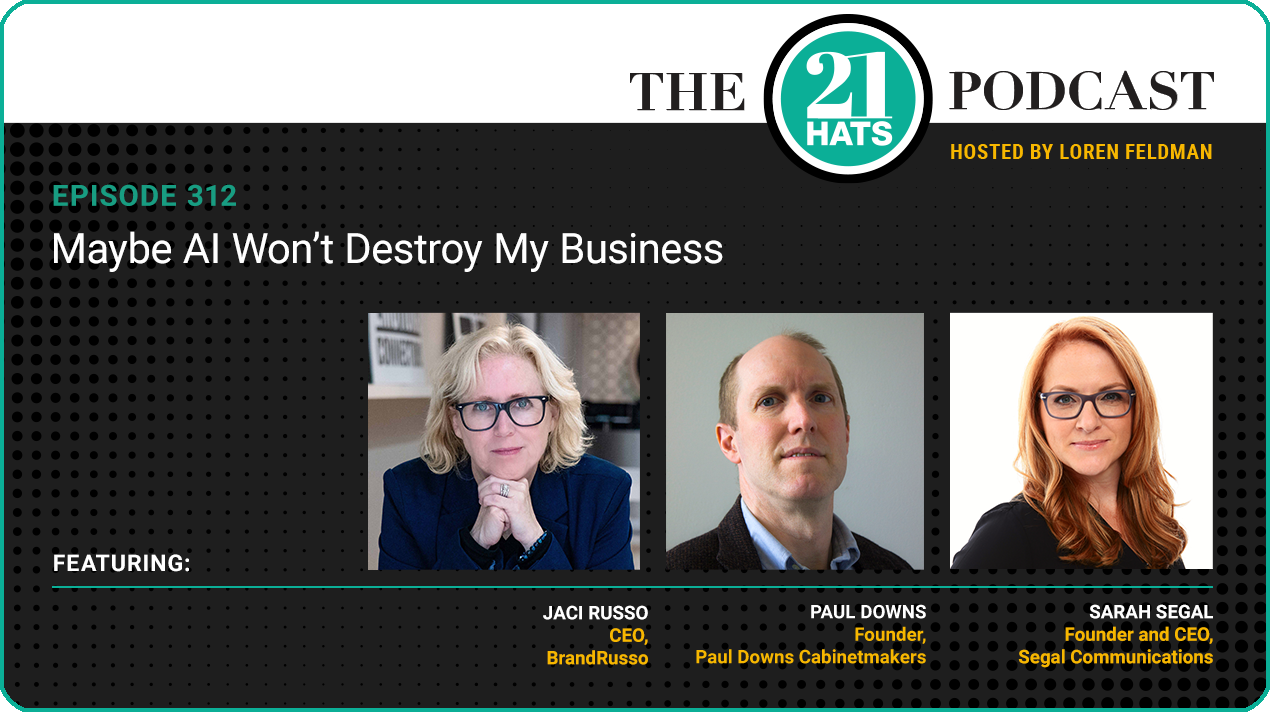
This week we explore some contrasting opinions about artificial intelligence. Paul Downs has serious doubts that AI will ever have a significant impact on his business. Paul, who builds custom conference tables, says his business depends on something AI still lacks: real world experience. While AI can generate impressive images and concepts, he argues that it has no understanding of manufacturing constraints, material properties, production processes, or the capabilities of the people and machines that have to bring an idea to life. “An image of a thing that looks cool is not a design,” Paul says. “A design is a set of information that's informed by intelligence and experience.”
Ted Wolf, who helps companies implement AI, agrees that AI can't replace the collective creativity and judgment of skilled people. But he believes Paul may be looking at the problem too broadly. Instead of asking whether AI can design and build custom furniture, Ted suggests breaking the workflow into smaller pieces and experimenting with targeted applications. “You know your business better than anybody else,” Ted tells Paul. “But don't look at the big picture and think that's the entire thing. There are many small pieces that people can start doing today.”
The result is a thoughtful debate about one of the biggest questions facing small business owners: Is AI going to change everything, or are there businesses where human expertise will remain irreplaceable?
Plus: Channon Kennedy shares what she learned from participating in a Goldman Sachs program for Black women entrepreneurs. And the owners discuss what debt can—and cannot—do for a business: “Funding does not fix a broken business model. It makes it die faster.”
20 years ago, Bo Burlingham gave a name to a feeling a lot of business owners had struggled to articulate. In his book Small Giants, Bo profiled companies that had chosen not to chase growth at all costs. Most were bootstrapped, owner-operated businesses that cared less about getting big than about building something enduring, meaningful, and excellent. They weren’t anti-growth. They just wanted growth to be intentional. And for many owners who read the book, the reaction was immediate: “I thought I was the only one who felt this way.” Out of that recognition grew a community—and eventually an organization—led in large part by Paul Spiegelman, whose own company embodied the Small Giants philosophy. With Bo’s encouragement, Paul launched the Small Giants organization 15 years ago to connect owners trying to build great companies without sacrificing culture, independence, or quality of life.
At our recent 21 Hats Live gathering in Cincinnati, we explored where that movement goes next in a Brainstorm session with Jean Moncrieff, who took over leadership of the Small Giants organization last year. Jean—who’s from South Africa, lives in Zurich, but is moving to the U.S.—brings both momentum and candor to the role. He recently led his first Small Giants Summit in Detroit, which attendees—including me—praised for its renewed energy and sense of purpose. He’s also the author of a terrific new book, Finding Freedom: The Business Owner’s Guide to Building a Valuable Company and a Meaningful Life. But as you’ll hear, Jean recognizes there are challenges ahead.
What exactly is Small Giants today? Who is it for? What makes it different from the many other organizations competing for the attention of business owners? Does it need a more formal set of principles—or even an operating system—to help companies put its philosophy into practice? Can it stay true to its founding mission while also attracting businesses large enough to support its events and programs? Ultimately, the conversation arrives at a tension at the heart of the enterprise: Can the Small Giants organization itself become a sustainable, profitable business without losing the values it was created to protect? In other words, can Small Giants become a true small giant?
Michelle Wyatt has replayed the events in her mind countless times, looking for warning signs she might have missed. But even now, she can’t find any. Both employees had passed background checks and drug tests. Both were considered trusted, valued members of the team. And yet, within a span of months, two violent incidents involving employees left Michelle and her company reeling. In this week’s conversation, Michelle joins Jay Goltz, who has dealt with employee violence in his own business, and special guest Sandy Kapell, who’s made a career leading human resources, to wrestle with a question that haunts a lot of business owners: How much responsibility can you reasonably bear for the actions of your employees?
The discussion goes beyond hiring practices and background checks. Michelle talks candidly about the grief her team experienced, the guilt of wondering whether she should have seen something sooner, the relief that the violence didn’t occur aboard her riverboat cruise ship, and the unsettling realization that no amount of experience truly prepares you for something like this. “Please stop torturing yourself,” Jay tells Michelle. “From what you've said, there's just nothing you could have done about this. It's part of business, unfortunately.”